
Is a mini split actually better than central air for your home
Central AC vs ductless mini split comparison: Find the best HVAC for your Texas home's comfort, efficiency & installation needs.
Is a Mini Split Actually Better Than Central Air for Your Home?
The central ac vs ductless mini split comparison is one of the most common questions Houston homeowners face when it's time to upgrade their cooling system — and the honest answer is that neither system wins every time.
Here's a quick breakdown to help you decide:
| Factor | Central AC | Ductless Mini Split |
|---|---|---|
| Best for | Homes with existing ductwork | Homes without ducts or needing zoned control |
| Energy efficiency | Up to 26 SEER (loses up to 30% via duct leaks) | Up to 38+ SEER2 (no duct losses) |
| Installation disruption | High if new ducts needed | Minimal (3-4 inch wall opening) |
| Temperature control | Whole-home, single thermostat | Room-by-room, individual thermostats |
| Indoor visibility | Hidden vents only | Wall-mounted units visible |
| Lifespan | ~15 years | 20-30 years |
| Heating capability | Requires separate furnace | Built-in heat pump on most models |
| Air filtration | Superior (high-MERV filters) | Basic (smaller internal filters) |
The biggest factor in this decision? Your existing ductwork. If your home already has well-sealed ducts, central AC is often the most cost-effective path. If your home lacks ducts — or you only need to cool specific rooms — a ductless mini split is hard to beat.
Greater Houston homes face a unique challenge: brutal summer heat, high humidity, and the occasional mild winter. That means your HVAC system has to work harder than almost anywhere else in the country. Choosing the wrong system doesn't just affect your comfort — it hits your energy bill every single month.
Below, we'll walk through every major factor so you can make a confident, informed choice for your home.
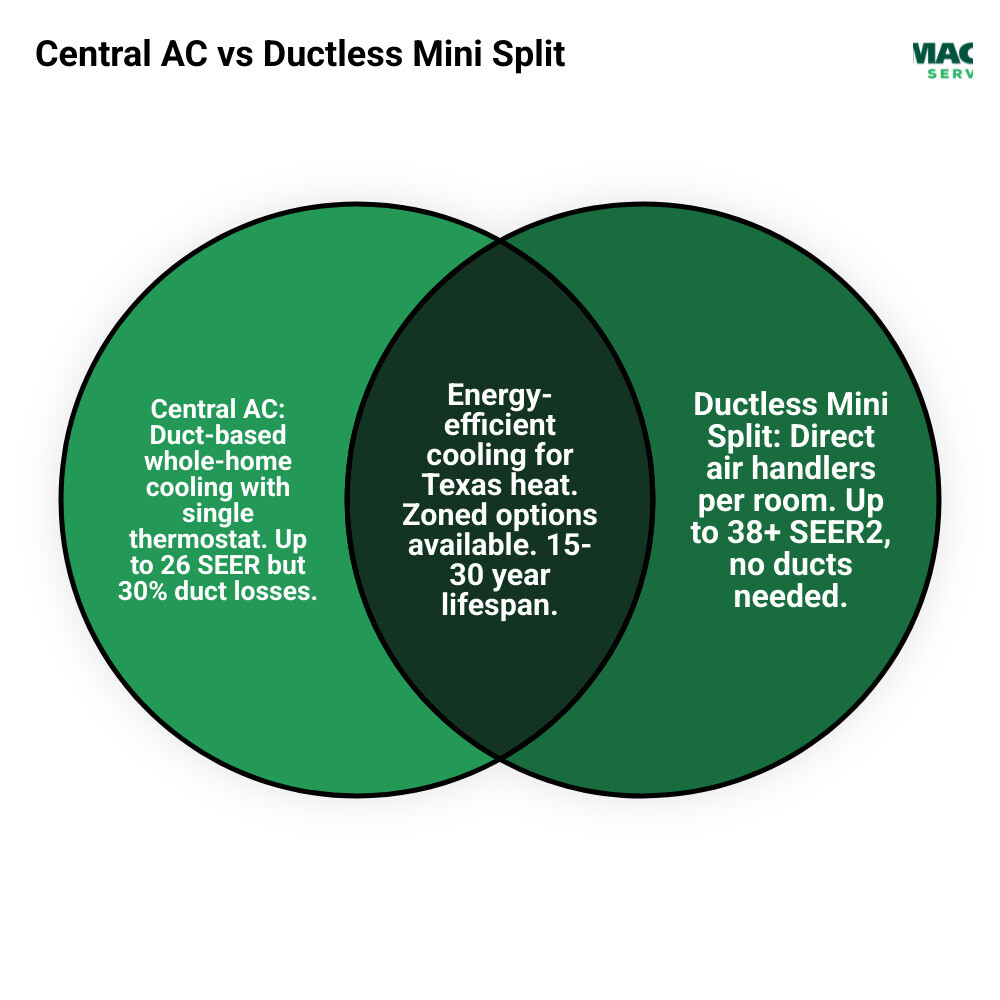
Central AC vs Ductless Mini Split Comparison: Key Differences
When we look at the central ac vs ductless mini split comparison, the most obvious difference is how they move air. Central AC is a "whole-home" solution. It relies on a single, powerful indoor unit (usually in an attic or closet) that pushes air through a spiderweb of ducts to every room at once.
Ductless systems, often called mini splits, take a modular approach. Instead of one big air handler, you have small, sleek units mounted directly on the walls of the rooms you want to cool. These units connect to an outdoor compressor via small refrigerant lines, eliminating the need for bulky metal or flex ducts entirely.
Zoned Comfort in the Central AC vs Ductless Mini Split Comparison
Have you ever dealt with "thermostat wars" in your house? You know the drill: one person is freezing in the bedroom while someone else is sweating in the kitchen. Traditional central AC usually relies on one thermostat to tell the whole house what to do.
In contrast, ductless systems offer built-in "zoned comfort." Each indoor unit has its own thermostat and remote. If you’re in Dickinson, TX and want your home office at a crisp 68 degrees while the guest room stays at 75, a mini split makes that happen effortlessly. This level of control is a game-changer for families with different temperature preferences.
Aesthetics and Visibility
For some homeowners, the "look" of the system is the deciding factor. Central AC is the winner for those who want their cooling to be invisible. All you see are small supply and return vents on the ceiling or floor.
Mini splits require an indoor unit in each room. While the standard is a white wall-mounted box, modern technology in 2026 has given us more options. You can now find ceiling cassettes that sit flush with the drywall, floor-mounted handlers that look like modern radiators, or even slim-duct versions that hide behind a small soffit. If you are updating a home in Spring, TX, we can help you find a style that complements your decor rather than clashing with it.
How Each System Works: Ducts vs. Direct Air Distribution
To understand which is better, we have to look under the hood. Both systems use a refrigerant cycle to absorb heat from inside your home and dump it outside. They both have an outdoor condenser unit and an indoor evaporator coil. The difference lies in the "delivery" method.
Central Air Mechanics
A central system pulls warm air from your house through "return" registers, passes it over a cold evaporator coil to remove heat and moisture, and then uses a large blower motor to shove that cold air back through the "supply" ducts. This centralized air handler is often paired with a furnace or a large electric heat strip for winter. In places like Tiki Island, TX, where salt air and humidity are constant factors, keeping these central units well-maintained is vital for the system's performance.
Ductless System Mechanics
Mini splits skip the "pushing air through tunnels" phase. Refrigerant travels through small copper piping—often called a conduit line—directly to the indoor unit in your room. These systems use "inverter technology," which allows the compressor to speed up or slow down like a car's accelerator. Traditional central units are often "all or nothing," but a mini split in La Marque, TX can run at 20% power just to maintain a steady temperature, using much less electricity in the process.
Energy Efficiency and Performance in the Texas Heat
In April 2026, energy efficiency isn't just a buzzword; it’s a necessity. The central ac vs ductless mini split comparison shows a clear winner on paper: ductless systems.
The biggest enemy of efficiency is duct loss. According to the U.S. Department of Energy, typical ductwork loses over 30% of its cooling energy through leaks, gaps, and poor insulation. When you go ductless, you immediately reclaim that 30%. While premium central systems can reach around 26 SEER, top-tier mini splits can soar past 38 SEER2. If you're curious about the technical shift, you can read more about comparing heat pumps vs traditional HVAC systems.
Performance in Extreme Climates
Houston’s humidity is legendary. Central AC systems are excellent at dehumidification because they pull air from the entire house through one large coil. However, modern mini splits have caught up. Many now feature "dry modes" specifically designed for humid areas like Texas City, TX.
When it comes to high-ambient cooling (operating when it’s 105°F outside), both systems are built to handle the heat, provided they are sized correctly. Mini splits also shine in the winter; as heat pumps, they can reverse their cycle to provide incredibly efficient heating without the high cost of electric furnace strips.
Long-Term Energy Savings
While the initial setup is an investment, the operational savings of a mini split are significant. By only cooling the rooms you are actually using—a concept known as "occupancy-based cooling"—you can slash your utility bills by 25% to 40%.
Furthermore, the Inflation Reduction Act of 2022 continues to offer major incentives in 2026. Homeowners in Jersey Village, TX can often claim federal tax credits under Section 25C, which can cover up to 30% of the installation cost for qualifying heat pump systems (up to $2,000).
Installation Flexibility and Home Compatibility Scenarios
Every home has a different "story," and that story usually dictates which HVAC system fits best.
Retrofitting Older Homes
If you live in a historic home in Galveston, TX or a house built on a concrete slab with no attic space, installing central AC can be a nightmare. It often involves cutting into original plaster, lowering ceilings to hide ducts, or losing closet space to air handlers.
Mini splits are the perfect "retrofit" solution. Installation only requires a 3-inch hole through the exterior wall for the refrigerant and drain lines. This minimal disruption preserves the architectural integrity of older homes while bringing them into the modern age of comfort.
Hybrid Setups and Additions
You don't always have to choose one or the other. Many of our neighbors in Shoreacres, TX use a hybrid approach. They keep their existing central AC for the main part of the house but install a mini split for:
- Garage Apartments: Providing independent cooling for guests or tenants.
- Sunrooms: Handling the massive heat gain from all that glass without overtaxing the main house system.
- Attic Conversions: Cooling a space that was never designed to have ductwork.
- Master Suites: Allowing for a "sleeping zone" that stays extra cool at night while the rest of the house stays at a more energy-efficient temperature.
Maintenance, Lifespan, and Indoor Air Quality Factors
Maintenance is where these two systems diverge the most. Central AC requires you to change a large filter every 1 to 3 months. You also need to consider professional duct cleaning every 3 to 5 years to remove dust, pet dander, and allergens that accumulate in the vents.
Air Filtration and Quality
Central systems generally offer better whole-home air filtration. Because they use a centralized air handler, you can install high-MERV filters or UV air purifiers that treat every cubic foot of air in the house. This is a big plus for allergy sufferers in Jersey Village, TX.
Mini splits have smaller, washable filters inside each unit. These need to be rinsed every 2 to 4 weeks. While they are great at catching dust, they don't typically offer the same level of advanced medical-grade filtration as a ducted system. However, because there are no ducts, there is no place for mold or dust to hide and circulate through the house.
Expected System Lifespan
A well-maintained central AC system typically lasts about 15 years in our humid Gulf Coast climate. Ductless mini splits have a slight edge here; because they don't have to work as hard to push air through restrictive ducts, they can often last 20 to 25 years.
Regardless of which you choose, professional annual tune-ups are the only way to ensure your system reaches its full potential. We recommend a check-up in the spring before the Texas heat truly kicks in.
Frequently Asked Questions
Which System Wins the Central AC vs Ductless Mini Split Comparison for Noise?
Ductless mini splits are the undisputed champions of quiet. The indoor units often operate at 19 to 26 decibels—that is literally softer than a human whisper. Central AC systems aren't necessarily "loud," but you will definitely hear the "whoosh" of air moving through the vents and the clatter of the air handler starting up in the attic.
Can Mini Splits Provide Heating as Well as Cooling?
Yes! Most modern mini splits are "heat pumps." They don't create heat; they simply move it. Even in chilly weather, they can extract heat from the outside air and move it indoors. They are incredibly efficient for our moderate Texas winters, often providing a much more comfortable, consistent warmth than the "blast" of a traditional furnace.
Which System is Easier to Install in an Existing Home?
Ductless systems are much faster and less disruptive to install. A single-zone mini split can often be installed in about half a day. Retrofitting a house with new ductwork for a central system can take a week or more and involves significant construction, drywall repair, and painting.
Conclusion
At Mackey Services, we’ve spent 30 years helping our neighbors in the Greater Houston Area stay comfortable. We know that every home in Dickinson, League City, and Pearland has its own unique needs. Whether you decide that the invisible power of central air conditioning is right for you, or you’re ready to embrace the zoned efficiency of a ductless system, we are here to provide the reliable, family-like service you deserve.
Choosing between these two isn't about finding the "best" system—it's about finding the best system for your life. If you're ready to end the thermostat wars and lower your energy bills, give us a call. We'll help you navigate the central ac vs ductless mini split comparison and ensure your home remains a sanctuary of unwavering comfort.
Ready for a better day?
One call handles it all — HVAC, electrical, and generators across the Texas Gulf Coast. Less to pay. Better day. That's the Mackey way.
Mon–Fri: 7 AM – 8 PM · Sat: 8 AM – 5 PM · Licensed & insured · #TACLA 112769C · #TECL 558211