
Reversing the Heat: A Simple Guide to How Heat Pumps Work
Discover how does a heat pump work: from vapor-compression cycle to heating/cooling modes, efficiency & types for energy savings.
What Every Houston Homeowner Should Know About Heat Pumps
How does a heat pump work is one of the most common questions homeowners ask when considering an upgrade from a traditional furnace or air conditioner — and for good reason. A heat pump is a single electric system that both heats and cools your home by moving heat from one place to another, rather than generating it from scratch. That simple difference is why heat pumps can deliver up to 4 units of warmth for every 1 unit of electricity they consume.
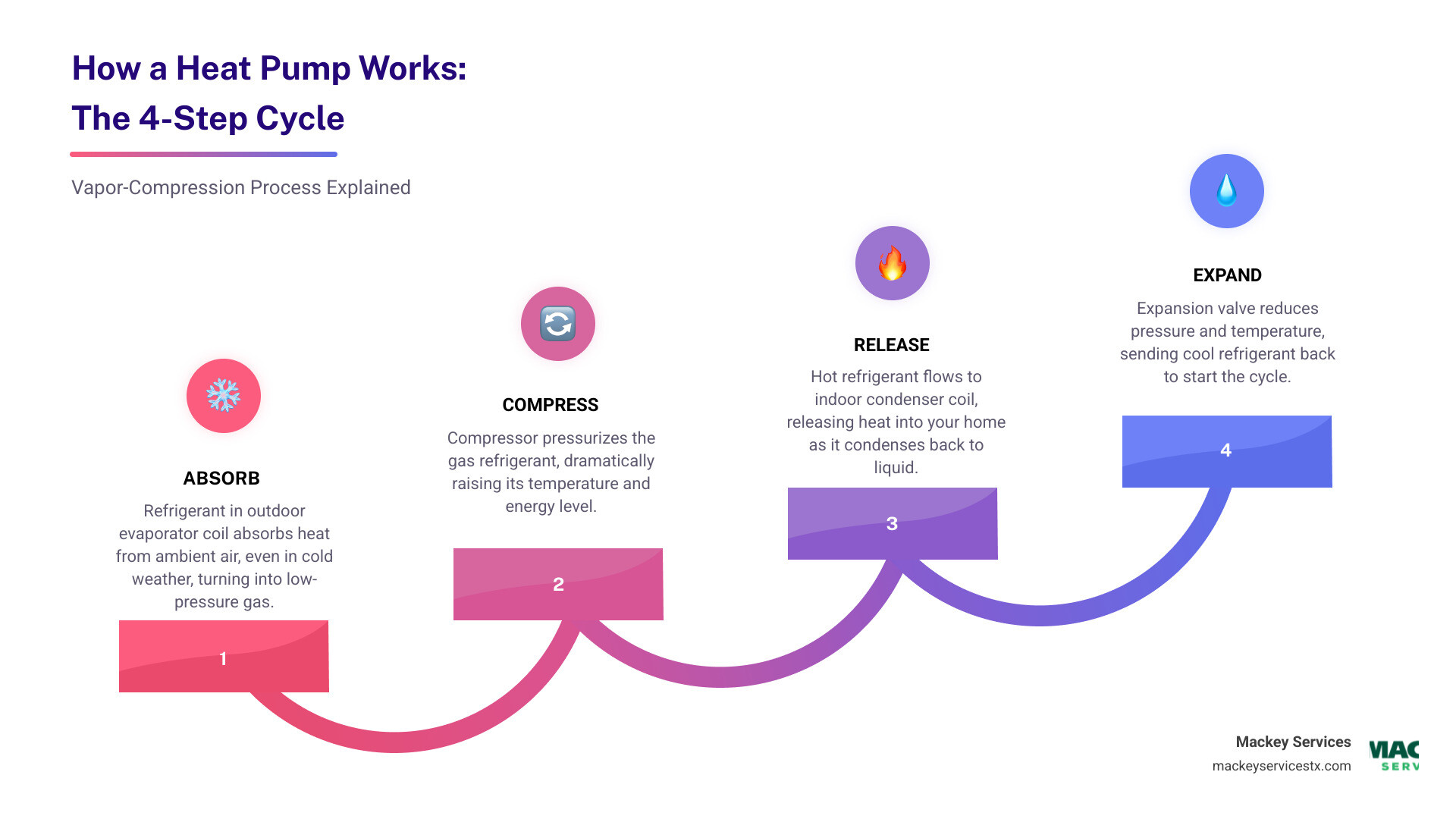
Quick answer: How a heat pump works, step by step:
- Absorb - A refrigerant fluid circulates through an outdoor coil and absorbs heat energy from the surrounding air (even cold air contains usable heat)
- Compress - The compressor pressurizes the refrigerant, raising its temperature significantly
- Release - The hot refrigerant flows to an indoor coil and releases that heat into your home
- Expand - An expansion valve drops the refrigerant's pressure and temperature, and the cycle repeats
In summer, the system simply runs in reverse — pulling heat out of your home and dumping it outside, exactly like a standard air conditioner.
For homeowners in the Greater Houston area, where summers are brutal and winters are mild but unpredictable, a heat pump is one of the most practical and efficient comfort systems available. The sections below break down exactly how the technology works, why it outperforms traditional systems, and what types are available for different homes and budgets.
The Core Mechanics: How Does a Heat Pump Work?
To understand the magic of these systems, we have to look at the vapor-compression cycle. While a furnace creates heat by burning gas or using electric resistance (like a giant toaster), a heat pump is more like a "heat mover." It uses mechanical energy to shift thermal energy from a "source" to a "sink."
In physics, heat always wants to move from a warm place to a cold place. A heat pump uses a little bit of electricity to flip that script, forcing heat to move uphill from the cold outdoors into your warm living room during the winter. This process relies on a closed loop of refrigerant that constantly changes states between a liquid and a gas. By manipulating the pressure of this fluid, we can control exactly when and where it absorbs or releases heat.
If you are curious about how this technology can fit into your specific home setup, our team provides expert Heat Pump Services across the Greater Houston Area to help you find the perfect match.
The Four Main Components and Their Functions
Every standard heat pump relies on four heavy hitters to get the job done:
- Evaporator Coil: This is where the "magic" starts. Low-pressure, cold refrigerant flows through this coil. Because the refrigerant is colder than the air passing over it, it soaks up heat like a sponge. As it absorbs this energy, the liquid refrigerant evaporates into a gas.
- Compressor: This is the heart of the system. It takes that low-pressure gas and squeezes it tightly. If you’ve ever felt a bicycle pump get hot while you’re inflating a tire, you’ve seen this principle in action: increasing pressure increases temperature. The compressor turns the refrigerant into a high-pressure, super-hot vapor.
- Condenser Coil: The hot gas travels to this coil, where a fan blows air over it. The heat from the refrigerant is transferred to that air (which then heads into your ducts). As the refrigerant loses heat, it condenses back into a high-pressure liquid.
- Expansion Valve: Before the refrigerant can go back to the evaporator to pick up more heat, it needs to cool down. The expansion valve acts like a nozzle, suddenly dropping the pressure. This causes the temperature to plummet, preparing the refrigerant to start the cycle all over again.
If any of these parts stop doing their job, you'll notice a quick drop in comfort. When that happens, you can rely on our pros for Heat Pump Repair Houston TX to get the cycle back in balance.
The Role of Refrigerant in How a Heat Pump Works
Refrigerant is the "blood" of the system. It is a special chemical compound designed to have an incredibly low boiling point—often well below -15°F. This is why a heat pump can still find "heat" in the air even when it feels freezing to us.
The secret lies in latent heat. When a substance changes phase (like from liquid to gas), it absorbs a massive amount of energy without necessarily changing its temperature. By precisely timing these phase changes through pressure manipulation, the system can carry huge amounts of thermal energy into your home using very little electricity. If you suspect a leak or a drop in performance, getting a Heat Pump Repair Pasadena TX specialist to check your levels is essential for maintaining that efficiency.
One System, Two Jobs: Heating and Cooling Modes
The most impressive part of a heat pump is its versatility. Unlike a furnace/AC combo, which requires two separate pieces of equipment, a heat pump uses a reversing valve to switch the direction of the refrigerant flow. This one component allows the system to change which coil acts as the "evaporator" and which acts as the "condenser."
Cooling Mode: Acting Like an Air Conditioner
In the sweltering Texas summer, how does a heat pump work? It works exactly like a standard air conditioner. The reversing valve directs the cold refrigerant to the indoor coil (now acting as the evaporator). As indoor air blows over the coil, the refrigerant absorbs the heat from your home.
This process doesn't just lower the temperature; it also provides vital dehumidification. As the warm, moist indoor air hits the cold coil, water vapor condenses into liquid and drains away, leaving your home feeling crisp and dry. The heat absorbed from your living room is then pumped to the outdoor unit and rejected into the atmosphere. To keep this process running smoothly during our long summers, regular Heat Pump Maintenance Jamaica Beach TX is a smart move for coastal homeowners.
Heating Mode: How a Heat Pump Works in Cold Weather
When the "Blue Norther" winds blow through Texas, you simply flip your thermostat to "heat," and the reversing valve clicks into a new position. Now, the outdoor coil becomes the evaporator, and the indoor coil becomes the condenser.
Even at 35°F, there is plenty of ambient heat in the air. The refrigerant outside gets even colder than the winter air, allowing it to extract heat energy. That energy is compressed, brought inside, and released as warm air. During particularly damp, cold days, you might see steam rising from your outdoor unit—don't worry! That’s just the defrost cycle melting away ice to keep the coils clear. For residents in more humid pockets of the region, Heat Pump Maintenance San Leon TX ensures your defrost settings are calibrated correctly for the local climate.
Measuring Performance and Energy Efficiency
Efficiency isn't just a buzzword; it’s a measurable stat that dictates your monthly utility bills. When evaluating how does a heat pump work in terms of value, we look at several key ratings:
| Metric | Meaning | Ideal Range |
|---|---|---|
| COP | Coefficient of Performance (Real-time efficiency) | 3.0 to 4.5 |
| SEER2 | Seasonal Energy Efficiency Ratio (Cooling) | 14 to 20+ |
| HSPF2 | Heating Seasonal Performance Factor (Heating) | 8 to 10+ |
While an electric space heater has a COP of 1.0 (meaning 1 unit of electricity equals 1 unit of heat), a high-efficiency air-source heat pump can achieve a COP of 3.8 or higher. That is a massive leap in performance! If you’re ready to upgrade to a high-efficiency unit, we offer Heat Pump Installation Baytown TX to ensure your new system is sized perfectly for your square footage.
Why Heat Pumps Outperform Traditional Systems
The reason heat pumps are the "greenest" option on the market is simple: moving heat is much easier than making it. Because the system is simply transferring 1 to 4.5 kWh of thermal energy for every 1 kWh of electricity used, it can reach efficiencies of 300% to 400%.
Compare that to a brand-new gas furnace, which might be 95% efficient at best. Many modern heat pumps are also Energy Star certified, meaning they meet strict government guidelines for energy savings. For those in the surrounding communities, Heat Pump Service Wallisville TX can help you analyze your current energy usage and see how much you could save by switching.
Exploring the Different Types of Heat Pumps
Not all heat pumps are created equal. Depending on your property and your needs, you might choose from:
- Air-Source Heat Pumps (ASHP): The most common type. They exchange heat with the outside air. They are easy to install and work beautifully in the Houston climate.
- Ground-Source (Geothermal) Heat Pumps: These use the stable temperature of the earth (usually 50-60°F) to exchange heat. While they have a higher upfront cost, they can achieve a staggering COP of 7.2.
- Water-Source Heat Pumps: These extract heat from a nearby body of water or a well.
- Absorption Heat Pumps: Often powered by natural gas or solar energy rather than electricity, these use an ammonia-water cycle instead of a compressor.
Whether you need a simple air-source unit or a more complex setup, our Professional Heat Pump Service Texas City TX ensures the job is done right the first time.
Specialized Applications and Hybrid Systems
Heat pumps aren't just for whole-home central air. They are incredibly versatile:
- Ductless Mini-Splits: Perfect for room additions, garages, or homes without existing ductwork.
- Dual-Fuel Configurations: A "hybrid" setup that pairs a heat pump with a gas furnace. The heat pump handles the mild days, and the furnace kicks in only during extreme freezes.
- Domestic Water Heating: Dedicated heat pump water heaters are now common for high-efficiency hot water.
- Industrial & District Heating: Large-scale systems can even use waste heat from factories or data centers to warm entire neighborhoods.
Environmental Impact and Refrigerant Considerations
As we look toward April 2026 and beyond, the HVAC industry is focused on decarbonization. Since heat pumps run on electricity, they can be powered by renewable sources like onshore wind or solar. In fact, a heat pump powered by wind energy can result in emissions as low as 3 gCO2 per kWh of thermal energy.
The industry is also shifting toward refrigerants with lower Global Warming Potential (GWP), such as R-32. These newer fluids are more efficient and have a much smaller environmental footprint if a leak occurs.
Frequently Asked Questions about Heat Pump Operation
Can a heat pump work in freezing temperatures?
Yes! While older models struggled below 25°F, modern "cold climate" heat pumps use advanced variable-speed compressors and flash injection technology to stay efficient even at -5°F. For the rare Houston hard freeze, most systems include backup electric heat strips to ensure you stay warm no matter what.
Does a heat pump bring in fresh outside air?
No. This is a common myth. A heat pump recirculates the air already inside your home. It only moves heat across the barrier, not the air itself. If you want fresh air, you would need to pair your system with an Energy Recovery Ventilator (ERV) or a dedicated ventilation system.
How long do heat pump systems typically last?
On average, a well-maintained heat pump lasts about 15 years. Because the outdoor unit runs year-round (for both heating and cooling), it works harder than a standalone AC. This makes preventative maintenance absolutely critical to reaching that 15-to-20-year milestone.
Conclusion
Understanding how does a heat pump work is the first step toward a more comfortable, energy-efficient home. At Mackey Services, we bring 30 years of experience and an A+ BBB rating to every job. Whether you are in Dickinson, League City, or anywhere in the Greater Houston Area, we provide reliable, family-like service for unwavering comfort. If you're ready to see what a heat pump can do for your utility bills and your home's comfort, explore our Heat Pump Services today.
Ready for a better day?
One call handles it all — HVAC, electrical, and generators across the Texas Gulf Coast. Less to pay. Better day. That's the Mackey way.
Mon–Fri: 7 AM – 8 PM · Sat: 8 AM – 5 PM · Licensed & insured · #TACLA 112769C · #TECL 558211