
When the Sun Wins: Troubleshooting AC Failure During Heatwaves
Discover common reasons AC stops cooling in extreme heat. Troubleshoot filters, refrigerant leaks, capacitors & more for heatwave relief!
Why Your AC Stops Cooling When Temperatures Spike
The common reasons ac stops cooling in extreme heat are easier to understand than most people think — and knowing them can save you from a miserable summer night waiting on an emergency repair call.
Here is a quick breakdown:
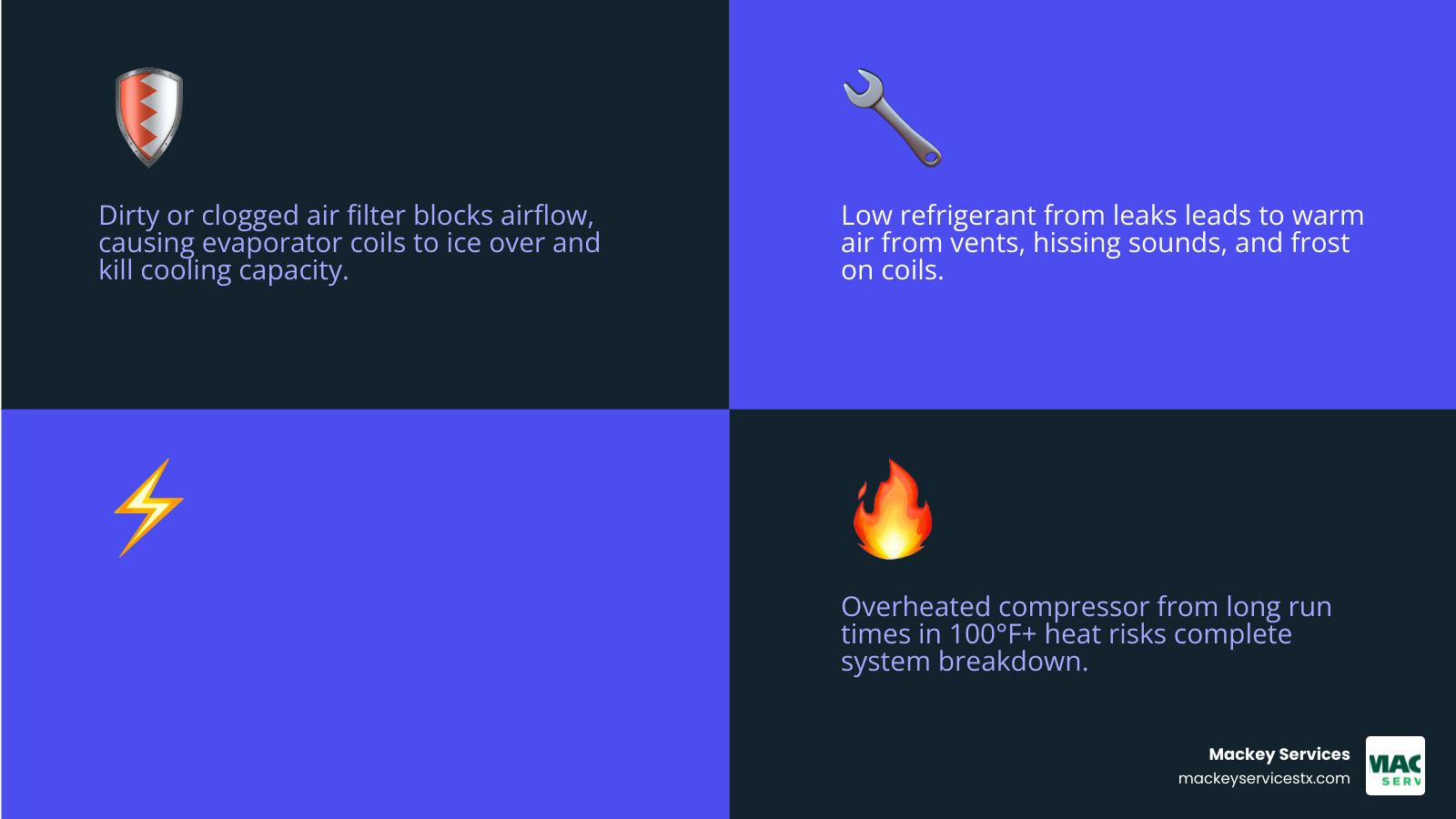
- Dirty or clogged air filter — Blocks airflow, causes the evaporator coil to ice over, and kills cooling capacity
- Low refrigerant from a leak — Warm air from vents, hissing sounds, or frost on the coil are key warning signs
- Dirty evaporator or condenser coils — Coated coils cannot transfer heat efficiently, forcing the system to work harder
- Failed capacitor — The most commonly replaced AC part; capacitors are especially vulnerable to summer heat and can prevent the system from starting
- Overheated or failing compressor — The heart of your AC; extreme heat and long run times push it toward breakdown
- Thermostat problems — Wrong settings, dead batteries, or a faulty sensor can mimic a full AC failure
- Undersized or aging system — A unit past its 10-15 year lifespan or too small for your home simply cannot keep up when outdoor temps soar above 95-100°F
Houston summers do not ease up. When outdoor temperatures push past 100°F for days at a time, your air conditioning system is essentially running a marathon at a full sprint — with no rest. Most AC systems are engineered to maintain indoor air roughly 20°F cooler than the outside temperature. That means on a 100°F day, the realistic target is around 80°F indoors, not the 68°F you might be hoping for.
When the system is already working at its limit, even a minor problem — a dusty filter, a weakening capacitor, or a small refrigerant leak — can push it over the edge completely. For homeowners and small business owners in the Greater Houston area, that combination of relentless humidity and extreme heat makes these failures happen faster and more often than in milder climates.
This guide walks you through exactly what goes wrong, how to spot it early, and when it is time to call in a professional.
Common Reasons AC Stops Cooling in Extreme Heat
When the mercury hits triple digits in April 2026, your outdoor condenser unit becomes the frontline of a literal battle against physics. Its job is to release the heat collected from inside your home into the outdoor air. However, high outdoor temperatures raise the refrigerant pressure within the system. This makes it much harder for the unit to "dump" heat.
If the outdoor coil is caked in Houston dust, pollen, or lawn debris, that heat exchange fails. The system keeps running, the pressure keeps climbing, and eventually, the unit may simply shut down to protect itself from permanent damage. This is why we emphasize the importance of our AC Maintenance Houston TX Guide to ensure your coils stay clean before the heatwave hits.
Restricted Airflow and Dirty Filters
It sounds too simple to be true, but a $15 air filter is often the culprit behind a multi-thousand-dollar system failure. During a heatwave, your AC runs almost constantly. This means it is pulling in air—and dust—at a much higher rate than usual.
When a filter is clogged, the blower motor has to work twice as hard to pull air through the return. This restricted airflow leads to a drop in pressure at the evaporator coil (the indoor part). Paradoxically, this causes the coil to drop below freezing. Moisture from our humid Houston air hits that freezing coil and turns into a block of ice. Once your coils are encased in ice, they can no longer absorb heat, and you’ll notice weak, room-temperature airflow coming from your vents. During peak summer, we recommend a strict 30-day replacement rule for pleated filters.
Low Refrigerant and Leak Warning Signs
Refrigerant is the lifeblood of your cooling system. It doesn't get "used up" like gasoline; if it’s low, you have a leak. In extreme heat, low refrigerant levels are catastrophic because the remaining fluid has to work under much higher pressure to move heat.
Watch for these red flags:
- Hissing or Bubbling: Sounds coming from the refrigerant lines usually indicate a high-pressure leak.
- Ice on the Lines: Just like a dirty filter, low refrigerant causes the evaporator coil to freeze over.
- Warm Air: If the air coming out of your registers feels like a lukewarm breeze, the system likely lacks the "juice" to actually remove heat.
How Aging Units Struggle as Common Reasons AC Stops Cooling in Extreme Heat
Most air conditioners have a reliable lifespan of 10 to 15 years. As we move through 2026, many systems installed in the early 2010s are reaching their breaking point. An aging unit naturally loses efficiency as its mechanical parts wear down.
In extreme heat, an old system may "short cycle," turning on and off rapidly, or it may simply run for 24 hours straight without ever reaching your thermostat setting. If your energy bills are skyrocketing while your comfort is plummeting, you may want to check out our guide on 7 Signs You Need a New AC to see if a replacement is more cost-effective than constant repairs.
Electrical Component Failure and Mechanical Strain
Heat is the enemy of electricity. As outdoor temperatures rise, electrical resistance increases, and components like blower motors and compressors have to pull more "amps" to do their job. This puts immense strain on the power grid and your home’s internal wiring.
During our routine inspections, we often find that heat has physically warped or "mushroomed" electrical connections. To understand how we catch these issues before they leave you sweating, see our list of 8 Things That Happen During AC Checks.
Why Capacitors are Common Reasons AC Stops Cooling in Extreme Heat
The capacitor is a small, silver cylinder that acts like a high-powered battery for your motors. It provides the initial electrical jolt needed to start the compressor and the outdoor fan. Unfortunately, capacitors are incredibly heat-sensitive.
When a capacitor fails—often signaled by a clicking or humming sound from the outdoor unit without the fan spinning—the motors can't start. This is the most common part we replace during a Houston summer.
| Feature | Central AC / Heat Pump | Ductless Mini-Split |
|---|---|---|
| Common Failure | Capacitor Burnout | Control Board Error |
| Heat Sensitivity | High (Outdoor Unit) | Medium (Inverter Driven) |
| Symptom | Humming but no fan | Error codes on display |
| Repair Type | Part Replacement | Electronic Diagnosis |
Thermostat Malfunctions and Incorrect Settings
Sometimes the "failure" isn't in the AC unit at all, but in the brain of the system. We often see thermostats set to "On" instead of "Auto." When set to "On," the fan blows 24/7, even when the AC isn't actually cooling. This can blow humid air back into your home and make it feel warmer.
Check for:
- Dead Batteries: A fading screen can cause erratic signals to the AC.
- Calibration: If the thermostat says it's 72°F but your handheld thermometer says 78°F, the sensor may be failing.
- Smart Features: Some smart thermostats may automatically raise the temperature during "peak hours" to help the grid, which can catch you off guard during a heatwave.
Troubleshooting and Professional Maintenance
Before you assume the worst, there are a few "sanity checks" every homeowner should perform. If your system has stopped cooling, start with these 9 Tips to Troubleshoot an AC Problem.
Simple Steps Before Calling a Technician
- Check the Breaker: Extreme heat can cause the AC to pull enough power to trip the circuit breaker. Flip it all the way off and then back on once.
- Examine the Filter: If it’s dark gray or furry, change it immediately.
- Clear the Outdoor Unit: Ensure there are at least two feet of clearance around your outdoor unit. Trim back any bushes or weeds that might be "suffocating" the condenser.
- Rinse the Coils: With the power off, a gentle rinse with a garden hose (no pressure washers!) can remove dust and improve efficiency.
When to Call a Professional HVAC Technician
While DIY troubleshooting is great, certain common reasons ac stops cooling in extreme heat require a licensed expert. Refrigerant handling, for example, requires EPA certification and specialized tools to find microscopic leaks.
You should call us immediately if:
- You hear loud banging, screeching, or hissing.
- You see visible ice on the copper refrigerant lines.
- The indoor blower is running, but the outdoor unit won't kick on.
- The breaker trips a second time after you reset it (this indicates a dangerous electrical short).
For a deeper dive into what professional care looks like, read our AC Maintenance Houston TX Complete Guide.
Frequently Asked Questions about Heatwave AC Failure
Why is my AC freezing up when it is 100 degrees outside?
It seems impossible for ice to form when it’s 100°F, but it happens all the time! This is usually due to a lack of airflow (dirty filter) or low refrigerant. When the heat isn't being absorbed by the refrigerant properly, the moisture in our humid air freezes onto the coil, eventually creating a literal block of ice that stops all cooling.
Can high indoor humidity make my AC stop cooling?
Yes. Your AC has two jobs: lowering the temperature and removing moisture (latent heat). If the humidity is extremely high, the system spends all its energy turning water vapor into liquid and draining it away, leaving very little "cooling power" left to lower the actual air temperature. This is why your home might feel "clammy" even if the AC is running.
How often should I change my filter during a heatwave?
While the standard advice is every 90 days, during a Houston heatwave, you should check it every 30 days. If you have pets or a dusty environment, you might even need to change it every 3 weeks when the system is running 18+ hours a day.
Conclusion
At Mackey Services, we have spent 30 years helping our neighbors in Dickinson, League City, Pearland, and throughout the Greater Houston Area survive the most brutal summers on record. We know that when your AC fails during a heatwave, it isn't just an inconvenience—it’s an emergency for your family’s comfort and safety.
Whether you are dealing with a blown capacitor, a refrigerant leak, or an aging system that has finally met its match, our family-oriented team is here to provide unwavering comfort with an A+ BBB rating. Don't let the sun win this summer. If your system is struggling, reach out for Reliable Air Conditioning Services today.
Ready for a better day?
One call handles it all — HVAC, electrical, and generators across the Texas Gulf Coast. Less to pay. Better day. That's the Mackey way.
Mon–Fri: 7 AM – 8 PM · Sat: 8 AM – 5 PM · Licensed & insured · #TACLA 112769C · #TECL 558211