
Air Purifiers vs Dehumidifiers for Mold Prevention
Discover how air purification and dehumidification reduce mold risk with HEPA filters, humidity control & expert IAQ tips for Houston homes.
How Air Purification and Dehumidification Reduce Mold Risk
How air purification and dehumidification reduce mold risk is one of the most important things Houston-area homeowners can understand — especially given the region's relentless heat and humidity. Mold only needs two things to get started: moisture and a surface to grow on. In Greater Houston, moisture is rarely in short supply. When indoor humidity climbs above 50-60%, mold spores that are always present in the air can settle, germinate, and form colonies within as little as 24-48 hours.
Here is a quick breakdown of how these two approaches work together:
- Air purifiers use high-efficiency filters (like True HEPA) to capture airborne mold spores — particles typically between 1 and 30 microns — before they land on surfaces and start growing
- Dehumidifiers remove excess moisture from the air, keeping indoor relative humidity in the 30-50% range where mold simply cannot thrive
- Used together, they address both the root cause (moisture) and the symptom (airborne spores), giving you a much stronger defense than either device alone
- Neither device kills existing mold on surfaces — that requires physical cleaning or professional remediation
- The 24-48 hour window matters: drying out wet areas and filtering the air quickly after any moisture event dramatically reduces your mold risk
For Houston homeowners, this is not a theoretical concern. High ambient outdoor humidity means indoor moisture levels can creep up even without a visible leak. Understanding how these tools work — and their limits — helps you make smarter decisions about protecting your home and your family's health.
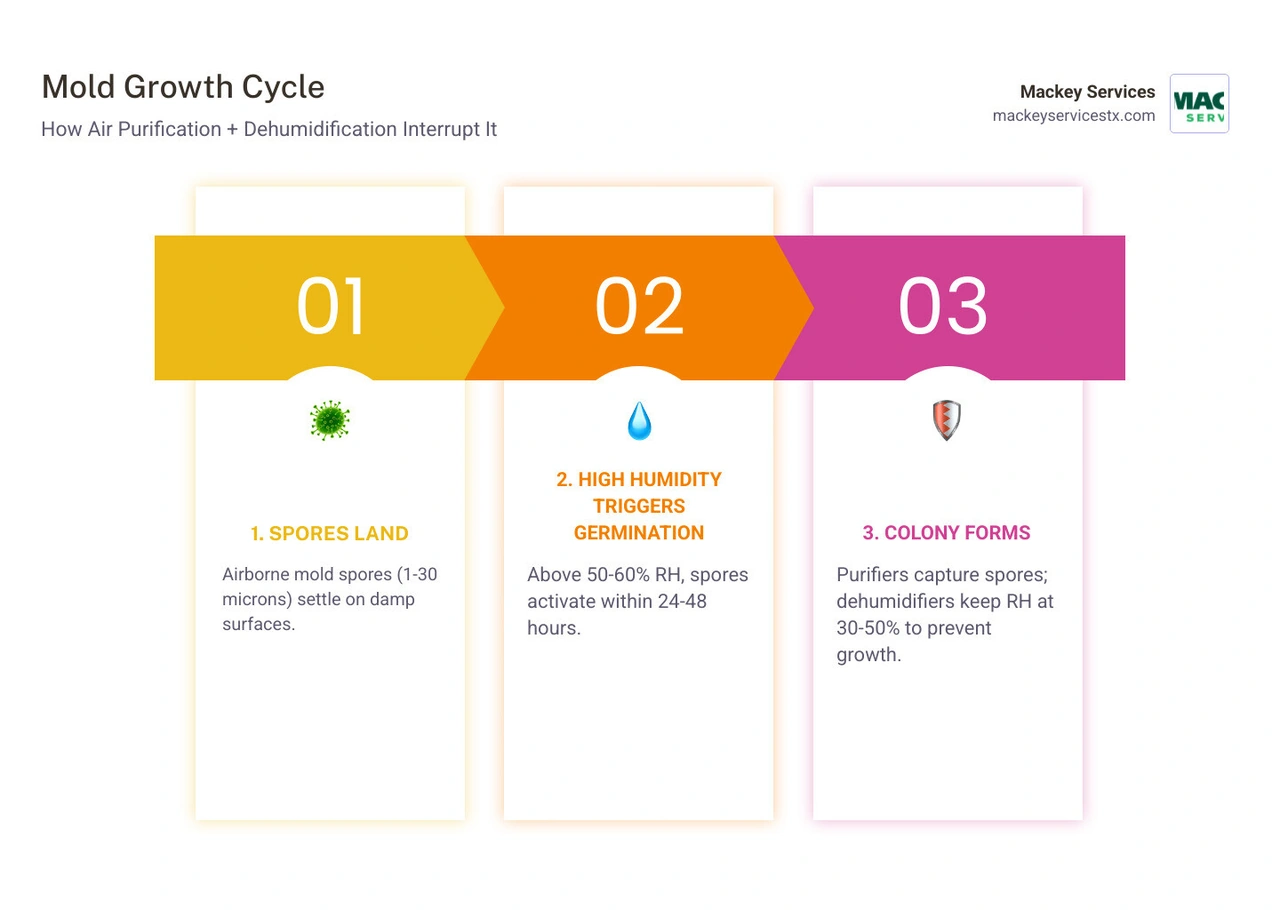
Living in the Greater Houston area in April 2026 means we are all too familiar with the "swamp" feeling that accompanies our coastal climate. To keep our homes healthy, we have to look at mold prevention as a two-front war. On one front, we have the airborne spores themselves; on the other, we have the moisture that allows them to thrive.
How air purification and dehumidification reduce mold risk is by interrupting the "mold triangle." Just like a fire needs heat, fuel, and oxygen, mold needs spores, a food source (like your drywall or wood framing), and moisture. We can’t easily remove the food source, and spores are naturally occurring everywhere. That leaves moisture and spore concentration as our primary targets.
When we provide Indoor Air Quality Service Shoreacres TX, we often explain that mold can begin growing within a very tight 24-48 hour window of moisture exposure. If your home’s relative humidity (RH) stays above 60%, you are essentially providing a buffet for fungal growth. Dehumidifiers work to pull that moisture out of the air, while air purifiers reduce the "load" of spores waiting to land. In fact, research shows that HEPA air purifiers can decrease airborne fungi 1.5 to 6 times faster than natural settling rates. This means fewer spores are available to find that one damp corner in your bathroom or laundry room.
The Science of Air Purifiers and Mold Spore Capture
To understand why air purifiers are effective, we have to look at the size of the enemy. Mold spores typically measure between 1 and 30 microns, though many common indoor species like Aspergillus and Penicillium stay in the 2 to 10-micron range.
This is where True HEPA filtration becomes the gold standard. A True HEPA filter is rated to capture 99.97% of particles as small as 0.3 microns. Since mold spores are significantly larger than 0.3 microns, a properly maintained Whole House Air Purification Houston TX system is incredibly efficient at snagging these spores before they can circulate through your ductwork.
How air purification and dehumidification reduce mold risk by capturing spores
When we talk about "capturing" spores, we are looking at two main methods: mechanical filtration and electrostatic capture.
- Mechanical Filtration: This is the physical barrier. As air is pushed through the dense mat of fibers in a HEPA filter, the spores become trapped.
- Electrostatic Capture: Some advanced systems, like HEPASilent™ technology, use an electrostatic charge to make particles "sticky," allowing the filter to catch even smaller fragments (down to 0.1 microns) without restricting airflow.
By utilizing Clean Air Systems, you aren't just catching the spores; you are also removing the fragments and mycotoxins that mold can release. Many high-end purifiers also include an activated carbon layer. While the HEPA filter handles the physical spore, the carbon layer adsorbs the MVOCs (Microbial Volatile Organic Compounds)—that classic "musty" smell that often signals a mold problem. Reducing this allergen load is vital for family members with asthma or allergies, as it prevents the respiratory irritation that mold exposure frequently causes.
The Role of Dehumidification in Preventing Fungal Growth
If air purifiers are the "scouts" catching the invaders, dehumidifiers are the "engineers" changing the environment so the invaders can't survive. In Houston, our outdoor dew points are often high enough that even a perfectly functioning air conditioner might struggle to keep indoor humidity at safe levels.
According to ASHRAE standards and the EPA, we should aim for an indoor relative humidity of 30-50%. Once you cross the 60% threshold, mold growth risk increases exponentially.
| Humidity Level (RH) | Mold Growth Risk | Impact on Home |
|---|---|---|
| Below 30% | Very Low | Can cause dry skin and respiratory irritation. |
| 30% - 50% | Ideal | Prevents mold germination and dust mite proliferation. |
| 50% - 60% | Moderate | Some mold species can begin to colonize damp surfaces. |
| Above 60% | High | Significant risk of rapid mold growth and structural damage. |
A Whole House Dehumidification Sugarland TX system works by lowering the dew point of the air inside your home. By removing gallons of water from the air every day, these systems ensure that surfaces like window sills, cold water pipes, and exterior-facing walls stay dry.
How air purification and dehumidification reduce mold risk through moisture control
The mechanics of a dehumidifier are similar to an air conditioner but optimized for water removal rather than temperature change. The unit pulls in humid air and passes it over refrigerated cooling coils. As the air cools, the water vapor condenses into liquid droplets (just like a cold soda can "sweats" on a Houston patio). This water is then drained away, and the now-dry air is reheated and circulated back into the house.
By installing Whole House Dehumidification Wallisville TX, you are protecting the very structure of your home. High humidity doesn't just invite mold; it can cause wood to warp, paint to peel, and even attract pests like termites and cockroaches that crave damp environments. Controlling vapor pressure prevents moisture from being driven into your drywall and insulation, which are the primary "food" sources for mold colonies.
Strategic Placement and Maintenance for Maximum Protection
To get the most out of these technologies, placement and upkeep are key. For portable units, you want them in "high-moisture" zones—basements (if you have one in the rare Houston spots that do), laundry rooms, bathrooms, and kitchens. However, for most of our neighbors in Crosby or Todville, a whole-home solution integrated into the HVAC system is much more effective.
When we provide Indoor Air Quality Service Crosby TX, we look at the entire airflow of the house. A whole-home dehumidifier can be tied directly into your existing ductwork, ensuring that every room—not just the one with a portable unit—stays at that 45% RH sweet spot.
Maintenance Checklist for Mold Prevention:
- Filter Replacement: HEPA filters usually need to be swapped every 12 to 18 months, but in high-spore environments, you might need to check them every 6 months.
- Coil Cleaning: The cooling coils in your dehumidifier and AC must be kept clean. Dust buildup on damp coils is a prime spot for "dirty sock syndrome" (mold growth on the coils themselves).
- Drainage Check: Ensure the condensate drain line is clear. A backed-up drain line is a common source of localized mold growth in Houston attics.
- HVAC Integration: Having a Whole House Air Purification Todville TX system means your HVAC fan can circulate purified air even when the AC isn't actively cooling.
Frequently Asked Questions about Mold Control
Can air purifiers or dehumidifiers kill existing mold on surfaces?
This is a common misconception we encounter. The short answer is no. Air purifiers trap airborne spores, and dehumidifiers stop new mold from growing by removing moisture, but they cannot "kill" a colony that has already taken root in your drywall or carpet. If you see visible mold, it must be physically removed using appropriate cleaning protocols or by a professional. Dehumidifiers can make mold go "dormant" by drying it out, but the spores remain viable and can "wake up" the moment humidity rises again.
What is the ideal indoor humidity level to prevent mold?
The sweet spot is 30% to 50%. We recommend every Houston homeowner keep a small, inexpensive tool called a hygrometer in their living room. If you notice your indoor humidity consistently staying above 55%, it’s time to look into dehumidification solutions. Keeping it below 50% also has the added benefit of killing off dust mites, which are another major trigger for indoor allergies.
When is professional mold remediation necessary?
You should call in the pros if:
- The mold covers an area larger than 10 square feet (roughly a 3x3 patch).
- You suspect mold is growing inside your walls or HVAC ducts.
- You have experienced significant water damage from a pipe burst or storm.
- Family members are experiencing persistent health symptoms like unexplained coughing, wheezing, or skin rashes that improve when they leave the house.
Conclusion
At Mackey Services, we’ve spent 30 years helping our neighbors across the Greater Houston Area—from Dickinson and League City to Pearland and Baytown—breathe easier. With our A+ BBB rating and deep roots in the community, we understand that mold prevention isn't just about equipment; it’s about peace of mind.
How air purification and dehumidification reduce mold risk is through a consistent, whole-home strategy that targets both moisture and airborne contaminants. Whether you need a whole-home HEPA system or a high-capacity dehumidifier to combat the Texas humidity, we are here to provide the family-like service and unwavering comfort you deserve.
If you’re ready to take control of your home’s environment and protect your family from the risks of mold, explore our IAQ Solutions today. Let us help you turn your home into a true sanctuary of clean, dry air.
Ready for a better day?
One call handles it all — HVAC, electrical, and generators across the Texas Gulf Coast. Less to pay. Better day. That's the Mackey way.
Mon–Fri: 7 AM – 8 PM · Sat: 8 AM – 5 PM · Licensed & insured · #TACLA 112769C · #TECL 558211