
How to Decide Between AC Repair and Replacement Without Losing Your Cool
Decide should i repair or replace my ac with our guide: signs, 5,000 rule, age, efficiency & Houston tips. Save money now!
The AC Repair vs. Replace Decision Every Houston Homeowner Faces
Should I repair or replace my AC is one of the most stressful questions a homeowner can face — especially in the middle of a sweltering Houston summer when your system suddenly stops working. The stakes feel high because they are. A rushed decision can mean throwing money at a dying system, or spending on a full replacement you didn't actually need yet.
Here's a quick answer to help you decide right now:
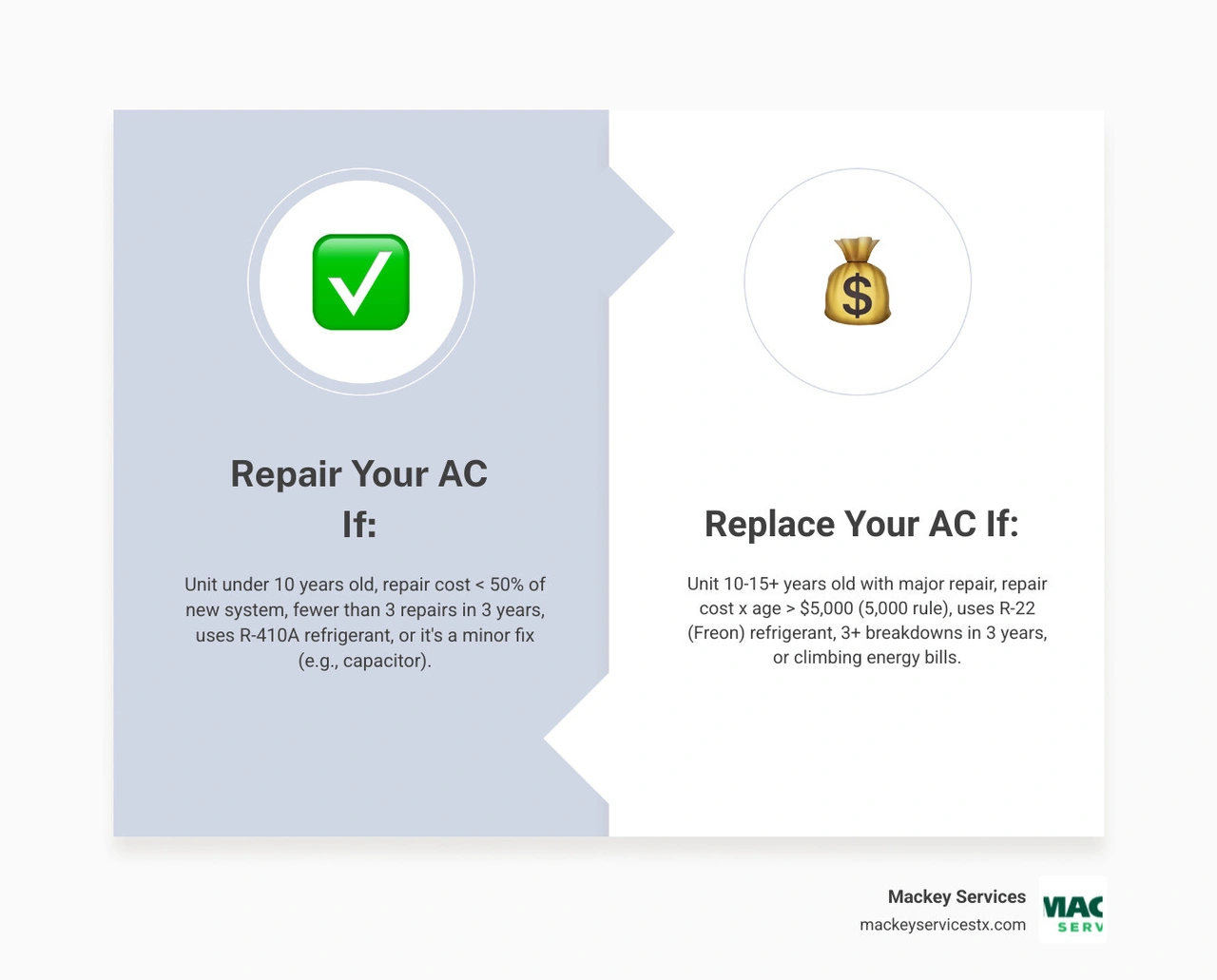
Repair your AC if:
- Your unit is under 10 years old
- The repair costs less than 50% of a new system's price
- You've had fewer than 3 repairs in the past 3 years
- Your system uses R-410A refrigerant
- The repair is a minor fix (capacitor, thermostat, clogged drain)
Replace your AC if:
- Your unit is 10-15+ years old and needs a major repair
- The repair cost multiplied by the unit's age exceeds $5,000 (the "5,000 rule")
- Your system uses R-22 (Freon) refrigerant
- You've had 3 or more breakdowns in the past 3 years
- Your energy bills have been climbing steadily with no clear cause
The right answer depends on your specific system, your budget, and how long you plan to stay in your home. The sections below break down every factor you need to make a confident, informed choice — without the pressure.
Identifying Common Signs Your Air Conditioner Needs Professional Attention
Living in the Greater Houston Area, from Dickinson to Baytown, means we ask a lot of our air conditioners. Our climate isn't just hot; it's a relentless humidity chamber. When your AC starts to struggle, it usually isn't shy about letting you know.
The first red flag most of us notice is weak airflow. If you put your hand up to a vent and it feels more like a gentle sigh than a cool breeze, your system is working overtime for very little reward. This often goes hand-in-hand with uneven temperatures. If your living room feels like the Arctic but your bedroom is a sauna, your AC is likely failing to distribute air properly or is struggling to keep up with the heat load.
Then there are the sounds. Every AC makes a bit of noise, but if yours starts banging, squealing, or grinding, it’s a cry for help. A loud rattling could mean something is loose, while a high-pitched screech might point to a failing motor or compressor. Before you panic, check out these 9 Tips to Troubleshoot an AC Problem to see if there’s a simple fix you can handle yourself.

Minor Issues Worth Fixing
Not every hiccup requires a full system overhaul. In fact, many of the calls we go on in Houston and Pearland turn out to be minor issues that are well worth the repair.
One of the most common "scary" problems is a clogged drain line. In our humid climate, your AC pulls gallons of water out of the air every day. If that drain line gets backed up with algae or debris, the system might shut down entirely to prevent a flood. This is a simple fix that’s part of Proper Maintenance of Commercial AC and residential units alike.
Other minor fixes include:
- Dirty Filters: It sounds too simple, but a clogged filter can choke your system and make it look like it's dying.
- Thermostat Calibration: Sometimes the AC is fine, but the "brain" (the thermostat) is telling it the wrong thing.
- Capacitor Replacement: These are small electrical components that help the motors start. They fail often but are relatively inexpensive to swap out.
When we come out for a visit, we’ll show you exactly what’s going on. If you’re curious about the process, here is What Should You Expect During HVAC System Maintenance.
Major Red Flags and Safety Concerns
While we love a simple fix, there are some "red flag" issues that mean your system is in serious trouble. One of the biggest is a failing compressor. As the heart of your system, the compressor is responsible for moving refrigerant. If you notice clicking noises or the unit refuses to start, you should look for Signs Your HVAC Air Compressor Needs Repair.
Safety first: If you ever smell an electrical burning scent or see smoke, turn the system off at the breaker immediately. Similarly, if your AC is frozen (literally covered in ice), don't just keep running it. This is usually caused by a refrigerant leak or severe airflow restriction.
One common question we get is, "Is It Okay for My AC to Run 24/7?" In a Houston July, it might feel like it has to, but if it never stops and the house is still warm, that’s a sign of a major mechanical failure that could lead to a safety hazard if left unaddressed.
The Financial Math: Should I Repair or Replace My AC?
When you’re staring at a repair estimate, it’s easy to feel like you’re just throwing good money after bad. To find out if it's financially smarter to keep your current unit, we have to look at the long-term ROI.
| Factor | Favor Repair | Favor Replacement |
|---|---|---|
| Unit Age | Under 10 years | Over 12-15 years |
| Repair Cost | Minor (under 25% of new system) | Major (over 50% of new system) |
| Refrigerant | R-410A | R-22 (Freon) |
| Efficiency | Bills are stable | Bills are skyrocketing |
| Frequency | First repair in years | 3+ repairs in 3 years |
If you’re seeing 7 Signs It's Time for a New Air Conditioner Greater Houston, such as persistent humidity or rising bills, the math often tips toward replacement. A new system isn't just an expense; it’s an investment in lower monthly bills. To keep your current system from reaching this point too early, know How Often Should HVAC Systems Be Serviced.
Applying the 5,000 Rule to Decide Should I Repair or Replace My AC
In the HVAC world, we use a handy financial heuristic called the 5,000 Rule. It’s a simple multiplication formula that helps take the emotion out of the decision.
The Formula: (Age of the Unit in Years) x (Estimated Cost of Repair) = Decision Number
- If the number is under $5,000: Repair is likely the smarter move.
- If the number is over $5,000: You should seriously consider replacement.
For example, if you have an 8-year-old unit and the repair is $400, your number is $3,200. That’s a clear repair. But if that same unit is 12 years old and needs a $600 repair, your number is $7,200. At that point, you’re spending money on a system that is likely to break again soon. Even with repairs, the Benefits of Routine AC Maintenance can only take an old machine so far.
When Frequent Breakdowns Mean You Should Repair or Replace My AC
There is a point where "one more repair" becomes a pattern of systemic decline. We often suggest the Three-Repair Rule: if your AC has needed three or more significant repairs in the last three years, it’s telling you that it’s tired.
When major components start failing back-to-back — first a fan motor, then a capacitor, then a leak — you’re paying for a new system one piece at a time, but without the benefit of a new warranty or lower energy bills. If you find yourself constantly calling an AC Maintenance Company in Baytown TX just to keep the air blowing, it’s time to look at 14 Signs to Upgrade the HVAC System in Your Home.
How Age and Technology Influence the Decision to Replace
In 2026, AC technology is lightyears ahead of where it was even a decade ago. While a well-maintained system can last 15 to 20 years, many residential units in the harsh Houston climate start to decline between 12 and 15 years.
You can check your system's age by looking at the nameplate on the outdoor condenser. Look for the "Manufacture Date" or use the serial number to look it up online. If your system is approaching its 15th birthday, it’s already on borrowed time. Modern systems aren't just more reliable; they use advanced technology like variable-speed compressors to keep your home at a perfectly steady temperature, rather than the "blast of cold then nothing" cycle of older units. Check these 7 Signs It's Time for a New Air Conditioner Greater Houston to see how your old unit stacks up.
Refrigerant Transitions: R-22 vs. R-410A and Beyond
One of the biggest "deal breakers" for AC repair is the type of refrigerant your system uses. If your unit was manufactured before 2010, there’s a good chance it uses R-22 (Freon).
Because R-22 is harmful to the ozone layer, its production was completely banned in the U.S. in 2020. This has made the remaining supply incredibly scarce and expensive — sometimes $100 to $200 per pound! If an R-22 system has a leak, the cost to "recharge" it can be astronomical. We almost always recommend replacement for R-22 systems because you’re essentially pouring money into an obsolete technology.
Today, we are seeing even newer standards like R-454B coming into play to be even more eco-friendly. Upgrading now ensures you aren't stuck with a system that will be impossible to service in a few years. This is one of the most important 14 Signs to Upgrade the HVAC System in Your Home.
Energy Efficiency and SEER2 Ratings
Efficiency is measured by the SEER2 (Seasonal Energy Efficiency Ratio) rating. Think of it like MPG for your car. Older units might have a SEER rating of 8 or 10. In 2026, modern high-efficiency units can reach SEER2 18 or even 25+.
What does that mean for your wallet? Switching from an old SEER 10 unit to a modern high-efficiency system can reduce your energy consumption by 30% to 50%. In a place like Houston, where the AC runs for most of the year, those savings can total thousands of dollars over the life of the system.
Plus, as of April 2026, there are still significant federal tax credits available through the Inflation Reduction Act and local utility rebates for installing high-efficiency heat pumps and AC units. These incentives can often total $2,000 or more, making the "replace" option much more attractive. You can see the long-term Benefits of Routine AC Maintenance even more clearly when you start with a high-efficiency baseline.
Lifestyle and Home Factors in the Repair vs. Replace Decision
Sometimes the decision isn't just about the machine; it's about the people living inside. Home comfort is about more than just the temperature on the thermostat. It’s about humidity control and indoor air quality.
Old systems often struggle to pull moisture out of the air, leaving your home feeling "clammy" even if the air is cold. New systems are designed to manage humidity much more effectively, which prevents mold growth and helps everyone breathe easier. If you’re noticing excessive dust or musty smells, it might be time to ask What Should You Expect During HVAC System Maintenance to see if your system can even be saved.
Long-Term Residency vs. Moving Soon
How long do you plan to live in your current home? This is a huge factor in the should i repair or replace my ac debate.
- The Seven-Year Plan: If you plan to stay in your home for 7 years or more, replacement is almost always the better financial move. You’ll recoup the cost through energy savings and avoid the stress of future breakdowns.
- The Moving Soon Strategy: If you’re planning to sell within the next year or two, a "stop-gap" or "bridge" repair might be more pragmatic. However, keep in mind that a brand-new AC with a transferable warranty can be a huge selling point in the Houston real estate market.
Whether you're managing a home or looking into Proper Maintenance of Commercial AC, protecting your investment is the top priority.
Warranty Status and Manufacturer Support
Before you sign off on a major repair, check your warranty status. Most quality systems come with a 5-to-10-year parts warranty. If your unit is 8 years old and the failed part is covered, the repair becomes much more affordable because you’re only paying for labor.
However, if your warranty has expired, you are on the hook for every penny. We can help you verify your registration and see what’s covered. Knowing your warranty status is a key part of understanding How Often Should HVAC Systems Be Serviced and when to let go.
Frequently Asked Questions about Should I Repair or Replace My AC?
How can I check my AC unit's age and refrigerant type?
You can find this information on the "data plate" on the side of your outdoor condenser unit. It looks like a large sticker with a lot of text. Look for the "MFR DATE" for the age. For the refrigerant, look for "Refrigerant Type" or "Factory Charge." It will usually say R-22, R-410A, or R-454B. If you can’t find it, take a photo of the plate and send it to us — we can look it up for you in seconds!
Are there any financial incentives or rebates available for replacing an old AC unit in 2026?
Yes! In 2026, homeowners can still take advantage of federal tax credits (up to $2,000 for high-efficiency heat pumps) and various utility rebates. Many local Houston-area power providers offer "instant rebates" for installing ENERGY STAR certified equipment. These incentives are designed to make high-efficiency cooling more affordable for everyone.
What are the benefits of replacing an older AC unit with a new, more efficient model?
The benefits are huge:
- Lower Bills: Save up to 50% on cooling costs.
- Better Comfort: Superior humidity control and consistent temperatures.
- Peace of Mind: A new 10-year warranty means no surprise repair bills.
- Quiet Operation: Modern units are significantly quieter than older models.
- Eco-Friendly: New refrigerants and lower energy use reduce your carbon footprint.
Conclusion
Deciding should i repair or replace my ac doesn't have to be a shot in the dark. By using the 5,000 rule, checking your refrigerant type, and considering your long-term plans for your home, you can make a choice that fits your life and your budget.
At Mackey Services, we’ve been helping our neighbors in Dickinson, League City, Friendswood, and across the Greater Houston Area stay cool since 1992. With over 30 years of experience and a commitment to family-owned values, we’re here to give you honest, professional advice. Whether you need a quick capacitor swap or a custom-fabricated ductwork system for a new high-efficiency unit, our 24/7 emergency readiness ensures you never have to lose your cool for long.
Ready for an expert opinion you can trust? More info about air conditioning services is just a click away, or give us a call to schedule your diagnostic today.
Ready for a better day?
One call handles it all — HVAC, electrical, and generators across the Texas Gulf Coast. Less to pay. Better day. That's the Mackey way.
Mon–Fri: 7 AM – 8 PM · Sat: 8 AM – 5 PM · Licensed & insured · #TACLA 112769C · #TECL 558211