
Beating the Beach: Maintenance Secrets for a Longer-Lasting Gulf Coast AC
Discover how to extend the life of your AC on the coast with DIY rinsing, pro coatings & maintenance tips for Galveston humidity & salt air corrosion.
Why Gulf Coast Homeowners Need a Smarter AC Strategy
How to extend the life of your AC on the coast starts with understanding one uncomfortable truth: your system is working against a harsh, relentless environment every single day.
Here's a quick overview of the most important steps:
- Rinse your outdoor unit monthly with fresh water (power off first) to wash away salt deposits
- Change air filters every 30 days — not the standard 90 — due to faster buildup from humidity and salt
- Apply protective coil coatings to create a barrier between metal components and salt air
- Schedule professional maintenance twice a year — before summer and after storm season
- Install a whole-home surge protector to guard against storm-related electrical damage
- Keep two feet of clearance around your outdoor unit at all times
- Watch for early warning signs like rust, rising energy bills, or longer run times
Living near the Gulf Coast means ocean breezes, beautiful views, and warm weather year-round. But that same salty air that makes coastal life so appealing is quietly working against your air conditioning system. Salt particles settle on metal components, humidity keeps your system running harder and longer, and Gulf storms bring power surges that can fry sensitive electronics — all at the same time.
The numbers tell the story clearly. While a well-maintained AC in a dry inland climate can last 13 to 20 years, coastal systems — especially those within 10 miles of the shoreline — often need replacement two to three years sooner. In the Greater Houston and Galveston area, units can log 2,500 to 3,500 operating hours every year, compared to just 1,000 to 1,500 hours in northern states. That's not just wear — that's an accelerated countdown.
The good news? With the right maintenance habits and a few smart upgrades, you can push back against that timeline significantly.
Why Coastal Living is Tough on Your HVAC System
If you live in Galveston, La Porte, or Seabrook, your air conditioner isn't just a luxury; it’s a survival tool. However, the very environment that makes our region beautiful is a nightmare for mechanical equipment. The primary culprit is salt air.
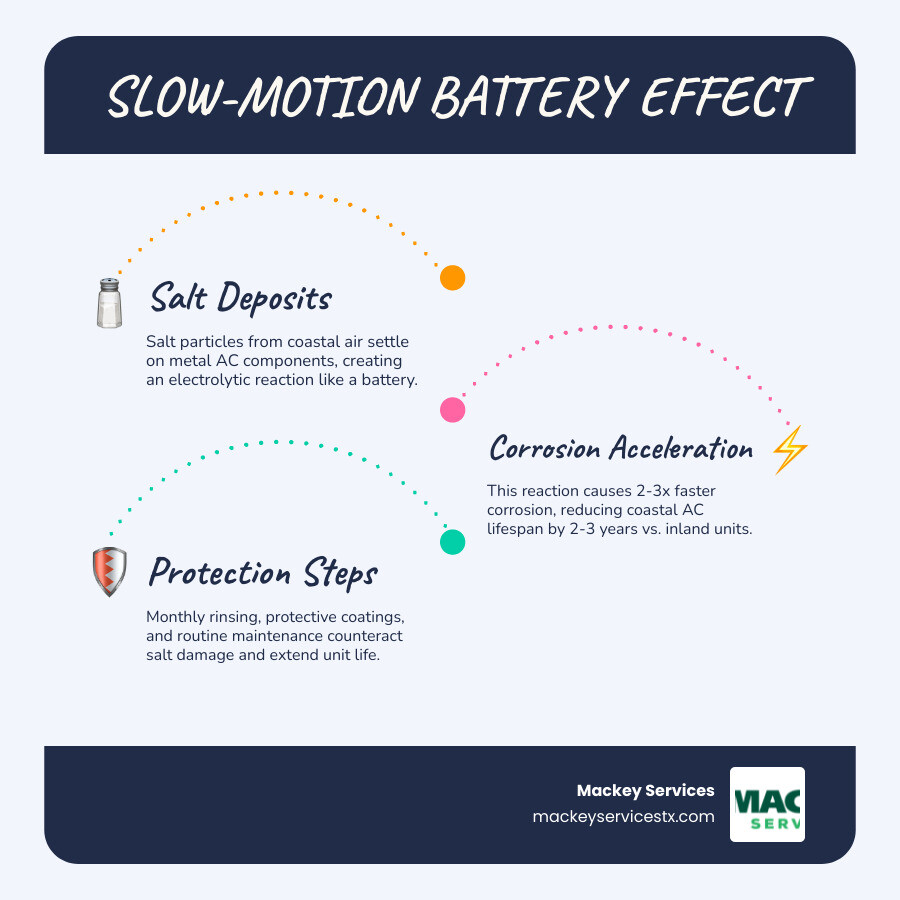
When microscopic salt particles travel inland, they settle on your outdoor condenser coils. When combined with our high humidity (often hovering between 60-70% relative humidity year-round), a chemical process known as an electrolytic reaction occurs. Think of your AC unit as a "slow-motion battery." The salt and moisture create a bridge that allows electricity to flow between different types of metal in your unit, causing them to corrode at rates two to three times faster than inland systems.
This corrosion isn't just an eyesore; it’s an efficiency killer. As the delicate aluminum fins on your coils pit and flake away, the system loses its ability to transfer heat. Research shows that salt damage can reduce HVAC efficiency by up to 30% over time. This means your unit has to run longer and work harder just to maintain the same temperature, leading to a massive spike in wear and tear.
Furthermore, the benefits of routine AC maintenance become even more critical when you consider our humidity. Excess moisture doesn't just make the air feel "heavy"; it forces the AC to work double-time as a dehumidifier. This leads to more frequent condensate drain line clogs from algae and mineral deposits, and in extreme cases, it can even promote mold growth inside the air handler. Following a 24-hour AC maintenance guide Houston TX can help you stay ahead of these moisture-related failures.
How to Extend the Life of Your AC on the Coast with DIY Care
You don't need a toolbox full of specialized equipment to protect your investment. In fact, some of the most effective ways to how to extend the life of your AC on the coast are simple tasks you can do yourself.
First and foremost, let’s talk about rinsing. If you live within 10 miles of the Gulf, salt is constantly accumulating on your unit. We recommend a gentle monthly rinse with fresh water. This simple act washes away the salt film before it can begin the "slow-motion battery" corrosion process. If you’re located in a high-exposure area like Galveston, this is non-negotiable. Learn more about AC maintenance Galveston TX to keep your beachside system humming.
Another critical DIY task is managing your air filters. While inland homes might get away with changing filters every three months, coastal homes should stick to a 30-day cycle. Salt, sand, and high humidity make indoor particles "stickier," which clogs filters faster and puts immense strain on the blower motor.
Don't forget the area around the unit either. We often see beautiful coastal landscaping that has grown too close to the condenser. You need at least two feet of clear space around the unit for proper airflow. If the unit can't "breathe," it overheats, which is a major factor when people ask, is it okay for my AC to run 24/7? (Spoiler: It's okay for it to run often, but not if it’s suffocating under a hibiscus bush!)
Essential DIY Steps: How to Extend the Life of Your AC on the Coast
When you head outside to rinse your unit, follow these safety steps:
- Power Off: Always turn the system off at the thermostat and the outdoor disconnect box first.
- Use a Garden Hose: Never use a pressure washer! The high pressure can bend the delicate aluminum fins, permanently damaging the unit.
- Gentle Spray: Use a soft spray to wash the coils from top to bottom.
- Clear Debris: Remove any leaves, sand, or salt crust from the base pan.
If you notice the unit isn't cooling properly even after a cleaning, check out these 9 tips to troubleshoot an AC problem before calling in the pros.
Professional Strategies for Salt-Air Protection
While DIY care is great, the harsh Gulf Coast environment often requires industrial-strength protection. This is where professional upgrades come into play.
One of the most effective professional strategies is the application of protective coatings, such as E-coatings or specialized coastal-grade sprays. These coatings provide a microscopic barrier that prevents salt from ever touching the metal. For residents needing AC maintenance La Porte TX, we often recommend these coatings as a primary defense against the industrial and salt-laden air of the bay.
Another "secret weapon" for coastal ACs is the use of sacrificial anodes. Much like the anodes used on boat engines, these zinc or magnesium rods are installed to attract the corrosion away from your expensive AC components. If the salt wants to eat something, it eats the cheap anode instead of your copper coils!
When it’s time for a new unit, we suggest looking for coastal-rated models. These systems often feature copper fins (which resist salt better than aluminum) and stainless steel hardware. Additionally, what should you expect during HVAC system maintenance in a coastal area? You should expect a deep dive into your electrical components. Salt air can cause "micro-shorts" on control boards, which our technicians can spot before they turn into a total system failure.
Advanced Upgrades: How to Extend the Life of Your AC on the Coast
Beyond the outdoor unit, consider how the indoor environment affects the system’s lifespan. In places like Friendswood or Pearland, the humidity is relentless. Installing a whole-home dehumidifier can take a massive load off your AC. Instead of the AC struggling to both cool and dry the air, the dehumidifier handles the moisture, allowing the AC to run shorter, more efficient cycles.
For those in AC maintenance Friendswood TX, we also suggest zoning systems. By only cooling the rooms you are using, you reduce the total operating hours of the system, effectively adding years to its life.
Knowing When to Repair vs. Replace Your Coastal Unit
There comes a point where even the best maintenance can't fight off the inevitable. In the Greater Houston area, the "10-year threshold" is a very real thing for coastal units. While an inland system might be in its "middle age" at 10 years, a Galveston or Texas City unit is often entering its twilight years.
| Feature | Coastal AC System | Inland AC System |
|---|---|---|
| Expected Lifespan | 10–12 Years | 15–20 Years |
| Annual Operating Hours | 2,500–3,500 | 1,000–1,500 |
| Corrosion Risk | Extreme | Low to Moderate |
| Repair Frequency | 40% Higher | Standard |
| Efficiency Loss | Up to 30% | Minimal with care |
If your system is over 10 years old and you’re seeing 14 signs to upgrade the HVAC system in your home, such as frequent breakdowns or a sudden jump in electric bills, it might be time to stop pouring money into repairs. Coastal units require replacement parts 40% more frequently than inland units once corrosion takes hold.
However, don't give up too early. Understanding how regular maintenance gives your HVAC system a longer lifespan can help you decide if a repair is a solid investment or just a band-aid. If your coils are still structurally sound and the corrosion is minimal, a professional cleaning and coating might buy you another three to five years of comfort.
Frequently Asked Questions about Coastal AC Longevity
How often should I rinse my outdoor unit in a salt-air environment?
For homes within 5-10 miles of the coast, we recommend a gentle fresh-water rinse once a month. This prevents the buildup of salt film that triggers corrosion. Always remember to turn off the power at the disconnect box before you start, and never use a high-pressure nozzle. For more specific advice for your neighborhood, check our tips for AC maintenance Galveston TX.
What are the first signs of salt air corrosion on an AC?
The earliest signs are often "pitting" on the aluminum fins—small, dark spots that look like the metal is being eaten away. You may also notice white, powdery salt deposits or flaking metal on the outdoor cabinet. Other signs include a noisier outdoor fan (due to corroded bearings) and a slow but steady increase in your monthly energy bills as the system loses efficiency.
Does a whole-home dehumidifier help extend AC life on the coast?
Absolutely. In the Gulf Coast region, humidity is often a bigger challenge than the heat itself. A whole-home dehumidifier allows your AC to focus solely on lowering the temperature. This reduces the "run time" of your compressor and blower motor, potentially saving 15-20% on energy costs and reducing wear on critical components. It’s one of the best investments for how to extend the life of your AC on the coast.
Conclusion
At Mackey Services, we’ve spent 30 years helping neighbors across the Greater Houston Area—from the historic streets of Galveston to the growing communities of Dickinson and Pearland—beat the coastal heat. With our A+ BBB rating and deep roots in Texas, we understand that a coastal AC needs more than just a standard tune-up; it needs a specialized defense strategy.
Whether you need air conditioning maintenance Sugarland TX or a coastal-grade system replacement in Texas City, our family-oriented team is here to ensure your comfort is unwavering. Don't let the salt air win the battle for your backyard.
Schedule your coastal AC service today and let us help you get every possible year of cool, crisp air out of your system.
Ready for a better day?
One call handles it all — HVAC, electrical, and generators across the Texas Gulf Coast. Less to pay. Better day. That's the Mackey way.
Mon–Fri: 7 AM – 8 PM · Sat: 8 AM – 5 PM · Licensed & insured · #TACLA 112769C · #TECL 558211