
Is Your AC Just Salty or Is It Time for a Replacement?
Learn when should you replace your ac in a coastal climate. Spot salt corrosion signs, repair vs. replace tips & upgrade timing for Houston homes.
Why Coastal Homeowners Need to Think Differently About AC Replacement
When should you replace your AC in a coastal climate is one of the most important questions you can ask as a homeowner near the Gulf Coast. The short answer: sooner than you think.
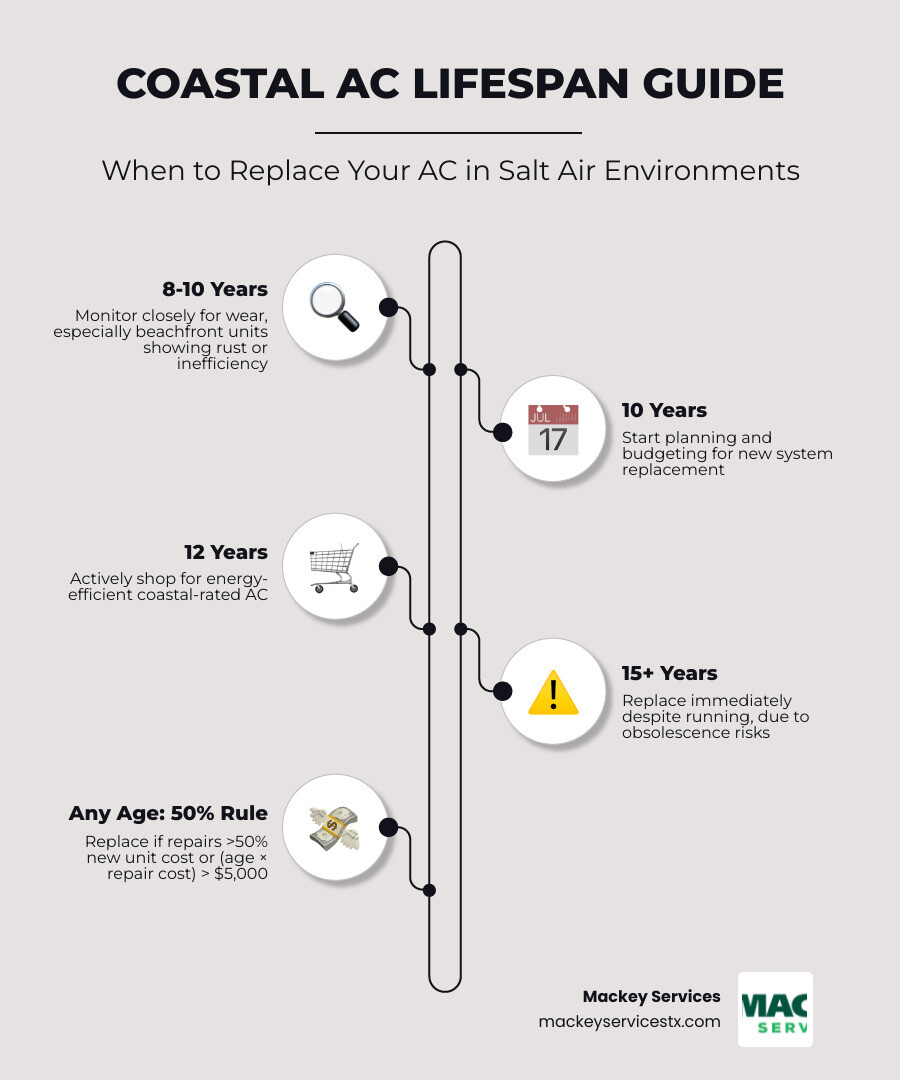
Here is a quick reference based on your system's age and condition:
- 8-10 years old - Start paying close attention; beachfront and near-shore systems may already be showing significant wear
- 10 years old - Begin planning and budgeting for replacement
- 12 years old - Start actively shopping for a new system
- 15+ years old - Replace now, even if the unit is still running
- Any age - Replace immediately if repair costs exceed 50% of a new system's price, or if (system age × repair cost) exceeds $5,000
Salt air, relentless humidity, and near year-round runtime put coastal AC systems under stress that inland units simply never face. While the national average lifespan for a central air conditioner is 15 to 20 years, systems on the Gulf Coast realistically last 10 to 15 years — and units within a mile of the water may only hold up 8 to 12 years. That is not a small difference. It is years of unexpected breakdowns, rising energy bills, and comfort problems if you are not watching closely.
In the Greater Houston area, where salty Gulf air travels miles inland on the breeze, this is not just a beachfront problem. It affects neighborhoods well away from the shoreline too.
The Coastal Toll: Why Ocean Air Shortens HVAC Lifespan
Living in places like Galveston, Seabrook, or Kemah means enjoying the beautiful Gulf views, but your air conditioner is essentially living in a war zone. The "hidden enemy" in our air is salt. Even if you can’t see it, salt particles travel miles inland on our ocean breezes. When these particles land on your outdoor condenser unit, they don't just sit there; they trigger a chemical reaction.
The Electrolytic Reaction
In a coastal climate, salt combined with high humidity creates an electrolytic reaction. This effectively turns your outdoor unit into a "slow-motion battery" that eats away at metal surfaces. Specifically, it targets the thin aluminum fins and copper tubing of your condenser coils. As these metals corrode, they lose their ability to transfer heat. This means your system has to work much harder to achieve the same cooling effect, leading to a massive spike in component wear.
Heavy Runtime and Humidity Load
While a system in a northern state might only run for 1,000 to 1,500 hours a year, our systems in the Greater Houston area are marathon runners. We often log 2,500 to 3,500 hours or more annually. When you combine this heavy usage with our 70-85% relative humidity, the strain is immense. Your AC isn't just cooling the air; it's working overtime as a dehumidifier. This constant moisture removal can lead to algae growth in drain lines and accelerated rust on internal electrical connections.
The marine layer—that thick, salty mist we often see in the mornings—can push indoor humidity levels above 80% if your system isn't functioning at peak efficiency. This puts even more stress on the blower motors and evaporator coils. To understand how to fight back against these elements, check out A Homeowner's Guide to Extending Your HVAC System's Lifespan.
When Should You Replace Your AC in a Coastal Climate?
The big question remains: when should you replace your ac in a coastal climate? Because our environment is so much harsher than the national average, we have to adjust our expectations for longevity.
| Feature | Inland/National Average | Coastal/Gulf Coast Reality |
|---|---|---|
| Typical Lifespan | 15–20 Years | 10–15 Years |
| Beachfront Lifespan | N/A | 8–12 Years |
| Annual Runtime | 1,000–1,500 Hours | 2,500–3,500+ Hours |
| Corrosion Rate | Standard | 2–3x Faster |
| Efficiency Loss | Minimal over time | Up to 30% due to salt |
10-Year Planning
Once your system hits the 10-year mark in a coastal area, it is officially in its "senior years." This is the time to start a replacement fund. In areas like Port Aransas or Rockport, systems often only last 7 to 10 years. While we might get a few more years out of a unit in Dickinson or League City, the 10-year milestone is when efficiency starts to drop off a cliff.
15-Year Threshold
If your system has reached 15 years in the Greater Houston area, you are essentially living on borrowed time. Modern systems have reached 16-22 SEER (Seasonal Energy Efficiency Ratio) ratings, whereas your 15-year-old unit likely struggles to hit an 8 or 10 SEER rating. Replacing a unit this old can lead to energy savings of 30-50%. For more details on spotting the end, see 7 Signs You Need a New AC.
Key Signs Your System is Failing the Salt Test
You don't always need a calendar to tell you it's time for a change. Your system will often send "S.O.S." signals:
- Visible Rust and Corrosion: If the outdoor cabinet looks like a sunken ship, the internal coils are likely in worse shape.
- 20% Energy Bill Increase: If your usage hasn't changed but your bill has jumped 20% or more, your system is losing its battle with efficiency.
- Frequent Repairs: Are you seeing your HVAC technician more often than your neighbors? If you're replacing parts 40% more frequently than you used to, the end is near.
- Weak Airflow or Noisy Compressor: Salt buildup restricts airflow, forcing the compressor to work harder and louder.
- Moisture Issues: In our climate, excess humidity indoors or standing water around the unit are major red flags. If you're wondering, Are Air Conditioners Supposed to Leak Water? Understanding AC Condensation and Leak Issues Greater Houston can help you distinguish between normal condensation and a failing system.
When to Replace Your AC in a Coastal Climate Based on Age
We recommend a proactive approach to avoid the "emergency replacement" trap.
- The 10-Year Proactive Plan: Get a professional assessment. We check for "coil rot" and electrical pitting that salt air causes.
- The 12-Year Shopping Window: Start looking at new technology. Variable-speed blowers and coastal-rated coatings have improved significantly in the last decade.
- The 15-Year Immediate Replacement: At this stage, a major component failure (like a compressor or coil leak) is inevitable. Replacing now on your own terms is much cheaper than an emergency call in the middle of a July heatwave.
Furthermore, the industry is moving away from older refrigerants. R-22 is completely phased out, and R-410A is currently being phased down. If your old system uses these, a simple refrigerant leak can become an impossibly expensive repair.
Repair vs. Replace: Navigating the "Salty" Decision
Deciding whether to sink more money into an old unit or invest in a new one can be stressful. To make it easier, we use two objective rules of thumb.
The 50% Rule
If the cost of a single repair is 50% or more of the cost of a brand-new system, you should almost always replace it. In a coastal climate, a major repair on an old unit is often just "putting a bandage on a shark bite." The salt will continue to eat the other components, and you’ll likely be facing another repair soon.
The $5,000 Rule
Multiply the age of your AC system by the estimated repair cost. If the total is over $5,000, replacing the system is typically the smarter investment.
- Example: A 12-year-old system needs a $600 repair. 12 x 600 = $7,200. Since $7,200 is well over $5,000, it's time to shop for a new unit.
The Benefits of Upgrading
When you choose to replace, you aren't just getting a working machine; you're getting modern technology designed for our environment. Modern 16-22 SEER systems offer:
- Superior Humidity Control: Variable-speed technology allows the system to run longer, lower-intensity cycles, which pulls significantly more moisture out of the air.
- Energy Savings: You can often cut your cooling costs by 30-50%.
- Peace of Mind: A new warranty protects you from the unexpected costs that plague older coastal units.
Maximizing Longevity in Harsh Marine Environments
Even if you aren't ready for a replacement today, you can extend the life of your current system by fighting back against the salt.
The Power of the Rinse
One of the simplest things you can do is rinse your outdoor unit with fresh water from a garden hose once a month. This washes away the salt film before it can start the corrosion process.
- Safety First: Always turn the power off at the disconnect box before rinsing.
- Gentle Pressure: Never use a pressure washer; it will flatten the delicate aluminum fins and ruin the unit.
Maintain Clearance and Airflow
Keep at least two to three feet of clearance around your outdoor condenser. In the Greater Houston area, we have fast-growing vegetation that can quickly choke a unit. Trim back shrubs and keep the area free of leaves and debris. This ensures the unit can "breathe" and doesn't overheat.
Professional Maintenance is Key
In a coastal climate, an annual checkup isn't enough. We recommend semi-annual professional service. Our technicians can apply protective coatings to the coils and check for early signs of salt-induced electrical failure. For a full checklist, see our AC Maintenance Houston TX Complete Guide.
Strategic Timing for Your Coastal AC Upgrade
If you've determined that it's time for a replacement, timing your purchase can save you a significant amount of money and stress.
The "Off-Season" Advantage
Most people wait until their AC dies in the middle of summer to replace it. This is the most expensive and stressful way to do it.
- Fall (October-November): This is often the best time. Demand is lower, and you can see savings of 15-25% compared to peak season pricing.
- Early Spring (February-March): Another great window. You can beat the summer rush and often find savings of 10-20%.
- Avoid Summer: Replacing a unit in June or July can drive costs up by 20-40% due to high demand and emergency labor rates.
Planned vs. Emergency Replacement
A planned replacement offers 15-30% cost savings compared to an emergency one. When you plan ahead, you have time to:
- Research the best coastal-rated equipment.
- Compare different SEER ratings.
- Apply for necessary permits without rushing.
- Avoid the "hurricane season delay" where supply chains and labor can be disrupted by storms.
Frequently Asked Questions
Does salt air really shorten AC life?
Yes, absolutely. Salt in coastal air accelerates corrosion on metal components two to three times faster than in dry, inland climates. This leads to refrigerant leaks, restricted airflow, and a total system lifespan that is 2 to 5 years shorter than the national average.
Can I rinse my outdoor unit to remove salt?
Yes, and you should! Rinsing your outdoor unit with fresh water from a garden hose once a month is one of the best ways to prevent salt buildup. Just remember to turn the power off first and avoid using high-pressure settings that could damage the fins.
What features should I look for in a coastal AC?
When shopping for a new unit in the Greater Houston area, look for:
- E-coatings or Epoxy Coatings: These are specialized anti-corrosion treatments for the coils.
- Copper Fins: While more expensive, copper resists salt corrosion much better than aluminum.
- Corrosion-Resistant Cabinets: Look for units with high-quality paint or stainless steel hardware.
- High SEER Ratings: To combat the high energy costs of our long cooling seasons.
- Variable-Speed Blowers: Essential for managing our intense Gulf Coast humidity.
Conclusion
Determining when should you replace your ac in a coastal climate doesn't have to be a guessing game. By watching the age of your system, keeping an eye on your energy bills, and performing regular maintenance, you can stay ahead of the salt and humidity.
At Mackey Services, we’ve spent 30 years helping families across the Greater Houston Area—from Galveston to Pasadena and Dickinson to Pearland—stay comfortable in one of the toughest climates in the country. As an A+ BBB-rated company, we pride ourselves on providing reliable, family-like service that treats your home with the respect it deserves. We understand the unique challenges of Gulf Coast living and can help you choose a system that is built to last.
Don't wait for your AC to give up in the middle of a Texas summer. Schedule your coastal AC assessment today and let us help you ensure your home remains a cool, dry sanctuary.
Ready for a better day?
One call handles it all — HVAC, electrical, and generators across the Texas Gulf Coast. Less to pay. Better day. That's the Mackey way.
Mon–Fri: 7 AM – 8 PM · Sat: 8 AM – 5 PM · Licensed & insured · #TACLA 112769C · #TECL 558211