
Does Your Electrical Panel Support an EV Charger?
Discover if does your electrical panel support an EV charger. Learn capacity checks, upgrades & pro tips for safe Level 2 home charging.
Understanding Your Home’s Electrical Capacity
Does your electrical panel support an EV charger? For most Houston-area homeowners, the answer depends on a few key factors — your panel's amperage rating, how much of that capacity you're already using, and whether you have room for a dedicated 240-volt circuit.
Here's a quick look at whether your panel is likely ready:
| Panel Type | Likely Compatible? | Notes |
|---|---|---|
| 200-amp panel, low existing load | Yes | Most common scenario for modern homes |
| 200-amp panel, high existing load | Maybe | Requires a professional load calculation |
| 100-amp panel | Often no | May need upgrade or load management device |
| 60-amp or fuse panel | No | Upgrade required before installation |
About 20% of homes need some kind of electrical upgrade before an EV charger can be safely installed. If your home is older, already running high-demand appliances like central air conditioning, an electric water heater, or a pool pump, your panel may not have enough headroom for a Level 2 charger without some changes first.
The good news? A full panel replacement isn't always necessary. In some cases, smart load management systems or a subpanel can solve the problem at a lower cost and with less disruption to your home.
This guide walks you through how to assess your panel's capacity, what warning signs to watch for, and what your options are if your current setup falls short.
Think of your electrical panel as the "brain" of your home’s electrical system. It takes the high-voltage power from the utility grid and distributes it safely to your lights, appliances, and gadgets. But just like a brain, it can only handle so much information—or in this case, amperage—at once.
Every panel has an amperage rating, which is the maximum amount of electricity it can pull from the grid at any given moment. Most modern homes built in the last 20 to 30 years come standard with a 200-amp service. This is generally plenty of power to run a modern household, including an EV charger. However, many older homes in areas like Pearland or Pasadena may still have 100-amp or even 60-amp panels.
To find your rating, look for the "main breaker." This is usually a large switch at the very top or bottom of your panel. It should have a number stamped on it—likely 100, 150, or 200. If you see a 100-amp breaker and you’re already running a central AC unit and an electric dryer, your panel is likely "full" from a capacity standpoint, even if there is physical space for more switches.
If you discover your panel is outdated or undersized, you might need an Electrical Panel Replacement in Piney Point Village TX to ensure your home can handle the modern demands of 2026 technology.
Does Your Electrical Panel Support an EV Charger?
The big question isn't just "do I have enough power?" but "do I have the right kind of power?" Most standard household outlets provide 120 volts. An EV charger—specifically a Level 2 charger—needs a 240-volt circuit. This is the same type of heavy-duty connection used by your electric oven or clothes dryer.
To support this, your panel needs:
- Sufficient Amperage: The capacity to handle an additional 40 to 60 amps of continuous load.
- Physical Space: Two empty slots side-by-side to install a "double-pole" breaker.
- Modern Safety Standards: A panel that isn't showing signs of age, corrosion, or wear.
If you’re unsure where to start, we recommend a professional assessment. Proper EV Charging Station Installation in Houston TX starts with confirming that your infrastructure won't be pushed past its breaking point.
Power Requirements for Level 1 vs. Level 2 Charging
When deciding if your panel is ready, you first need to choose which "Level" of charging you plan to use.
| Feature | Level 1 Charging | Level 2 Charging |
|---|---|---|
| Voltage | 120V (Standard Outlet) | 240V (Dedicated Circuit) |
| Amperage Need | 12-16 Amps | 40-60 Amps |
| Charging Speed | 3–5 miles of range per hour | 25–50 miles of range per hour |
| Panel Impact | Low | Significant |
| Installation | Plug-and-play | Requires licensed electrician |
Level 1 is the "trickle charge." It’s fine if you only drive 20 miles a day, but for most Houstonians with long commutes, it’s just too slow. Level 2 is the gold standard for home charging, but because it draws so much power continuously, it’s the primary reason people ask, "does your electrical panel support an ev charger?"
Deciding between the two often comes down to your daily driving habits. You can learn more about the trade-offs in our guide on Should You Charge an EV at Home or a Public Station.
How to Check if Your Electrical Panel Supports an EV Charger
You don't need to be an electrician to do a preliminary "vibe check" on your electrical system. Here is how we suggest you start:
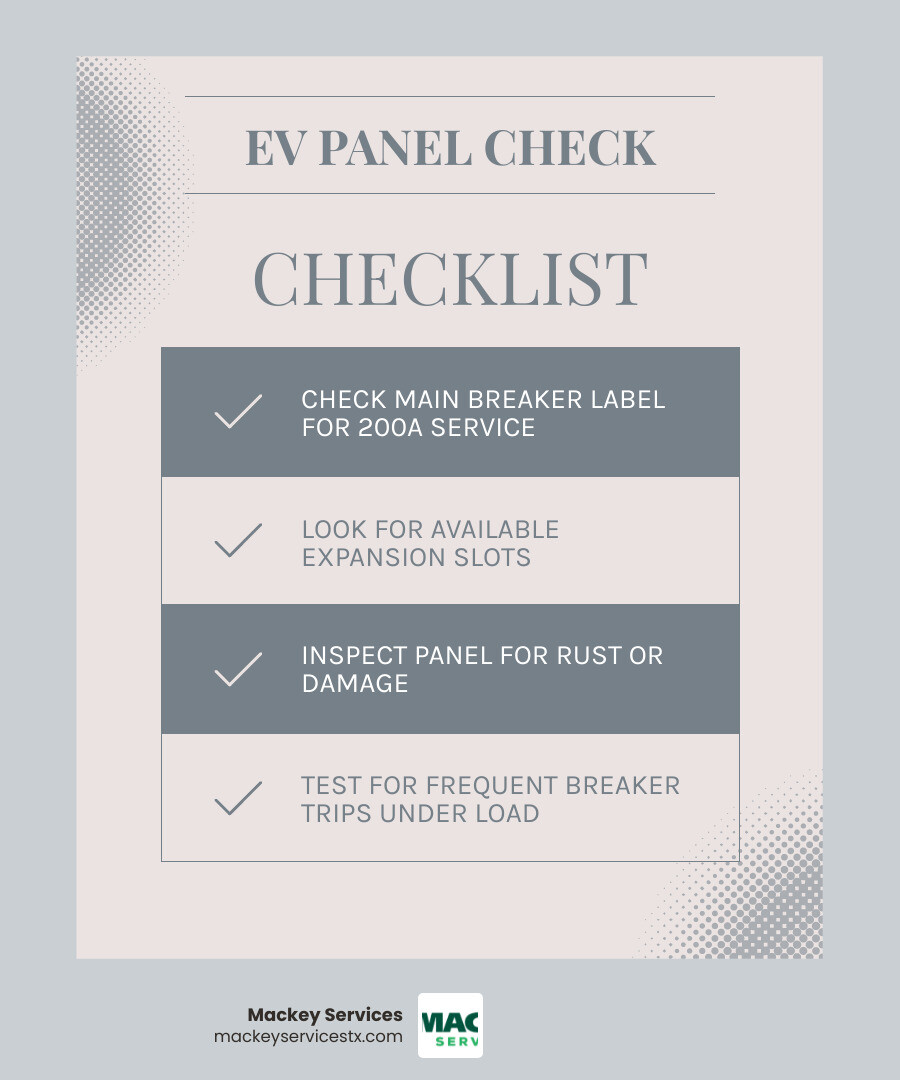
- Check the Main Breaker: As mentioned, look for that 100 or 200 label. If it’s 200, you’re in a good starting position.
- Count the "Knockouts": Look at the switches in your panel. Are there any empty spaces where a new switch could be added? A Level 2 charger requires two vertical spaces.
- Look for High-Draw Appliances: Make a mental list. Do you have an electric water heater? Central AC? A hot tub? A pool pump? The more "big" items you have, the less room there is for an EV.
- Check the Brand: If your panel says "Federal Pacific," "Zinsco," or "Sylvania," stop right there. These brands are notorious for safety issues and often need to be replaced regardless of whether you’re getting an EV.
If you see rust, hear buzzing, or notice that the panel feels warm, you should immediately call for an Electrical Repair in Houston TX before plugging anything new into your home.
Signs You Need an Electrical Upgrade Before Installation
Sometimes your house tries to tell you it’s overwhelmed before a breaker even trips. If you’re considering an EV charger, watch for these "cries for help" from your electrical system:
- Flickering Lights: Do your lights dim for a split second when the AC kicks on? That’s a sign that your system is struggling to meet sudden demands for power.
- Frequent Breaker Trips: If you can’t run the microwave and the hair dryer at the same time without a trip to the garage, your panel is already at its limit.
- The "Full" Panel: If every single slot in your breaker box is occupied, you literally have no place to put the new EV breaker.
- Age: If your home was built before the 1980s and hasn't had an electrical update, the wiring might not be rated for the continuous high-heat load that an EV charger generates.
Knowing When Does It Make Sense to Replace an Electrical Panel is vital for your safety. An EV charger isn't like a toaster; it runs for hours at a time at high amperage. Any weakness in your panel will be found and exploited by that constant flow of electricity.
Professional Load Calculations and Safety Standards
This is where the "science" happens. When we come to your home, we don't just guess if your panel can handle the load. We perform what’s called a Load Calculation based on the National Electrical Code (NEC).
The NEC has two very important rules for EV chargers:
- The 125% Rule: Because an EV charger is a "continuous load" (meaning it runs for more than three hours), the circuit must be sized at 125% of the charger’s output. For example, a 48-amp charger requires a 60-amp breaker.
- The 80% Safety Margin: We ensure that your total household load doesn’t exceed 80% of your panel’s rated capacity. This prevents the panel from overheating and ensures long-term reliability.
If your current panel is borderline, we might suggest an Electrical Panel Upgrade in Wallisville TX to give you the "headroom" needed to charge safely while the rest of your house runs smoothly.
Why Your Electrical Panel Must Support an EV Charger Safely
Why all the fuss about load calculations and safety margins? Because the risks of getting it wrong are serious. An inadequate panel trying to feed a hungry EV charger can lead to:
- Electrical Fires: Overloaded wires generate heat. If the breaker fails to trip, that heat can ignite the insulation inside your walls.
- Equipment Damage: Voltage drops caused by an overtaxed panel can damage the sensitive electronics in your new car or your home appliances.
- Insurance Issues: If you install a charger without a permit or on an unrated panel and a fire occurs, your insurance company may deny your claim.
In some cases, the issue isn't just the panel, but the wiring itself. Older homes may require Whole Home Rewiring in La Porte TX to safely support modern 240-volt infrastructure.
Alternatives to a Full Panel Replacement
If you’ve read this far and are worried that a multi-thousand-dollar panel upgrade is your only path forward, take a breath! In April 2026, we have more technology than ever to help homeowners avoid a total overhaul.
- Subpanels: If your main panel has the power (amperage) but lacks the physical space (slots), we can install a small subpanel nearby to house the EV breaker and a few other circuits.
- Load Management Systems: These "smart" systems monitor your home's total power usage. If you turn on the oven and the AC at the same time, the system will temporarily throttle down the EV charger to keep you under your panel’s limit.
- Circuit-Sharing Devices: These allow your EV charger and another appliance (like a dryer) to share the same circuit. The device ensures they don't both run at the same time.
- Smart Splitters: A simpler version of circuit sharing that plugs into an existing 240V outlet.
Before you decide, it's worth asking, Should You Invest in a Home EV Charger? For most, the convenience and long-term savings make it a "yes," especially when these clever alternatives are available.
Frequently Asked Questions about EV Panel Compatibility
Can a 100-amp panel support a Level 2 charger?
It depends on your "existing load." If you have gas appliances (stove, water heater, furnace), you might have enough room on a 100-amp panel for a 30-amp or 40-amp EV charger. However, if your home is "all-electric," a 100-amp panel will almost certainly struggle. A professional load calculation is the only way to know for sure.
What are the risks of overloading an older panel?
Beyond the fire risks mentioned earlier, you'll deal with "nuisance tripping." Imagine your car stops charging at 2:00 AM because the refrigerator cycled on and tripped the main breaker. You'll wake up to a dead battery and a warm fridge. Overloading also causes "thermal stress" on your wiring, which shortens the lifespan of your entire electrical system.
Are there tax credits for panel upgrades in 2026?
Yes! As of April 2026, the Federal 30C Tax Credit (Alternative Fuel Vehicle Refueling Property Credit) is still a major incentive. It can cover up to 30% of the cost of hardware and installation for EV charging equipment, up to $1,000. Furthermore, if a panel upgrade is required specifically to install the charger, those costs may also be eligible. Many local utility companies in the Houston area also offer rebates for installing "Smart" chargers that help balance the grid.
Conclusion
Determining "does your electrical panel support an ev charger" is the most important step in your journey toward electric vehicle ownership. While it might seem like a lot of technical jargon, it really comes down to safety and reliability. You want to plug your car in at night and trust that it will be ready for your morning commute without putting your home at risk.
At Mackey Services, we’ve spent 30 years helping neighbors across the Greater Houston Area—from League City to Deer Park and everywhere in between—navigate their home's electrical needs. We provide reliable, family-like service to ensure your transition to EV charging is seamless and safe.
Don't guess when it comes to high-voltage electricity. Contact our expert electricians today for a professional load calculation and a custom installation plan that fits your home and your budget.
Ready for a better day?
One call handles it all — HVAC, electrical, and generators across the Texas Gulf Coast. Less to pay. Better day. That's the Mackey way.
Mon–Fri: 7 AM – 8 PM · Sat: 8 AM – 5 PM · Licensed & insured · #TACLA 112769C · #TECL 558211