
Surviving the Salt Air: A Guide to Coastal HVAC Longevity
Discover the average lifespan of an HVAC system on the Gulf Coast: 10-15 years. Learn how to combat salt air corrosion and extend your unit's life.
Why the Average Lifespan of an HVAC System on the Gulf Coast Is Shorter Than You Think
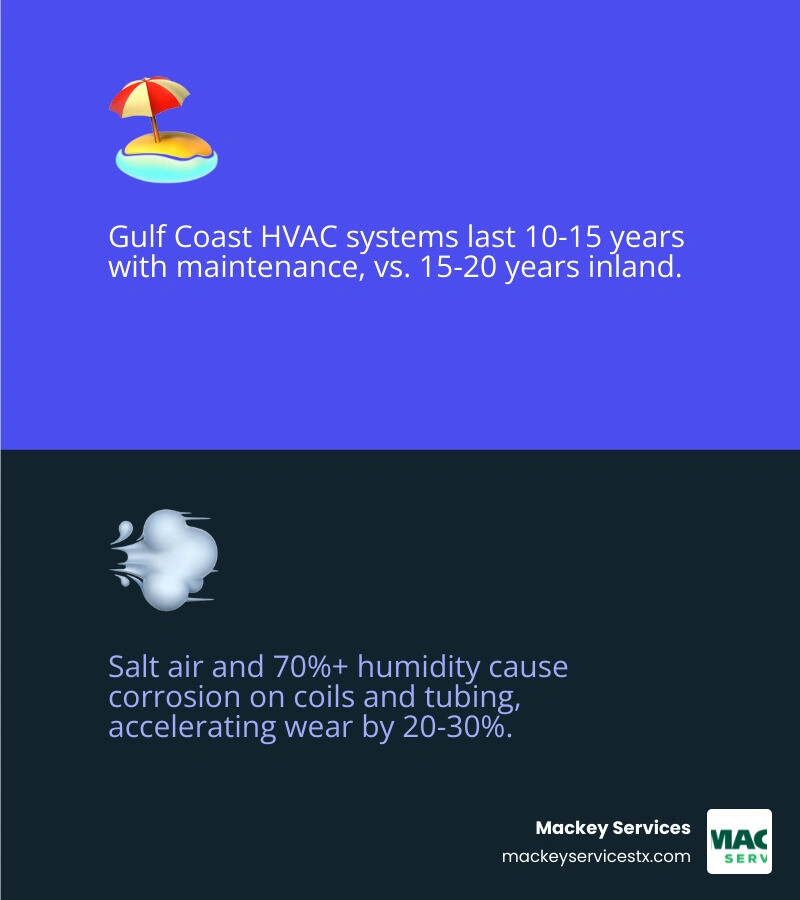
The average lifespan of an hvac system on the gulf coast is significantly shorter than the national standard — typically falling between 10 and 15 years, compared to 15–20 years in inland or temperate climates. Here's a quick breakdown:
| Location | Typical HVAC Lifespan |
|---|---|
| National average (inland) | 15–20 years |
| Gulf Coast (with maintenance) | 10–15 years |
| Gulf Coast (without maintenance) | 8–12 years |
| Within 1–2 miles of coast | 7–12 years |
If you live in Dickinson, League City, Friendswood, or anywhere along the greater Houston coastline, your AC system is working harder — and aging faster — than most. The combination of salt air blowing in off the Gulf, humidity that regularly tops 70%, and summer temperatures that push past 100°F creates a uniquely punishing environment for HVAC equipment. Add in near-constant runtime from April through October, and it's easy to see why local systems wear out years sooner than national averages suggest.
This guide breaks down exactly what's cutting your system's life short, which system types hold up best, and what you can do to get the most years out of your investment — whether your unit is brand new or already a decade old.
What is the average lifespan of an hvac system on the gulf coast?
When we talk about how long an air conditioner lasts, we usually look at national averages provided by manufacturers. However, those numbers are often based on "ideal" conditions — places where the unit might only run for a few months out of the year and the air is clean and dry. In our neck of the woods, from Galveston up to Houston, those ideal conditions simply don't exist.
As of May 2026, we’ve seen that the average lifespan of an hvac system on the gulf coast typically hovers around 10 to 14 years. This is often referred to as the "coastal penalty." While a homeowner in the Midwest might brag about their 22-year-old unit, a homeowner in Dickinson is likely looking at a replacement much sooner. Without a proactive approach, some units near the water can even fail as early as year seven or eight.
For more details on these timelines, you can check out our deep dive on How Long Does an AC System Last on the Gulf Coast.
Regional variations in the average lifespan of an hvac system on the gulf coast
Even within the Greater Houston area, location matters. If you live in Pearland or Rosharon, you might get a few more years out of your system compared to someone living directly on the water in Galveston or Seabrook.
- Inland Areas (Alvin, Manvel, Pearland): These systems usually last 12–16 years. While they still deal with the Texas heat and humidity, they aren't hit as hard by the direct "salt spray" zone.
- Coastal Cities (Galveston, Texas City, Kemah): Proximity to the salt water is the biggest variable. Units within a mile of the coast often see a lifespan of 5–12 years. The salt air acts like a slow-motion chemical attack on the metal components.
How maintenance impacts the average lifespan of an hvac system on the gulf coast
The single biggest factor within your control is maintenance. Think of it like a car: if you never change the oil and drive it through salt water every day, it won’t last long. On the Gulf Coast, documented service records aren't just for peace of mind; they can literally extend your system's life by 2 to 4 years.
By catching small issues like a failing capacitor or a dirty coil early, we prevent "cascade failures" where one broken part puts so much strain on the compressor that the whole system dies prematurely. We've put together A Homeowner's Guide to Extending Your HVAC System's Lifespan to help you stay on top of these essential tasks.
The Coastal Penalty: Why Salt Air and Humidity Shorten Lifespan
Why is our environment so tough on machinery? It comes down to chemistry and workload. The "silent killer" of HVAC systems here is salt air corrosion. When salt-laden air from the Gulf reaches your outdoor condenser unit, it deposits chloride ions onto the delicate aluminum fins and copper tubing.
This leads to galvanic corrosion — a process where two different metals (like the aluminum fins and copper tubes) react with the salt and moisture to create a tiny electrical current that eats away at the metal. Eventually, the fins turn to dust or the copper develops "pitting" leaks, causing your refrigerant to escape.
To understand the science behind this, read How Salt Air and Humidity Shorten AC Lifespan.

High Humidity and System Workload
On the Gulf Coast, humidity rarely stays below 70% during the summer. Your AC has two jobs: lowering the temperature and removing moisture. In Dickinson and League City, the "latent load" (the energy required to remove moisture) is massive.
This high humidity means your system produces a huge volume of condensate (water). If the drain lines aren't clear or the evaporator coils are dirty, you’re looking at biological growth like mold and algae. This growth restricts airflow, forcing the fan motor to work harder and shortening its life. For some DIY tips on keeping things running smoothly, see these Air Conditioning Service Tips to Help You Save Energy.
Extreme Heat and Runtime Hours
While a system in a cooler state might log 1,200 hours of runtime a year, a system in Southeast Texas often logs between 2,800 and 3,200 hours. We are essentially putting two to three years of "national average" wear on our units every single calendar year.
Triple-digit days in July and August cause the compressor to cycle constantly. This "thermal fatigue" — the constant heating up and cooling down of electrical components — leads to wire degradation and mechanical wear that simply doesn't happen in milder climates.
Comparing System Types: Central AC vs. Heat Pumps in Texas
In our service area, we primarily see two types of systems: traditional central AC (split systems) and heat pumps. Each has a different "expiration date" based on how they are used.
Central AC Systems (with a gas furnace) usually last 12–15 years. Because the furnace only runs for a few weeks a year during our mild Dickinson winters, the heating side of the system often outlasts the cooling side by a decade. However, the furnace still needs love! Check out Your Guide to Furnace Maintenance and learn about Common Furnace Problems That Are Easily Avoided with Routine Maintenance to ensure your winter comfort.
Heat Pumps and Year-Round Usage
Heat pumps are becoming more popular in places like Friendswood and Pearland because they are incredibly efficient for our climate. However, there is a trade-off: because a heat pump provides both heating and cooling, the outdoor unit runs year-round.
This constant usage typically results in a shorter lifespan of 8–12 years. The reversing valve (the part that tells the unit to switch from cooling to heating) and the compressor are under constant stress every season. If you have one of these systems, you’ll want to read Home Heating Maintenance: What Do Heat Pumps Need to keep it in top shape.
Ductless Mini-Splits and Packaged Units
- Ductless Mini-Splits: These often last 12–15 years. Their inverter technology allows them to run at lower speeds, reducing mechanical stress. However, because they are often installed in "hot spots" like sunrooms or workshops, they need frequent filter cleanings to prevent biological growth.
- Packaged Units: Often seen on rooftops or in commercial settings, these units are fully exposed to the elements. Without protective cabinets, UV degradation and rust can take them out in as little as 10 years.
Proactive Care: How to Extend Your System’s Life
You don't have to just sit back and watch the salt eat your AC. There are actionable steps we recommend to every homeowner in the Greater Houston area.
- The Quarterly Rinse: Every three months, use a garden hose on a low-pressure setting to gently rinse the salt spray off your outdoor unit. Do not use a pressure washer, as it will flatten the delicate fins and ruin the unit.
- Filter Discipline: Change your filters every 30 to 90 days. In high-pollen or high-dust areas like Alvin or Rosharon, stick to the 30-day mark. We recommend MERV 8 to 11 filters to balance clean air with proper airflow.
- Clearance: Keep at least two feet of space around your outdoor unit. Trim back those hibiscus bushes and keep the grass clippings away.
Protective Measures for Coastal Homes
If you are replacing a unit or want to protect a newer one, consider these "coastal-grade" upgrades:
- Corrosion-Resistant Coatings: Factory-applied epoxy or phenolic coatings on the coils act as a shield against salt.
- Stainless Steel Fasteners: Standard screws will rust shut in a few years near the coast; stainless steel stays serviceable.
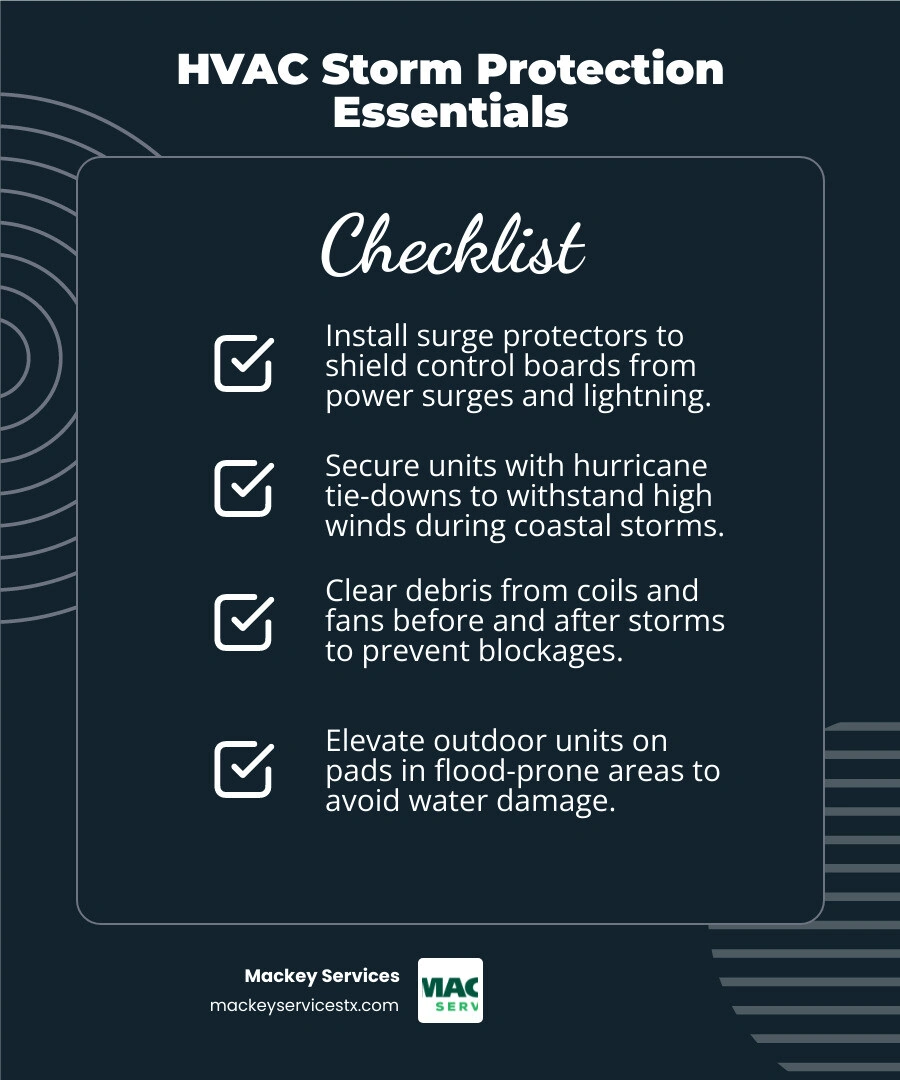
- Elevated Pads: If you live in a flood-prone area like parts of Houston or Dickinson, elevating the unit on a taller plastic or concrete pad can save it during heavy rain events.
Storm Readiness and Surge Protection
Coastal storms bring more than just rain; they bring power surges and lightning. A single surge can fry the control board of a modern high-efficiency AC. We strongly recommend installing a dedicated HVAC surge protector. Additionally, ensure your unit has proper hurricane tie-downs to keep it on its pad during high winds.
The $5,000 Rule: Knowing When to Replace Your Unit
When your system starts acting up, you face the age-old question: repair or replace? We often use the $5,000 Rule as a guide.
The Formula: Multiply the age of the unit by the cost of the repair. If the result is more than $5,000, it’s usually time to replace. For example, a $600 repair on a 10-year-old unit equals $6,000. In that case, putting money into an old, salt-damaged system is often throwing "good money after bad."
Warning Signs of System Failure
Keep an ear (and a nose) out for these red flags:
- Unusual Noises: Grinding (bearings), hissing (refrigerant leak), or loud banging.
- Rising Energy Bills: If your usage hasn't changed but your bill has spiked, the system is losing efficiency.
- Frequent Breakdowns: If we’re visiting you more than once a season, the system is telling you it’s tired.
- Refrigerant Issues: If your unit still uses R-22 (a phased-out refrigerant), repairs will be increasingly difficult and expensive.
Selecting a Durable New System
If it is time for a new unit, don't just buy the cheapest one available. For the Gulf Coast, look for:
- High SEER2 Ratings: The new 2023 standards require a minimum of 14.3 SEER2 in the South. Higher ratings mean lower bills.
- Variable Speed Compressors: These handle our humidity much better than standard units.
- Warranty Registration: Always register your new system within 60 days to ensure you get the full 10-year parts warranty.
Frequently Asked Questions about Coastal HVAC Lifespan
How often should I rinse my outdoor AC unit if I live near the Gulf?
If you can see the water from your porch, we recommend a gentle rinse once a month. If you’re a few miles inland (like in Friendswood), once every three months is usually sufficient to remove salt and dust buildup.
Does salt air affect my indoor air handler?
Not directly, as it's shielded inside your home. However, the high humidity can cause the indoor evaporator coil to stay wet, which leads to biological growth. Keeping your filters clean is the best defense for the indoor portion of your system.
Is a heat pump or a central AC better for Dickinson, TX homes?
It depends on your energy source. If you have natural gas, a central AC with a gas furnace is a reliable, long-lasting combo. If your home is all-electric, a high-efficiency heat pump is an excellent choice, though it may have a slightly shorter lifespan due to year-round use.
Conclusion
Living on the Gulf Coast is a dream, but the salt and heat can make it a nightmare for your mechanical systems. While the average lifespan of an hvac system on the gulf coast is shorter than elsewhere, you aren't powerless. With the right maintenance, protective coatings, and a little help from the pros, you can keep your home cool for many years to come.
At Mackey Services, we’ve been helping our neighbors in Dickinson, League City, and the Greater Houston area stay comfortable since 1992. As a family-owned business with 30 years of experience and an A+ BBB rating, we understand exactly what the Texas coast throws at your equipment. Whether you need a 24/7 emergency repair, a custom ductwork solution, or a new coastal-rated installation, we're here to provide reliable, family-like service.
Don't wait for the heat to win. Schedule your professional HVAC service today and let us help you maximize your system's lifespan.
Ready for a better day?
One call handles it all — HVAC, electrical, and generators across the Texas Gulf Coast. Less to pay. Better day. That's the Mackey way.
Mon–Fri: 7 AM – 8 PM · Sat: 8 AM – 5 PM · Licensed & insured · #TACLA 112769C · #TECL 558211