


Selecting Salt-Tolerant Plants for Commercial Properties Near the Seawall
Based on 1,000+ Houston reviews!
Summer heat and constant salt spray can devastate coastal landscapes by September. Replacing struggling shrubs now with specialized, salt-hardy species ensures strong roots before winter storms hit.
.jpg)
Recovering from Summer: The Coastal Landscaping Challenge
The peak summer heat has finally broken, but if you manage a coastal property, the environmental damage is already done. At Mackey Services, our team sees this frustration firsthand every September when we evaluate commercial properties across the Gulf Coast. Selecting salt-tolerant plants for commercial properties near the seawall is a frustrating challenge when you are staring at brown, brittle foliage that looked perfectly healthy just a few months ago. The compounding stress of intense Gulf Coast sun combined with constant onshore salt spray creates an incredibly hostile environment for standard nursery plants. By the time late summer arrives, many non-native shrubs and ornamental flowers have succumbed to severe salt burn and wind fatigue, leaving your exterior looking neglected.
Replacing dead or struggling plants is a critical property management task that cannot be deferred. Bare garden beds and dying shrubs send the wrong message to tenants, customers, and visitors. However, simply replacing them with the exact same vulnerable species will only trap you in an expensive, endless cycle of failure. The key to breaking this cycle lies in taking advantage of the September fall-prep transition. This strategic window allows you to execute replacements using specialized, salt-hardy species that can establish themselves before the harsh winter weather arrives. If you are ready to upgrade your exterior, exploring professional commercial property services is the first step toward a resilient landscape.
Understanding the Harsh Realities of the Seawall Microclimate
Generic planting advice fails miserably in coastal zones because it ignores the extreme localized conditions. In our years of managing landscapes throughout Dickinson and the Galveston Seawall district, we've learned that the environment here is not just "coastal"—it is a hyper-local microclimate with unique destructive forces. Onshore winds carry salt aerosols up to a mile inland, but the most severe, landscape-destroying impact occurs within the first 1/8 mile of the water. If your property sits in the Galveston Seawall commercial district, your plants are fighting a daily battle against elements that standard commercial landscaping simply cannot survive without expert intervention.
To succeed here, you must understand the specific threats your plants face. Based on what our crews observe daily, the damage occurs through three primary mechanisms:
• Aerosolized Sodium Chloride: This is direct salt spray carried by the wind. It coats the leaves, draws moisture out of the plant tissue, and causes the classic "salt burn" (brown, crispy leaf edges).
• Soil Salinity: This is salt that has accumulated in the dirt itself, either from storm surges or prolonged salt spray washing off the leaves and into the root zone. High soil salinity prevents roots from absorbing fresh water, essentially causing the plant to die of thirst even when the ground is wet.
• Wind Fatigue: Constant coastal breezes physically damage rigid plant structures. The relentless motion breaks stems, tears leaves, and forces the plant to expend massive amounts of energy just trying to repair physical tissue rather than growing.
• Aerosolized Salt — Primary Impact on Plants: Foliage dehydration and tissue damage — Visual Symptoms: Brown margins on leaves, leaf drop on the windward side
• Soil Salinity — Primary Impact on Plants: Root disruption and nutrient lockout — Visual Symptoms: Overall stunted growth, wilting despite watering
• Wind Fatigue — Primary Impact on Plants: Physical breakage and energy depletion — Visual Symptoms: Bent stems, torn foliage, asymmetrical growth habits
Because of these compounding factors, standard commercial landscaping approaches will fail. Success requires species specifically adapted to resist these exact environmental stressors.
Why the Fall Planting Window is Critical for Root Establishment
A common misconception we encounter in commercial property management is that spring is the universally ideal time to plant. In our experience working along the coast, spring planting is often a costly trap. If you install new shrubs in April, they have only a few short weeks to establish roots before the brutal Gulf Coast summer heat arrives, bringing peak sun intensity and heavy transpiration demands. Instead, agronomic science and our own field results point to the September fall-prep transition as the optimal window for installing salt-tolerant species.
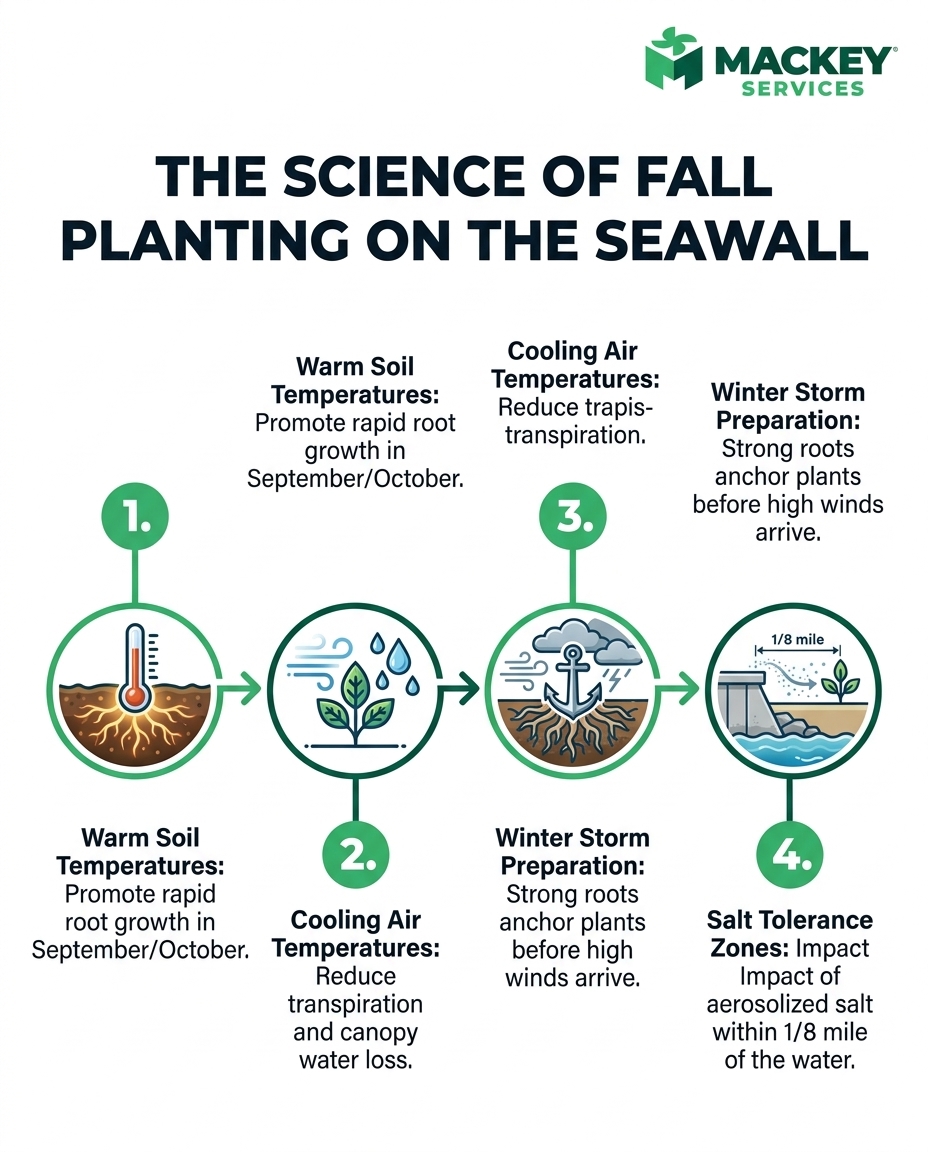
The advantage of fall planting comes down to the relationship between soil temperature and air temperature. In early fall, the coastal soil remains thoroughly warmed from the summer months. Warm soil is the primary trigger for rapid root expansion. While the roots are actively growing in the warm earth, the decreasing air temperatures above ground provide massive relief to the plant's canopy. Establishing strong root systems now is vital because it anchors the plants and prepares them to withstand the high winds and heavy salt loads of incoming winter coastal storms.
The Science of Transpiration and Salt Stress
Transpiration is the process by which moisture is carried through plants from roots to small pores on the underside of leaves, where it changes to vapor and is released to the atmosphere. During the summer, high heat forces plants to transpire at maximum rates just to stay cool. If a plant is also dealing with aerosolized salt drawing moisture from its leaves, the water demand becomes impossible to meet, resulting in rapid death.
By planting in the fall, cooler air drastically reduces the water demand of the plant canopy. This reduced water demand helps new transplants survive their initial exposure to salt spray while their roots take hold. The plant can redirect its energy away from desperate survival and toward building a robust, deep root network that will sustain it through the following summer.
Top Salt-Tolerant Shrubs for Professional Curb Appeal
Commercial properties require a specific type of landscaping. The plants must possess extreme hardiness to survive the Galveston Seawall commercial district, but they must also maintain a neat, professional appearance that reflects well on the businesses they surround. You cannot simply plant wild, unkempt coastal weeds; you need structured, attractive shrubs that thrive in USDA Zone 9b despite constant exposure.
When our landscaping crews design seawall-adjacent beds, we consistently recommend these top commercial-grade, salt-tolerant shrubs for coastal properties:
• Texas Sage (Leucophyllum frutescens): This outstanding shrub features striking silver foliage that naturally resists salt burn. The tiny hairs on the leaves prevent salt aerosols from making direct contact with the plant tissue. It is highly drought-tolerant and produces vibrant purple blooms in response to changes in humidity, providing excellent seasonal color.
• Oleander (Nerium oleander): When it comes to extreme tolerance for both wind and aerosolized salt, Oleander is unmatched. Its thick, waxy cuticles act as a physical shield against salt spray. It grows rapidly, provides dense screening, and blooms profusely. (Note: All parts of the Oleander are toxic if ingested, so placement should be strategic).
• Indian Hawthorn (Rhaphiolepis indica): For low-profile, salt-resistant foundation planting, Indian Hawthorn is a staple. It maintains a naturally mounded, tidy shape without requiring constant pruning, making it ideal for commercial maintenance budgets. Its leathery leaves shrug off salt spray, and it provides a professional, manicured look year-round.
• Dwarf Yaupon Holly (Ilex vomitoria 'Nana'): Native to the Gulf Coast, this evergreen shrub is practically bulletproof. It handles high soil salinity, direct salt spray, and poor drainage equally well. We often use it as an excellent, low-maintenance alternative to traditional boxwoods, which often struggle and die in seawall microclimates.
Utilizing Ornamental Grasses as Natural Windbreaks
Protecting a commercial landscape is not just about choosing tough individual plants; it is about using landscape design to create protective microclimates. A pattern we see often in struggling coastal properties is a lack of natural windbreaks. We highly recommend utilizing specific ornamental grasses to disrupt the flow of onshore winds, forcing the air up and over the more sensitive plants situated behind them.
Flexible grasses are far superior to rigid shrubs for this purpose because they absorb wind energy rather than fighting it. When high coastal winds hit a rigid plant, the stems break. When those same winds hit ornamental grasses, the blades simply bend and diffuse the wind's force.
Gulf Muhly (Muhlenbergia capillaris) is an exceptional choice for this role. It boasts incredibly high salt tolerance and provides striking, purplish-pink fall color right during the September fall-prep transition. To effectively utilize grasses as windbreaks, our team follows these layout strategies:
1. Identify the Prevailing Wind: Determine the primary direction of the onshore coastal winds hitting your property (typically from the south or southeast along the Gulf).
2. Establish the Front Line: Plant a dense, staggered row of Gulf Muhly or similar salt-hardy grasses on the direct windward edge of your landscape beds.
3. Layer for Depth: Space the grasses closely enough that their mature canopies will touch, creating a continuous, flexible barrier that filters salt and slows wind speed.
4. Protect Sensitive Assets: Position your moderately salt-tolerant foundation shrubs and decorative seasonal color behind this grassy barrier, utilizing the "wind shadow" to reduce their environmental stress.
Preparing the Soil: Mitigating Coastal Salinity
Even the most resilient plants will fail if the soil environment is toxic. Over the long, dry summer months, salt accumulates heavily in the soil. Before installing any new landscaping, addressing this accumulated soil salinity is critical. Sandy coastal soils drain quickly, which is generally a benefit, but they can still trap crystalline salt in the root zone if not properly managed.
Our soil preparation process always starts with deep watering, known as leaching. Before planting, heavily saturate the empty planting beds with fresh water. This process dissolves the accumulated salts and pushes them down deep into the soil profile, safely below the future root zone of your new transplants. This creates a temporary "clean zone" where new roots can establish without immediate chemical burn.
Next, you must incorporate specific organic amendments. Coastal sand lacks nutrient retention and organic matter. Mixing in high-quality compost or composted pine bark improves the soil's ability to hold onto fresh water and essential nutrients while still allowing excess moisture to drain away. Finally, proper mulching is essential to prevent rapid moisture loss and temperature fluctuations.
• Shredded Hardwood — Suitability for Coastal Properties: Excellent — Reasoning: Mats down over time, resisting wind displacement; retains moisture well.
• Pine Straw — Suitability for Coastal Properties: Good — Reasoning: Interlocks naturally, holds up to wind, adds acidity to alkaline sandy soils.
• Lightweight Wood Chips — Suitability for Coastal Properties: Poor — Reasoning: Easily blown away by constant coastal winds or washed out by heavy rains.
• Rubber Mulch — Suitability for Coastal Properties: Very Poor — Reasoning: Traps excess heat in the root zone and provides no organic soil benefits.
Enhancing Aesthetics and Protecting Your Investment
Agronomic choices directly impact business outcomes. For retail centers, office parks, and hospitality venues, maintaining pristine curb appeal is directly tied to tenant retention and customer perception. A dying, salt-burned landscape signals neglect, while a vibrant, resilient exterior communicates professionalism and success.
We've helped countless property managers break the cycle of replacing dead boxwoods every spring. By selecting the right native and adaptive species during the September fall-prep transition, you drastically reduce long-term replacement frequency. You invest in a landscape that actually appreciates in size and beauty over time, freeing up your property management budget for other exterior enhancements.
To maximize the impact of your new coastal plantings, consider how they integrate with your hardscaping and illumination. Highlighting the unique textures of Gulf Muhly or the silver foliage of Texas Sage with proper lighting transforms the property at night. Updating your commercial landscape lighting ensures that your new fall installations remain a striking focal point for evening foot traffic, adding a layer of security and high-end aesthetic appeal to the property.
Frequently Asked Questions About Coastal Commercial Landscaping
What plants grow best near the ocean for commercial properties?
The most successful coastal plants feature adaptations like waxy cuticles, silver foliage, or flexible stems to survive salt and wind. Excellent choices for commercial properties include Texas Sage, Oleander, Indian Hawthorn, and Gulf Muhly grass. These species provide the neat, professional appearance required for commercial spaces while surviving the harsh realities of the Galveston Seawall commercial district.
How do you protect commercial landscaping from salt spray?
The most effective protection method we recommend is utilizing natural windbreaks. Planting a frontline barrier of flexible, highly salt-tolerant ornamental grasses forces the wind up and over, filtering out salt aerosols before they hit sensitive plants. Additionally, regularly rinsing foliage with fresh water during dry, windy periods helps wash away accumulated salt before it can burn the leaves.
What are the most salt-tolerant shrubs for Texas Zone 9b?
For USDA Zone 9b, the top performers include Dwarf Yaupon Holly, Texas Sage, and Oleander. These shrubs thrive in the warm climate and possess the genetic hardiness to withstand both high soil salinity and direct aerosolized salt spray, making them staple choices for coastal commercial beds.
Is Texas Sage salt tolerant enough for the seawall?
Yes, Texas Sage is highly salt tolerant and performs exceptionally well near the seawall. Its signature silver foliage is covered in microscopic hairs that prevent salt spray from making direct contact with the plant's cellular tissue, effectively shielding it from salt burn while providing excellent drought resistance.
Why is September the best time to plant near the seawall?
September offers a unique window where the soil remains warm enough to encourage rapid root growth, but the air temperatures begin to cool. This combination reduces transpiration stress (water loss from the leaves) while allowing the plant to build a strong root system before the heavy winds of winter storms arrive.
How do you fix salt burn on coastal plants?
Salt burn cannot be reversed on existing leaves, but you can save the plant from further decline. First, heavily leach the soil around the base with fresh water to push accumulated salts below the root zone. Then, gently rinse the canopy to remove dried salt spray, and wait for new growth to emerge before pruning away the dead, brown foliage.
Secure Your Property's Curb Appeal Before Winter Hits
The window for optimal root establishment is closing quickly. Taking advantage of the September fall-prep transition is the single most effective way to ensure your new landscaping survives the incoming winter coastal storms and thrives through next summer. Delaying until spring simply sets your property up for another cycle of salt burn, wind fatigue, and costly plant replacements.
Protect your commercial investment by consulting with local experts who truly understand the unique demands of seawall microclimates. By choosing the right salt-tolerant species and executing the installation at the right time, you can secure a vibrant, professional exterior year-round. If you are ready to assess your property's current landscape health and plan for a resilient future, reach out to the experts serving Galveston and surrounding service areas today.
Clients Say About Us
Customer Testimonials
Our AC stopped working during a heatwave, but your team responded quickly and restored comfort within hours. Professional, friendly, and highly recommended!



Service Finance
Enjoy a new HVAC system today with flexible financing through Service Finance. Convenient monthly payment options make it easier to upgrade comfort now and pay over time, subject to credit approval.
Blogs