

Mitigating Hard Water Scale on Commercial Water Features in Alvin
Based on 1,000+ Houston reviews!
Accelerated hard water scale calcification destroys commercial fountain pumps during peak evaporation. Proactive plumbing interventions stop this damage before a complete system failure occurs.
.jpg)
The Hidden Threat to Your Commercial Fountain Investment
That strange, grinding noise coming from your outdoor fountain pump is not just a sign of age—it is a symptom of a much deeper mechanical failure. Here at Mackey Services, our technicians often find that if you are responsible for mitigating hard water scale on commercial water features in Alvin, you already know the frustration of watching high-end pumps struggle to maintain water flow. The persistent issue of hard water scale calcification plagues Alvin commercial properties, turning beautiful architectural elements into continuous maintenance headaches.
Addressing this root cause requires a proactive approach through specialty commercial services to stop the damage at its source.
Many facility managers treat mineral buildup as a purely aesthetic problem, focusing only on the white chalky rings forming on decorative tiles. However, the true danger lies beneath the surface. Scale calcification is a primary mechanical risk that aggressively destroys electrical pump components. As mineral deposits harden inside the plumbing infrastructure, they create severe restrictions that force the entire system to work outside its designed parameters.
The critical decision point: Property managers face a stark choice. You can either continue funding reactive, continuous pump replacements, or you can implement professional plumbing and electrical interventions to address the root cause of the calcification. True mitigation requires understanding exactly how local municipal water interacts with heavy-duty commercial equipment.
Understanding Alvin's Municipal Water Profile and Mineral Content
Through our years of working on local plumbing systems, we've learned that the groundwater sources supplying the Gulf Coast region are inherently rich in dissolved minerals. High levels of calcium and magnesium are suspended in the municipal water supply, making the water fundamentally "hard." While this water is perfectly safe for general municipal use, it behaves very differently when introduced to the continuous circulation, aeration, and evaporation cycles of large-scale commercial fountain systems.
Understanding the specific mineral load is the first step in protecting commercial landscaping and water features from premature failure.
There is a vast difference between residential water softening needs and the heavy-duty requirements of commercial water features. A residential system might process a few hundred gallons a day in a closed loop. A commercial fountain in Alvin commercial properties processes thousands of gallons an hour, exposing the water to open air, sunlight, and constant agitation. This massive volume requires industrial-grade filtration and softening interventions to manage the sheer volume of dissolved solids passing through the pump housing.
The Chemistry of Hard Water Scale
To understand why scale is so destructive, you have to look at the chemistry of precipitation. When municipal water enters a fountain, the calcium and magnesium are dissolved. However, as the water is aerated and exposed to changing temperatures, these dissolved solids precipitate—meaning they fall out of the solution and return to a solid state.
How the deposits form:
• Bonding: The precipitated calcium carbonate seeks a surface to bond with, aggressively attaching to metal pump housings, PVC piping, and impeller blades.
• Layering: Once a microscopic layer forms, it creates a textured surface that encourages even faster accumulation of new minerals.
• Hardening: Over time, these layers cure into a rock-hard crystalline structure that cannot be removed by simple brushing or standard water flow.
How Late-Summer Evaporation Accelerates Scale Buildup
The rate of scale formation is not constant throughout the year. The extreme climate of the Texas Gulf Coast plays a massive role in how quickly calcification occurs. High temperatures and direct sunlight cause rapid water volume loss in large outdoor fountains, fundamentally changing the chemistry of the water left behind in the basin.
During late-summer August, as the community transitions into the back-to-school season and end-of-season cooling, our team typically sees peak evaporation rates. A commercial fountain can lose a significant percentage of its total water volume to the atmosphere every single day. The thermodynamics of this water loss create a severe mechanical threat. When water evaporates, it turns into pure vapor, leaving 100% of its dissolved minerals behind in the fountain basin.
The Concentration Effect in Outdoor Features
This daily evaporation cycle creates a compounding problem known as the concentration effect. As the pure water evaporates, the ratio of minerals to remaining water skyrockets. The water becomes supersaturated with calcium and magnesium.
• Daily Evaporation — Impact on Mineral Concentration: Removes pure water, leaving all original minerals behind in the basin.
• Auto-Fill Valves — Impact on Mineral Concentration: Introduces new municipal water, adding a fresh load of dissolved minerals to the already concentrated system.
• Continuous Aeration — Impact on Mineral Concentration: Increases the rate of evaporation by exposing more water surface area to the hot, dry air.
• Direct Sunlight — Impact on Mineral Concentration: Heats the water, accelerating the chemical precipitation of calcium carbonate onto metal surfaces.
Because commercial fountains use auto-fill valves to maintain water levels, the system automatically replaces the evaporated water with fresh municipal water. This new water brings a fresh load of minerals. Day after day, the mineral concentration grows exponentially, leading to aggressive calcification rates that can seize a pump in a matter of weeks if the water chemistry is not professionally monitored and treated.
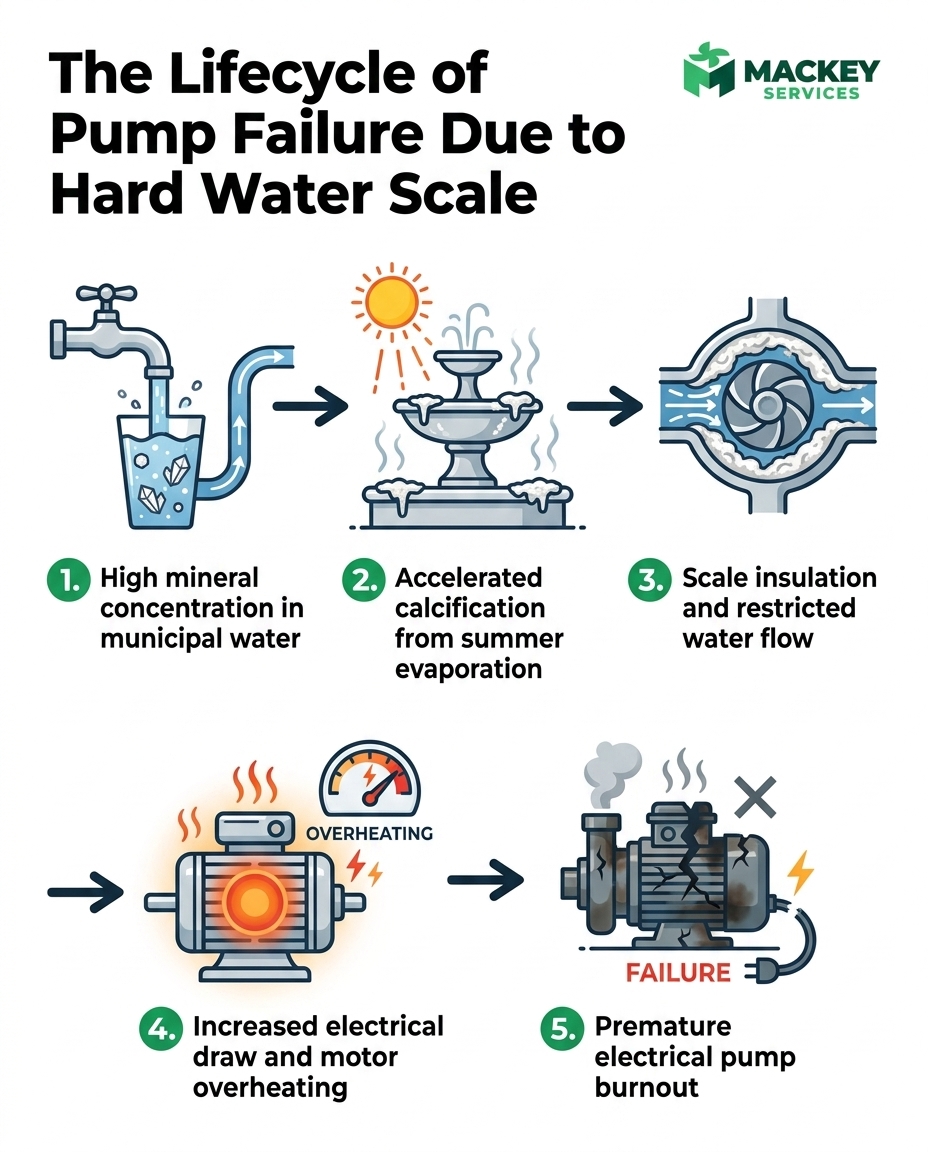
The Direct Link Between Mineral Scale and Electrical Pump Burnout
The most expensive consequence of hard water scale is not the cost of cleaning the fountain basin—it is the catastrophic failure of the electrical pump motor. There is a direct, unavoidable link between plumbing water quality issues and electrical system failures. Providing comprehensive electrical pump protection requires understanding this chain reaction, something our licensed electricians deal with regularly.
As scale builds up inside the pump volute, it coats the impeller blades. The impeller is designed to slice through water with precise tolerances. When coated in a thick layer of calcium, the impeller loses its hydrodynamic shape. It creates drag, significantly reducing water flow efficiency. The motor must now work twice as hard to move half as much water.
Furthermore, calcium carbonate is an excellent thermal insulator. Commercial electrical pump motors rely on the flow of water around them, or the dissipation of heat through their metal casings, to stay cool. When calcification coats the motor housing, it traps the heat inside. The restricted flow forces the electrical motor to draw higher amperage to keep the heavy, scale-coated impeller turning. High amperage combined with trapped heat inevitably leads to melted windings and premature motor burnout.
Recognizing the Warning Signs of Pump Stress
Facility managers at Alvin commercial properties must learn to identify the early warning signs of electrical stress before the motor fails completely. Catching these symptoms early allows for preventative descaling rather than expensive replacement.
• Unusual humming or grinding noises: A loud, low-pitched hum usually indicates the motor is drawing high amperage but struggling to turn a calcified impeller.
• Frequent tripping of breakers: If the fountain repeatedly trips GFCI outlets or commercial breakers, the motor is overdrawing electricity due to mechanical resistance.
• Noticeable pressure drops: A visible reduction in fountain spray height or sluggish waterfall flow indicates the internal plumbing or pump volute is choked with mineral deposits.
Why Aesthetic Cleaning Isn't Enough for Commercial Systems
A pattern we see often at Mackey Services is facility managers calling a landscaping or pool cleaning crew when scale begins to show on the decorative surfaces of a commercial fountain. These crews typically apply superficial acid washes and chemical descalers to remove the white rings from the tile. While this improves the look of the feature, it does absolutely nothing to protect the mechanical heart of the system.
Superficial acid washing is a cosmetic fix. True mechanical mitigation requires disassembling the pump housing, inspecting the electrical connections, and safely removing calcification from the internal volute and impeller. There is a massive liability in having untrained personnel handle submerged electrical water pumps during routine cleaning. High-voltage commercial pumps operating in water present a severe shock hazard if the waterproof seals are compromised during amateur descaling attempts.
For property managers, following outdoor electrical safety tips means keeping untrained personnel away from high-voltage commercial pump panels. Protecting these expensive commercial assets requires integrated cross-trade knowledge. This is where Mackey Services provides a unique advantage for Alvin commercial properties: possessing the comprehensive cross-trade expertise to handle both the rigorous electrical pump safety protocols and the specialized plumbing and water treatments required to keep the system running safely.
Professional Mitigation Interventions for Commercial Water Features
Permanently protecting a commercial water feature from hard water damage requires a structured, professional approach. It is not a matter of pouring a bottle of descaler into the basin once a month. Professional mitigation involves commercial-grade equipment and strict adherence to electrical safety standards.
The standard professional intervention protocol our team follows includes:
1. Water Quality Profiling: Technicians test the municipal water supply and the concentrated basin water to determine the exact hardness levels and precipitation rates.
2. Commercial-Grade Softening Integration: Installing high-volume water softening and filtration systems specifically designed to handle the continuous fill-rate of commercial features, removing dissolved solids before they enter the fountain basin.
3. Mechanical Descaling: Safely isolating the power supply, removing the pump, and using specialized, non-corrosive industrial agents to dissolve scale from the impeller and internal plumbing lines without degrading the PVC or metal housings.
4. Electrical Load Testing: Measuring the amperage draw of the pump motor under load to ensure it is operating within safe limits and that the internal windings have not been compromised by previous thermal stress.
Integrating Plumbing and Electrical Maintenance
Establishing a routine maintenance schedule is standard practice for facility managers across Alvin and surrounding service areas. The key to success is coordinating the descaling treatments with regular electrical load testing. Whenever a pump is descaled, a licensed professional must verify that the waterproof seals remain intact and that the electrical connections comply with all commercial building codes and safety standards. This dual-trade approach prevents small plumbing leaks from becoming major electrical hazards.
Frequently Asked Questions About Commercial Fountain Maintenance
Does hard water ruin fountain pumps?
In our experience, yes, hard water is one of the leading causes of premature fountain pump failure. The dissolved minerals in hard water precipitate out and form solid calcium carbonate scale on the pump's internal moving parts. This scale adds weight to the impeller, restricts water flow, and forces the motor to overheat as it struggles to maintain circulation.
How does calcium buildup affect electrical water pumps?
Calcium buildup acts as both a mechanical obstruction and a thermal insulator. Mechanically, it chokes the water flow, which forces the electrical motor to draw higher amperage to keep spinning. Thermally, the thick layer of scale traps heat inside the motor casing, preventing the pump from cooling itself and eventually leading to melted electrical windings.
How do you keep a commercial fountain from scaling?
Preventing scale in a commercial fountain requires treating the water before it enters the system. Professional mitigation involves installing commercial-grade water softening and filtration systems on the auto-fill water lines. Additionally, managing the concentration effect during periods of high evaporation by routinely monitoring water chemistry is highly recommended.
How do you remove heavy scale from a large water feature?
Heavy scale removal on a commercial scale requires professional mechanical descaling. This involves safely shutting down the electrical power, isolating the plumbing, and using industrial-grade, non-corrosive descaling solutions to break down the calcium bonds. Acid washing should only be performed by professionals to avoid damaging the pump seals, electrical housings, and surrounding landscaping.
How often should commercial fountain pumps be inspected for mineral buildup?
We recommend that commercial fountain pumps undergo a professional inspection at least twice a year, though quarterly inspections are preferred in areas with high evaporation rates. During the hot summer months, when water loss and mineral concentration peak, more frequent monitoring of the pump's electrical amperage draw can catch scale buildup before it causes a motor failure.
Protect Your Commercial Water Feature from Premature Failure
Ignoring hard water scale on commercial pumps carries a massive financial cost. What begins as a minor aesthetic annoyance quickly escalates into severe mechanical drag, electrical thermal overload, and catastrophic pump burnout. Relying on superficial cleaning crews to manage heavy mineral loads leaves your expensive equipment entirely unprotected against the harsh realities of local municipal water and extreme summer evaporation.
Protecting your investment requires professional, cross-trade expertise that addresses both the plumbing chemistry and the electrical load. A clear, technical explanation of how local hard water destroys equipment is only the first step; taking action is the next. Protect your property by scheduling a comprehensive professional assessment with the team at Mackey Services to implement the plumbing and electrical interventions required to permanently secure your investment.
Clients Say About Us
Customer Testimonials
Our AC stopped working during a heatwave, but your team responded quickly and restored comfort within hours. Professional, friendly, and highly recommended!



Service Finance
Enjoy a new HVAC system today with flexible financing through Service Finance. Convenient monthly payment options make it easier to upgrade comfort now and pay over time, subject to credit approval.
Blogs