

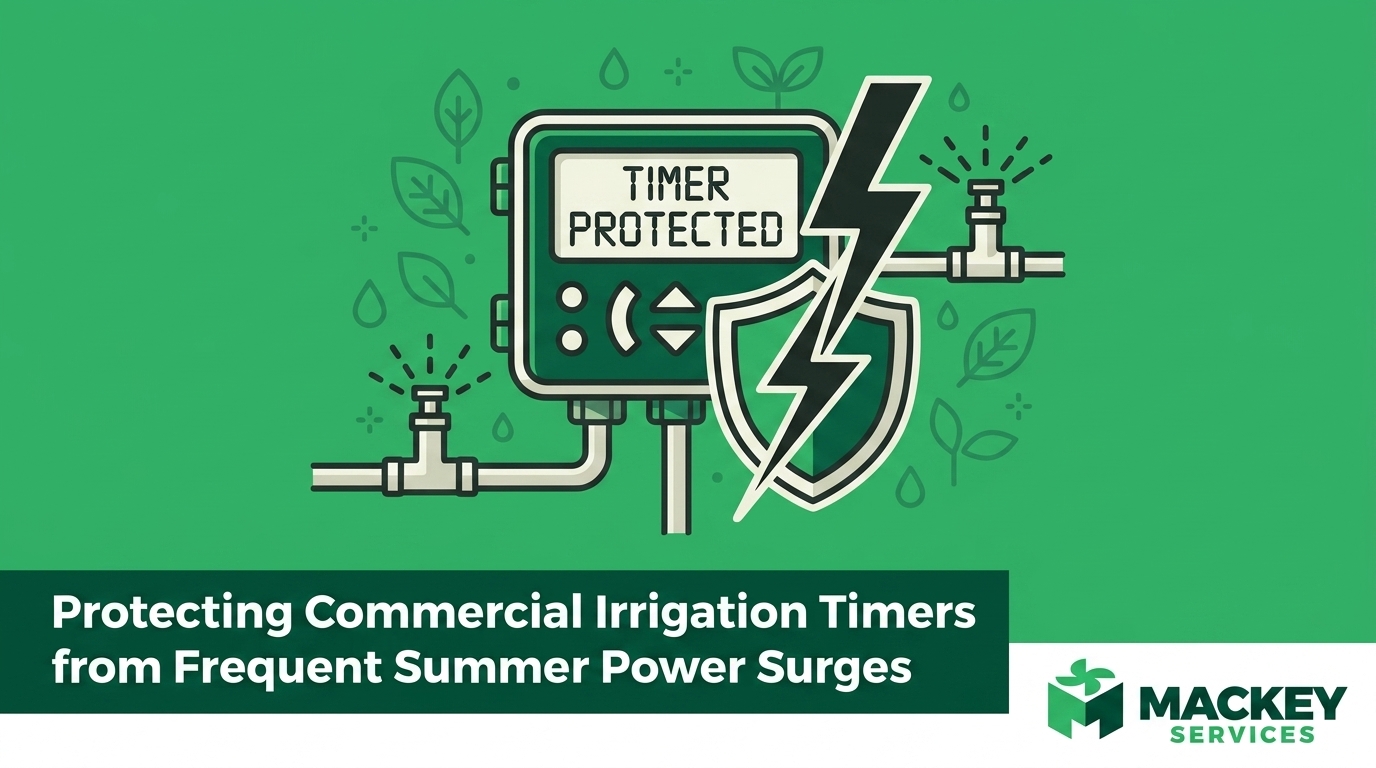
Protecting Commercial Irrigation Timers from Frequent Summer Power Surges
Based on 1,000+ Houston reviews!
Summer afternoon thunderstorms bring violent lightning that repeatedly fries exposed landscaping electronics. See why point-of-use surge protection is the only reliable defense.
.jpg)
The Hidden Cost of Summer Storms on Landscaping Infrastructure
At Mackey Services, our team frequently fields distressed calls when intense July afternoon thunderstorms roll in, making protecting commercial irrigation timers from frequent summer power surges a critical operational priority for property managers. The Texas Gulf Coast is known for its severe, fast-moving summer weather. While these storms bring brief relief from the peak heat, they also deliver violent lightning and severe electrical grid fluctuations. For commercial properties, this intense weather creates a hidden, recurring threat to outdoor electronic infrastructure.
Many facility managers find themselves trapped in a frustrating cycle. A storm passes through, the power flickers, and days later, the maintenance team discovers dead patches of grass across the property. The culprit is almost always a fried irrigation controller. Because these sensitive electronics sit outside the main building's protective envelope, they take the full brunt of voltage spikes. Constantly replacing this hardware drains maintenance budgets and pulls your staff away from other essential duties.
The true cost of these electrical disruptions extends far beyond the price of a replacement timer. When your watering schedule fails during peak summer heat, the damage compounds rapidly. Consider the cascading effects on your property:
• Lost agronomic investments: High-end commercial turf and ornamental plants can suffer irreversible heat stress within just a few days of missed watering.
• Wasted labor hours: Maintenance teams must spend hours manually watering zones, diagnosing electrical faults, and reprogramming new controllers from scratch.
• Water waste: A corrupted logic board might fail in the "open" position, causing sprinklers to run continuously and driving up utility bills.
• Diminished curb appeal: Brown, dying landscaping negatively impacts the professional image of your business park, retail center, or residential complex.
To break this cycle, you need a resilient defense strategy. Integrating professional commercial landscaping services with robust electrical planning is the only way to safeguard these remote systems against the unpredictable Gulf Coast climate.
Why Standard Whole-Building Protection Falls Short Outdoors
A pattern we see often when auditing commercial properties in Dickinson is the misconception that the main electrical panel's defenses cover everything on the property. While whole-building surge protection is highly effective for indoor appliances and office equipment, it often leaves remote outdoor circuits completely vulnerable. Understanding this gap in your electrical armor is the first step toward securing your landscaping infrastructure.
Whole-building protectors sit at the primary electrical service entrance. They monitor the main feed from the utility grid and clamp down on incoming voltage spikes before they enter the building's internal wiring. However, commercial irrigation controllers are typically mounted on exterior walls, utility poles, or standalone pedestals far from the main structure. They frequently operate on separate sub-panels or dedicated outdoor circuits. If a lightning strike hits the ground near your property, the massive electrical charge can travel through the soil, enter the buried irrigation wiring, and travel backward into the controller—completely bypassing the main building's electrical panel.
To understand the difference in vulnerability, consider how indoor and outdoor circuits compare:
• Physical Location — Main Building Circuits: Enclosed, climate-controlled, near the main grounding rod. — Remote Outdoor Circuits: Exposed to elements, hundreds of feet from main panel.
• Exposure to Ground Strikes — Main Building Circuits: Low. Protected by structural grounding systems. — Remote Outdoor Circuits: High. Buried wires act as antennas for rogue voltage.
• Defense Mechanism — Main Building Circuits: Covered by primary whole-building surge devices. — Remote Outdoor Circuits: Often isolated, requiring dedicated point-of-use defense.
• Grid Fluctuation Impact — Main Building Circuits: Filtered before reaching sensitive indoor electronics. — Remote Outdoor Circuits: Directly impacts sensitive outdoor microprocessors.
A single lightning strike can carry up to 300 million volts. While a direct hit is rare, the electromagnetic field generated by a nearby strike induces massive voltage spikes in any conductive material nearby, including your sprinkler wiring. This is exactly why Texas properties need surge protection that extends beyond the main electrical room and out to the perimeter of the property in Dickinson and the Texas Gulf Coast.
The Vulnerability of Modern Smart Controllers
In our years of maintaining commercial landscaping, we've seen a massive shift in technology. Older, mechanical sprinkler timers used heavy-duty dials and physical gears. They were relatively rugged, though inefficient. Today's commercial irrigation timers are essentially specialized computers. They rely on highly sensitive microprocessors to manage complex watering schedules, monitor weather data, and connect to facility management networks via Wi-Fi or cellular signals.
These advanced logic boards operate on very low voltages. Even a minor grid fluctuation—the kind that barely makes the lights flicker inside the office—can scramble a smart controller's programming memory. A slightly larger spike will permanently fuse the delicate circuitry on the motherboard. Because these smart controllers are significant investments designed to optimize water usage across massive properties, the cost of replacing them season after season far exceeds the cost of installing proactive, dedicated electrical defense.

How Point-of-Use Surge Protection Defends Remote Electronics
The most effective way to stop replacing your irrigation hardware is to stop the voltage spikes before they reach the microprocessor. This requires point-of-use surge protection. In a commercial outdoor context, point-of-use protection refers to a specialized, hardwired device installed immediately adjacent to, or directly inside, the equipment it is meant to protect.
Unlike standard indoor defenses, commercial-grade point-of-use surge protectors are built to withstand harsh outdoor environments and repeated electrical assaults. When you invest in professional electrical surge protection for your landscaping hardware, the defense mechanism operates through a precise, instantaneous sequence:
1. Continuous Monitoring: The point-of-use device continuously monitors the electrical current flowing into the irrigation controller's transformer. It allows standard 120V power to pass through uninterrupted so the system functions normally.
2. Instant Interception: The moment a July afternoon thunderstorm causes a voltage spike on the grid, or a nearby lightning strike induces a surge in the wiring, the device detects the anomaly. This detection happens in fractions of a nanosecond.
3. Voltage Diversion: Using specialized components like Metal Oxide Varistors (MOVs), the protector rapidly absorbs the excess electrical energy. It acts like a pressure relief valve for electricity.
4. Safe Grounding: The intercepted rogue voltage is immediately shunted away from the fragile logic board and directed safely into the earth via a dedicated grounding wire.
5. System Reset: Once the surge passes, the device automatically resets, allowing normal power to resume and keeping your watering schedules intact without requiring any human intervention.
It is crucial to understand that consumer-grade plug-in power strips offer absolutely zero protection in these scenarios. They are not rated for outdoor use, they cannot handle the massive joule ratings required to stop storm-induced surges, and they do not provide the hardwired grounding necessary to divert the energy safely. True defense requires commercial-grade hardware engineered specifically for outdoor electrical panels and irrigation systems.
The Intersection of Electrical Safety and Agronomic Health
Safeguarding your commercial landscaping infrastructure requires a unique blend of expertise. Installing hardwired outdoor surge protection is not a DIY task, nor is it a job for a standard groundskeeper. It involves modifying 120V or 240V electrical circuits, tying into facility sub-panels, and ensuring proper earth grounding. This work legally requires a licensed electrical professional to ensure compliance with local building codes and to prevent severe fire or shock hazards.
However, standard electricians often lack a deep understanding of complex commercial irrigation infrastructure. They might know how to wire a breaker, but they may not understand how to properly isolate the delicate 24-volt zone wiring from the high-voltage main feed, or how to recalibrate the smart controller's evapotranspiration data after a power cycle. Conversely, standard commercial landscapers understand the agronomic needs of the soil and turf, but they legally cannot and should not perform hardwired electrical modifications.
This is exactly why we recommend a dual-expert approach. Because the Mackey Services team holds both licensed electrical credentials and deep commercial landscaping expertise, we can ensure a seamless, safe, and effective installation. Our dual-licensed team understands exactly how much voltage specific controller models can tolerate, where the grounding rods must be placed to avoid interfering with buried PVC pipes, and how to verify that the watering schedules are perfectly optimized once the electrical work is complete. This cross-disciplinary knowledge ensures your property remains electrically safe while your turf stays green and healthy.
Comprehensive Power Strategies for Commercial Properties
While commercial-grade point-of-use surge protectors serve as the vital first line of defense for specific outdoor equipment, they are just one component of a resilient facility management plan. Severe July afternoon thunderstorms do more than just fry microprocessors; they frequently knock out utility power to entire city blocks. For commercial properties, maintaining overall power continuity during these outages is critical for safety, security, and the bottom line.
When designing a layered electrical protection strategy, our electrical professionals look at the property holistically. It starts at the property line and works inward. The outermost layer includes the point-of-use protectors defending the irrigation controllers, outdoor lighting timers, and security gate motors. The middle layer consists of the whole-building surge devices at the main panel, shielding the indoor HVAC systems, server rooms, and office equipment from grid fluctuations.
The final layer of a comprehensive strategy addresses total power loss. When the grid fails completely, surge protectors cannot keep your systems running. This is where backup power systems become essential. Integrating backup generator services ensures that your critical commercial operations—from emergency lighting and security servers to essential HVAC zones—remain online regardless of what the weather is doing outside. By combining targeted point-of-use surge defense with reliable backup power, facility managers can completely insulate their properties from the chaotic effects of summer storm season.
Frequently Asked Questions About Irrigation Electrical Protection
Can a power surge damage a sprinkler timer?
Yes, a power surge can easily damage or completely destroy a modern sprinkler timer. Today's commercial irrigation controllers rely on highly sensitive microprocessors and delicate logic boards to manage complex watering schedules. Even a relatively minor voltage spike from a grid fluctuation can corrupt the programming memory or permanently melt the internal circuitry, rendering the unit useless.
Do irrigation controllers need surge protectors?
Absolutely, irrigation controllers require dedicated surge protectors, especially in regions prone to heavy lightning and severe summer storms. Because these controllers are typically located outdoors and frequently operate on remote sub-panels, they do not benefit from the main building's electrical defenses. They need commercial-grade point-of-use protection installed directly at the equipment to intercept spikes before they reach the sensitive electronics.
Why did my commercial sprinkler timer stop working after a storm?
If your commercial sprinkler timer stopped working immediately after a storm, it likely suffered a severe voltage spike. This spike could have come from a direct lightning strike nearby, or more commonly, a surge traveling through the utility grid or buried zone wires. When this excess energy hits the unprotected controller, it instantly fries the motherboard, causing a total system failure.
How do you protect outdoor electronics from lightning?
You protect outdoor electronics from lightning by having a licensed professional install hardwired, commercial-grade point-of-use surge protection directly at the equipment's power source. This device detects incoming voltage anomalies and instantly shunts the destructive energy safely into the ground. It is critical to rely on professional installation rather than consumer plug-in strips, which offer no real defense against lightning-induced surges.
Does whole-building surge protection cover my landscape timers?
Rarely. Whole-building surge protection is designed to defend the circuits physically located inside the main structure. Remote outdoor equipment, like landscape timers, gate motors, and pool pumps, are often wired on separate, distant circuits. Furthermore, surges can enter the system through buried outdoor wires, entirely bypassing the main electrical panel and hitting the controller directly.
Stop Replacing Hardware After Every Gulf Coast Storm
After years of helping businesses across the Texas Gulf Coast, we know firsthand that facility managers in Dickinson have enough on their plates without having to constantly troubleshoot dead landscaping and replace burnt-out electrical hardware after every passing storm. Relying on standard building defenses leaves your valuable outdoor infrastructure exposed, leading to wasted budget, stressed turf, and unnecessary operational headaches.
The cycle of replacing unprotected timers season after season is entirely preventable. By investing in commercial-grade point-of-use surge protectors, you establish a permanent, reliable shield for your sensitive microprocessors. Proper, professionally installed defense provides the peace of mind that your watering schedules will run exactly as programmed, no matter how severe the summer weather gets. Take control of your property's electrical resilience today, and ensure your landscaping infrastructure is protected before the next storm hits.
Clients Say About Us
Customer Testimonials
Our AC stopped working during a heatwave, but your team responded quickly and restored comfort within hours. Professional, friendly, and highly recommended!



Service Finance
Enjoy a new HVAC system today with flexible financing through Service Finance. Convenient monthly payment options make it easier to upgrade comfort now and pay over time, subject to credit approval.
Blogs