

The Reliability Gap Between Hardwired and Solar Commercial Landscape Lighting
Based on 1,000+ Houston reviews!
As fall brings shorter days, failing solar path lights create safety risks for commercial properties. See why upgrading to hardwired LED guarantees the reliable illumination your business needs.
.jpg)
Shorter Days Expose the Weaknesses in Commercial Solar Lighting
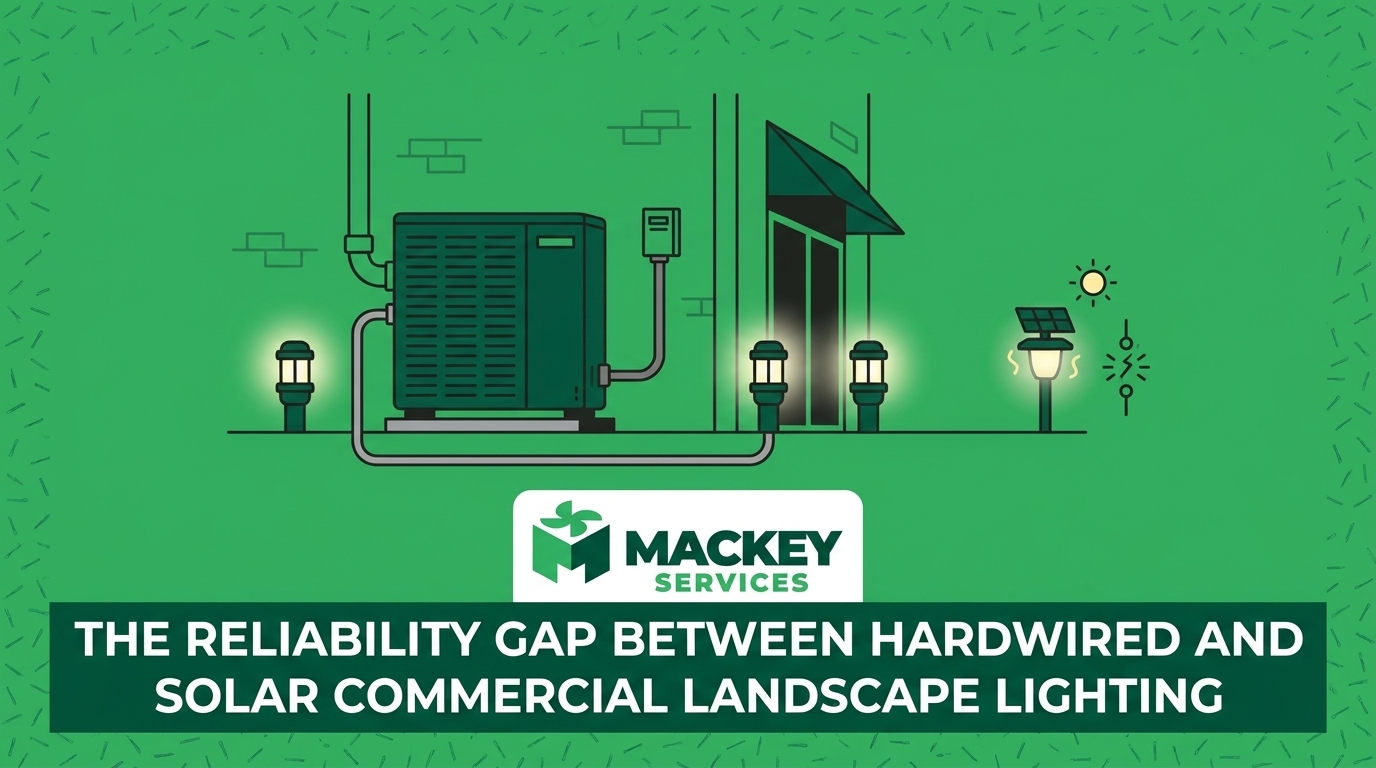
As the September and early fall transition brings shorter days to the Gulf Coast, our team at Mackey Services sees property managers abruptly forced to confront the reliability gap between hardwired and solar commercial landscape lighting. You might notice the shift almost overnight. It is 6:30 p.m., the sun is already dipping below the horizon, and the solar path lights you installed last spring are barely casting a dull glow across your walkways. This seasonal shift highlights a concrete problem we encounter regularly: off-the-shelf solar fixtures simply cannot hold a sufficient charge just as earlier evenings demand reliable, consistent illumination to keep your tenants, employees, and customers safe.
For businesses dealing with these seasonal challenges, we have found that upgrading your property with comprehensive commercial landscaping services that integrate professional electrical installation is the most effective way to ensure lasting safety and visibility.
Every property manager eventually reaches a critical decision point. You can continue the frustrating cycle of replacing dead solar batteries and swapping out cloudy plastic housings every few months, or you can invest in a permanent, reliable electrical solution. Integrating beautiful outdoor aesthetic design with secure, professional electrical infrastructure is not just about making your business look good after dark. It is about taking control of your property's safety profile and ensuring your exterior lighting performs exactly as expected, no matter what time the sun goes down or what the weather brings.
The Hidden Liability Risks of Dim Pathways in Business Districts
In our experience working throughout Dickinson commercial districts, inadequate or flickering lighting is much more than a minor visual nuisance. It is a direct, measurable liability risk. When pathways, stairwells, and parking lot perimeters are poorly lit, the chances of a trip-and-fall accident increase significantly, exposing your business to entirely preventable legal and financial consequences.
The Problem: We often see commercial property managers rely on solar lighting as a quick, off-the-shelf fix for dark zones. However, these units are highly susceptible to environmental interference. Solar panels rapidly lose their charging efficiency when covered in everyday dust, pollen, or the sticky residue that accumulates from nearby trees and traffic exhaust. Even a thin layer of grime can severely limit the panel's ability to absorb ambient light.
The Cause: Because solar fixtures depend entirely on the daily sunlight they manage to capture, their lumen output is inherently unpredictable. A slightly dirty panel or an overcast afternoon means the light might run out of stored power by 8:00 p.m. This leaves your business district walkways dangerously dark during peak evening operating hours, creating deep shadows where uneven pavement or steps become invisible hazards.
The Solution: The Illuminating Engineering Society (IES) outlines strict safety standards for exterior commercial lighting, emphasizing the absolute need for consistent, measurable illumination along all pedestrian paths. Off-the-shelf solar units cannot guarantee this consistency. We find that commercial properties quickly outgrow these temporary solar solutions because the liability risks of an unlit walkway far outweigh the initial convenience of a wire-free installation. To protect your business and your visitors, you need a system that delivers a reliable, predictable beam of light every single night.
How Coastal Weather Accelerates Solar Battery Degradation
The environment along the Gulf Coast is notoriously harsh on outdoor electronics. Having serviced commercial properties across Dickinson for years, we know firsthand how the local climate impacts your building's exterior. This same weather aggressively attacks the internal components of standard solar path lights, drastically shortening their operational lifespan.
Most commercial solar lights feature unsealed or poorly sealed battery compartments. This fundamental design flaw leaves the internal electronics highly vulnerable to environmental intrusion. Gulf Coast cloud cover, heavy seasonal rains, and high humidity easily penetrate the cheap plastic housings of these fixtures. Once moisture gets inside, our technicians see the internal destruction happen rapidly.
One of the most destructive forces for these fixtures is galvanic corrosion. When the salty, humid coastal air interacts with the dissimilar metals inside the battery contacts, it causes a rapid chemical reaction. This corrosion builds up as a crusty, white or green residue on the battery terminals. As this residue thickens, it severely restricts the flow of electricity from the solar panel to the battery, and ultimately from the battery to the LED bulb. The light will begin to flicker, dim, and eventually fail altogether.
Furthermore, heavy rains and continuous moisture exposure cause the protective plastic over the solar cells to turn yellow and cloudy over time, further reducing their ability to absorb whatever sunlight is available. The reality is that solar hardware is fundamentally mismatched for the rigorous demands of coastal commercial properties. The combination of salt air, driving rain, and intense humidity guarantees premature failure, forcing property managers into a continuous loop of maintenance and replacement.
The Autumnal Equinox and the Solar Charging Crisis
The mathematical reality of solar lighting becomes painfully obvious during the September and early fall transition. This period marks the autumnal equinox, a time when daylight hours rapidly decrease and nighttime hours stretch longer across the northern hemisphere.
This seasonal shift creates a direct solar charging crisis for commercial properties. Here is exactly how we see this transition cause solar systems to fail when you need them most:
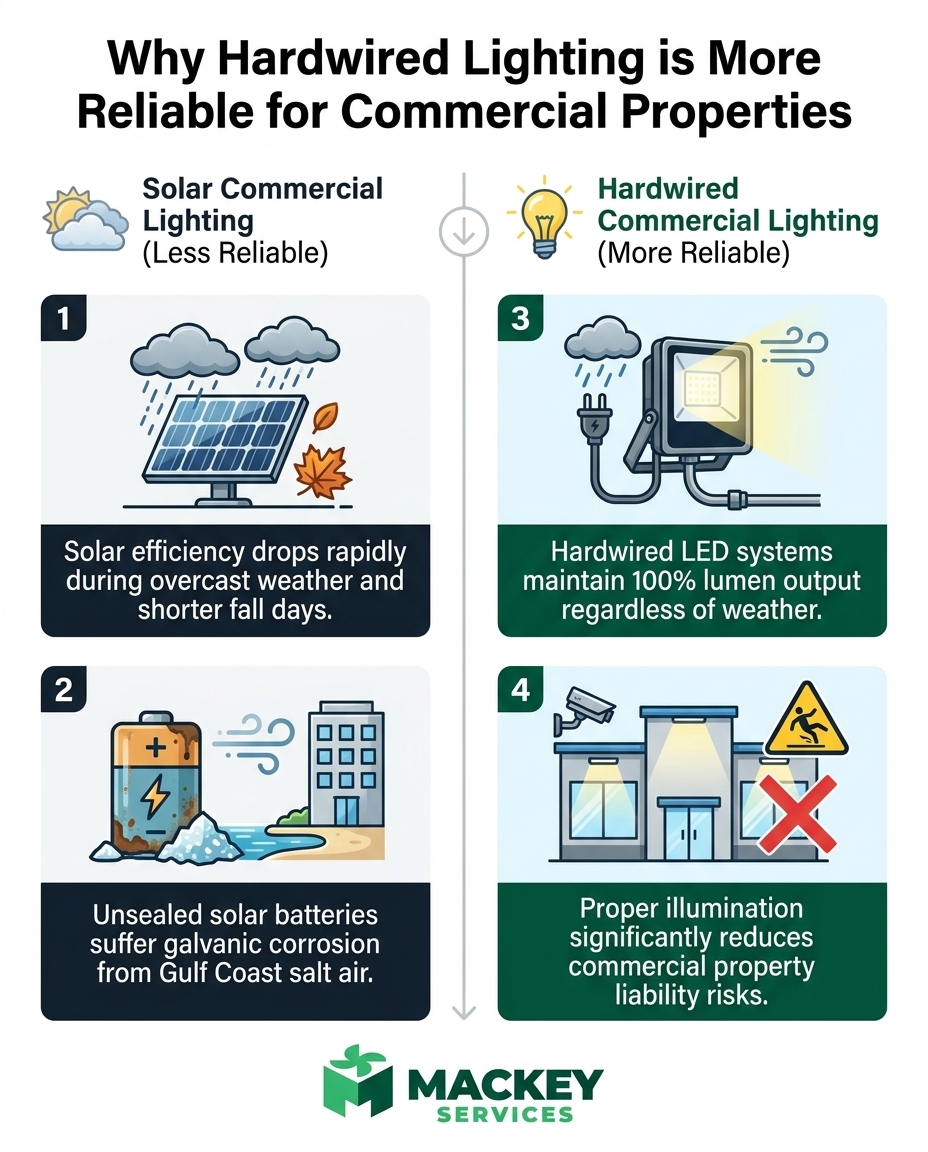
1. Reduced Charging Window: Fewer daylight hours mean the solar panels have significantly less time to absorb energy. A battery that took eight hours to reach a full charge in July might only get five hours of viable sunlight in late September.
2. The Evening Paradox: Just as the batteries are receiving their weakest charge of the year, businesses require lighting earlier in the evening. You need the lights to turn on at 6:00 p.m. instead of 8:30 p.m., demanding more hours of output from a battery that is only half full.
3. Overcast Weather Interference: Fall weather patterns often bring more overcast, cloudy days. This further diminishes the solar panel's efficiency, meaning the batteries might not reach a full charge for several days in a row, leading to compounding energy deficits.
4. Rapid Battery Drain: Because the lights are turning on earlier and running longer on a weak charge, the batteries are drained to absolute zero every single night. Deep-cycling these small batteries repeatedly destroys their chemical lifespan, causing them to fail entirely within a few weeks.
To avoid this seasonal trap, we strongly advise property managers to look toward permanent infrastructure. By having professionals like us focus on adapting commercial landscape lighting timers on a hardwired system, you bypass this seasonal dependency entirely. A hardwired system draws consistent power from your building, ensuring your lights turn on precisely when needed and stay on until dawn.
Why Hardwired Low-Voltage LED Systems Guarantee Safety
In our professional opinion, the most effective way to eliminate the unpredictability of solar power is to upgrade to a hardwired low-voltage LED system. For the properties we service throughout Dickinson commercial districts, this transition is a vital step toward long-term safety, security, and operational peace of mind.
Unlike solar units that rely on fragile internal batteries, hardwired low-voltage LED systems maintain 100% of their rated lumen output at all times. They draw a continuous, regulated stream of power directly from your property's electrical grid through a dedicated transformer. This means a 300-lumen path light will deliver exactly 300 lumens at 6:00 p.m., 11:00 p.m., and 4:00 a.m. There is no fading, no flickering, and no sudden blackouts just because the previous day was cloudy.
The professional-grade hardwired fixtures we install are built with extreme durability in mind. They utilize heavy-duty cast brass, copper, or powder-coated aluminum bodies with completely sealed, watertight O-ring gaskets. This structural integrity locks out the heavy rains, salt air, and humidity that destroy cheaper solar alternatives, ensuring the internal wiring remains pristine year after year.
Power is distributed through centralized, commercial-grade transformers. These transformers allow for reliable, programmable power distribution across massive properties. You can set precise schedules, establish multiple lighting zones, and adjust the output to meet the exact security needs of your business. By guaranteeing this level of reliability, hardwired systems directly mitigate the liability risks of trips, falls, and security breaches.
Consistent Lumens Through Every Season
The true value of a hardwired system reveals itself as the seasons change. Because the system does not rely on ambient sunlight, there is absolutely no dimming as the night progresses. Your entryways and walkways remain brilliantly illuminated from dusk until dawn. Furthermore, the system has complete immunity to cloudy days, heavy storms, and the short winter afternoons that render solar lights useless. If you manage multiple properties or require specialty property services, this guaranteed consistency is non-negotiable for maintaining a safe commercial environment.
Bridging Aesthetics with Electrical Code Compliance
Installing commercial lighting is not just about sticking fixtures into the dirt to make a courtyard look pretty. It requires a deep understanding of structural aesthetics combined with strict adherence to electrical safety codes.
In Dickinson commercial districts, improper low-voltage wiring can create massive operational problems. One of the most common issues our technicians encounter with amateur installations is voltage drop. If a wire run is too long or the gauge of the wire is too thin for the electrical load, the fixtures at the end of the line will receive less power. This results in dim, uneven lighting that looks unprofessional and fails to meet safety standards. Correcting voltage drop requires precise mathematical calculations regarding wire length, fixture wattage, and transformer capacity.
This is why our approach—combining licensed electrical expertise with commercial landscaping knowledge—ensures safe, weather-resistant installations that will not fail during critical night hours. A professionally designed system integrates seamlessly into your existing landscape architecture. The wiring is properly trenched, buried at the correct depth, and protected in conduit where necessary, ensuring there are no exposed wires to act as tripping hazards or fall victim to landscaping equipment like lawnmowers and weed trimmers.
Proper installation also ensures the entire system can withstand heavy commercial-level wear and tear. From heavy foot traffic to severe coastal storms, a code-compliant hardwired system is anchored securely and wired safely. This professional approach bridges the gap between a beautiful nighttime aesthetic and a rigorously secure commercial environment.
Head-to-Head: Hardwired vs. Solar for Commercial Properties
When helping property managers make infrastructure decisions during the September and early fall transition, we rely on clear, comparative data. Here is exactly how hardwired low-voltage LED systems stack up against commercial solar lights:
• Lumen Consistency — Hardwired Low-Voltage LED: Provides 100% output continuously from dusk until dawn, completely unaffected by weather. — Commercial Solar Lighting: Dims progressively as batteries drain; highly dependent on daily sunlight and panel cleanliness.
• Weather Resistance — Hardwired Low-Voltage LED: Uses heavy-duty, sealed fixtures that lock out moisture, salt air, and heavy rain. — Commercial Solar Lighting: Unsealed plastic housings are highly vulnerable to moisture intrusion and rapid salt corrosion.
• Lifespan & Maintenance — Hardwired Low-Voltage LED: Lasts for years with minimal maintenance; commercial LED bulbs have exceptionally long lifespans. — Commercial Solar Lighting: Requires frequent, frustrating battery replacements and routine panel cleaning to function.
• Commercial Safety — Hardwired Low-Voltage LED: Meets strict liability and electrical code standards for guaranteed pedestrian safety. — Commercial Solar Lighting: Poses unpredictable safety risks due to sudden failures, deep shadows, and inconsistent illumination.
The data clearly shows that while solar might offer a quick setup, hardwired systems deliver the permanent, uncompromising reliability required for a commercial business.
Frequently Asked Questions About Commercial Landscape Lighting
Are hardwired landscape lights better than solar?
The short answer is yes, and it is what we always recommend for commercial applications. Hardwired systems provide a guaranteed, continuous stream of power that ensures your lights maintain maximum brightness all night long. In Dickinson commercial districts, where safety and liability are major concerns, you cannot afford the unpredictable dimming and sudden failures associated with solar batteries. Hardwired systems also use heavier, sealed fixtures that withstand harsh coastal weather much better than cheap solar plastics.
Why do commercial solar lights fail so quickly?
Our electricians find that commercial solar lights typically fail quickly because their internal components are not built to withstand constant environmental exposure. The unsealed battery compartments allow humidity and salt air to enter, which rapidly causes galvanic corrosion on the battery contacts. Once the contacts corrode, the battery can no longer receive a charge from the solar panel or send power to the LED bulb. Furthermore, the constant deep-cycling of draining the battery to zero every night destroys the battery's chemical lifespan in just a few months.
Why do my solar path lights stop working in the fall?
Your solar path lights stop working in the fall due to the autumnal equinox, which drastically reduces the amount of available daylight. Because the sun sets earlier, the solar panels have fewer hours to charge the internal batteries. At the exact same time, the lights are forced to turn on earlier in the evening, demanding more power from a battery that is only partially charged. This massive energy deficit causes the lights to dim quickly and shut off completely long before dawn.
Are hardwired landscape lights safer for businesses?
Yes, hardwired landscape lights are significantly safer for businesses because they eliminate the risk of unexpected dark zones. Consistent, predictable illumination is required by safety organizations like the Illuminating Engineering Society (IES) to prevent trips, falls, and security breaches on commercial properties. A professionally installed hardwired system ensures that every walkway, parking lot perimeter, and entryway remains brilliantly lit, directly reducing your liability as a property manager.
How do coastal environments affect outdoor lighting fixtures?
Coastal environments aggressively attack outdoor lighting fixtures through a combination of high humidity, heavy seasonal rains, and corrosive salt air. If a fixture is not completely sealed with watertight gaskets, the salt and moisture will penetrate the housing and destroy the internal wiring and battery contacts. This is why our team sees off-the-shelf solar lights degrade so rapidly on the Gulf Coast, and why heavy-duty cast brass or aluminum hardwired fixtures are the only sustainable choice for long-term exterior illumination.
Secure Your Property with Reliable Lighting This Fall
As the September and early fall transition brings earlier evenings and longer nights, you cannot afford to leave your property's safety to chance. Upgrading from unpredictable solar units to a permanent, hardwired low-voltage LED system provides the ultimate peace of mind. You will know with absolute certainty that your walkways, entryways, and parking areas will be brilliantly illuminated every single night, regardless of the weather.
Now is the time to act before the darkest and most unpredictable months of the year arrive. Do not wait for a liability issue or a tenant complaint to force your hand. Let our experienced team at Mackey Services evaluate your current exterior lighting setup. By addressing the reliability gap between hardwired and solar commercial landscape lighting today, you can ensure your property remains safe, secure, and visually stunning all year long.
Clients Say About Us
Customer Testimonials
Our AC stopped working during a heatwave, but your team responded quickly and restored comfort within hours. Professional, friendly, and highly recommended!



Service Finance
Enjoy a new HVAC system today with flexible financing through Service Finance. Convenient monthly payment options make it easier to upgrade comfort now and pay over time, subject to credit approval.
Blogs