
The Cost of Running a Space Heater vs. Installing a Single-Zone Mini-Split
Weighing the cost of running a space heater vs. installing a single-zone mini-split? Compare your long-term efficiency options before winter hits.
The Myth of the 'Cheap' Winter Quick-Fix
Evaluating the cost of running a space heater vs. installing a single-zone mini-split usually starts with a common misconception: that buying a small, portable box from the hardware store is the most cost-effective way to warm up a drafty room. You plug it in, the coils glow red, and the immediate area gets warm. But relying on high-draw portable heaters to manage chronically cold spaces creates a significant, hidden burden on your home's infrastructure. The real problem isn't the upfront purchase; it is the daily operational strain and the long-term inefficiency of generating heat from scratch.
As the weather begins to turn, homeowners face a clear decision point. You can either continue risking electrical strain and high energy usage with a temporary fix, or you can upgrade to a permanent, highly efficient solution. If you are looking at your September pre-heating-season fall prep checklist, now is the time to evaluate how you plan to stay comfortable. Instead of waiting for the first freezing night to dust off an old portable unit, it pays to look closely at your permanent heating services options. Upgrading to a dedicated single-zone mini-split provides a reliable, energy-efficient way to tackle those stubborn, unconditioned rooms before the harsh cold arrives.
Key considerations for your heating strategy:
- Operational efficiency: How much electrical power is actually converted into usable heat for your living space.
- Infrastructure impact: The hidden toll that continuous high-wattage devices take on your existing wiring and breaker panel.
- Long-term value: The difference between paying for a temporary band-aid year after year versus investing in a permanent property upgrade.
The Hidden Electrical Strain on Your Home's Infrastructure
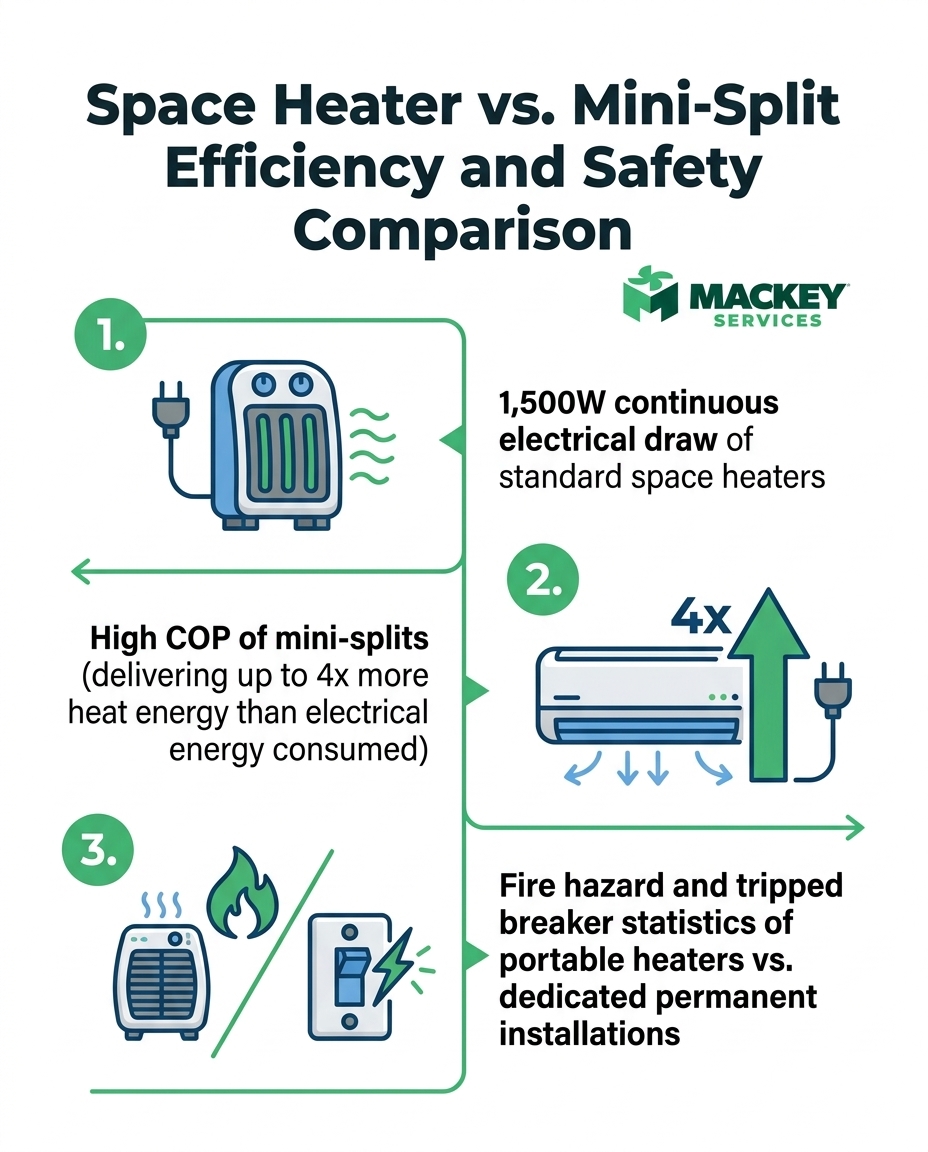
Most homeowners don't realize that portable heaters are some of the most power-hungry appliances you can plug into a standard wall outlet. The typical 1,500-watt electrical draw of standard resistive space heaters is massive when you look at how residential wiring is actually designed. A standard bedroom or living room circuit is usually rated for 15 amps. When you plug in a 1,500-watt device, it instantly pulls about 12.5 amps all by itself. That leaves almost zero capacity for anything else on that shared circuit.
This creates a cascading effect throughout your home. If you have a television, a few lamps, or a computer running on the same circuit, the combined electrical load easily exceeds the safe limit. The immediate result is a tripped breaker. While resetting a breaker might seem like a minor annoyance, frequent tripping is actually a serious warning sign. It means your electrical panel is doing its job to prevent an overload, but constantly pushing the system to its breaking point degrades the breakers and the wiring over time.
What Happens Behind the Drywall
When wiring operates near its maximum capacity for hours on end, it generates physical heat inside your walls. This thermal stress can cause wire insulation to become brittle and connections at the outlets to loosen. Over time, this compromises your overall electrical system safety, leading to hidden hazards that are entirely preventable.
Permanent HVAC installations operate entirely differently. A professional installation includes running a dedicated, appropriately sized electrical circuit directly from your main breaker panel to the new equipment. This means the heating system has its own isolated power supply. It never competes with your vacuum cleaner, your television, or your bedside lamps, ensuring safe, continuous operation without stressing the rest of your home's infrastructure.
Fire Hazards vs. Permanent Peace of Mind
The conversation around portable heating isn't just about utility usage; it is fundamentally about safety. According to the National Fire Protection Association (NFPA), heating equipment is a leading cause of home fires during the winter months, and portable units with resistive heating elements are the primary culprits. These devices generate intense, localized heat that can easily ignite nearby combustibles like curtains, bedding, or upholstered furniture.
The danger often peaks during sudden temperature drops. When an unexpected freeze hits, homeowners rush to plug in heaters wherever they can, often neglecting safe clearance zones in their panic to get warm. This panic-usage leads to extension cord overloads, tipped-over units, and electrical shorts. Our team at Mackey Services sees the aftermath of this panic-usage firsthand every year. During a recent severe winter freeze, we helped a local Dickinson family whose central system couldn't keep up with the sudden drop in temperature. They had resorted to plugging in multiple space heaters, constantly tripping their breakers. When our technicians arrived, we thoroughly evaluated their entire electrical and HVAC setup. By clearly explaining the safety risks and outlining the necessary upgrades, we helped them transition to a permanent, safe, and highly efficient heating overhaul, allowing them to finally ditch the dangerous stopgaps.
The Advantage of Dual Expertise
Because our team at Mackey Services brings dual expertise in both HVAC and electrical systems, we approach these installations with a comprehensive safety-first mindset. A professional installation ensures that the mechanical heating load is perfectly matched with a safe, dedicated electrical circuit. This eliminates the fire risks of exposed heating elements and the nuisance of tripped breakers.
A wall-mounted permanent unit provides true peace of mind. It sits safely out of the way of daily foot traffic, children, and pets. There are no glowing coils, no tripping hazards from stretched power cords, and no constant worry about whether you remembered to unplug the unit before leaving the house.
Efficiency Showdown: Resistive Heating vs. Heat Pump Technology
To truly understand the difference between these two approaches, you have to look at how they create warmth. Portable heaters use resistive heating. This is a 1:1 energy conversion process. For every one unit of electrical energy the device consumes, it produces exactly one unit of heat energy. It is a hard physical limit; a resistive heater can never be more than 100% efficient.
Modern mini-splits use heat pump technology, which completely changes the math. Instead of generating heat from scratch by running electricity through a high-resistance wire, a heat pump uses a small amount of electricity to transfer existing heat from the outside air into your home. Even when it feels cold outside, there is still ambient thermal energy in the air. The system captures this energy, concentrates it, and pumps it indoors.
Because they are moving heat rather than creating it, heat pumps boast a high Coefficient of Performance (COP). A modern system can easily achieve a COP of 3.0 or higher, meaning it delivers three to four times more heat energy than the electrical energy it consumes. This massive difference in kilowatt-hour (kWh) consumption translates to a vastly more efficient home over the long term.
Side-by-Side Performance Metrics
Here is a breakdown of how the two technologies compare on key operational metrics:
| Feature | Portable Space Heater | Single-Zone Mini-Split |
|---|---|---|
| Energy Efficiency Rating | Maximum 100% (1:1 conversion) | 300%+ (High Coefficient of Performance) |
| Electrical Draw | Continuous 1,500W on a shared circuit | Variable inverter draw on a dedicated circuit |
| Safety Profile | High risk of fire and overloaded breakers | Low risk, safely mounted, no exposed elements |
| Heat Distribution | Localized, uneven hot and cold spots | Even, fan-forced room circulation |
Solving the Perpetually Cold Room Problem
Almost every home has that one room that never quite stays comfortable. Often, these architectural challenges stem from inadequate insulation, long ductwork runs that lose pressure before reaching the vent, or spaces that were never designed to be conditioned in the first place. In our years of servicing Dickinson TX homes, our team frequently encounters this exact issue in older properties with enclosed patios or room additions. These spaces usually have large windows, exterior-grade walls, and no connection to the main central air system.
With Dickinson's mild winters punctuated by sudden, sharp cold snaps, these specific rooms become incredibly drafty. This sudden chill tempts homeowners to drag out dangerous temporary heaters just to make the space usable. But tying these challenging spaces into your existing central HVAC system is rarely the best answer. Extending ductwork is invasive, and your current central unit likely wasn't sized to handle the additional square footage. If you force the central system to push air that far, you end up overheating the rest of the house just to make the sunroom bearable.
The Power of Targeted Zoning
This is where independent zoning shines. A dedicated system solves the root cause of the drafty room rather than just putting a temporary band-aid on it. You gain precise control over that specific area's temperature without impacting the thermostat in the main hallway. If you are exploring options for an unconditioned space, understanding the logistics of heating a sunroom addition with a dedicated mini-split can help you see why independent zoning is vastly superior to relying on extension cords and glowing metal coils.
The Long-Term Value of a Dedicated Heating Upgrade
When you evaluate heating options, the true cost is always measured in years of operational efficiency and electrical safety. A portable unit might be a cheap purchase at the hardware store, but you pay for it every single month in high utility usage, electrical strain, and compromised safety. A permanent upgrade reverses that equation.
Beyond the immediate relief of a warm room, a dedicated system adds substantial long-term value to your property. Buyers and appraisers recognize permanent, high-efficiency HVAC installations as valuable home improvements, whereas a closet full of space heaters signals that the home has unresolved comfort issues.
Year-Round Utility and Incentives
The benefits don't stop when winter ends. Because these systems utilize heat pump technology, they are fully reversible. That means the same unit providing highly efficient warmth in January will provide whisper-quiet, high-efficiency cooling during the sweltering heat of August. You are effectively solving two seasonal problems with one installation.
Additionally, upgrading to high-efficiency heat pump technology often qualifies homeowners for various generic energy rebates or federal tax credits designed to promote energy conservation. While specific programs and availability change, these incentives can make the transition to a permanent, safe heating solution even more attractive. We always advise readers to verify current programs with their local utility providers or a tax professional to see what incentives might apply to their upgrade.
Make the Safe Choice for Your Home's Winter Comfort
Achieving safe, high-efficiency comfort doesn't have to involve tripping breakers or worrying about fire hazards. By moving away from high-draw portable units and embracing dedicated heat pump technology, you protect your home's electrical infrastructure while keeping your utility usage in check.
Before the cold weather settles in for the season, take the proactive step to address your home's problem areas. We encourage you to schedule a professional assessment of that perpetually cold room. Our team is ready to discuss permanent zoning options that fit your home's unique layout, ensuring you stay warm, safe, and comfortable all winter long.
Frequently Asked Questions
Does a space heater use more electricity than a mini-split?
Yes, a standard portable heater uses significantly more electricity to heat the same amount of space. It draws a continuous, heavy load of power to generate heat through resistance. A mini-split uses a variable-speed inverter to efficiently transfer heat, requiring far fewer kilowatt-hours to maintain the same temperature.
Is it cheaper to run a space heater or central heat?
Running a space heater is generally less efficient per square foot than running a modern central system or a dedicated heat pump. While you might only be heating one small area, the 1:1 energy conversion of a portable unit means you are paying a premium for every degree of warmth. Permanent systems leverage higher efficiency ratings to keep utility usage lower over time.
Are mini-splits good for heating a single room?
They are exceptional for this exact purpose. Single-zone systems are specifically designed to provide targeted, independent temperature control for individual rooms or additions. They solve the problem of drafty spaces without requiring you to alter your main central ductwork or overheat the rest of your house.
Is a mini-split safer than a space heater?
Absolutely. Permanent heat pumps are hardwired into dedicated electrical circuits, eliminating the risk of overloaded shared wiring and tripped breakers. Furthermore, they are mounted safely out of reach and have no exposed heating elements, removing the fire hazards associated with portable units.
How does the wattage of a single-zone mini-split compare to a portable heater?
A portable unit typically pulls a fixed, continuous 1,500 watts whenever it is turned on. A mini-split, however, uses inverter technology to ramp its power usage up and down smoothly based on the room's exact needs. This means it often runs at a much lower wattage to maintain the temperature once the room is comfortable.
Can constantly running a portable heater damage my home's electrical panel?
Yes, running a high-draw appliance continuously on a standard residential circuit pushes the wiring and the breaker to their maximum limits. Over time, this constant thermal stress can degrade the breaker mechanism, loosen connections, and compromise the safety of your home's electrical panel.
Ready for a better day?
One call handles it all — HVAC, electrical, and generators across the Texas Gulf Coast. Less to pay. Better day. That's the Mackey way.
Mon–Fri: 7 AM – 8 PM · Sat: 8 AM – 5 PM · Licensed & insured · #TACLA 112769C · #TECL 558211