

Adapting Commercial Landscape Lighting Timers for the Late Summer Shift
Based on 1,000+ Houston reviews!
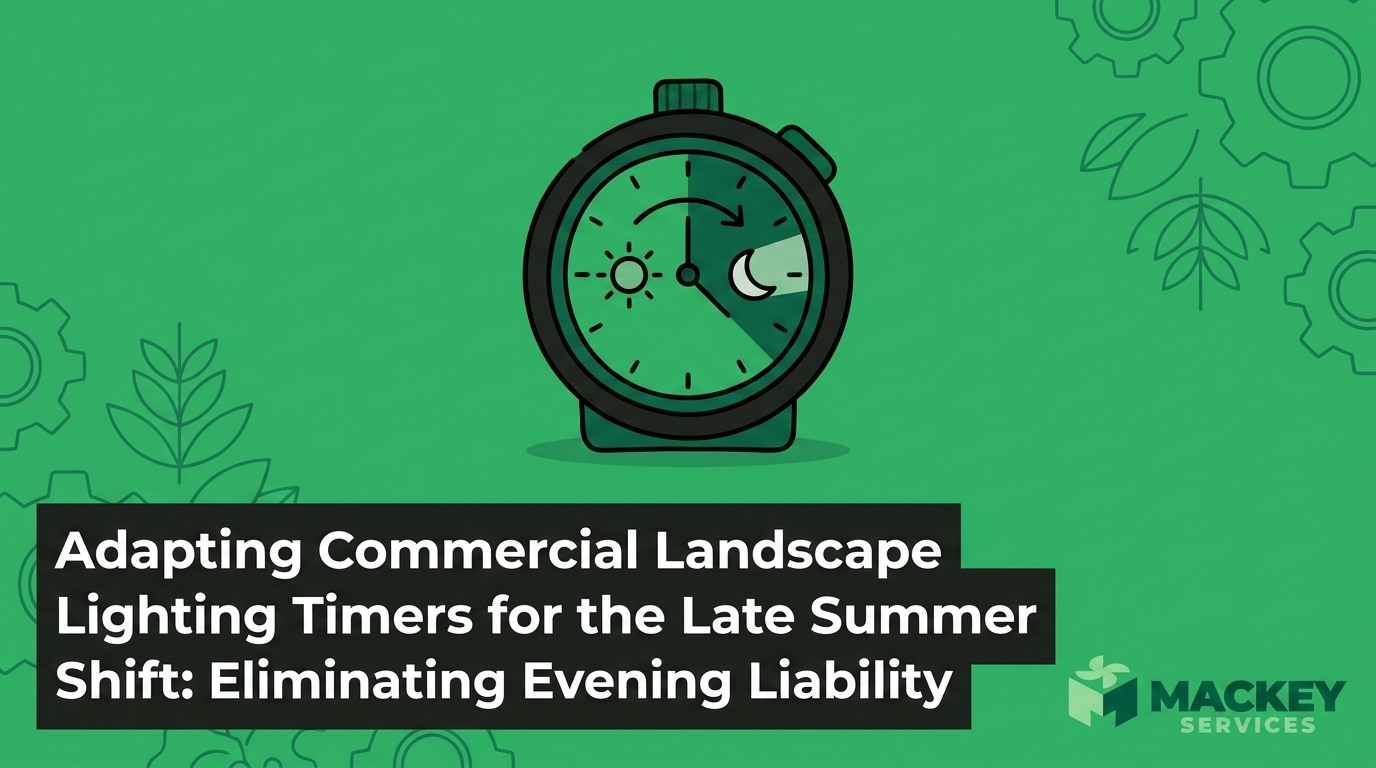
As August days shorten, fixed schedules leave commercial properties in the dark for up to 45 minutes. Upgrading to astronomical timers eliminates this evening liability.
.jpg)
The 1-to-2 Minute Daily Shift: Why Late Summer Catches Properties Off Guard
Adapting Commercial Landscape Lighting Timers for the Late Summer Shift becomes an urgent priority for property managers as sunset times begin shifting earlier by 1 to 2 minutes every single day throughout August. While a minute or two might seem insignificant on a Tuesday, those minutes quickly compound into nearly an hour of lost evening daylight by the end of the month as the back-to-school transition begins. For businesses relying on fixed mechanical lighting schedules set during the peak of the summer solstice, this gradual change creates a serious problem. By late August, our team frequently sees properties plunged into darkness for 30 to 45 minutes before their exterior lights finally kick on. Because of this rapidly changing window, proactive adjustments are critical for maintaining a secure environment.
To keep your premises safe and well-lit, you can partner with professional commercial landscaping services to evaluate your exterior setup, or upgrade your electrical controls to automate the process entirely.
In our experience serving Dickinson TX businesses, the August late-summer transition forces commercial property managers to make a definitive choice: continue dispatching maintenance personnel to manually adjust analog and digital fixed timers every few weeks, or permanently solve the problem by upgrading to automated astronomical timers. Many facility managers make the mistake of waiting for the November Daylight Saving Time clock change to address their lighting schedules. Unfortunately, waiting until late fall leaves a dangerous multi-month gap where parking lots, walkways, and entry points remain unlit during the tail end of typical business hours.
Common signs your property is caught off guard:
• The twilight gap: Employees are walking to their vehicles in near-total darkness before the system activates.
• Constant manual overrides: Staff members are frequently accessing the electrical panel to bypass the timer.
• Customer complaints: Visitors report feeling unsafe navigating unlit pathways leading to your entrance.
• Wasted maintenance hours: Facilities teams are spending valuable time repeatedly reprogramming digital timers to chase the sunset.
Evaluating Slip-and-Fall Liabilities on Dark Commercial Premises
Our electrical team consistently advises that properly timed exterior lighting is a primary factor in reducing premises liability for Dickinson TX commercial properties. When a business invites the public onto its grounds, it assumes a legal duty of care to provide a safe, navigable environment. A lighting timer that falls out of sync with the natural sunset creates a predictable, recurring window of danger. If an accident occurs during this unlit period, the property owner cannot easily claim ignorance, as the failure of the lighting system is a direct result of inadequate seasonal maintenance.
Dark pathways, uneven sidewalks, and poorly illuminated parking areas during early evening business hours drastically increase the risk of slip-and-fall accidents. A customer failing to see a curb, a wet patch of pavement, or a piece of debris can easily sustain an injury that leads to significant legal and financial repercussions. To mitigate these risks comprehensively, integrating your lighting schedule with professional commercial electrical services ensures that your entire exterior grid operates flawlessly when it matters most.
Beyond physical accidents, unlit premises serve as a magnet for vandalism, loitering, and security breaches. Criminals actively look for properties that appear closed or abandoned due to a lack of exterior illumination. When a timer fails to activate the lights promptly at dusk, it inadvertently signals that the building is vulnerable.
The Cost of Inconsistent Illumination
Even brief periods of darkness before lights activate create high-risk windows for accidents. A 30-minute delay in illumination might coincide exactly with a shift change or the evening rush of customers. During this time, the transition from a brightly lit interior to a dark exterior severely impairs human night vision, making obstacles even harder to detect.
Furthermore, insurance providers and local compliance guidelines often mandate consistent exterior illumination for commercial safety. A documented history of erratic lighting can complicate insurance claims or even lead to increased premiums. The perceived safety of your employees and customers is directly tied to how well your property is lit. When people feel unsafe walking to their cars, it damages your business's reputation and employee morale.
Why Traditional Photocells and Mechanical Timers Fail in August
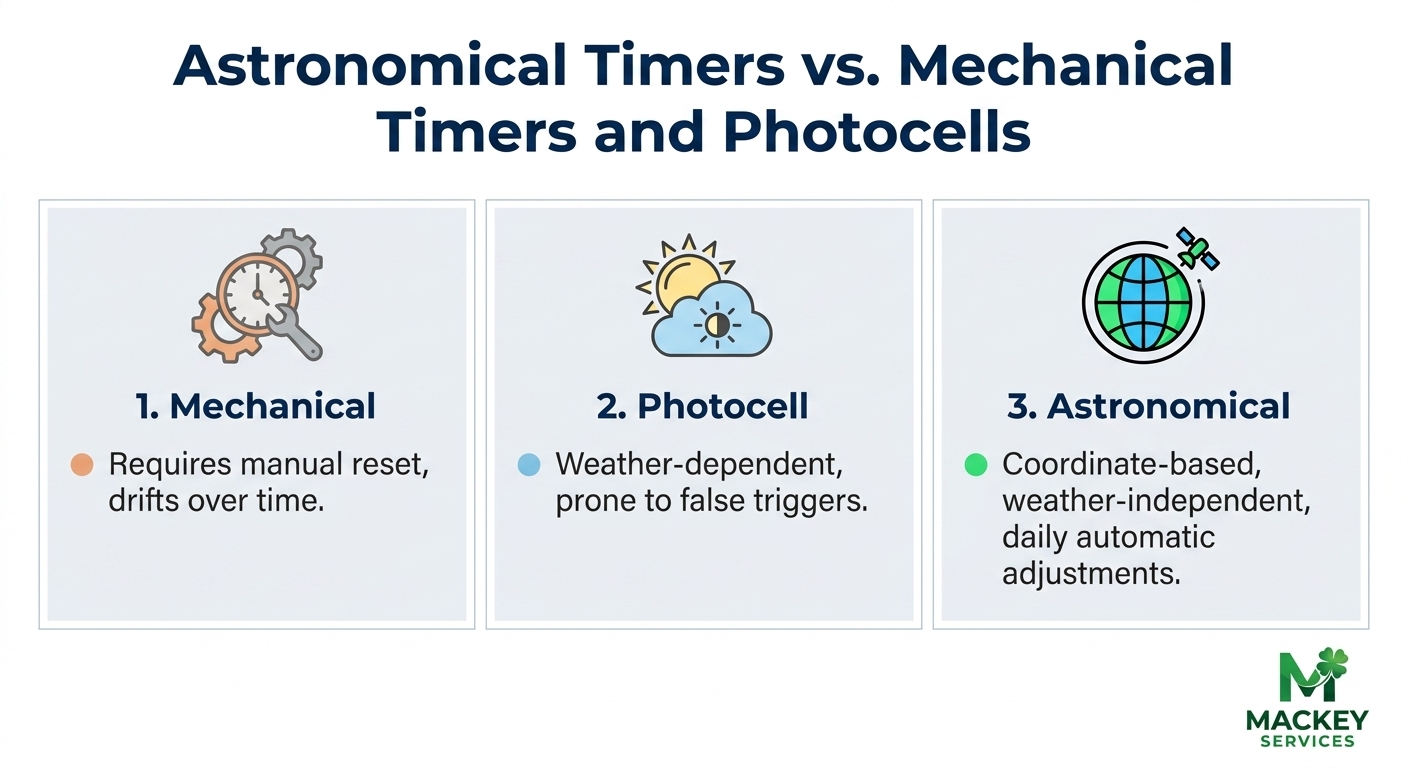
For decades, commercial properties have relied on mechanical dial timers and photocell sensors to manage exterior illumination. However, we've seen firsthand how the August late-summer transition exposes the critical flaws in these legacy systems. Mechanical timers, which use physical trippers on a rotating dial, require constant manual intervention. Every time the sunset shifts, or a brief power outage throws the dial out of sync, a maintenance worker must physically open the panel and adjust the pins. This wastes valuable labor hours and is highly prone to human error.
Photocell sensors, which activate lights based on ambient light levels, present an entirely different set of challenges. Along the Texas Gulf Coast, our technicians know that late-summer afternoon storms frequently roll in, creating dark, overcast skies hours before actual sunset. These heavy clouds trick photocells into turning on the lights prematurely, wasting significant amounts of electrical energy. Once the storm passes and the sun re-emerges, the lights may turn off again, only to require reactivation a short time later.
Additionally, photocells are highly vulnerable to environmental degradation. Dust, dirt, moisture, and debris accumulate on the sensor lenses over time, progressively degrading their accuracy. A dirty photocell might keep the lights on all day or fail to recognize when dusk has actually arrived.
Comparing Commercial Lighting Control Systems:
• Mechanical Timers — Operational Mechanism: Physical rotating dial with on/off trippers. — Vulnerabilities & Failures: Drifts out of sync during power outages; cannot adapt to daily sunset changes. — Maintenance Requirements: Requires manual resetting every few weeks to chase the shifting sunset.
• Photocell Sensors — Operational Mechanism: Light-sensitive eye that detects ambient darkness. — Vulnerabilities & Failures: Tricked by heavy storm clouds, shade from growing trees, or nearby artificial lights. — Maintenance Requirements: Lenses require frequent cleaning to prevent false triggers and erratic behavior.
• Astronomical Timers — Operational Mechanism: Digital microprocessor using geographic coordinates. — Vulnerabilities & Failures: Highly reliable; immune to weather, debris, and seasonal daylight shifts. — Maintenance Requirements: Virtually zero maintenance after initial professional programming.
The Mechanics of Astronomical Timers for Commercial Applications
The definitive solution to the late summer lighting shift is the installation of an astronomical timer. Unlike legacy systems, an astronomical timer is an advanced digital controller that uses precise geographic coordinates to calculate exact sunrise and sunset times for your specific location, every single day of the year. This completely eliminates the guesswork and the need for physical sensors.
Because the system relies on mathematical algorithms rather than ambient light detection, it is entirely immune to weather conditions, dirt, or shadows. Dickinson TX commercial properties benefit immensely from this technology, as the timer automatically adjusts the lighting schedule without any manual input, remaining perfectly synchronized with the gradual daily loss of daylight throughout late summer and fall.
How astronomical timers execute perfect daily schedules:
1. Coordinate Initialization: A technician inputs the exact latitude and longitude of the property into the timer's digital interface.
2. Date and Time Synchronization: The current date, time, and local time zone (including Daylight Saving Time rules) are programmed into the system's memory.
3. Algorithmic Calculation: The internal microprocessor calculates the precise minute the sun will set and rise for that specific day based on the earth's rotation and the property's coordinates.
4. Offset Programming: Facility managers can set custom offsets—for example, commanding the lights to turn on exactly 20 minutes before sunset to ensure a seamless transition from daylight to artificial illumination.
5. Automated Execution: The timer triggers the lighting contactors precisely on schedule, adjusting itself by 1 to 2 minutes daily to track the seasonal shift.
Programming Geographic Coordinates
The true power of an astronomical timer lies in its geographic specificity. By entering local latitude and longitude data, the system understands exactly where it is on the globe. This precise localization means it accounts for the unique daylight patterns of your specific region, rather than relying on generic regional estimates.
This geographic programming completely eliminates weather-dependent sensor vulnerabilities. It doesn't matter if a severe thunderstorm darkens the sky at 3:00 PM, or if a nearby streetlamp casts a glare on your electrical panel—the astronomical timer will only activate the lights when the true sunset arrives. Furthermore, built-in battery backups preserve this complex programming and maintain the internal clock during power outages, ensuring the system resumes normal operation the moment power is restored.
Integrating Timers with Broader Commercial Electrical Maintenance
Upgrading your lighting controls is about more than just convenience; it is an ideal opportunity to evaluate the overall health of your outdoor electrical circuits. The August late-summer transition brings high temperatures, intense humidity, and frequent thunderstorms, all of which put immense strain on commercial electrical infrastructure. When our Mackey Services technicians open a panel to install a new digital timer, we actively look to identify and resolve underlying issues that threaten the stability of your entire lighting network.
Protecting sensitive digital timers and automated systems from voltage spikes and power surges is a critical part of this integration. A nearby lightning strike or a grid fluctuation can easily fry the microprocessor inside an astronomical timer if the panel is not properly shielded. Implementing robust surge protection at the panel level ensures your investment remains secure. This principle applies to all automated outdoor systems; for instance, protecting irrigation timers from power surges uses similar protective strategies to prevent catastrophic equipment failure.
Furthermore, ensuring outdoor lighting panels are properly weather-sealed against late summer humidity and rain is essential. Moisture intrusion is a leading cause of electrical shorts and corrosion in commercial outdoor panels. A comprehensive upgrade includes replacing worn weather stripping, sealing conduit entries, and verifying that the enclosure maintains its required NEMA rating. Finally, integrating new automated controls requires careful load balancing. A licensed professional will verify that the lighting contactors and relays are correctly sized to handle the electrical load without overheating or tripping breakers.
Ensuring Code Compliance Through Professional Installation
Commercial electrical upgrades require strict adherence to local and national electrical codes. Unlike a simple residential porch light, commercial landscape lighting networks involve high-voltage panels, heavy-duty contactors, and complex load distributions. Attempting DIY electrical work on commercial properties introduces severe safety hazards, including the risk of electrocution, electrical fires, and catastrophic system failure. Furthermore, unpermitted or improper installations can instantly void your property insurance and expose your business to massive liability in the event of an accident.
Proper installation ensures correct load management across extensive landscape lighting networks. An astronomical timer does not typically carry the heavy electrical load of the lights directly; instead, it sends a low-voltage signal to a heavy-duty contactor that handles the high amperage. Wiring this relay system correctly is paramount. Mackey Services provides expert commercial electrical upgrades, ensuring local businesses maintain safety and curb appeal with precise astronomical timers installed perfectly to code.
Professional technicians guarantee that the coordinate programming is precise, the offsets are configured correctly for your business hours, and the entire system is fully tested under load. During a recent commercial equipment replacement, one customer noted how our technicians patiently explained the technical details of the new controls, ensuring the property manager was completely comfortable with the system's operation before wrapping up the job. This level of communication ensures you are never left guessing how to operate your newly upgraded equipment.
The Value of Dependable Commercial Maintenance
Clear communication of expectations during the upgrade process is vital for minimizing disruption to your daily operations. A professional team will coordinate the installation to ensure your property is never left without essential lighting overnight. They will map out the circuits, label the panel clearly, and provide documentation on how the new astronomical timer is configured.
Ultimately, professional installation delivers long-term reliability and peace of mind for property managers. Knowing that your exterior lighting is managed by a weather-proof, mathematically precise system—installed by licensed experts who stand behind their work—allows you to focus on running your business rather than chasing the sunset. For properties requiring comprehensive oversight, leveraging our specialty services ensures all your unique commercial maintenance needs are met with the highest standard of care.
Frequently Asked Questions About Commercial Lighting Timers
What is an astronomical timer for commercial landscape lighting?
An astronomical timer is a digital controller that calculates exact sunrise and sunset times based on programmed geographic coordinates. Instead of using a physical light sensor or a mechanical dial, it relies on mathematical algorithms to determine precisely when it gets dark at your specific location. This allows the timer to automatically adjust its schedule every single day to account for the changing seasons. It provides a completely hands-off, weather-independent solution for commercial exterior lighting.
Why are my commercial lights turning on too late in August?
During the August late-summer transition, sunset times shift earlier by 1 to 2 minutes every day. If your property uses a fixed mechanical or digital timer that was programmed during the long days of June or July, the timer's set point is now out of sync with the actual sunset. By late August, this drift can leave your property in total darkness for 30 to 45 minutes before the timer finally activates the lights. Upgrading to an astronomical timer prevents this dangerous twilight gap.
How do astronomical timers adjust to shorter days without sensors?
Astronomical timers use a built-in microprocessor programmed with your exact latitude, longitude, current date, and time. Because the earth's rotation and orbit are mathematically predictable, the timer's internal algorithm calculates the precise minute the sun will set on any given day of the year. It automatically shifts the lighting schedule earlier in the fall and later in the spring without ever needing a physical photocell to measure ambient light.
Should commercial landscape lights stay on all night?
The decision to leave commercial landscape lights on all night depends heavily on your property's security needs, local zoning ordinances, and energy goals. While essential security lighting and pathway illumination should remain active to deter vandalism and ensure safety, decorative landscape lighting is often scheduled to turn off after business hours to conserve energy. Astronomical timers allow you to program split schedules—for example, turning all lights on at dusk, but turning non-essential aesthetic lights off at midnight.
Why is a photocell sensor unreliable during afternoon storms?
Photocells rely on detecting ambient light levels to determine if it is day or night. When severe late-summer afternoon storms roll in, the heavy cloud cover drastically reduces ambient light, tricking the photocell into thinking the sun has set. This causes the exterior lights to turn on prematurely, wasting electricity. Once the storm passes and the sky brightens, the lights may shut off again, creating erratic and unprofessional lighting behavior for your commercial property.
Can an astronomical timer be retrofitted into an existing commercial lighting panel?
Yes, an astronomical timer can almost always be retrofitted into an existing commercial electrical panel. A licensed professional electrician will remove the outdated mechanical dial or bypass the faulty photocell, installing the digital timer in its place. The electrician will then wire the new timer to control the existing lighting contactors and relays, ensuring the new digital brain can safely manage the high-voltage load of your exterior lighting network.
Secure Your Property Before the Fall Time Change
Upgrading to astronomical timers provides hands-off safety compliance, completely eliminating the liability risks associated with dark walkways and unlit parking areas. As Dickinson TX commercial properties navigate the rapid daylight loss of late summer, relying on outdated mechanical dials or weather-dependent photocells is a risk your business simply cannot afford.
We encourage property managers to act during this critical seasonal shift before the evenings become completely dark during peak operating hours. Stop wasting valuable maintenance time chasing the sunset. Consult with a licensed professional today to evaluate your current lighting controls, upgrade your electrical panel, and achieve the peace of mind that comes with a perfectly synchronized, automated lighting system.
Clients Say About Us
Customer Testimonials
Our AC stopped working during a heatwave, but your team responded quickly and restored comfort within hours. Professional, friendly, and highly recommended!



Service Finance
Enjoy a new HVAC system today with flexible financing through Service Finance. Convenient monthly payment options make it easier to upgrade comfort now and pay over time, subject to credit approval.
Blogs