
How Does a Whole Home Backup Generator Work?
Learn how does a whole home backup generator work during outages and when power returns for reliable whole-house protection.
What Every Houston Homeowner Should Know About Whole Home Backup Generators
Understanding how does a whole home backup generator work is the first step toward protecting your family from the power outages that hit the Texas Gulf Coast every storm season. Here's the short answer:
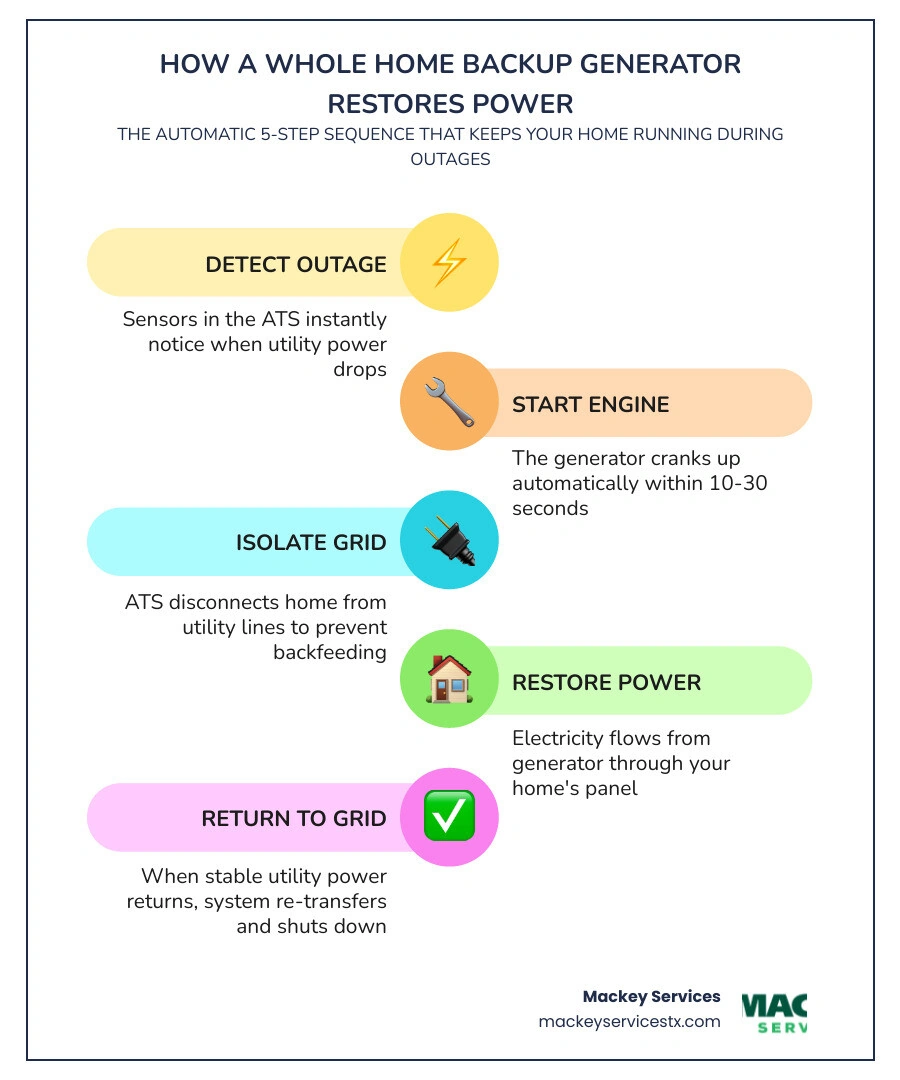
How a whole home backup generator works — at a glance:
- Detects the outage — Sensors in the automatic transfer switch (ATS) notice the moment utility power drops.
- Starts automatically — The generator engine cranks up on its own, usually within 10 to 30 seconds.
- Isolates your home from the grid — The ATS disconnects your home from the utility line to prevent dangerous backfeeding.
- Restores your power — Electricity flows from the generator through your electrical panel to your circuits.
- Monitors for grid return — Once stable utility power comes back, the system transfers you back to the grid and shuts the generator down.
No extension cords. No manual startup. No running outside in a storm. The whole process is automatic.
If you live in Dickinson, League City, Friendswood, or anywhere along the Gulf Coast, you already know that outages here aren't just inconvenient — they can mean days without air conditioning in the middle of a Texas summer, spoiled food, and homes left vulnerable to heat, flooding, or frozen pipes. A permanently installed standby generator keeps your home running normally while your neighbors are in the dark.
Standby vs. Portable: Choosing the Right Backup Power
When looking into emergency power options for your home, you will generally compare two main systems: a permanent standby generator and a temporary portable generator. While both are designed to keep your lights on, they operate in completely different ways, offer vastly different levels of convenience, and have distinct power capacities.
A portable generator is a freestanding unit that you typically store in your garage or shed. When a storm hits, you must drag it outside, fill it with gasoline, pull-start the engine, and run heavy-duty extension cords through open windows or doors to your individual appliances. Because they run on gasoline, they require manual refueling every few hours. This means keeping fresh fuel stored on your property, which can be a significant safety hazard and a major hassle during extended municipal fuel shortages.
A whole home standby generator, on the other hand, is a permanent installation. It sits on a concrete pad or elevated wooden platform outside your home, looking very similar to a central air conditioning unit. It is hardwired directly into your home's electrical panel and connected to your property’s natural gas line or a large liquid propane tank.
The biggest differentiator is automatic operation. A standby generator is constantly monitoring your incoming utility power. Whether you are fast asleep, cooking dinner, or out of town, the system detects a power failure and takes over within seconds. There are no cords to run, no heavy machinery to drag through the rain, and no need to store highly flammable gasoline.
To help you visualize the differences, here is a quick breakdown of how these two options compare:
| Feature | Whole Home Standby Generator | Portable Generator |
|---|---|---|
| Installation | Permanent, professional installation | Temporary, mobile unit |
| Startup Method | Fully automatic (10–30 seconds) | Manual pull-start or electric button |
| Fuel Source | Natural gas or liquid propane (continuous) | Gasoline or small propane tanks (manual refill) |
| Power Capacity | High (7.5 kW to 26 kW or more) | Low to medium (2 kW to 10 kW) |
| Home Connection | Directly wired to your main electrical panel | Heavy-duty extension cords or manual inlet |
| Maintenance | Scheduled self-tests and annual service | Manual oil changes, fuel stabilization, storage prep |
| Safety | High (weatherproof enclosure, no carbon monoxide risk indoors) | Moderate (must be positioned at least 20 feet away to avoid CO fumes) |
If you are weighing these options and wondering whether a permanent solution makes sense for your property, you can explore our detailed guide on Is a Whole House Generator a Wise Investment. For many homeowners along the Texas Gulf Coast, the peace of mind that comes with a fully automated, high-capacity system is well worth the long-term protection it provides.
How Does a Whole Home Backup Generator Work?
To truly understand how does a whole home backup generator work, it helps to look at the system as a continuous, protective loop. The generator is not just a passive machine that waits for you to turn it on; it is an intelligent, integrated network of components that constantly communicates with the utility grid and your home’s electrical system.
The core of this system is the relationship between the generator unit itself, the utility grid, and your home's electrical panel. These parts are joined together by a specialized device known as the Automatic Transfer Switch (ATS). Think of the ATS as the "brain" of the operation. It acts as a traffic controller, ensuring that electricity flows safely from only one source at a time.
Under normal conditions, electricity travels from the local utility company's power lines, through your electric meter, into your main electrical panel, and out to your lights, appliances, and air conditioner. During this time, your standby generator remains in "standby mode," quietly monitoring the incoming electrical current while keeping its starting battery charged and ready.
Step-by-Step: How Does a Whole Home Backup Generator Work During an Outage?
When a severe storm, grid failure, or fallen tree interrupts your power supply, the system springs into action. Here is exactly what happens step-by-step:
1. Outage Detection
The automatic transfer switch continuously measures the voltage and frequency of the incoming utility power. If the voltage drops below a safe level or fails entirely, the ATS detects this disruption within seconds. It waits a brief moment (usually 2 to 5 seconds) to confirm that the outage is not just a momentary flicker before signaling the generator to start.
2. Engine Startup
Once the signal is received, the generator’s internal control board uses its 12-volt starting battery to crank the engine. The engine runs on your home’s natural gas or liquid propane supply. Within seconds, the engine reaches its optimal operating speed of 3,600 RPM, which is required to produce standard 60Hz household electricity.
3. Grid Isolation
Before any power can be sent to your home, the ATS must perform a critical safety step: grid isolation. The transfer switch physically disconnects your home’s electrical panel from the utility grid. This is crucial because it prevents "backfeeding." Backfeeding occurs when electricity from a home generator flows backward into the utility lines, which can severely injure or electrocute utility linemen working to restore power.
4. Load Transfer
Once the generator engine is running smoothly and the home is safely isolated from the utility grid, the ATS shifts its internal contacts to the generator position. Electricity now flows from the generator's alternator, through the ATS, and directly into your electrical panel.
5. Power Restoration
Your lights turn back on, your refrigerator starts running, and your air conditioner kicks back in. This entire process, from the initial flicker of the lights to full power restoration, typically takes between 10 and 30 seconds.
If you are located in the northern Galveston County area, you can learn more about customized installations for your neighborhood by checking out our dedicated page on Whole House Generator in Friendswood.
Restoring Grid Power: How Does a Whole Home Backup Generator Work When Utility Service Returns?
The generator's job does not end when the storm passes and the utility company repairs the lines. The system is just as smart about handing power back to the grid as it is about taking it over.
1. Utility Monitoring
While your generator is running and powering your home, the ATS continues to monitor the utility lines. It is waiting for the power grid to come back online.
2. Line Stabilization
When the utility power returns, the ATS does not switch back immediately. Power grids can be highly unstable right after restoration, experiencing rapid surges and drops. The ATS monitors the incoming utility voltage for several minutes (usually 3 to 5 minutes) to ensure the power is stable, clean, and safe for your home's sensitive electronics.
3. Re-Transfer Sequence
Once the ATS confirms the utility power is stable, it initiates the re-transfer. It safely disconnects your home’s electrical panel from the generator and reconnects it to the utility grid. This transition is so fast that you might only notice a split-second blink of your lights.
4. Engine Cool-Down
After the load is removed from the generator, the engine does not shut off immediately. It continues to run without a load for a few minutes. This cool-down period allows the engine and alternator to dissipate excess heat gradually, protecting the internal components from thermal stress and prolonging the life of the system.
5. Return to Standby Mode
Once cooled down, the generator engine shuts off. The control panel resets, the battery charger begins topping off the starting battery, and the system returns to standby mode, waiting silently for the next power disruption.
For residents in nearby Brazoria County, you can explore how this seamless transition works for homes in your area by visiting our page on Whole House Generator in Pearland.
Key Components, Fuel Sources, and Sizing
A whole home backup generator is a sophisticated piece of machinery made up of several key components working in perfect harmony:
- The Engine: This is the muscle of the system, converting fuel (natural gas or liquid propane) into mechanical energy. These engines are built for extreme durability, similar to heavy-duty automotive engines, allowing them to run for days or weeks at a time.
- The Alternator: This component converts the mechanical energy produced by the engine into electrical energy. It uses a rotating magnetic field to generate the clean, stable alternating current (AC) electricity that your appliances require.
- The Control Board: The "computer" of the generator, which monitors engine parameters, processes signals from the ATS, tracks oil pressure and engine temperature, and records historical runtime data.
- The Enclosure: A heavy-duty, weather-resistant outer shell (usually made of corrosion-resistant aluminum, which is essential for our humid, salty Gulf Coast climate) that protects the internal components from wind, rain, and debris while dampening operating noise.
Choosing Your Fuel Source
When planning your system, selecting the right fuel source is one of the most important decisions you will make. Standby generators typically run on one of three fuels:
Natural Gas (NG)
- Pros: Connects directly to your existing utility gas line, providing an unlimited, continuous fuel supply. You never have to worry about delivery trucks, refilling tanks, or running out of fuel during a prolonged multi-week outage.
- Cons: If you live in an area without natural gas infrastructure, this option is unavailable. Additionally, extreme natural disasters (like major earthquakes) can occasionally disrupt gas utility lines.
Liquid Propane (LP)
- Pros: Highly efficient fuel that burns clean and is readily available for homes off the gas grid. It is stored in a large dedicated tank on your property, giving you complete control over your fuel supply.
- Cons: Requires monitoring tank levels and scheduling deliveries with a propane provider. During a widespread regional outage, delivery trucks may have difficulty reaching your home due to blocked roads.
Diesel
- Pros: Extremely reliable and commonly used for very large residential or commercial applications where massive power output is required.
- Cons: Diesel fuel has a limited shelf life and can degrade if left sitting for long periods. It requires regular fuel conditioning, and the generator must have a large on-site storage tank that requires manual refilling.
Sizing Your Generator Correctly
Choosing the right size generator is not about the physical dimensions of the unit; it is about its electrical output, measured in kilowatts (kW). Typical residential standby generators range from 7.5 kW to 26 kW.
To determine the correct size for your home, you must perform a load calculation. This involves listing all the appliances you want to run simultaneously during an outage, identifying their "running watts" (the power needed to keep them operating) and their "starting watts" (the extra surge of power required to start electric motors, such as your air conditioner's compressor).
For example, a standard 3-ton central air conditioner might require 3,000 to 5,000 watts to run, but needs up to 10,000 watts or more just to start up. If your generator is too small, attempting to start your AC could overload the system and cause it to shut down.
To optimize your system without buying an excessively large generator, we often utilize Smart Management Modules (SMM). These smart modules manage high-demand appliances (like your AC, pool pump, or electric dryer) by cycling them on and off in a controlled sequence, preventing the generator from becoming overloaded.
For a comprehensive guide on planning your backup power system and choosing the right size for your property, take a look at our Whole Home Generator Investment Guide 2026.
Frequently Asked Questions about Standby Generators
Installing a standby generator is a significant step toward securing your home’s comfort. Naturally, homeowners have plenty of questions about how these systems perform over time. If you are located on the island or along the coast, you can find localized information on our page for Whole House Generator in Galveston.
Below, we answer some of the most common questions we receive from homeowners in our service areas.
How long can a whole home backup generator run continuously?
A standby generator running on natural gas can theoretically run indefinitely, as long as the utility gas line remains active and pressurized. If your system runs on liquid propane, your runtime depends on the size of your storage tank and your household power load. For example, a typical 500-gallon propane tank can provide enough fuel to run a medium-sized standby generator continuously for about 7 to 10 days under normal household usage.
However, even with an unlimited fuel supply, generators are mechanical engines that require periodic maintenance. During an extended outage, you should shut the generator down every 24 to 48 hours of continuous operation to check the engine oil level, top it off if necessary, and inspect the air filter and overall condition of the unit.
Do standby generators require regular maintenance?
Yes, just like your car, a standby generator requires routine maintenance to ensure it starts reliably when you need it most. Essential maintenance tasks include:
- Weekly Exercise Cycles: Most modern standby generators are programmed to turn themselves on automatically once a week for 12 to 20 minutes. This "exercise cycle" lubricates the engine parts, charges the battery, and runs diagnostic checks to ensure the system is ready.
- Oil and Filter Changes: The engine oil and oil filter must be changed regularly. Most manufacturers recommend the first oil change after a brief break-in period (usually 25 to 30 hours of operation), and then annually or every 100 to 200 hours of runtime thereafter.
- Spark Plugs and Air Filters: These should be inspected annually and replaced as needed to maintain clean, efficient combustion.
- Battery Maintenance: The starting battery should be tested regularly and typically replaced every 2 to 3 years to prevent starting failures.
Regular professional service is the best way to catch minor issues before they turn into major problems during a storm.
Can a standby generator power my entire house including the AC?
Yes, absolutely. A properly sized standby generator can easily power your entire home, including high-demand systems like your central air conditioner, electric water heater, well pump, and kitchen appliances.
To achieve this without needing a massive, industrial-sized unit, we use load management strategies. By installing smart management modules, we can prioritize your electrical loads. For instance, if your generator is running near its capacity and your central AC needs to kick on, the system can temporarily pause power to a non-essential appliance (like a pool pump) for a few minutes until the AC compressor starts up and its power demand drops back down to its running wattage. This allows you to maintain full comfort throughout your home safely and efficiently.
Conclusion
At Mackey Services, we have spent over 30 years helping homeowners in Dickinson, Texas, and across the Greater Houston Area keep their homes comfortable, safe, and fully powered. Our team of licensed electricians and generator specialists understands the unique challenges of Gulf Coast weather—from summer humidity to tropical storms.
When you choose us, you get the expertise of an A+ BBB rated, family-owned business dedicated to providing reliable, high-quality service. We handle every step of your backup power journey, from professional load calculations and precise permitting to expert installation, gas line connections, and ongoing maintenance.
Don't wait for the next major storm to leave your family in the dark and without air conditioning. Contact us today to schedule a consultation, and let us help you find the perfect automatic backup power solution for your home. You can explore our services and get started by visiting our Mackey Services Generator Services page.
Ready for a better day?
One call handles it all — HVAC, electrical, and generators across the Texas Gulf Coast. Less to pay. Better day. That's the Mackey way.
Mon–Fri: 7 AM – 8 PM · Sat: 8 AM – 5 PM · Licensed & insured · #TACLA 112769C · #TECL 558211