
Eliminating the 'Dirty Sock' Smell from Your AC Vents After Months of Heavy Use
Eliminating the 'dirty sock' smell from your AC vents after months of heavy use means treating the coil. See why we use UV lights to fix this for good.
Is Your Home Smelling Like a Gym? The Late-Summer AC Odor Explained
Have you noticed a sudden, foul locker room scent blasting from your registers every time the thermostat kicks on? As families across Dickinson gear up for the back-to-school transition, our technicians at Mackey Services field this familiar complaint almost daily. Eliminating the 'dirty sock' smell from your AC vents after months of heavy use is a top priority for many homeowners as late summer approaches. This is not just a case of trapped household dust or a slightly overdue filter change. That distinct, gym-bag odor is an active biological issue caused by bacterial growth thriving deep inside your system, specifically on the indoor evaporator coil.
By the time August arrives, your air conditioner has been running almost non-stop. That heavy workload creates the perfect dark, damp environment for microbes to multiply. When you face this specific odor, you are standing at a critical decision point: you can either permanently eliminate the biological source using targeted professional solutions, or you can waste time trying to mask it with ineffective sprays. In our experience, when you are dealing with this level of biological buildup, you need more than a quick wipe down; you need targeted indoor air quality solutions and professional AC repair and service to neutralize the problem at its root.
The Biology of "Dirty Sock Syndrome" on Your Evaporator Coil
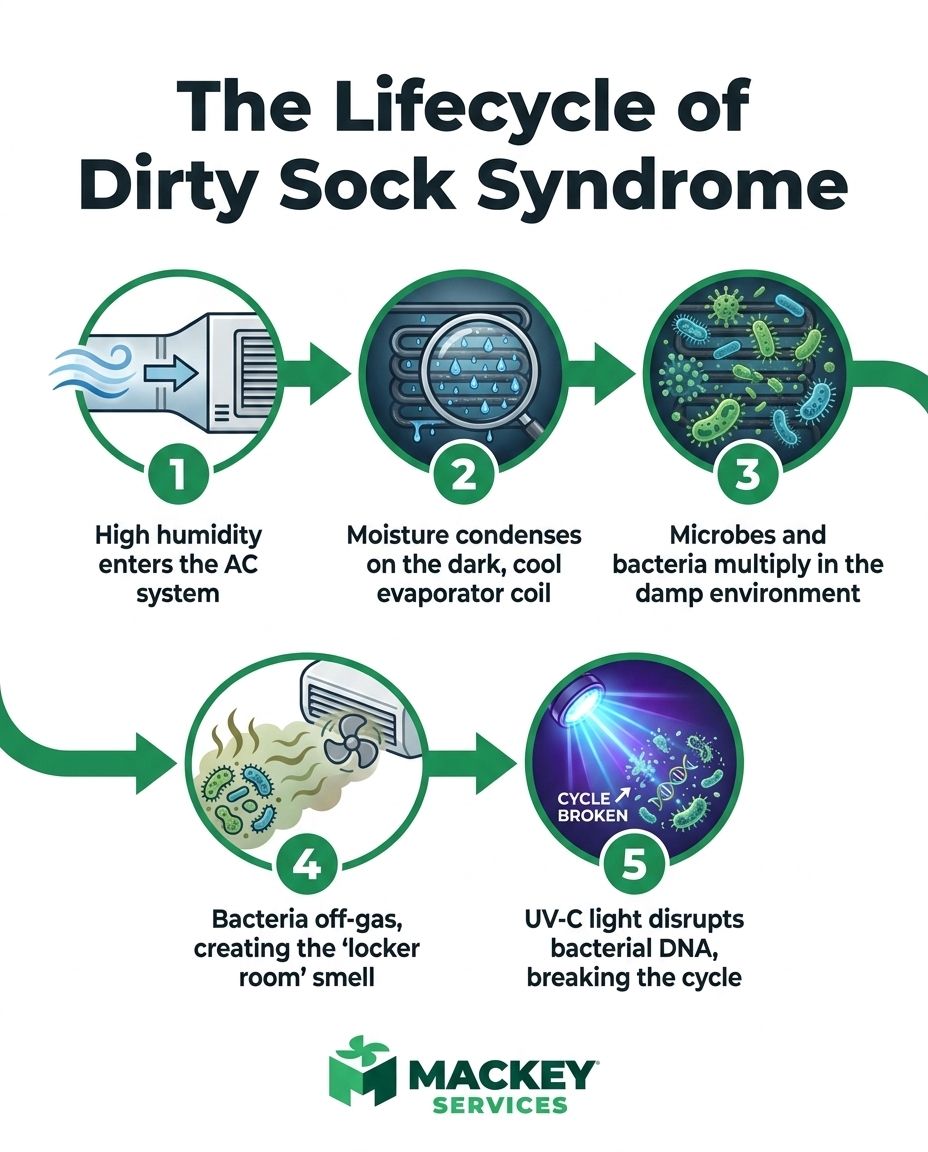
HVAC professionals refer to this specific late-summer phenomenon as "Dirty Sock Syndrome." Our team typically sees it occur when specific strains of bacteria and microbes accumulate in the dark, damp environment inside your air handler. By late August, a standard residential AC unit in our area has processed thousands of gallons of condensation. All that moisture maximizes the biological buildup on the indoor evaporator coil.
The foul smell you detect is actually the off-gassing of these living microbes as they multiply on the aluminum fins of the coil. As the fan blows air over the contaminated coil, it picks up these organic gases and distributes them throughout your living space. We always remind our customers that it is important to differentiate this specific biological odor from other common air conditioning smells, as the root causes and solutions are vastly different.
| Type of AC Odor | Typical Root Cause | Primary Solution |
|---|---|---|
| Dirty Sock / Locker Room | Bacterial and microbial growth on the wet evaporator coil. | Professional coil cleaning and UV-C light installation. |
| Electrical / Burning Plastic | Overheating motor, failing capacitor, or damaged wiring. | Immediate system shutdown and electrical repair. |
| Musty / Dusty | Clogged air filter pulling debris into the blower compartment. | Replacing the air filter and cleaning the blower assembly. |
| Vinegar / Sour | Excessive algae growth in a clogged condensate drain line. | Flushing and clearing the condensate drain system. |
Why the Evaporator Coil is Ground Zero
To understand why bacteria love your AC system, you have to look at how cooling actually works. The evaporator coil's primary job is to remove heat from your indoor air. As warm house air blows across the freezing cold refrigerant lines, moisture is extracted from the air through condensation—just like water beads forming on the outside of a cold glass of ice water.
This process leaves the coil completely soaked in water. The evaporator coil is constructed with thousands of tightly packed, paper-thin aluminum fins designed to maximize surface area. While great for heat transfer, these tight metallic spaces easily trap microscopic organic matter, pet dander, and skin cells that slip past your air filter. This trapped debris becomes the perfect food source for bacteria, while the constant condensation provides the water they need to thrive. When the system cycles off, the dark, enclosed cabinet becomes a humid incubator.
Why the Gulf Coast Climate Accelerates Coil Bacteria Growth
The severity of Dirty Sock Syndrome is heavily influenced by geography. In our years serving Dickinson TX and across the greater Gulf Coast region, we know that extreme summer humidity frequently exceeds 70 to 80 percent. This heavy, moisture-laden air places maximum dehumidification loads on residential air conditioning systems.
In drier climates, an air conditioner might run for twenty minutes and then sit idle for an hour. During that downtime, the indoor fan can dry off the evaporator coil, naturally stunting bacterial growth because the microbes are deprived of water. However, the Gulf Coast climate strips away this natural defense mechanism.
Because the demand for cooling is so intense, a Dickinson TX air conditioner runs almost continuously throughout the hottest parts of the day. The evaporator coil never gets a chance to fully dry out between cooling cycles. This perpetual wetness creates an unbroken, 24/7 breeding cycle for bio-slime. The coil remains a swampy environment from May through September, allowing the bacterial colonies to grow thicker and more resilient as the season progresses. By the time late August hits, the biological mass has reached a critical threshold, resulting in the sudden, overwhelming stench that floods your home.
The Risks of Ignoring the Odor or Attempting DIY Fixes
When faced with a foul-smelling home, the immediate instinct is often to reach for a quick, do-it-yourself fix. However, dealing with a contaminated evaporator coil requires precision and specialized equipment. We have seen too many well-meaning homeowners attempt to resolve Dirty Sock Syndrome on their own, only to make the problem worse and severely damage their HVAC equipment.
- Damaging delicate aluminum fins: The fins on your evaporator coil are incredibly fragile. Scrubbing them with standard household brushes or applying heavy pressure will crush the fins flat. Crushed fins block airflow, freeze the coil, drastically reduce system efficiency, and can easily void your manufacturer's warranty.
- Failing to penetrate the bio-slime: Standard chemical sprays and foaming cleaners from local hardware stores are rarely strong enough to penetrate the thick, established bio-slime that forms after months of heavy use. They might clean the surface, but the root bacteria remains safely hidden deep between the fins, ready to multiply again in a few days.
- Introducing harmful VOCs: Using heavily scented air fresheners, aerosol sprays, or scented candles near your return vents only masks the scent temporarily. Worse, it introduces additional Volatile Organic Compounds (VOCs) into your ductwork, degrading your indoor air quality even further rather than solving the biological issue.
- Allowing the contamination to spread: Ignoring the smell entirely is the most damaging choice. If left unchecked, the biological growth will eventually spread off the coil, clogging the condensate drain pan, backing up the drain lines, and even migrating into the porous materials of your ductwork.
How UV-C Lights and Professional Cleaning Eradicate the Smell
At Mackey Services, we know the only way to permanently defeat Dirty Sock Syndrome is a two-step professional approach: physical removal of the existing bacteria followed by active, ongoing biological defense.
Step 1: Professional Coil Cleaning
A professional coil cleaning is the mandatory first step. Our certified technicians use specialized, non-corrosive chemical agents designed specifically for HVAC coils. These solutions foam up and push the bio-slime out from deep within the fin pack without requiring aggressive scrubbing. The coil is then carefully rinsed, restoring both the physical airflow and the optimal heat transfer required for efficient cooling. This physical removal eliminates the immediate source of the odor.
Step 2: UV-C Germicidal Light Installation
Cleaning the coil solves the problem for today, but the Gulf Coast humidity guarantees the moisture will return tomorrow. This is where UV-C germicidal lights come in. Installed directly inside the air handler, these powerful ultraviolet lights shine continuously on the evaporator coil. The specific wavelength of UV-C light penetrates the cellular walls of bacteria, mold, and viruses, disrupting their DNA. Once their DNA is scrambled, the microbes can no longer reproduce. They die off completely, leaving the coil pristine.
The American Society of Heating, Refrigerating and Air-Conditioning Engineers (ASHRAE) strongly supports the use of UV-C applications in HVAC systems for microbial control. We highly recommend our UV light installations and professional coil cleanings as specialized Gulf Coast defense systems. They are designed specifically to handle the extreme high-humidity bacterial growth that local homeowners face, transforming a vulnerable, wet coil into a sterile environment.
Recognizing Broader Indoor Air Quality Issues Linked to AC Odors
A foul odor coming from your vents is often just the most noticeable symptom of a broader indoor air quality issue. Unaddressed biological growth on coils does not just smell bad; it leads to microscopic airborne irritants circulating throughout your living space. Every time the blower fan engages, it distributes these biological byproducts into your bedrooms, living room, and kitchen. For households with sensitive individuals, this can lead to increased respiratory irritation, coughing, and general discomfort.
When you bring in our professionals to address an AC odor, we do more than just look at the coil. A thorough Mackey Services technician investigates the entire system to find hidden sources of poor indoor air quality. We check the condition of the ductwork, evaluate the primary filtration setup, and inspect the condensate drainage system for standing water. Consider how broader system issues often hide beneath the surface. Recently, our team responded to a Dickinson home with a persistent odor and discovered a completely clogged condensate drain pan that was just days away from overflowing and causing water damage. That same thorough, system-wide diagnostic approach applies to your air conditioning when dealing with any persistent smell.
The best defense against these biological issues is proactive care. Routine system check-ups allow our technicians to detect early signs of bio-slime before it reaches the point of causing foul odors. By focusing on preventing mold growth in your HVAC system, you protect both your equipment and your indoor air. We highly recommend integrating a routine HVAC maintenance plan to ensure your coils remain clean, your drains flow freely, and your home stays fresh year-round.
Frequently Asked Questions About Dirty Sock Syndrome
Why does my AC smell like dirty socks?
The dirty sock smell is directly caused by bacterial and microbial growth thriving on your indoor evaporator coil. As your air conditioner removes heat and humidity from your home, the coil stays constantly wet. Over time, dust and organic matter bypass your filter, sticking to the wet coil and creating a breeding ground for bacteria, which then off-gas a foul, locker-room odor into your ductwork.
How do you treat dirty sock syndrome permanently?
Permanent treatment requires a professional coil cleaning followed immediately by the installation of a UV-C germicidal light. The cleaning physically removes the existing bio-slime and restores airflow, while the UV light shines continuously on the coil to scramble the DNA of new microbes, preventing them from ever reproducing and off-gassing again.
Will a UV light stop my AC from smelling?
Yes, a properly installed UV-C light will neutralize the bacteria causing the odor by disrupting their DNA. Because the microbes cannot reproduce under the ultraviolet light, the biological colony dies off. This prevents the off-gassing process, ensuring the air blowing through your vents remains clean and odor-free.
Is dirty sock syndrome dangerous to my family's health?
While Dirty Sock Syndrome is generally considered more of a severe nuisance than a direct danger, the underlying biological growth can exacerbate allergies and asthma. The bacteria and microbial byproducts circulating through your home's air can cause respiratory irritation, coughing, and congestion, especially in individuals with pre-existing sensitivities.
Can a dirty filter cause my AC to smell like a locker room?
While dirty filters restrict airflow and can trap standard dusty odors, the specific, pungent 'locker room' smell is almost always an evaporator coil issue. However, a severely clogged filter accelerates coil contamination by allowing more dust and organic debris to bypass the filter and stick to the wet coil, feeding the bacteria faster.
How long does it take for bacteria to build up on an AC coil?
In high-humidity climates like ours where the system runs constantly, significant bacterial buildup can occur in just a single cooling season. Even if a coil starts the spring clean, the continuous moisture and trapped debris can cultivate enough bio-slime by late summer to start producing noticeable odors throughout the home.
Restore Fresh Air to Your Home Today
Dealing with a locker room smell in your home is frustrating, but it is a highly treatable biological issue, not a permanent death sentence for your air conditioner. The key is to act quickly before the biological growth spreads further into your condensate drain pan or ductwork. Masking the scent will not solve the underlying problem, and ignoring it will only allow the bacteria to multiply.
You deserve a home that feels cool and smells completely fresh. Schedule a thorough inspection of your evaporator coil with our team and explore our comprehensive HVAC services to eliminate the odor at its source. With professional cleaning and active UV protection from Mackey Services, you can permanently say goodbye to Dirty Sock Syndrome and breathe easy again.
Ready for a better day?
One call handles it all — HVAC, electrical, and generators across the Texas Gulf Coast. Less to pay. Better day. That's the Mackey way.
Mon–Fri: 7 AM – 8 PM · Sat: 8 AM – 5 PM · Licensed & insured · #TACLA 112769C · #TECL 558211