
Whole-Home Surge Protection vs. Power Strips for Defending Luxury Electronics
Are your devices safe from grid spikes? Compare whole-home surge protection vs. power strips for defending luxury electronics. Decide with confidence.
The High-Stakes Gamble: Relying on Basic Strips for High-End Gear
A heavy, expensive plug-in strip with a glowing indicator light means your home theater is fully protected. This is one of the most dangerous myths in modern residential electrical safety. When our team at Mackey Services helps customers evaluate whole-home surge protection vs. power strips for defending luxury electronics, we often have to explain that that tiny glowing light provides a false sense of security. The reality is that high-end audio and visual components—such as OLED displays, network-attached storage drives, and sophisticated smart home hubs—are uniquely vulnerable to massive transient voltage spikes. These delicate microprocessors operate on minute electrical tolerances, making them highly susceptible to the extreme grid fluctuations we see during August late-summer grid stress.
For homeowners investing heavily in dedicated media rooms and smart automation, this creates a critical decision point. We often tell our clients they have to decide whether to risk sensitive equipment on a localized plug-in strip or to invest in a comprehensive, panel-mounted defense system. Relying solely on a basic strip is a gamble against the sheer physics of electrical surges. When late-summer heatwaves force the regional power grid to its absolute limits, the resulting brownouts and sudden voltage spikes require far more robust professional home services to mitigate. Moving beyond basic electrical safety means understanding exactly how high-voltage threats enter your home and why a localized defense is no longer enough for luxury electronics.
Understanding the Technical Limits of Plug-In Power Strips
To understand why standard surge protectors fail against massive external surges, you have to look closely at their technical specifications. Off-the-shelf power strips utilize components called Metal Oxide Varistors (MOVs) to absorb excess voltage. While these components are effective for minor, everyday electrical noise, they have strict physical limitations that are easily overwhelmed by major events.
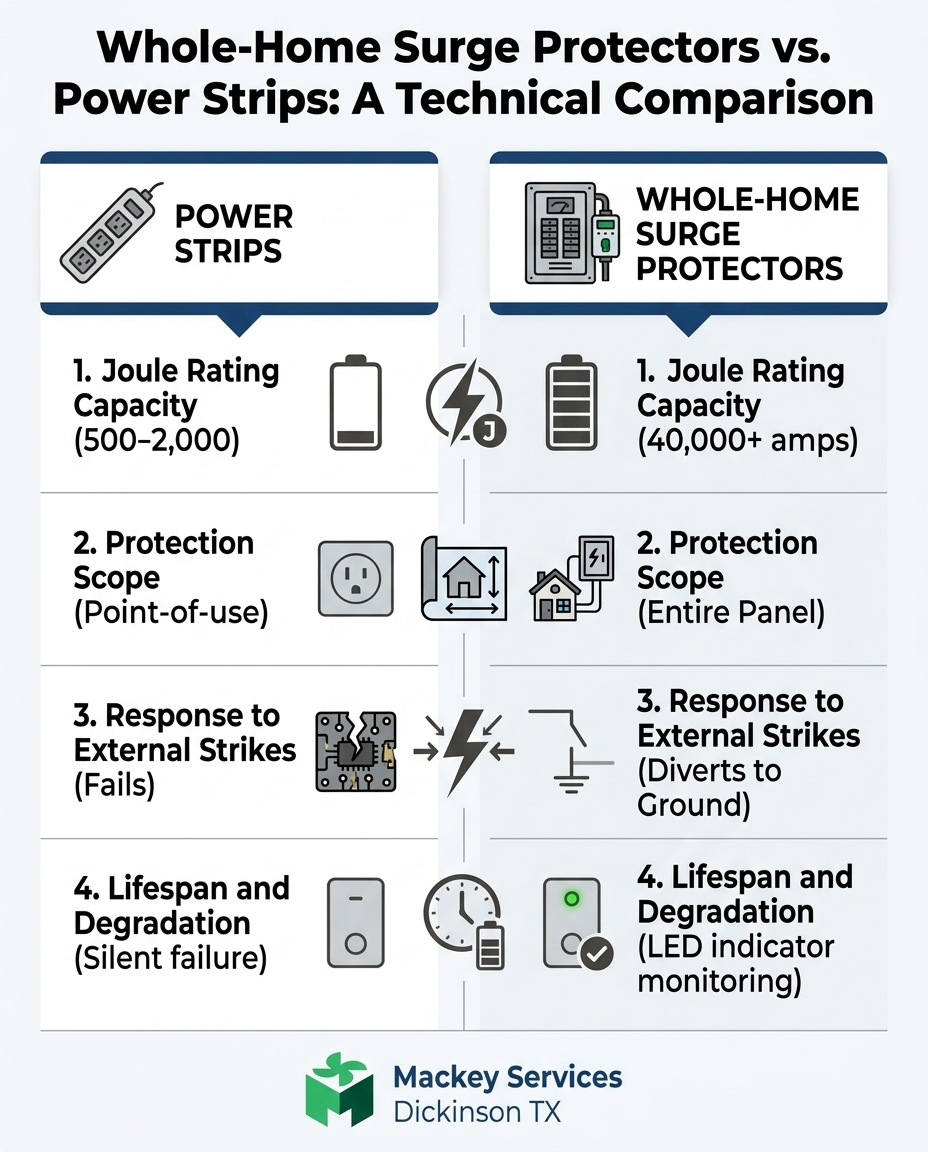
- Joule Ratings and Capacity: A joule is a measurement of energy absorption. Standard power strips typically offer between 500 and 2,000 joules of protection. Once that capacity is absorbed, the strip no longer offers any defense.
- Clamping Voltage Thresholds: This is the exact voltage at which the surge protector kicks in to divert excess power. Many standard strips have a high clamping voltage, meaning they allow too much excess electricity through before they even react, causing micro-damage to sensitive gear.
- Delayed Response Times: Point-of-use strips often react milliseconds too slowly. In the world of delicate microprocessors, a millisecond delay is more than enough time for a high-voltage spike to fry a motherboard.
- Silent Degradation: MOVs degrade slightly every time they absorb a small surge. Over time, your power strip loses its protective capabilities silently, leaving your luxury electronics completely unprotected without you ever realizing it.
While these plug-in devices are useful for minor fluctuations, they act as a localized, insufficient barrier against high-voltage threats. This is a primary reason why Texas homes need surge protection installed at the source.
Joule Capacity vs. Massive Voltage Spikes
The math behind joule capacity reveals the true vulnerability of plug-in strips. A high-end power strip might boast a 2,000-joule rating, which sounds substantial until you compare it to the sheer volume of transient current generated by severe external weather events. A nearby lightning strike or a major grid failure can send tens of thousands of amps through the utility lines in a fraction of a second. This massive influx of energy instantly depletes the 2,000-joule capacity of a plug-in strip, melting its internal components and allowing the remaining thousands of volts to travel directly into your home theater equipment. In areas like Dickinson TX, where severe weather is a reality, our electrical team routinely sees the aftermath of these events. We always remind customers that relying on a 2,000-joule strip to stop a grid-level surge is like trying to stop a flood with a sponge.
Why Regional Grid Instability Demands Stronger Defenses
The electrical grid operates under extraordinary strain, and contextualizing the surge threat requires looking at local seasonal data. The Texas grid places unique and severe stress on residential electrical systems, transforming robust electrical resilience from a luxury into an absolute necessity. During peak cooling seasons, extreme seasonal demands lead to conservation alerts and rolling fluctuations. When the grid drops voltage to conserve power and then suddenly restores it, the resulting surge travels straight from the utility pole into your home's main electrical panel.
This threat is compounded heavily by the weather. Extreme August heat heavily strains the utility grid at the exact same time that late-summer Gulf Coast thunderstorms reach their peak frequency. Localized lightning strikes routinely hit transformers and power lines, sending massive transient voltage spikes down the line. Because these external surges enter through the main service drop, they have a direct path to every circuit in your house. For homeowners looking to protect their investments, understanding this regional instability is crucial. It is also why many residents explore standby generator solutions to maintain stable, clean power during severe August late-summer grid stress. Without a heavy-duty defense at the main panel, your luxury electronics are at the mercy of the grid's volatility.
The Mechanics of Panel-Mounted Surge Protection
The Problem: Massive external grid spikes and lightning surges easily bypass localized point-of-use power strips, traveling through branch circuits to destroy hardwired luxury appliances and sensitive home theater components.
The Cause: Utility lines feed high-voltage electricity directly into a home's main breaker panel. Without a gatekeeper installed at this primary entry point, there is nothing to stop a massive transient current from flooding the internal wiring of the home. Standard plug-in strips simply do not have the physical capacity or the direct grounding path necessary to handle utility-level surges.
The Solution: Panel-mounted surge protection systems are installed directly at the breaker box to act as a primary, heavy-duty gatekeeper. Instead of trying to absorb the hit like a plug-in strip, these whole-home systems are designed to safely divert 40,000+ amps of transient current straight to the earth ground before it ever reaches the home's internal wiring. By stopping the surge at the source, these systems achieve an effective clamping voltage under 400V, protecting everything downstream. This comprehensive approach is the only way to protect hardwired luxury appliances—such as smart HVAC systems, built-in architectural audio, and automated lighting controls—that cannot simply be plugged into a standard power strip. For homes in Dickinson TX, this mechanical diversion is the definitive defense against external electrical threats.
Internal vs. External Threats: The Micro-Surge Problem
While external lightning strikes and grid failures are dramatic, they are not the only threat to your luxury electronics. Up to 80% of all power surges actually originate inside the home. These internal surges occur when large motorized appliances—such as HVAC compressors, refrigerators, and pool pumps—cycle on and off. Every time a heavy-duty motor starts up, it draws a massive amount of electricity, causing a brief voltage drop followed by a subsequent surge as the power stabilizes. These constant micro-surges slowly degrade the delicate microprocessors in home theaters and smart hubs over time, significantly shortening their lifespan.
During extreme heat, heavy internal electrical loads strain the breaker panel and can cause localized short circuits. In one recent late-summer service call our team handled, an air conditioning system repeatedly tripped a home's breakers. Our technicians diagnosed a short circuit in the system. While we repaired the AC and helped the homeowner avoid a full compressor replacement, that continuous breaker tripping sent repeated, intense micro-surges straight through the home's electrical wiring. A whole-home system regulates these internal fluctuations across the entire electrical panel, acting as a shock absorber for the whole house and protecting your delicate electronics from the heavy machinery running on the same electrical system.
How HVAC Cycling Impacts A/V Equipment
When an air conditioner kicks on during peak August late-summer grid stress, it requires a massive electrical draw to start the compressor. This sudden demand pulls current away from other circuits, creating a momentary voltage sag. When the compressor reaches its operating speed, the excess electricity rushes back into the system, creating a voltage spike. Because your sensitive A/V gear shares the same main electrical bus bar in the panel as your air conditioner, that spike travels directly into your receivers, amplifiers, and displays, causing cumulative damage to the circuitry.
Cascading Protection: The Ultimate Strategy for Luxury Gear
When it comes to true luxury electronics defense, it is not an "either/or" choice between a whole-home system and a plug-in strip. The ultimate strategy for safeguarding high-end home theaters in Dickinson TX is a concept known as cascading protection. Cascading protection is the strategic pairing of a panel-mounted system with high-quality point-of-use strips to create a layered defense.
In this layered approach, the whole-home unit acts as the heavy shield against massive external spikes, such as lightning or major grid surges. It takes the brunt of the 40,000-amp hit and diverts it safely to the ground. However, a small amount of residual voltage (usually under 400V) may still pass through. This is where the plug-in strip acts as the final, precision filter. The high-quality strip catches that residual voltage, as well as any minor internal micro-surges generated by nearby appliances, ensuring that absolutely clean, stable power reaches your delicate components.
| Protection Layer | Primary Function | Surge Capacity | Best Application |
|---|---|---|---|
| Panel-Mounted System | Diverts massive external surges to ground at the source. | 40,000+ Amps | Whole-house defense, hardwired appliances, HVAC. |
| Point-of-Use Strip | Filters residual voltage and minor internal micro-surges. | 500 - 2,000 Joules | Localized defense for specific A/V components. |
| Cascading Strategy | Combines both for zero-tolerance luxury gear defense. | Maximum layered capacity | High-end home theaters, smart hubs, automated homes. |
Why Licensed Installation Matters for Electrical Safety
Opening a main breaker panel is extraordinarily dangerous, and DIY installation of whole-home surge protectors is unsafe, highly ill-advised, and often illegal without proper permitting. A panel-mounted system is only as effective as its connection to the earth ground. Improper grounding renders even the most advanced surge protector completely useless, leaving your entire home vulnerable to catastrophic electrical damage.
This is why expert installation by licensed local professionals—like our team at Mackey Services—who deeply understand the unique vulnerabilities of the Texas power grid is critical for ensuring luxury electronics are truly defended. We know exactly how August late-summer grid stress impacts residential panels and can accurately recommend whether your home requires a Type 1 (installed on the line side of the main breaker) or Type 2 (installed on the load side) device. Furthermore, professional installation ensures total compliance with local electrical codes and maintains the strict warranty requirements of both the surge protection equipment and your high-end home theater components. Integrating panel inspections into your routine electrical maintenance guarantees that your layered defense system remains active and capable of handling whatever the grid throws at it.
Secure Your Home Theater Before the Next Grid Event
Understanding the severe limitations of plug-in strips gives homeowners the confidence to upgrade their electrical defenses. A standard power strip simply cannot stand up to the extreme voltage spikes generated by Dickinson TX weather and regional grid strain. By adopting a layered, professionally installed cascading approach, you ensure that your expensive home theater and smart automation systems are shielded from both massive external strikes and daily internal micro-surges. Do not wait for a catastrophic spike to realize your localized strips were insufficient. Schedule an assessment of your main panel and explore whole-home surge protection installation before the next major seasonal weather event impacts your neighborhood.
Frequently Asked Questions
Is whole house surge protection worth it for a home theater?
Yes, it is absolutely worth the investment for high-end home theaters. A panel-mounted system acts as a heavy-duty gatekeeper, stopping massive external voltage spikes before they can bypass your localized power strips and fry delicate microprocessors. Without this primary layer of defense, your expensive audio and visual components remain completely vulnerable to grid failures and lightning strikes.
Do I need surge protector power strips if I have a whole house surge protector?
Yes, you should still use high-quality point-of-use strips as part of a cascading protection strategy. While the whole-home unit diverts massive external surges, the plug-in strip catches any minor residual voltage and filters out internal micro-surges caused by nearby appliances cycling on and off. Together, they provide the ultimate layered defense for sensitive gear.
Can a power surge destroy a TV even if it's turned off?
Yes, a power surge can easily destroy a television even when the screen is powered down. Modern smart TVs are never truly "off"; they remain in a standby mode, keeping their internal power supplies and microprocessors actively connected to the electrical circuit. If a massive transient voltage spike travels through the wiring, it will bypass the standby state and melt the internal components instantly.
What is the difference between a Type 1 and Type 2 surge protector?
A Type 1 surge protector is typically installed on the line side of the main service entrance (between the utility pole and the main breaker) to defend against external lightning strikes. A Type 2 surge protector is installed on the load side (inside the main breaker panel) and protects against both external grid surges and internal micro-surges generated by large household appliances. A licensed professional can determine which type best suits your home's infrastructure.
How do I know if my whole-home surge protector is working?
Most modern whole-home surge protectors feature built-in LED status indicator lights on the face of the unit. As long as the green light is illuminated, the internal metal oxide varistors are functioning and the system is actively defending your panel. If the light goes out or turns red, the unit has absorbed its maximum capacity and must be replaced by a qualified electrician immediately.
How does extreme summer heat affect my home's electrical panel?
Extreme summer heat forces the regional power grid to run at maximum capacity, leading to rolling fluctuations, brownouts, and sudden voltage spikes as power is managed. Simultaneously, your home's air conditioner runs constantly, pulling heavy electrical loads that heat up the physical breakers and wiring inside your panel. This combination of external grid instability and internal heavy load creates the perfect storm for electrical surges and short circuits.
Ready for a better day?
One call handles it all — HVAC, electrical, and generators across the Texas Gulf Coast. Less to pay. Better day. That's the Mackey way.
Mon–Fri: 7 AM – 8 PM · Sat: 8 AM – 5 PM · Licensed & insured · #TACLA 112769C · #TECL 558211