
The Anatomy of an August Capacitor Failure in Overworked AC Units
Why an August capacitor failure in overworked AC units happens. See what that humming sound means for your compressor and decide when to call a professional.
Surviving the Late Summer Sizzle: When Your AC Reaches Its Breaking Point
Late summer in Dickinson, TX brings a relentless, oppressive heat, and if you are dealing with the anatomy of an August capacitor failure in overworked AC units, you already know the intense frustration of losing cold air when you need it most. By the time the back-to-school season rolls around, your air conditioner has likely been running non-stop since April. That continuous operation takes a heavy toll on the internal electrical components that keep the system moving. While many homeowners assume a sudden breakdown is just a random stroke of bad luck, the reality is usually much more predictable. These late-summer failures are almost always the result of cumulative wear and tear on a specific, highly stressed component.
When you need reliable HVAC services, getting timely air conditioning repair stops a minor component failure from ruining your entire system.
The unsung hero of your outdoor condenser unit is the capacitor. This small, cylindrical device bears the absolute brunt of the electrical strain required to keep your home cool. As the days drag on and the temperatures refuse to drop, the capacitor is forced to work harder and hotter than it was designed to endure. Understanding how this component operates—and why it eventually surrenders to the late summer / August in Dickinson, TX climate—is the first step in protecting your larger, much more expensive cooling equipment. Catching a struggling system before it completely locks up can save you from a major headache.
The Jump-Starter: Understanding Your AC Capacitor's Crucial Role
To understand why a failed capacitor brings your entire air conditioner to a grinding halt, you have to look at the sheer physical effort required to start a heavy mechanical motor. Your outside unit houses the compressor and the fan motor, both of which require a massive jolt of electricity to overcome their initial resting inertia. The power grid connected to your house simply cannot deliver that sudden, massive spike of energy fast enough on its own. That is where the capacitor steps in.
Think of the capacitor as a temporary, high-powered battery. It stores up electrical energy and then releases it in one powerful burst to jump-start the motors. Without this initial kick, the motors would just sit there, drawing current but failing to spin. If you have ever noticed a distinct humming or clicking sound from the outside condenser, you are likely hearing the motor trying desperately to start without the help of a functioning capacitor.
There are generally two types of capacitors working inside your system, and understanding their different roles highlights just how hard they work during a long cooling season.
| Capacitor Type | Primary Function | Impact of Failure |
|---|---|---|
| Start Capacitor | Delivers the massive initial jolt of torque (measured in microfarads) to get the heavy compressor motor spinning from a dead stop. | The compressor will not turn on at all. You will hear a loud buzzing or humming as the motor tries to pull locked-rotor amps. |
| Run Capacitor | Provides a continuous, steady supply of optimized voltage to keep the fan and compressor motors running smoothly and efficiently. | The system may start, but the motors will run hot, draw excessive amperage, and eventually shut down from thermal overload. |
Because these components are responsible for managing such intense electrical loads, they are inherently vulnerable to degradation over time. Every single time your thermostat calls for cooling, the capacitor takes a hit. Over a long season, those thousands of start-and-stop cycles add up.
Cumulative Thermal Fatigue: Why August is the Danger Zone
Capacitors are incredibly sensitive to heat. Inside the metal casing of the component is a dielectric fluid or specialized film that helps store the electrical charge. When exposed to high temperatures for prolonged periods, these internal materials begin to break down, lose their ability to hold a charge, and eventually bulge or leak. This timeline of thermal degradation explains exactly why failures spike so dramatically at the end of the cooling season.
In the Gulf Coast region, the environmental factors compound the mechanical stress. The combination of intense daytime solar radiation baking the metal condenser cabinet and the severe lack of significant nighttime cooldowns means the unit never truly gets to rest. The internal ambient temperature of the cabinet rarely drops enough to let the capacitor cool off, accelerating the breakdown of its internal materials. If you find yourself troubleshooting AC failure during heatwaves, cumulative thermal fatigue is usually the culprit.
The Timeline of Thermal Degradation
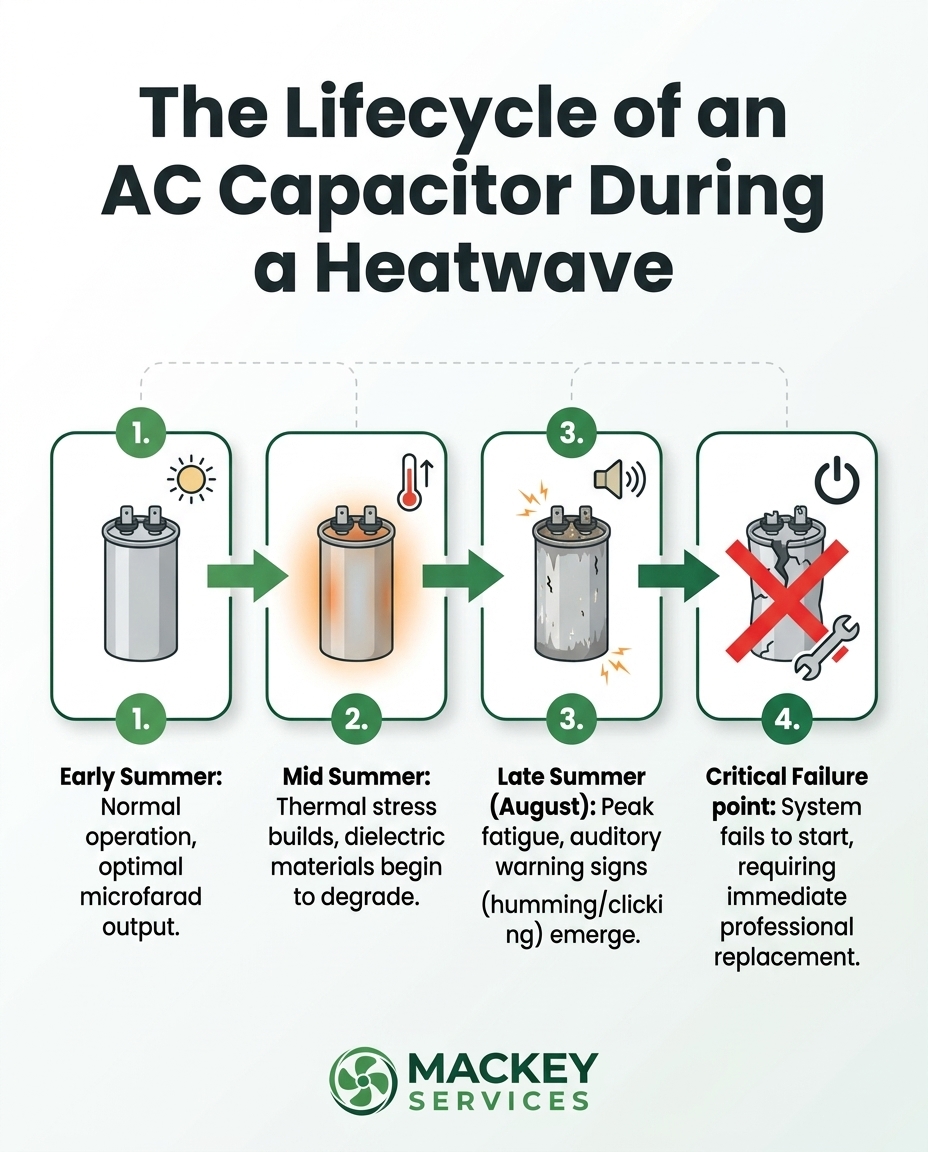
- Early Summer (May - June): The capacitor is operating within its normal thermal limits. The microfarad output matches the manufacturer's specifications, and the system starts smoothly. The dielectric materials inside are stable.
- Mid-Summer (July): The heat wave sets in. The system begins running longer cycles to combat the soaring humidity. Internal cabinet temperatures rise, and the dielectric fluid begins to slowly degrade under the constant thermal stress. The capacitor has to work slightly harder to store the same amount of energy.
- The Breaking Point (Late summer / August in Dickinson, TX): The component reaches its physical limit of thermal endurance. The internal pressure often causes the top of the capacitor to swell outward (commonly called "mushrooming"). The component can no longer deliver the necessary voltage, leading to hard starts and eventual complete failure.
By the time August arrives, the capacitor isn't just dealing with today's heat—it is suffering from the cumulative damage of the entire summer. The breakdown is a gradual physical degradation that finally crosses the threshold of functionality.
Auditory Alarms: Listening for the Warning Signs of Failure
Your air conditioning system will rarely fail without giving you a few hints first. Because a failing capacitor struggles to deliver the right amount of voltage, it forces the rest of the system to behave erratically. Equipping yourself with the knowledge to recognize these sensory clues is the best way to prevent a minor electrical issue from escalating into a catastrophic mechanical failure.
One local homeowner experienced an intermittent malfunction during a warm spell where the system simply stopped responding correctly. The technician listened closely to the problem, gathered the necessary diagnostic information, and walked the customer through the exact steps to monitor the system moving forward. Listening to your system—and knowing what those sounds mean—is a critical part of homeownership.
If you notice any of the following warning signs, your capacitor is likely on the verge of giving out:
- A distinct humming or clicking sound from the outside condenser: This is the most common and urgent warning sign. The clicking is the electrical relay trying to engage, and the loud hum is the motor trying to start but failing because it isn't receiving the necessary voltage kick.
- Hard starting: If your AC seems to stutter, hesitate, or shake violently when it kicks on, the capacitor is struggling to provide enough starting torque.
- Dimming house lights: When a weak capacitor fails to assist the compressor, the motor pulls an excessive amount of amperage directly from your home's electrical panel, which can cause the lights in your house to briefly dim or flicker.
- Intermittent breaker tripping: If your AC keeps tripping the circuit breaker, it is pulling too much current. This is a built-in safety mechanism protecting your home from the severe electrical strain caused by a degraded capacitor.
- Warm air blowing indoors: If the indoor fan is running but the outside compressor cannot start due to a dead capacitor, your vents will blow unconditioned, warm air into the house.
Ignoring these signs will only force the system to work harder, accelerating the damage to other components.
Protecting the Compressor: Why Prompt Action is Non-Negotiable
The decision point for a homeowner usually happens right after hearing that distinct humming or clicking sound from the outside condenser. Do you ignore it and hope the system eventually kicks on, or do you shut it down and call for help? The answer is always to turn the system off immediately at the thermostat. Prompt action is non-negotiable because the health of your compressor depends entirely on it.
The Problem: When a capacitor fails, it doesn't stop the thermostat from asking for cold air. The system will continue trying to start the compressor. Because the motor is heavy and requires that jump-start, it enters a state called "locked rotor." The motor is receiving electricity, but it cannot spin.
The Cause of Damage: In a locked rotor state, the electrical energy has nowhere to go, so it rapidly converts into intense heat. The compressor motor will begin to overheat severely. While modern compressors have internal thermal overload protectors that will eventually shut the motor down to prevent a fire, relying on this safety switch is incredibly dangerous. Repeatedly forcing the compressor to overheat will eventually melt the internal wire insulation, causing the motor to short out and die completely.
The Solution: Turning off the thermostat stops the cycle of electrical abuse. A capacitor replacement is a straightforward, routine repair. Replacing a ruined, burned-out compressor, on the other hand, is one of the most labor-intensive and financially draining repairs in the HVAC industry. By recognizing the warning sounds and acting quickly, you are quite literally saving the heart of your air conditioning system.
The Diagnostic Process: Why Capacitor Replacement Requires an Expert
With so many tutorials available online, it can be tempting to try and swap out a bulging component yourself. However, opening the electrical panel of an air condenser is incredibly dangerous. This specific repair must always be handled by a licensed professional. Capacitors are designed to store massive amounts of electrical energy, and they retain that lethal charge even after the power to the unit has been completely shut off at the breaker. Touching the wrong terminals can result in a severe, life-threatening shock.
Professional diagnostics go far beyond simply looking for a swollen part. Licensed technicians use specialized multimeters to safely discharge the component and test the microfarad readings against the exact manufacturer specifications. If a replacement is needed, they ensure the new part matches the exact voltage and capacitance ratings required by your specific unit. Installing the wrong size can permanently damage the fan motor or compressor.
For example, one customer recently reached out during the spring when their AC stopped cooling entirely. A technician arrived, safely troubleshot the electrical panel, cleaned up the wiring, and completely repaired the system—leaving the house perfectly cool before heading to the next stop. That level of thoroughness ensures that no other components were damaged during the failure.
Working with Mackey Services means relying on deep experience handling peak-summer AC emergencies throughout the Gulf Coast. Fast diagnostics and reliable replacement parts are critical when the heat index is soaring. If you are experiencing issues, checking our local service areas ensures you can get a qualified expert out to your home quickly to restore your cooling safely, especially during the brutal late summer / August in Dickinson, TX weather.
Breaking the Cycle: Shielding Your System from Future Heatwaves
While you cannot control the weather during late summer / August in Dickinson, TX, you can take proactive steps to reduce the thermal strain on your HVAC system. Lowering the overall workload on the condenser directly extends the lifespan of the electrical components inside.
Here are the most effective ways to shield your system from cumulative thermal fatigue:
- Keep the condenser coils clean: The outside unit needs to breathe to dissipate the heat it removes from your home. If the aluminum fins are clogged with dirt, grass clippings, or cottonwood seeds, the heat stays trapped inside the cabinet. This raises the internal temperature and cooks the capacitor much faster. Gently washing the coils with a garden hose (never a pressure washer) keeps airflow optimal.
- Provide natural shade: If your condenser sits in direct, blistering afternoon sunlight, consider planting a shade tree or installing an awning nearby. However, you must ensure there is at least two to three feet of completely unobstructed clearance around the unit for proper ventilation.
- Schedule seasonal tune-ups: The best defense against an August breakdown is a spring inspection. During routine AC maintenance, technicians measure the electrical draw and microfarad output of the capacitor. If it is showing signs of weakness, it can be replaced proactively before it fails under peak load.
- Monitor the age of the system: Most capacitors last between 5 to 10 years, depending on usage and climate. If your system is aging and has endured multiple brutal Texas summers, proactive component replacement makes sense to ensure reliability.
- Change your indoor air filters: A dirty indoor filter restricts airflow, forcing the outdoor unit to run longer cycles to achieve the target indoor temperature. Longer cycles mean more heat buildup inside the condenser cabinet.
By managing the factors you can control, you give your system a fighting chance to make it through the hottest months of the year without a catastrophic failure.
Frequently Asked Questions
What causes an AC capacitor to blow?
An AC capacitor typically blows due to cumulative thermal fatigue, excessive electrical surges, or simple old age. The heat from continuous operation breaks down the internal dielectric materials, causing the component to swell, leak, and eventually fail to hold a charge.
What does a bad AC capacitor sound like?
A failing capacitor usually produces a distinct humming or buzzing sound from the outside condenser unit. This noise happens because the motor is trying to start but isn't receiving the electrical jolt it needs, resulting in a loud electrical hum as it pulls locked-rotor amps.
Can a bad capacitor ruin an AC compressor?
Yes, forcing a system to run with a bad capacitor can absolutely ruin the compressor. Without the capacitor's assistance, the compressor motor will overheat repeatedly as it tries to start, which can eventually melt the internal wiring and cause a complete mechanical failure.
Can extreme heat cause an AC capacitor to fail?
Extreme heat is one of the primary causes of capacitor failure. High ambient temperatures combined with the heat generated by the running motors push the internal temperature of the condenser cabinet beyond the component's maximum thermal rating, accelerating its breakdown.
Why is my outside AC unit buzzing but the fan isn't turning?
If your outside unit is buzzing but the fan blades are stationary, the run capacitor has likely failed. The buzzing is the sound of electrical current reaching the motor, but without the capacitor to provide the starting torque, the fan simply cannot spin.
Keep Your Cooling System Running Strong
Surviving the late summer heat requires a cooling system that is operating at peak efficiency, and ignoring a struggling component will only lead to bigger problems down the road. If you hear a distinct humming or clicking sound from the outside condenser, shut the system off immediately. Schedule your professional replacement today to protect your compressor and restore your home's comfort safely.
Ready for a better day?
One call handles it all — HVAC, electrical, and generators across the Texas Gulf Coast. Less to pay. Better day. That's the Mackey way.
Mon–Fri: 7 AM – 8 PM · Sat: 8 AM – 5 PM · Licensed & insured · #TACLA 112769C · #TECL 558211