
Rewiring Historic Galveston Properties Without Destroying Plaster Walls
Why we use specialized routing for rewiring historic Galveston properties without destroying plaster walls. Decide with confidence before summer hits.
The Challenge of Modernizing Electrical Systems in Historic Coastal Homes
Your legacy electrical system is struggling to keep up with daily life, but the fear of Rewiring Historic Galveston Properties Without Destroying Plaster Walls keeps you frozen in indecision. You know that relying on century-old wiring is a massive safety hazard. At the same time, you refuse to let contractors tear open the irreplaceable lath and plaster that gives your coastal home its character. Owning a piece of coastal history comes with the heavy responsibility of preserving its architectural integrity while ensuring modern safety. In our years serving the Dickinson and coastal Texas areas, our team at Mackey Services has proven that you do not have to choose between a secure home and your beautiful original walls.
For comprehensive professional home services, our expert electricians use specialized routing techniques to protect your property while bringing your power grid into the modern era.
The True Cost of Waiting
Upgrading outdated electrical systems is often delayed because homeowners fear the demolition process. Many assume that updating a house means gutting it down to the studs. However, relying on legacy wiring during the heavy demands of the August late-summer cooling season poses severe fire and safety risks. Old wiring was never designed to handle the continuous draw of modern appliances, high-definition televisions, and central air conditioning.
The professional difference: Choosing a professional approach that utilizes specialized routing techniques allows for safe modernization without sacrificing the home's historic charm. Our experts understand the structural nuances of historic builds. We know exactly how to map out a safe, non-destructive path for new wiring, ensuring your home remains beautiful on the outside and structurally sound on the inside.
How Coastal Environments Accelerate Legacy Wiring Deterioration
Living near the water offers incredible views and a beautiful breeze, but that same environment is incredibly hostile to early 20th-century building materials. Our team routinely sees how Galveston's specific coastal humidity and airborne salt air uniquely accelerate the breakdown of early 20th-century cloth wiring insulation. When this vintage cloth sheathing absorbs moisture and salt, it becomes brittle, flakes away, and leaves bare conductive metal exposed inside your walls.
Knob-and-tube wiring lacks a grounding conductor, making it highly susceptible to faults as the protective sheathing degrades over time. Without a ground wire, any stray electrical current has nowhere safe to go, significantly increasing the risk of a severe shock or an electrical fire. Plaster walls can conceal this dangerous deterioration, allowing moisture intrusion to compromise bare wires silently over decades.
Signs of Hidden Deterioration
Because you cannot see the wires inside your walls, we recommend watching for these secondary warning signs to tell you when the coastal environment has compromised your system:
- Flickering or dimming lights: Often indicates that a degraded wire is struggling to maintain a consistent connection.
- Warm switch plates: A clear sign that electrical resistance is building up behind the wall, generating dangerous heat.
- Burning odors: A faint smell of ozone or melting plastic means an electrical arc is actively occurring.
- Two-prong outlets: If your home still relies on ungrounded two-prong receptacles, your system is completely unprotected from power surges.
Proactive replacement is absolutely necessary before degraded insulation leads to arcing or short circuits hidden within the wall cavities. Waiting for a complete failure in a coastal environment usually means waiting for a fire.
Meeting Modern Cooling Demands Safely
Historic homes were built long before the invention of high-capacity central air conditioning systems. When these beautiful houses were constructed, electricity was primarily used for a few low-wattage lightbulbs and perhaps a radio. Today, pushing modern HVAC systems to maximum capacity frequently overloads outdated electrical panels and ungrounded circuits. The sheer volume of electricity required to cool a large historic home is staggering compared to what the original builders anticipated.
When circuits are overloaded, the system will repeatedly trip breakers or suffer short circuits, leaving the home without cooling when it is needed most. A pattern we see often is homeowners reaching out to us during the intense heat of the August late-summer cooling season when their climate control system keeps tripping the circuit breakers under heavy load. Our technicians frequently diagnose short circuits in the outdated wiring and repair them to restore reliable comfort. This pattern of system failure is incredibly common when old wiring meets modern climate control.
Legacy Capacity vs. Modern Demand
Understanding the gap between what your home was built to handle and what you actually use explains why our professional upgrades are so vital.
| Electrical Component | Historic Standard (Pre-1950) | Modern Requirement |
|---|---|---|
| Main Service Panel | 30 to 60 Amps | 200+ Amps |
| Circuit Grounding | None (Two-wire system) | Dedicated Ground Wire |
| HVAC Dedicated Circuit | Non-existent | 220V Dedicated Line |
| Insulation Material | Cloth or Rubber (Degrades) | Thermoplastic (Moisture Resistant) |
A proper electrical upgrade ensures that the home's infrastructure can safely handle the sustained draw of the August late-summer cooling season. Without this modernization, your air conditioner will constantly fight a losing battle against inadequate power delivery.
Navigating Balloon Framing and Structural Quirks
When we work in Galveston historic districts, we frequently encounter balloon framing in homes built before the 1930s. This is a construction method with long, continuous wall cavities that run directly from the foundation all the way to the roofline. Unlike modern platform framing, which separates each floor with horizontal structural plates, balloon framing leaves the vertical wall spaces completely open.
This architectural style presents a massive safety hazard when paired with failing electricity. Balloon framing lacks modern fire blocking, meaning an electrical fire sparked by faulty wiring can spread rapidly from the ground floor to the attic in a matter of minutes. The open cavities act like a chimney, drawing the flames upward and destroying the home before emergency services can respond.
The Silver Lining for Professional Electricians
Interestingly, these continuous cavities, while a fire risk with old wiring, actually provide pathways for our professionals to route new wire because we understand the structural layout. Because there are no horizontal fire blocks in the way, an experienced Mackey Services electrician can drop a new wire from the attic straight down to a first-floor receptacle without having to cut open the middle of the wall.
- Mapping the drop: Our professionals carefully measure the distance from the attic access point to the target outlet on the floor below.
- Navigating obstacles: We account for diagonal bracing and historic plaster keys that might block the path.
- Executing the pull: Using specialized weights and chains, our team guides the new wire down the continuous cavity.
Blindly drilling into these walls without understanding the framing can cause extensive structural damage and severe plaster cracking. If a drill bit catches on a piece of historic wood lath, the vibration can shatter the brittle plaster on the other side of the wall in seconds.
Professional Wire Routing: Bypassing Plaster Walls
Replacing Knob-and-tube wiring requires specialized tools to fish new lines without relying on standard demolition. A general contractor might suggest tearing down the plaster and putting up modern drywall, but our preservation-minded electricians know how to work around the home's original materials. Understanding the dangers of DIY electrical work is especially important here, as amateur fishing attempts almost always result in destroyed walls and unsafe connections.
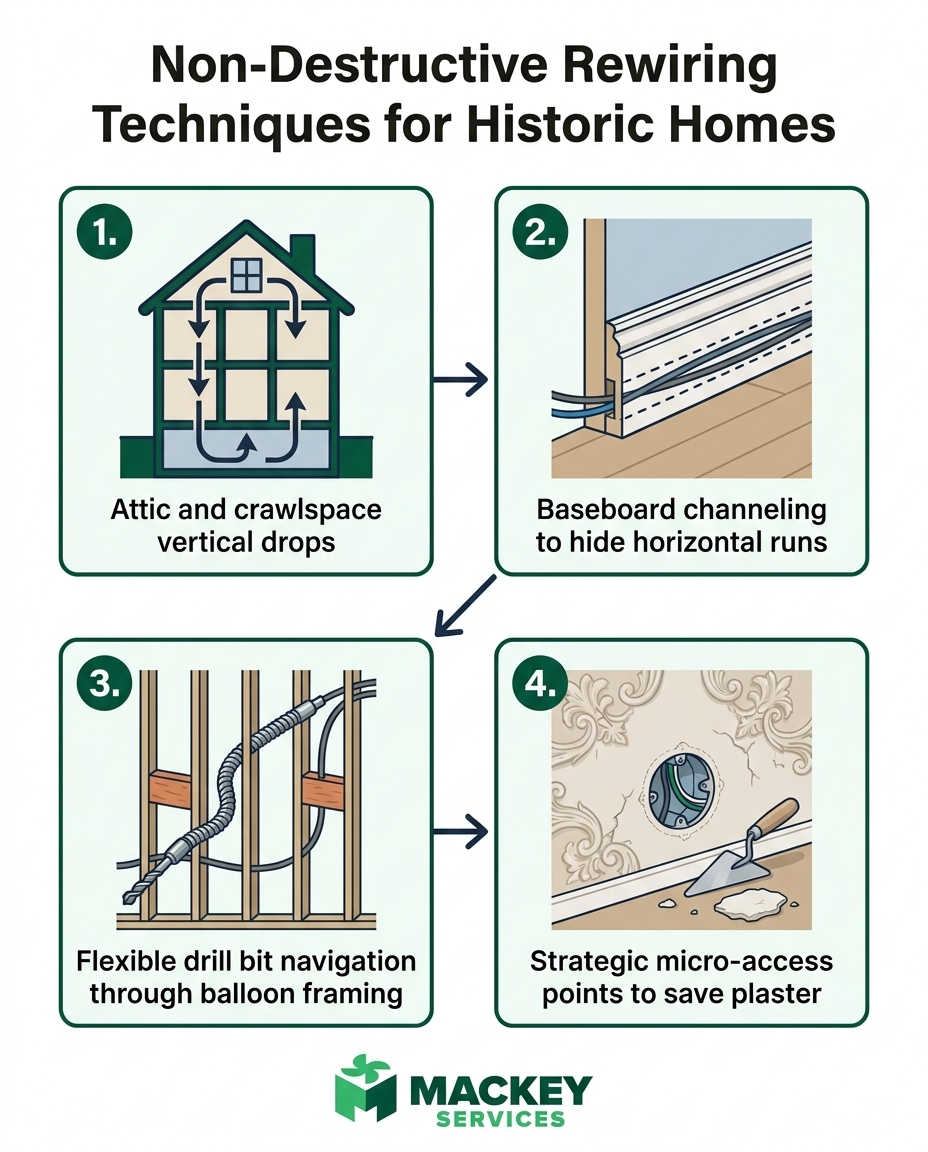
Our professionals use attics and crawlspaces as primary arteries, dropping wires down into wall cavities from above or pushing them up from below. This allows the bulk of the heavy electrical lifting to happen completely out of sight. Flexible drill bits and fiberglass rods allow our electricians to navigate tight spaces and cross-bracing without opening the wall surface. These methods require immense precision to avoid structural vibrations that can easily crack brittle, century-old lath and plaster.
The Role of Flexible Drill Bits
Flexible drill bits are long, bendable shafts that allow an electrician to drill through internal studs from a single small access point. By removing a switch plate, our professionals can insert a flexible bit and drill through horizontal blocking hidden inside the wall.
Precision is paramount: This technique requires intense professional training to avoid drilling into hidden plumbing, gas lines, or existing live wires. The operator relies entirely on tactile feedback to know what the bit is touching inside the dark wall cavity.
Attic and Crawlspace Arteries
Using the uppermost and lowermost unfinished spaces of the home minimizes the need for horizontal wire runs through living spaces. Instead of tearing a horizontal trench across your beautiful living room wall to connect three outlets, our electrician drops three individual vertical lines down from the attic.
Preserving the visible space: This strategy keeps the bulk of the electrical updates hidden in unfinished areas. The main trunk lines run safely along the crawlspace joists, completely invisible to anyone walking through the historic home.
Strategic Access: Baseboard Channeling and Micro-Cuts
Even with continuous wall cavities and attic access, there are always areas in Galveston historic districts where vertical drops simply are not an option. Solid brick firewalls, massive pocket doors, and complex staircases can block traditional wire fishing routes. When these obstacles arise, our professionals utilize existing architectural features to hide wire paths rather than reaching for a sledgehammer.
The baseboard bypass: Carefully removing historic baseboards allows our electricians to channel wiring behind the thick wooden trim. Once the wire is secured in the gap between the floor and the wall board, the original baseboard is meticulously reattached, completely concealing the work. This method allows for long horizontal runs across a room without ever touching the plaster above the trim line.
Precision micro-cuts: If a wall must be opened to navigate a complex corner, our professionals use strategic micro-access points rather than massive drywall cuts. A trained technician will cut a small, neat rectangle just large enough to fit a hand or a tool. Because the cut is surgical, the original piece of plaster can often be reinserted and patched seamlessly.
At Mackey Services, our specialized expertise in non-destructive electrical updates means we always prioritize your home's architectural beauty over quick, destructive methods. We understand that your plaster walls are irreplaceable, and our routing strategies reflect that deep respect for historic craftsmanship.
Complying With Local Preservation Standards
Homes located within Galveston historic districts are often subject to strict preservation guidelines enforced by local historical societies and municipal boards. These organizations exist to protect the unique visual and structural heritage of the island, and they take unapproved renovations very seriously.
Extensive wall replacements or exterior alterations for electrical updates are frequently prohibited or require complex, drawn-out approval processes. If a contractor suggests ripping down your plaster and replacing it with modern drywall, you could quickly find yourself facing heavy fines and stop-work orders from the local historical commission.
Why Local Expertise Matters
Non-destructive internal upgrades ensure compliance with these regulations while maintaining the home's structural integrity against coastal moisture intrusion. By keeping the original plaster intact, you preserve the home's historical classification and avoid triggering strict modern building codes that apply to full-scale demolitions.
Working with a local team like ours that understands these requirements prevents costly compliance violations and preserves the property's historical value. Our familiarity with the Galveston service area means we understand exactly what the local historical boards expect, ensuring your safety upgrades move forward smoothly, legally, and beautifully.
Frequently Asked Questions
Can electricians rewire a house without cutting walls?
Yes, our professional electricians can rewire a house with minimal to no wall cutting by using specialized fishing techniques. We utilize attics, crawlspaces, and basement areas to run the main trunk lines out of sight. From there, we drop wires vertically into the wall cavities, avoiding the need for large horizontal trenches in your plaster.
How do professionals fish wire through plaster walls?
Our professionals use flexible fiberglass rods, weighted chains, and long flexible drill bits to navigate inside the wall cavities. These tools allow us to bypass internal obstacles without vibrating or cracking the brittle plaster on the outside. It requires significant tactile skill and an understanding of historic framing techniques.
Is knob and tube wiring safe for modern air conditioners?
No, knob and tube wiring is never safe for modern air conditioners. This outdated wiring lacks a grounding wire and cannot handle the heavy, sustained electrical draw required by modern HVAC systems. Connecting a new air conditioner to this legacy wiring frequently results in tripped breakers, melted insulation, and a high risk of electrical fire.
How messy is rewiring a historic home?
When done by our team using non-destructive techniques, the process is surprisingly clean compared to standard demolition. Because our electricians are not tearing down walls, there is very little plaster dust generated. We use drop cloths, targeted micro-cuts, and immediate cleanup protocols to keep your living space tidy.
Does rewiring a historic home require removing the original baseboards?
It does not always require removing baseboards, but it is a highly effective technique when horizontal wire runs are necessary. Our professionals can carefully pry away the historic trim, run the wire in the gap behind it, and reattach the wood without damaging it. This completely hides the new wiring without touching the visible plaster.
Why is balloon framing a concern during electrical upgrades?
Balloon framing features continuous, open wall cavities from the foundation to the roofline without horizontal fire blocks. If an electrical spark ignites inside the wall, the fire can travel instantly to the attic. Upgrading the wiring mitigates this risk, and our professionals actually use these open cavities to easily drop new wires from above.
Upgrading your legacy power system does not mean sacrificing the architectural beauty of your coastal property. By relying on our professional, minimally invasive routing techniques, you can enjoy reliable power for your modern HVAC demands while resting easy knowing your historic plaster remains completely intact. Do not let the fear of demolition keep you living with dangerous wiring.
Ready for a better day?
One call handles it all — HVAC, electrical, and generators across the Texas Gulf Coast. Less to pay. Better day. That's the Mackey way.
Mon–Fri: 7 AM – 8 PM · Sat: 8 AM – 5 PM · Licensed & insured · #TACLA 112769C · #TECL 558211