
Preventing Catastrophic Drain Pan Overflows in Flat-Roof Commercial Buildings
What we found inside clogged RTUs and why preventing catastrophic drain pan overflows in flat-roof commercial buildings is critical. Get clear answers today.
The Hidden Threat Above: Late-Summer Condensate Dangers
August has arrived, and for the facilities we service across the Gulf Coast, preventing catastrophic drain pan overflows in flat-roof commercial buildings is likely the most critical maintenance task on the docket right now. At Mackey Services, our technicians see firsthand the toll the unrelenting late-summer heat takes on rooftop cooling equipment working around the clock to keep indoor spaces comfortable for the back-to-school transition and peak business hours. While you might be focused on keeping the air cold, a silent threat is steadily building inside the dark, damp cabinets of your cooling equipment.
If you rely on a commercial air conditioning system to cool a large footprint, you also need a routine HVAC maintenance plan to manage the massive amount of water that system pulls from the air. Commercial rooftop package units (RTUs) are specifically designed to handle heavy cooling loads, but that extreme performance comes with an extreme byproduct: condensation. Flat-roof commercial spaces are particularly vulnerable to water damage from above. When the systems designed to drain this condensation fail, gravity takes over, and the water finds the path of least resistance straight down into your building. Property managers face a crucial decision point this time of year: risk severe drop-ceiling and inventory damage, or proactively upgrade their condensate management systems before the August peak Gulf Coast humidity pushes their equipment past its breaking point.
The Mechanics of Moisture: Why RTUs Generate Gallons of Water
To understand why drain pans overflow, you first have to understand the sheer volume of water involved in commercial cooling. Commercial cooling systems do much more than simply lower the temperature of the air; they act as massive dehumidifiers for your entire building footprint. When warm, humid air passes over the freezing cold evaporator coils inside your RTU, the moisture in the air condenses into liquid water, much like a cold glass of iced tea sweating on a hot patio.
The Impact of Gulf Coast Humidity
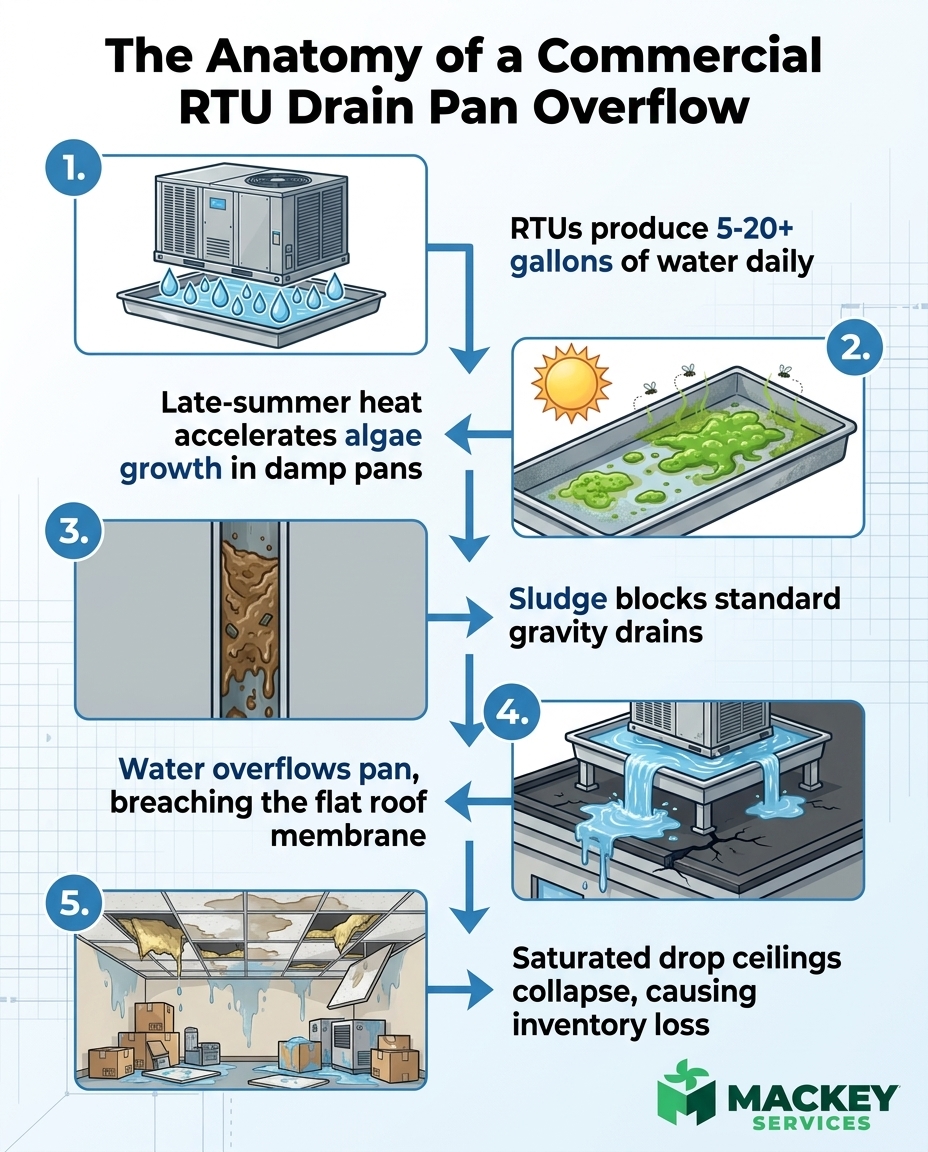
With extreme relative humidity often exceeding 80% during late summer, Dickinson TX commercial AC systems are forced to extract unprecedented amounts of moisture from the air. This isn't a trickle of water. Depending on the tonnage of the unit and the ambient conditions, commercial rooftop package units (RTUs) can easily produce between 5 to 20 or more gallons of condensate water every single day. Multiply that by several units on a large flat roof, and you have hundreds of gallons of water that must be safely routed off the building daily.
ASHRAE Guidelines and Continuous Operation
The American Society of Heating, Refrigerating and Air-Conditioning Engineers (ASHRAE) provides strict guidelines regarding commercial condensate management because this volume of water is so significant. During peak heat, your RTUs run continuously without cycling off. This continuous operation multiplies the daily water output, giving the drainage system absolutely no time to dry out or recover. The water flows endlessly into the primary drain pan, relying entirely on a clear exit path.
| Operating Condition | Condensate Volume Impact | System Stress Level |
|---|---|---|
| Mild Spring Weather (Short Cycles) | Low to Moderate | Minimal drainage stress; pans frequently dry out between cycles. |
| Early Summer (Regular Cycles) | High | Steady flow; drainage lines remain consistently wet. |
| Peak August Humidity (Continuous Operation) | Extreme (Gallons per day) | Maximum stress; constant standing water if drainage slows even slightly. |
Algae Blooms and Sludge: The Late-Summer Blockage Threat
The Problem: Even a properly sized drain line is useless if it becomes choked with debris. The environment inside a commercial RTU drain pan is the perfect incubator for biological growth. It is warm, completely dark, and constantly damp. As the summer progresses, this environment becomes increasingly hostile to clear drainage.
The Cause: The sustained August heat creates a compounding effect on rapid microbial and algae growth. Airborne dust, pollen, and microscopic organic matter constantly bypass filters and settle into the standing water of the drain pan. When you combine this organic food source with relentless heat and standing water, biological slime begins to grow rapidly. This algae doesn't just float; it binds with the dirt and dust to form a thick, dense sludge. This heavy sludge sinks into the drain line, coating the walls of the PVC pipe and slowly constricting the flow of water. Because this buildup takes months to reach critical mass, early-spring maintenance is often insufficient to prevent late-summer blockages. The lines might be perfectly clear in May, only to become completely obstructed by late August.
The Solution: Relying on a single early-season check leaves your building exposed during the most dangerous month of the year. Understanding how proper HVAC maintenance prevents mold growth and sludge buildup is critical. Facility managers must implement mid-season checks specifically targeting the drainage system before the August peak Gulf Coast humidity triggers a complete blockage.
Warning Signs of Sludge Buildup
- Slow draining: Water pools deeply in the primary pan before slowly receding when the unit shuts off.
- Foul odors: A musty, swamp-like smell enters the building through the supply vents.
- Visible slime: Thick, jelly-like substances appear around the edges of the drain pan during visual inspections.
- Frequent cycling: High humidity indoors because the system is pushing air over standing water instead of a dry coil.
Why Standard Gravity Drains Fail Under Peak Load
Most commercial rooftop units are installed with a basic gravity-fed condensate drain and a P-trap. The physics of this setup are relatively simple: water collects in the pan and flows downhill through a pipe, while the P-trap holds a small amount of water to prevent outside air from being sucked back into the unit. However, simple physics often fail when subjected to the extreme conditions of Dickinson TX commercial properties.
The High-Velocity Air Problem
Commercial blowers move a massive volume of air at high velocity. If the P-trap dries out during a brief cooler spell, or if the drain line is improperly pitched, the negative static pressure created by the blower can actually hold the water inside the drain pan. The air rushing backward through the dry drain pipe acts like a physical barrier, preventing the heavy condensate from draining. The pan fills up, and the moment the blower finally shuts off, all that suspended water drops at once, overwhelming the system.
The Limitations of Basic Protection
Gravity drains are also entirely defenseless against sudden, heavy sludge blockages. If a chunk of algae breaks loose and wedges itself in the P-trap, gravity cannot force it through. The water simply backs up. Emphasizing a proactive approach is vital here: relying solely on a primary gravity drain leaves the building entirely unprotected if a clog occurs. There is no alarm, no automatic shut-off, and no backup path for the water. The system will continue to pull moisture from the air, dumping gallon after gallon into a blocked pan until disaster strikes.
| Feature | Standard Gravity Drain | Active Condensate Management |
|---|---|---|
| Water Removal Method | Passive downhill flow | Passive flow with active monitoring |
| Blockage Response | None; water overflows pan | System shuts down to prevent overflow |
| Risk Level in Late Summer | Extremely High | Low to Minimal |
| Property Protection | None beyond the primary pan | Fail-safes protect the ceiling below |
The Chain Reaction of a Flat-Roof Drain Overflow
Ignoring condensate management carries severe business risks. When a drain pan fails on a flat commercial roof, it isn't just a mechanical inconvenience; it is a facility emergency. Based on the emergency commercial HVAC calls our Mackey Services technicians respond to across Dickinson every late summer, the operational downtime caused by preventable ceiling collapses can force businesses to close their doors for days or weeks while restoration crews tear out the damage.
Here is the exact chain reaction of how commercial rooftop package units (RTUs) cause catastrophic interior damage when their drains fail:
- The Primary Breach: The sludge blocks the P-trap completely. The RTU continues running, generating gallons of water that fill the primary pan until it breaches the edges and spills into the metal unit cabinet.
- The Roof Penetration: Water pools on the flat roof directly beneath the unit. It quickly finds the path of least resistance, which is almost always the ductwork penetrations or electrical conduits leading straight down into the building.
- The Ceiling Cavity Flooding: Water pours into the dark space above your drop ceiling, saturating insulation and pooling on top of acoustic ceiling tiles.
- The Catastrophic Collapse: Drop ceiling tiles are highly absorbent and extremely heavy when wet. Once saturated, the metal grid can no longer support the weight. The ceiling collapses without warning, dropping hundreds of pounds of wet debris, water, and ruined insulation directly onto desks, computers, or retail inventory below.
- The Secondary Threat: Even after the immediate mess is cleared, the prolonged moisture exposure inside the commercial space creates severe hazards requiring comprehensive indoor air quality solutions to mitigate subsequent mold outbreaks in the drywall and carpeting.
The Ultimate Fail-Safe: Electronic Float Switches and Secondary Pans
The good news is that this entire catastrophic chain reaction is completely preventable. In our experience outfitting commercial roofs across Dickinson, the technical solutions for preventing overflows are highly effective, provided they are installed correctly by a licensed professional. Do not attempt to wire or install these safety devices yourself, as they tie directly into the high-voltage and low-voltage control boards of your commercial equipment.
How Electronic Float Switches Work
An electronic float switch is a small, relatively simple device that acts as a mandatory emergency shut-off for your air conditioning system. Installed on the edge of the primary drain pan or directly into the primary drain line, it features a small magnetic float that rests at the bottom of a housing. Under normal conditions, water flows past it harmlessly. However, if the drain line clogs and water begins to back up, the rising water lifts the float.
The sequence of operations is instant: the moment the water rises to a critical level, the switch trips and breaks the low-voltage circuit to the thermostat. The AC compressor immediately shuts down, stopping the production of condensation long before an overflow occurs. For Dickinson TX commercial properties, this device is the line of defense between a minor service call and a major insurance claim.
The Role of Secondary Drain Pans
In addition to float switches, secondary (or auxiliary) drain pans provide an additional layer of physical protection. Installed beneath the primary unit components, this larger pan catches any water that manages to escape the primary system. Secondary pans are often plumbed with their own independent drain lines that terminate in highly visible areas—like over a window or a walkway. If you see water dripping from this secondary line, it is a visual alarm that your primary drain has failed.
The quick fix vs. the catastrophe: When a float switch trips, your building will temporarily lose cooling. While a warm building is a minor inconvenience, it pales in comparison to the massive expense of water damage restoration, inventory replacement, and operational downtime caused by a collapsed ceiling.
Proactive Condensate Management for Facility Managers
Protecting your commercial property requires more than just changing air filters. Facility managers must take a proactive, professional-level approach to mitigate the risks associated with heavy condensate production. The August peak Gulf Coast humidity leaves zero margin for error.
Here is what our team at Mackey Services recommends you do right now to protect your building:
- Schedule a late-summer professional flush: Do not wait for the system to fail. Have a licensed technician clear out the accumulated sludge from the primary and secondary drain lines using specialized high-pressure equipment.
- Conduct visual ceiling inspections: Walk your facility and look closely at the drop ceilings directly beneath your RTUs. Any faint brown water spots or sagging tiles are early warning signs of moisture intrusion.
- Mandate annual float switch testing: Float switches can become stuck over time due to dirt and scale. Ensure your HVAC professional physically tests every float switch during their maintenance visits to verify they will actually trip the system when needed.
- Never attempt DIY clearings: Clearing commercial main condensate lines requires specialized equipment, chemical treatments, and a thorough understanding of RTU static pressure. Attempting to clear these lines yourself can push blockages deeper into the plumbing or crack aged PVC fittings, worsening the problem.
Frequently Asked Questions
Why is my commercial AC leaking water from the roof?
Your commercial AC is leaking from the roof because the primary condensate drain line is blocked, forcing water to overflow the internal drain pan. This water pools inside the unit cabinet and eventually leaks out onto the flat roof membrane. From there, it typically follows electrical conduits or ductwork straight down into your building's ceiling cavity.
What causes an AC drain pan to overflow?
An AC drain pan overflows when biological sludge, algae, and dirt combine to create a dense blockage in the primary drain pipe. During periods of high humidity, the unit produces gallons of water continuously, giving the pan no time to drain slowly. If the system lacks an electronic float switch, the unit will continue running and overflowing indefinitely.
How do float switches prevent AC water damage?
Float switches prevent AC water damage by acting as an emergency shut-off for your cooling system. When water backs up in a clogged drain line, it lifts a small magnetic float inside the switch. This breaks the electrical circuit to the thermostat, immediately shutting down the AC compressor so it stops producing water before it can spill over the pan.
How often should commercial AC drain lines be cleaned?
Commercial AC drain lines should be professionally cleaned at least twice a year, typically in the early spring and again in late summer. The late-summer cleaning is especially critical in high-humidity regions, as months of continuous operation create massive algae blooms that peak just as the weather is hottest.
Can a clogged AC drain pipe cause a ceiling to collapse?
Yes, a clogged AC drain pipe is a leading cause of drop ceiling collapses in commercial buildings. When the pan overflows, the water saturates the acoustic ceiling tiles below, making them incredibly heavy. The metal grid cannot support the added weight of the wet tiles and soaked insulation, leading to a sudden and dangerous collapse.
Should I try to clear a commercial RTU condensate line myself?
No, you should never attempt to clear a commercial RTU condensate line yourself. Commercial systems operate under high static pressure and require specialized equipment to clear safely without damaging the PVC piping or the internal evaporator coils. Always hire a licensed professional to perform this maintenance.
Protecting Your Commercial Property from Water Damage
Don't let a preventable maintenance issue shut down your business operations this August. By understanding the massive volume of water your RTUs produce and taking proactive steps to manage it, you can avoid devastating interior damage. Ensure your building is protected with proper fail-safes and professional oversight by scheduling your late-summer line flush today.
Ready for a better day?
One call handles it all — HVAC, electrical, and generators across the Texas Gulf Coast. Less to pay. Better day. That's the Mackey way.
Mon–Fri: 7 AM – 8 PM · Sat: 8 AM – 5 PM · Licensed & insured · #TACLA 112769C · #TECL 558211