
Upgrading Your HVAC Filter Setup Before the Fall Allergy Season Hits
Why we recommend upgrading your HVAC filter setup before the fall allergy season hits. See how a 4-inch media cabinet protects your AC and clears the air.
Caught Between Ragweed Allergies and a Struggling Air Conditioner
Your air conditioner is running nonstop to fight the late-summer heat, but the house still feels warm, and you are already thinking about upgrading your HVAC filter setup before the fall allergy season hits. It is a frustrating and incredibly common dilemma. On one hand, you want to block out the incoming wave of pollen to keep your family breathing easily. On the other hand, you need your cooling system to keep up with the relentless August temperatures without breaking down. At Mackey Services, we frequently see homeowners try to solve this by heading to the local hardware store and buying the most expensive, densely pleated 1-inch allergy filter on the shelf. Unfortunately, this well-intentioned purchase often creates a massive problem for your HVAC system.
Here is the thing: standard residential ductwork is rarely designed to push air through highly restrictive 1-inch allergy filters. When you block the airflow in an attempt to capture microscopic particles, you inadvertently choke your air conditioner's blower motor. You are now faced with a crucial decision point. You can continue risking severe AC strain—and potentially a complete system failure—by using restrictive filters, or you can find a better filtration solution that protects both your lungs and your equipment. As we approach the August pre-fall ragweed season, the ultimate fix is a professional media cabinet retrofit. If you want to explore the best path forward, learning about proper indoor air quality solutions is the perfect place to start.
The Perfect Storm: Late-Summer Heat Meets Early Fall Pollen
The transition from late summer into early fall creates a unique set of challenges for your home's cooling and filtration systems. In our years of serving Dickinson TX, we've found this period to be particularly brutal. Your air conditioner is already working at its maximum capacity to manage the heavy August cooling loads, and the environmental factors outside are only making the job harder. When you combine intense heat, high humidity, and the sudden arrival of allergens, your HVAC system is pushed to its absolute limits.
To understand why this time of year is so demanding, let's break down the overlapping factors that create this perfect storm:
- The relentless cooling demand: Even as summer winds down, the daytime temperatures remain high. Your system runs for longer cycles just to maintain a baseline level of comfort, meaning the blower motor is already operating under continuous stress.
- The heavy moisture load: Dickinson TX is known for its oppressive humidity. Your air conditioner doesn't just cool the air; it also acts as a massive dehumidifier. Pulling that thick moisture out of the indoor air requires a steady, unrestricted volume of warm air passing over the indoor evaporator coil.
- The arrival of ragweed pollen: Just as the AC is working its hardest, fall allergen production begins. Ragweed pollen is incredibly fine and easily infiltrates homes through open doors, leaky windows, and natural drafts. Homeowners naturally react by installing highly restrictive filters to capture it.
- The compounding system strain: When you add a dense filter to a system already fighting heat and humidity, you severely reduce the air volume. A stressed system forced to work with inadequate airflow is highly likely to fail exactly when you need it most.
Understanding how Texas pollen and humidity affect your home's air is critical to protecting your equipment. When the system cannot breathe, it cannot cool or dehumidify effectively.
The Physics of Airflow: Why Dense 1-Inch Filters Choke Your AC
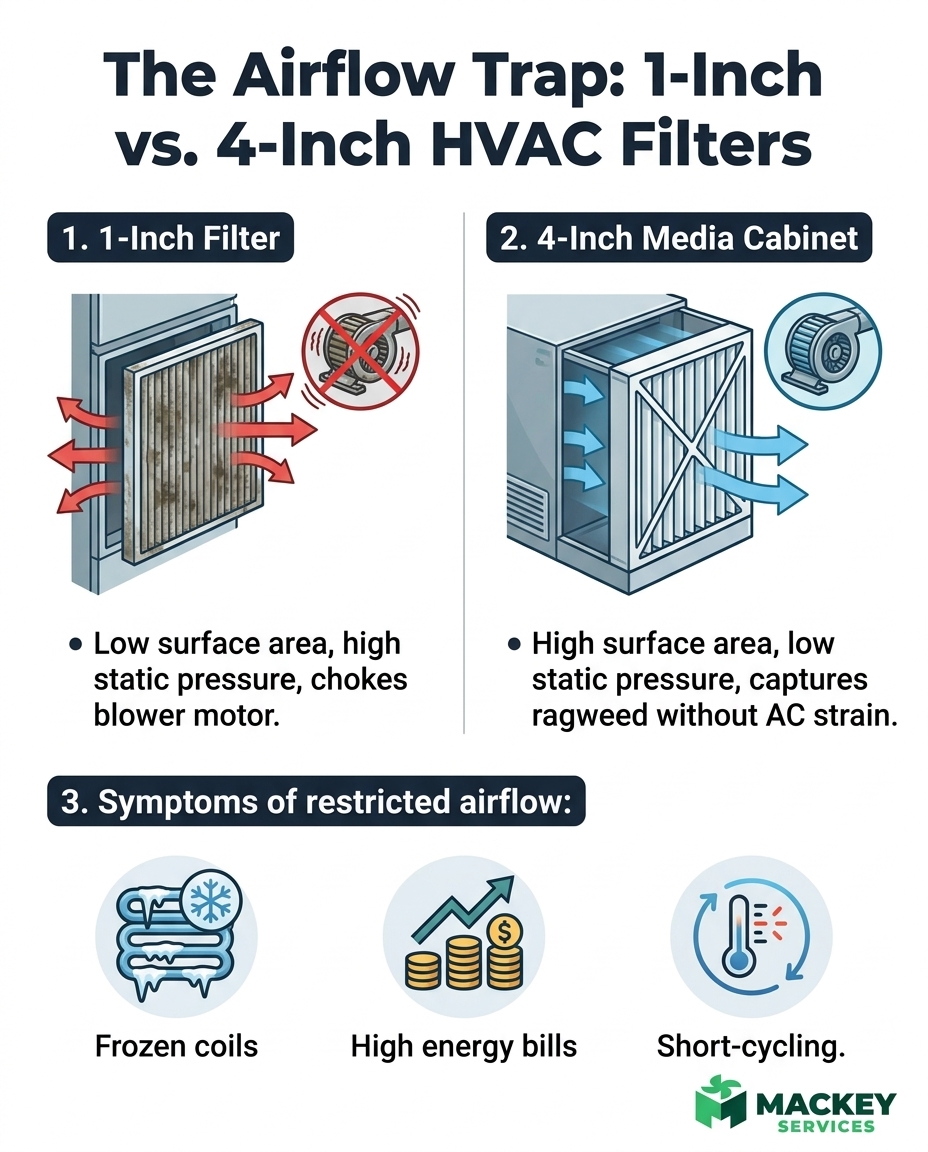
The Problem: Your HVAC system relies on a delicate balance of airflow, measured in a metric called static pressure. Static pressure is essentially the resistance to airflow within your ductwork. When you slide a high-MERV 1-inch filter into a standard return grille, you drastically increase this resistance.
The Cause: The issue comes down to the 1-inch vs 4-inch filter depth surface area. A 1-inch filter has very little physical space to fold its pleats. To achieve a high MERV rating (meaning it can catch tiny particles like ragweed pollen), manufacturers have to pack the filter fibers incredibly tightly. Because there is so little overall surface area, all the air must force its way through this dense, restrictive material. It is exactly like trying to breathe heavily through a tiny cocktail straw while running a marathon. The blower motor has to work overtime, straining to pull enough return air through the dense material to satisfy the system's needs.
The Solution: Upgrading the physical depth of the filter housing allows for a massive increase in pleated surface area. This means the air can spread out and pass through the filter media much more easily, reducing the static pressure drop while still capturing microscopic allergens. Our technicians at Mackey Services see the impact of restricted airflow often. One local homeowner reached out to our team during the spring when their AC was struggling to cool the house due to severely restricted airflow and older, undersized ductwork. Our technician evaluated the layout, replaced the old ducts with thicker insulated ones, and added a second return drop. The outcome was immediate: improved efficiency and balanced airflow throughout the home, proving just how vital proper air volume is to system performance.
Understanding MERV Ratings vs. System Capacity
The Minimum Efficiency Reporting Value (MERV) scale rates how effectively a filter traps airborne particles. While a higher MERV rating means smaller particles are captured, it also guarantees higher airflow resistance in a standard 1-inch format. Most standard residential ductwork is only designed to handle the low static pressure of basic, low-MERV 1-inch filters (usually MERV 4 to 8). Dropping a MERV 13 1-inch filter into a standard slot is a recipe for an overworked blower motor and a suffocated air conditioner.
Warning Signs Your AC is Starving for Air
When your air conditioner is choked by a restrictive filter, it will start to show symptoms long before the blower motor completely burns out. Identifying these warning signs early can save you from a catastrophic breakdown during the hottest part of the year. If you notice any of the following issues, your system is likely starving for air and requires professional air conditioning services to diagnose the restriction.
- Warm air blowing from vents: If the airflow is too slow, the air loses its cooling momentum before it ever reaches the furthest rooms in your house, leaving you with weak, lukewarm drafts.
- Unusually high energy bills: Because the blower motor has to work twice as hard to pull air through a dense filter, it consumes significantly more electricity. If your summer bills spike without a corresponding heat wave, airflow is a primary suspect.
- Constant running (short-cycling): A system that cannot breathe cannot satisfy the thermostat. It may run continuously, or it may overheat and shut down prematurely, only to turn right back on a few minutes later. This rapid cycling destroys components.
- Frozen evaporator coils: This is one of the most severe consequences. Your indoor evaporator coil gets extremely cold. It relies on a constant flow of warm return air to keep it from freezing. When airflow drops, the condensation on the coil turns to ice. In Dickinson TX, where high humidity means massive amounts of condensation, a frozen coil becomes a rapid and incredibly messy problem when it eventually thaws and overflows the drain pan.
- Strange noises from the return vent: If you hear a high-pitched whistling or a deep humming sound coming from your filter grille, it is the sound of the blower motor struggling against high static pressure.
Addressing these symptoms promptly prevents expensive late-summer repairs and extends the lifespan of your entire cooling system.
The Science of Surface Area: Media Cabinets Explained
If a 1-inch allergy filter is bad for your system, how do you protect your home from fall ragweed? The answer lies in the science of surface area. By upgrading to a 4-inch media cabinet, you change the physical dynamics of how air passes through the filtration system.
When you compare a 1-inch vs 4-inch filter depth surface area, the difference is staggering. A 4-inch filter has deep, V-shaped pleats that accordian out. If you were to take a standard 1-inch filter and stretch the pleated material out flat, you might get a few square feet of material. If you stretch out the material from a 4-inch media filter, you get massive amounts of square footage.
This expanded surface area is the secret to high-efficiency filtration without the high static pressure drop. Because the air has so much more physical space to pass through, the resistance drops dramatically. This design allows you to use a high-MERV filter (like MERV 11 or MERV 16) that easily captures microscopic ragweed pollen, pet dander, and dust mites, all while allowing the blower motor to breathe effortlessly.
| Feature | Standard 1-Inch Filter | 4-Inch Media Filter |
|---|---|---|
| Pleated Surface Area | Very low (highly restrictive) | Extremely high (unrestrictive) |
| Static Pressure Drop | High (strains blower motor) | Low (protects blower motor) |
| Allergy Protection | Poor (unless restricting airflow) | Excellent (captures fine pollen) |
| Replacement Frequency | Every 30 to 90 days | Every 6 to 12 months |
| System Efficiency | Decreases as dirt builds quickly | Maintains high efficiency longer |
Beyond protecting your equipment, these deeper filters have a significantly extended lifespan. Because there is so much more material to catch dust and debris, a 4-inch filter typically only needs to be changed once or twice a year, compared to the monthly chore of swapping out 1-inch filters.
Why Retrofitting Requires Professional Expertise
Once homeowners understand the benefits of a 4-inch media filter, the next question is usually, "Can I just buy one and slide it in?" The short answer is no. You cannot simply shove a 4-inch filter into a standard 1-inch return grille located in your ceiling or wall. Upgrading your filtration system requires the installation of a dedicated media cabinet directly into the ductwork, usually right next to the indoor air handler or furnace.
This process involves professionally retrofitting the cabinet into the existing sheet metal. Modifying ductwork is not a DIY weekend project. It requires a licensed professional to cut into the return plenum, install the housing, seal it perfectly to prevent air leaks, and ensure that the overall airflow balance of the home remains intact. If a cabinet is installed poorly, it can pull unconditioned, dusty attic or garage air directly into the system, defeating the purpose of the upgrade entirely.
This is where Mackey Services' expertise in safely retrofitting advanced media cabinets truly shines. Our technicians know how to integrate these high-capacity housings without stressing the existing blower motor or compromising your ductwork's integrity. When done correctly, professional filtration upgrades drastically improve conditions for asthma and allergy sufferers. Another customer of ours struggling with terrible asthma symptoms took action during the summer cooling season. By having our licensed technicians install a Lennox health climate HEPA filtration system alongside a new AC unit, their asthma symptoms significantly improved, and the home's overall energy consumption was reduced by a noticeable margin. That is the power of a properly executed HVAC system upgrades.
Timing Your Upgrade for Maximum Allergy Relief
Timing is everything when it comes to home comfort. The absolute best time to assess and upgrade your filtration system is in the late summer, just before the seasonal shift. By August, your air conditioner has been running hard for months, and any underlying airflow issues are likely becoming obvious. More importantly, this window occurs right before the August pre-fall ragweed season hits its peak.
Pairing a filter cabinet retrofit with an end-of-season system checkup is a brilliant strategy. A technician can evaluate the wear and tear from the summer heat, clean the blower motor, check the evaporator coil for dirt buildup, and then install the new media cabinet. This comprehensive approach ensures your system is completely revitalized.
There is a profound peace of mind that comes with knowing your home is prepared for the back-to-school transition and the heavy pollen drops of autumn. You won't have to worry about indoor air triggers disrupting your family's sleep or daily routines. Furthermore, protecting the AC now by fixing airflow restrictions ensures that your system will be reliable when you eventually switch over to heating as temperatures drop. Scheduling routine HVAC maintenance alongside your retrofit is the smartest way to transition between seasons smoothly.
Common Questions About Air Filters and AC Performance
Can I use a 4-inch filter instead of a 1-inch filter?
You can only use a 4-inch filter if your HVAC system has a specially designed media cabinet installed to accommodate it. You cannot force a 4-inch filter into a standard 1-inch wall or ceiling grille. Upgrading to the thicker filter requires a professional to modify your ductwork near the indoor unit to house the larger filter dimensions properly.
Does a high MERV filter restrict airflow?
Yes, in a standard 1-inch format, a high MERV filter significantly restricts airflow. Because the filter material must be woven very tightly to catch microscopic particles, it acts as a barrier to the air. However, a high MERV rating on a 4-inch filter does not restrict airflow in the same way, because the massive increase in 1-inch vs 4-inch filter depth surface area allows the air to spread out and pass through easily.
What MERV rating is best for ragweed allergies?
For effective relief from ragweed pollen, a filter with a rating of MERV 11 to MERV 13 is generally recommended. These filters are dense enough to trap fine pollen, pet dander, and dust mites. However, you should only use filters rated this high if you have a 4-inch media cabinet installed; using a MERV 13 in a 1-inch slot will almost certainly choke your blower motor.
Are thicker HVAC filters better for your AC?
Thicker HVAC filters are vastly superior for your air conditioning system's health and efficiency. The deep pleats provide maximum surface area, which dramatically lowers the static pressure drop across the filter. This means your blower motor doesn't have to work as hard to circulate air, reducing wear and tear while still providing excellent indoor air quality.
Can a high MERV filter damage my AC?
A high MERV 1-inch filter can absolutely cause severe damage to your air conditioner. By severely restricting the return airflow, these dense filters can cause the blower motor to overheat and fail prematurely. Furthermore, the lack of warm air passing over the indoor unit can cause the evaporator coil to freeze solid, potentially leading to compressor damage and water leaks.
How do I know if my air filter is choking my blower motor?
The most common signs include a high-pitched whistling sound at the return vent, weak airflow coming out of your supply registers, and unusually high electricity bills. You might also notice the system running constantly without actually cooling the house down, or you may find ice building up on the copper refrigerant lines near your indoor unit.
Breathe Easier and Protect Your System This Fall
Better indoor air quality should never come at the cost of a broken air conditioner. As we head into the August pre-fall ragweed season, relying on dense 1-inch filters is a risky gamble that forces your blower motor to work against extreme resistance. Upgrading to a 4-inch media cabinet is the definitive way to capture microscopic allergens while allowing your HVAC system to breathe freely and operate efficiently.
You don't have to choose between clean air and a cool, comfortable home. Our team at Mackey Services encourages you to explore professional indoor air quality solutions that are properly sized for your ductwork. Reach out to a local expert today to discuss your home's specific airflow needs and discover how a professional filtration retrofit can transform your indoor environment just in time for fall.
Ready for a better day?
One call handles it all — HVAC, electrical, and generators across the Texas Gulf Coast. Less to pay. Better day. That's the Mackey way.
Mon–Fri: 7 AM – 8 PM · Sat: 8 AM – 5 PM · Licensed & insured · #TACLA 112769C · #TECL 558211