
How a Stuck Reversing Valve Leaves You Freezing on the First Cold Night
See exactly how a stuck reversing valve leaves you freezing on the first cold night, and why this seasonal switchover failure requires pro repair.
The Sudden Chill: When Your Heat Pump Fails on the Seasonal Switchover
The first fall cold snap in September or October is finally here, but our team at Mackey Services knows that learning exactly how a stuck reversing valve leaves you freezing on the first cold night is certainly not the welcome to autumn you expected. You walk over to the thermostat, switch the system from cooling to heating, and wait for that comforting wave of warmth to fill the house. Instead, after a few minutes of operation, the vents start blowing distinctly chilly air into your living room. It is a frustrating and often panic-inducing moment for any homeowner. Before you assume the entire HVAC system has permanently failed and needs a total replacement, it helps to understand the mechanical transition happening behind the scenes. More often than not, the culprit is a single, targeted component refusing to shift gears.
Need immediate help with your heating services, or looking to upgrade your heat pump system? Our local experts are ready to restore your comfort.
When a heat pump fails to switch modes successfully, the system is usually physically locked in its previous state. The outdoor unit might sound like it is running perfectly, the indoor fan is pushing air through the ductwork, and the thermostat claims it is calling for heat. Yet, the physical reality of the air temperature tells a different story. This sudden disconnect between what the thermostat requests and what the equipment delivers almost always points directly to the reversing valve. Assuringly, we find that this specific failure is a very common, highly targeted issue rather than an immediate sign of total system death.
Understanding the Reversing Valve: The Mechanical Heart of Your System
To understand why your system is suddenly blowing cold air, you first need to understand how a heat pump operates year-round. Unlike traditional gas furnaces that burn fuel to create heat, heat pumps use the exact same refrigeration cycle for both heating and cooling. They do not generate heat; they simply move it from one place to another. During the summer, the system absorbs heat from inside your home and pumps it outside. During the winter, it absorbs ambient heat from the outdoor air and pumps it inside. The component responsible for changing the direction of this heat transfer is the reversing valve.
Often referred to as a 4-way valve, this component acts as the mechanical director of your entire HVAC system. It is a brass body containing a sliding mechanism that physically reverses the flow of pressurized refrigerant. When you look at the heavy cooling load of a Texas summer—just like how a heat pump handles 100-degree Texas afternoons—the valve stays locked in one specific position to keep the cold air flowing indoors.
When the weather finally shifts in Dickinson, TX, and the surrounding Gulf Coast areas, the sudden demand for heat requires this valve to actuate. If the valve fails to slide into its new position, the refrigerant continues flowing in the cooling direction. The system remains physically locked in cooling mode, no matter how high you turn up the thermostat.
The Toll of a Long Summer: Why Valves Stick in Cooling Mode
The Problem: The most common time for a reversing valve to fail is during the first major seasonal switchover of the year. Homeowners turn on their heat for the first time in months, only to be met with a blast of cold air. The system appears to be running normally, but the temperature is completely wrong for the season.
The Cause: This specific timing is a direct byproduct of regional weather patterns. In our years of servicing HVAC systems in Dickinson, TX, our team sees how long, hot summers require continuous cooling from March to September, drastically increasing the likelihood of the valve sticking during the first fall switchover. Inside the brass body of the valve is a precision-machined slide. For eight or more months, this physical slide sits perfectly still in one identical position while high-pressure refrigerant flows around it. Continuous operation in one mode, combined with the lack of actuation during the long cooling season, allows internal components to mechanically bind or stick. Microscopic wear, temperature fluctuations, and months of dormancy mean that when the sudden temperature drop finally forces the valve to move, it simply cannot break free from its resting place.
The Solution: Resolving a stuck slide requires professional diagnostics to determine if the valve can be safely freed or if the component has sustained permanent mechanical damage. Because the valve is a sealed component under extreme pressure, it cannot simply be lubricated from the outside. A licensed technician must evaluate the system's pressures and electrical signals to determine the safest path forward to restore your heating.
Electrical Solenoids vs. Mechanical Slides: What Goes Wrong Inside
When a reversing valve fails to shift, the breakdown typically falls into one of two categories: electrical or mechanical. While the end result is the same—a house that refuses to warm up—the underlying causes are very different. In one recent early fall scenario, our Mackey Services technicians responded to a local system that malfunctioned intermittently in heat mode after running for hours. Our team gathered the diagnostic data and advised the customer to restart the system while we monitored the electrical draw, demonstrating how these mode-switching issues can sometimes be complex and require careful observation. Understanding what goes wrong inside the unit helps clarify why professional air conditioning and heating diagnostics are so critical.
When the Solenoid Fails to Fire
The electrical solenoid is a magnetic coil attached to the outside of the reversing valve. When you switch your thermostat to heat, it sends a low-voltage electrical signal to this coil. The coil energizes, creating a strong magnetic field that pulls a small pilot valve, which in turn uses the system's own refrigerant pressure to move the main slide.
- The Signal Drops: The thermostat sends the signal, but the magnetic coil does not energize to create the required pull.
- Electrical Shorts: This failure can be caused by damaged wiring, electrical shorts in the control board, or a burnt-out solenoid coil.
- Breaker Issues: In severe cases, a shorted solenoid coil can cause the system to trip electrical breakers when it attempts to shift modes.
When the Mechanical Slide Jams
A mechanical failure means the electrical side of the system is working perfectly, but the physical components refuse to cooperate. The thermostat sends the signal, and the solenoid coil energizes exactly as it should, but the internal slide remains stubbornly in place.
- Internal Binding: The coil energizes, but the internal slide refuses to move due to friction or binding.
- System Contaminants: Often caused by internal wear, lack of use over the long summer, or microscopic contaminants in the refrigerant lines.
- Default Operation: While the system may still operate perfectly in its default cooling mode, it cannot physically reverse the refrigerant to provide heat.
Diagnosing the Symptoms: Is It Just the Valve or a Dead Compressor?
One of the most stressful parts of a heating failure is the fear that the compressor—the most expensive component in the system—has died. However, we always remind our customers that distinguishing between a stuck valve and a catastrophic compressor failure can provide immense psychological relief. If your system cooled your home perfectly the day before the cold snap, the compressor is highly likely to be in good working order.
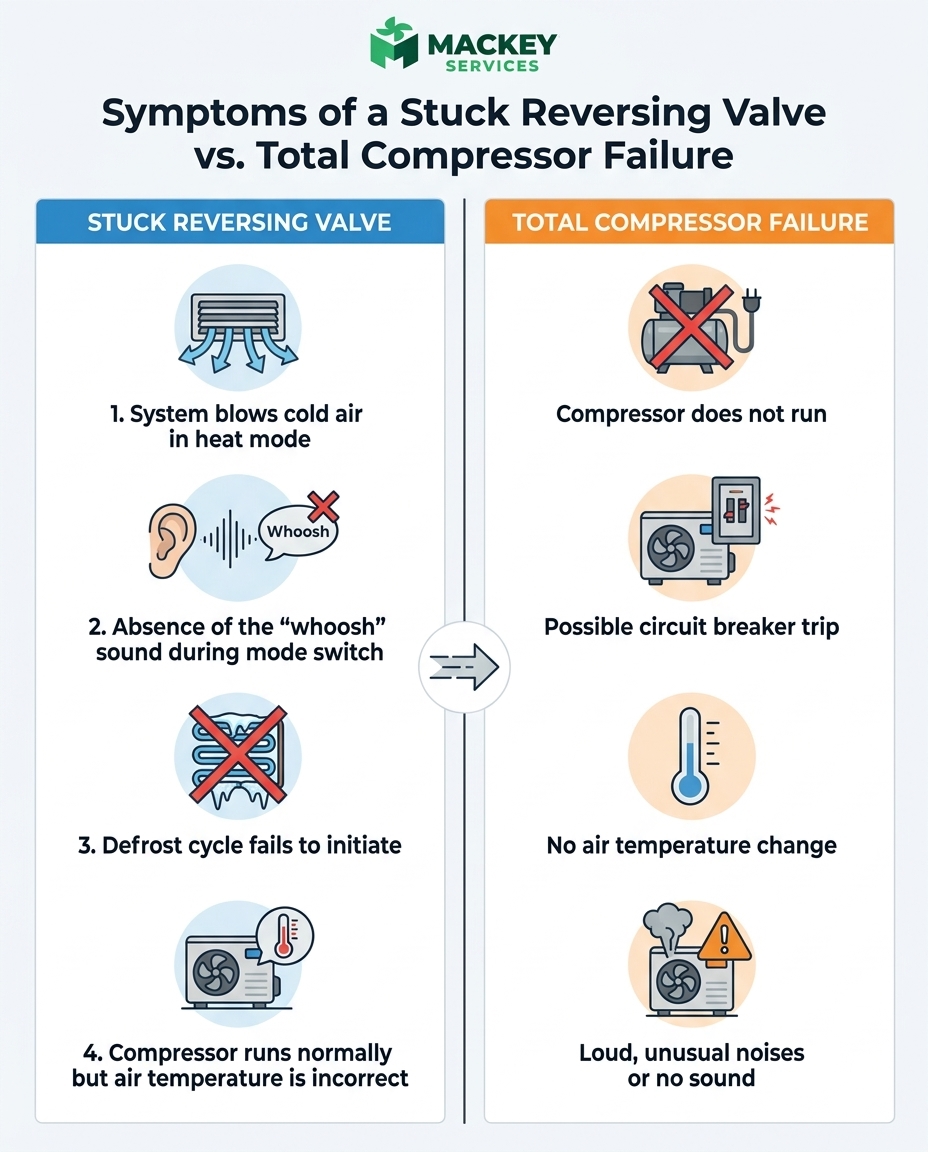
A key indicator of a healthy reversing valve is the auditory feedback it provides. When a heat pump successfully shifts from cooling to heating, you can often hear a distinct "whoosh" sound from the outdoor unit as the pressurized refrigerant abruptly changes direction. The absence of this sound when switching modes is a primary symptom of a stuck valve.
| Symptom to Check | Stuck Reversing Valve | Dead Compressor |
|---|---|---|
| Airflow Temperature | Blows cold air while in heat mode | Blows unconditioned, room-temperature air |
| Outdoor Unit Sound | Runs normally, but missing the "whoosh" sound | Silent, buzzing, or clicking without starting |
| Defrost Cycle | Fails to initiate or complete properly | System will not run long enough to freeze up |
| Previous Day Operation | Cooled the house perfectly yesterday | System was likely struggling or failing prior |
While these symptoms provide a strong indication of where the problem lies, identifying the exact point of failure requires professional diagnostic tools. Technicians use specialized gauges and multimeters to confirm whether the issue is a burnt solenoid, a jammed slide, or a deeper refrigerant problem.
The Dangers of DIY: Why You Should Never Tap a Valve with a Hammer
When faced with a sudden heating failure, it is tempting to search online for a quick fix. One of the most common and dangerous internet myths our team sees is the suggestion that tapping a stuck reversing valve with a hammer or wrench will unstick it. This advice is fundamentally unsafe and can quickly turn a manageable repair into a catastrophic system failure.
Modern reversing valves are constructed from brass and are under extreme pressure from the refrigerant running through them. Striking the valve body can easily dent the casing, which permanently jams the internal slide and guarantees the valve must be replaced. Worse, a hard strike can fracture the brazed copper joints connecting the valve to the compressor. This causes a rapid, catastrophic release of pressurized refrigerant, which poses severe frostbite risks to your skin and eyes, and completely disables the system.
Furthermore, reversing valves involve high-voltage components. The solenoid coil operates using electrical current, and tampering with it without proper training risks severe electrical shock. Handling refrigerant and replacing a faulty valve requires specialized brazing equipment, deep knowledge of system pressures, and mandatory EPA Section 608 certification. This is strictly a job for licensed professionals who have the training to safely recover the refrigerant, unbraze the old valve, and install the new one without damaging the surrounding heat-sensitive components.
Preventing Switchover Surprises with Routine Fall Care
The best way to avoid waking up to a freezing house is to catch mechanical issues before the weather actually drops. Proactive solutions and routine check-ups are designed to test these transition components while the weather is still mild. In one instance during a recent pre-season startup, our technicians found a homeowner's system was refusing to switch modes; our team efficiently troubleshot the reversing valve and repaired the unit on the spot, ensuring the system was fully operational before the first cold front arrived. This same proactive approach applies heavily to fall heating preparation.
Scheduling routine HVAC maintenance during the transition weeks provides peace of mind that your system will seamlessly transition when the temperature finally plummets. Here is how a professional tune-up addresses the reversing valve:
- Testing the Mode Switch: Technicians physically test the reversing valve by switching the system from cooling to heating, listening for the proper mechanical actuation and verifying the temperature shift.
- Verifying Electrical Draw: Using a multimeter, the technician checks the electrical draw of the solenoid coil. An unusually high or low reading can predict a coil failure before it actually stops working.
- Inspecting Wiring and Connections: The low-voltage wiring connecting the thermostat to the reversing valve is inspected for fraying, corrosion, or loose connections that could interrupt the signal.
- Checking Refrigerant Levels: Because the reversing valve relies on the system's internal pressure to move the slide, low refrigerant levels can prevent it from shifting. Technicians verify the charge is accurate for optimal performance.
By thoroughly testing these components during a scheduled visit, you avoid the panic of an emergency service call on the first freezing night of the year.
Stay Warm This Fall with Expert Diagnostics
A heat pump that refuses to switch into heating mode is undoubtedly frustrating, but a stuck reversing valve is a solvable mechanical issue, not a reason to panic. By understanding how the long summer cooling season impacts this critical component, you can approach the first fall cold snap with clear expectations. Remember that diagnosing and resolving high-voltage electrical components and pressurized refrigerant lines requires specialized training and equipment.
As a trusted local HVAC expert in Dickinson, Mackey Services provides prompt, reliable diagnostics to fix stuck reversing valves before the Texas winter chill fully sets in. Relying on licensed professionals ensures safe, accurate repairs that protect the lifespan of your entire system. If your heat pump is struggling to produce heat or refusing to switch modes, seek expert help to restore your comfort safely and efficiently.
Frequently Asked Questions
Why is my heat pump blowing cold air in heat mode?
When a heat pump blows cold air in heat mode, the system is usually stuck in its cooling cycle. This happens because the reversing valve, which directs the flow of hot or cold refrigerant, has failed to shift positions. While the thermostat asks for heat, the physical mechanics of the unit remain locked in the summer cooling position.
What causes a reversing valve to stick?
A reversing valve typically sticks due to mechanical binding or an electrical failure. After months of remaining in the cooling position during long summers, the internal slide can become physically jammed from lack of use. Alternatively, the electrical solenoid coil that triggers the valve can burn out or short-circuit, preventing it from receiving the signal to move.
Is a stuck reversing valve a total system failure?
No, a stuck reversing valve is a localized component issue, not a sign of total system failure. If the system was cooling your home perfectly the day before, major components like the compressor are likely still in good working order. Replacing or repairing the valve will restore normal heating function without requiring a whole-system replacement.
Can a stuck reversing valve be fixed without replacing it?
In some cases, an electrical issue with the reversing valve can be fixed by simply replacing the external solenoid coil. However, if the internal mechanical slide is permanently jammed or damaged, the entire brass valve body must be replaced. A licensed technician must perform diagnostics to determine which type of failure has occurred.
How do professionals safely diagnose a bad reversing valve?
Professionals diagnose a bad reversing valve by measuring the electrical voltage at the solenoid coil and checking the temperature differential across the refrigerant lines. They use specialized gauges to monitor system pressures during a mode switch. Because this involves high voltage and pressurized refrigerant, it requires EPA Section 608 certification to handle safely.
Ready for a better day?
One call handles it all — HVAC, electrical, and generators across the Texas Gulf Coast. Less to pay. Better day. That's the Mackey way.
Mon–Fri: 7 AM – 8 PM · Sat: 8 AM – 5 PM · Licensed & insured · #TACLA 112769C · #TECL 558211