
The Pre-Fall 'Test Run': Why You Should Turn on Your Furnace Before You Need It
Curious about the pre-fall 'test run': why you should turn on your furnace before you need it? See how a 15-minute September test prevents winter emergencies.
Beating the Texas Chill: The Strategy Behind the September Test
September in Dickinson brings a welcome shift as the heavy summer heat begins to wane, which is exactly why understanding The Pre-Fall 'Test Run': Why You Should Turn on Your Furnace Before You Need It is so critical. Right now, the weather is mild, the evenings are comfortable, and your home is likely sitting at a pleasant temperature without much help from your HVAC equipment. But behind the scenes, your heating equipment has likely been sitting completely idle since last winter.
A typical pattern we see is homeowners waiting until the very first freezing night of the year to flip their thermostat over to "heat." If something is broken, they discover the failure at the worst possible moment. Their house gets colder by the hour, their family is uncomfortable, and they are forced into a chaotic scramble to find an available technician. By taking advantage of the September pre-fall transition, you can completely avoid this stressful scenario.
The solution is simple, proactive, and costs nothing to execute. By taking just a few minutes to run a controlled test of your heating system while the weather outside is still mild, you gain total control over your seasonal preparation. If the system fires up perfectly, you earn immediate peace of mind. If the system struggles or fails to ignite, you have plenty of time to schedule a repair on your own terms, long before the cold weather actually arrives.
The 8-Month Dormancy Effect on Gulf Coast Heating Systems
Heating equipment in South Texas operates under a very specific set of environmental conditions. Unlike northern climates where furnaces run for more than half the year, our local systems sit dormant for approximately 75% of the year. This long period of inactivity creates unique mechanical challenges that generic, national advice often ignores.
When you combine an eight- or nine-month cooling season with the high ambient humidity of Dickinson and the Texas Gulf Coast, you create an environment where idle mechanical parts are constantly exposed to moisture and airborne particles. Whether you rely on a traditional gas furnace or a modern heat pump, this prolonged dormancy takes a toll on the internal components.
Dust Accumulation During the Cooling Season
Even when your furnace isn't actively generating heat, your indoor air is still moving through the system. As your air conditioner runs throughout the spring and summer, the blower motor constantly pulls air through the ductwork and across the dormant heating components. Over the course of eight months, this circulating air deposits microscopic particulate matter onto the heat exchanger, the burners, and the sensitive electronic sensors.
Because Dickinson frequently experiences humidity levels above 70%, this isn't just dry dust. The ambient moisture in the air mixes with the settling dust to create a stubborn, caked-on layer of grime that clings tightly to metal surfaces. By the time fall arrives, your heating components are wearing a thick blanket of this accumulated debris.
Moisture's Impact on Moving Parts
Beyond the dust buildup, prolonged high humidity has a direct impact on the physical movement of mechanical parts. Metal components that are designed to open, close, spin, or slide rely on tight tolerances and factory lubrication to function smoothly. When these parts sit completely motionless from February until October, the ambient moisture can cause micro-corrosion.
Lubricants can slowly dry out or become gummy, and metal valves can begin to stick. A system that ran flawlessly during the final cold snap of last winter might suddenly refuse to operate simply because a tiny internal valve has seized up after eight months of humid inactivity. This is the primary reason why a proactive test run is so essential for Gulf Coast homeowners.
How to Execute the 15-Minute Thermostat Test Safely
Performing a 15-minute thermostat test is a straightforward process, but it requires a careful, methodical approach. It is important to remember that this is strictly a test of your system's operation—it is not a mechanical repair guide. If your system fails this test, you should never attempt to open the cabinet and fix internal components yourself.
Pre-Test Preparations
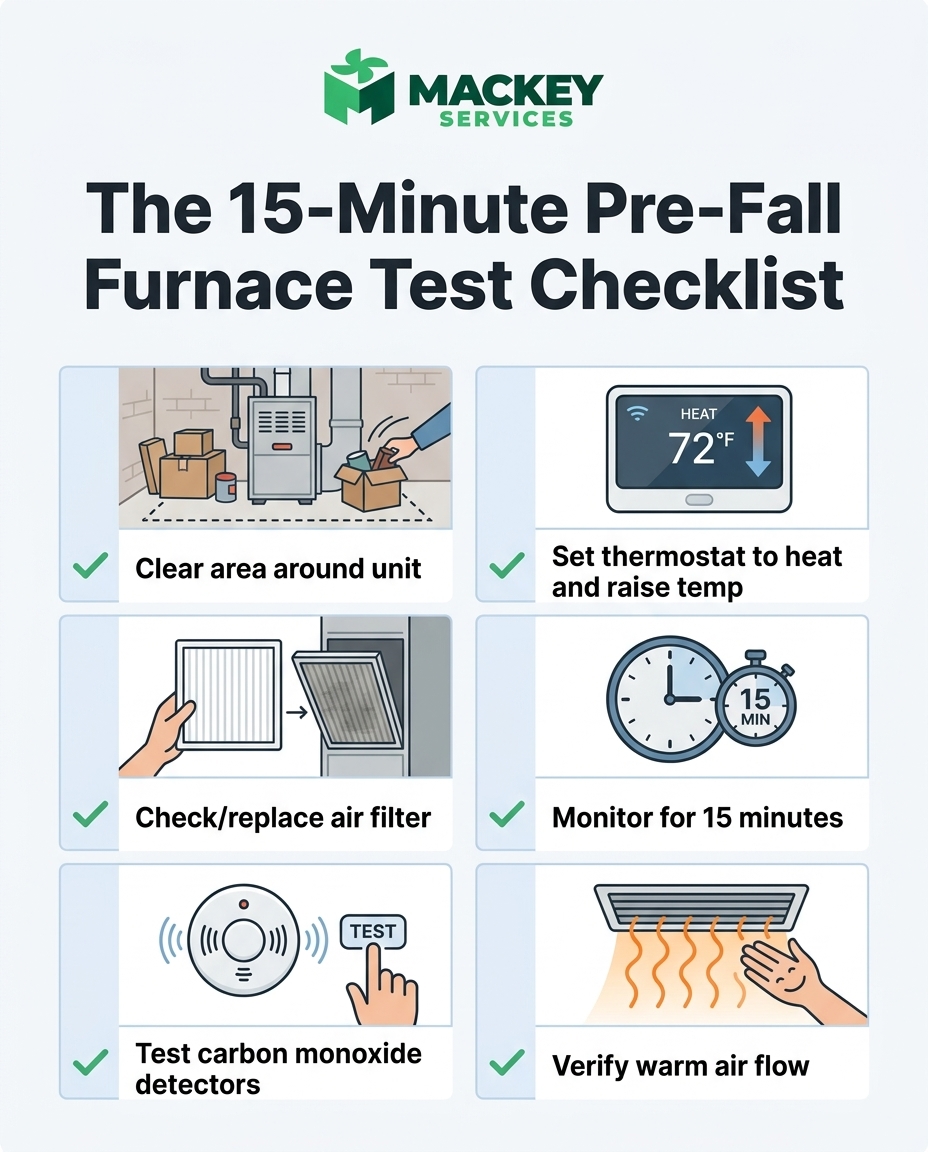
Before you ever touch the thermostat, you need to prepare the physical environment around your heating equipment. Taking five minutes to set the stage ensures that your test run is safe and accurate.
- Clear the surrounding area: Over the summer, it is incredibly common for homeowners to store holiday decorations, boxes, or cleaning supplies near their indoor HVAC unit. Remove all combustible materials and ensure there is a clear, three-foot perimeter around the equipment.
- Inspect the air filter: A clogged filter will suffocate the system, causing it to overheat and shut down prematurely. Pull the current filter out and hold it up to a light source. If you cannot see light shining through the material, replace it with a fresh one before proceeding.
- Verify carbon monoxide detectors: If you utilize gas heating, verify that your home's carbon monoxide detectors have fresh batteries and are functioning correctly by pressing their test buttons.
- Open your air vents: Walk through your home and make sure that all supply registers and return grilles are fully open and unobstructed by furniture or rugs.
Monitoring the Cycle
Once the area is prepped, you are ready to initiate the test. Stand near your thermostat and switch the system mode from "Cool" or "Off" over to "Heat." Raise the target temperature three to five degrees above the current room temperature to force the system to turn on.
- Listen for the initial click: You should hear a distinct click from the thermostat, followed shortly by the sound of the system waking up. For gas furnaces, you will typically hear a small draft inducer motor start humming first.
- Wait for ignition: Within a minute or two, you should hear the distinct "whoosh" of the gas burners igniting, followed by the larger blower motor kicking on to push air through the house.
- Check the airflow: Let the system run continuously for a full 15 minutes. Walk to the vents in your furthest rooms and hold your hand over the registers. Verify that the air blowing out is noticeably warm and steady.
Decoding the First-Cycle Burning Dust Smell
One of the most common reasons homeowners panic during their first heating cycle of the year is a sudden, noticeable odor spreading through the house. If you turn on your heat for the first time in eight months and immediately smell something burning, your first instinct might be to shut everything down and call for emergency help.
Here is the reality: a brief burning smell is entirely normal and expected during the first run of the season. Remember the layer of caked-on dust we discussed earlier? When the heat exchanger finally warms up to its operating temperature, that accumulated dust literally burns off the metal surfaces. The resulting odor is pushed through your ductwork and into your living spaces.
The standard timeline: This normal burning dust smell should begin to dissipate quickly. In most homes, the odor will completely clear out within 15 to 30 minutes of continuous operation. Opening a few windows during your test run can help ventilate the house while the dust clears.
However, it is vital to know the difference between burning dust and a dangerous mechanical failure. Use this quick reference guide to decode what you are smelling:
| Type of Odor | Likely Cause | Required Action |
|---|---|---|
| Dusty, singed hair smell | Normal dust burning off the heat exchanger. | Monitor for 15-30 minutes; it should fade. |
| Rotten eggs or sulfur | A dangerous natural gas leak near the unit. | Shut off the system immediately, leave the house, and call for help. |
| Electrical burning or ozone | Overheating blower motor or melting wires. | Turn off the system at the thermostat and call a professional. |
| Musty, dirty sock smell | Bacterial growth on the indoor evaporator coil. | Schedule a professional coil cleaning and tune-up. |
Hidden Component Failures Revealed by a Test Run
The primary goal of your 15-minute test run isn't just to burn off the summer dust—it is to verify that the intricate sequence of operations inside your heating equipment is functioning smoothly. Modern heating systems have multiple safety checkpoints that must be cleared before warm air is delivered to your home. If any of these components fail due to long dormancy, the system will lock itself out to prevent a safety hazard.
Failed Ignitors
The ignitor is one of the hardest-working components in your furnace. In modern systems, this is typically a hot surface ignitor made of delicate silicon carbide. When the thermostat calls for heat, this component glows white-hot to ignite the incoming gas. Because these ignitors are fragile, the combination of long dormancy, settling moisture, and accumulated dust can cause them to crack or fail to reach the necessary temperature.
The symptom: You will hear the system click on, the small draft motor will hum, and you might even hear a faint click indicating the gas valve is trying to open—but the burners will never actually light. After a few failed attempts, the system will shut itself back down and blow cold air.
Stuck Gas Valves
Gas valves are mechanical gates that control the flow of fuel into the burners. When they sit in the closed position for eight solid months in a humid environment, the internal mechanisms can easily become stuck. The electrical signal from the control board tells the valve to open, but the physical resistance is too strong.
The mechanical reality: Forcing a stuck gas valve is incredibly dangerous. These components are calibrated to precise pressures, and any tampering can result in a severe gas leak or a fire hazard. If your system attempts to start but cannot establish a flame, a stuck valve is a very common culprit that requires licensed professional intervention to diagnose and replace safely.
Avoiding the Chaos of the First-Freeze Emergency Rush
Extreme weather has a way of forcing hidden mechanical flaws out into the open when you least expect it. Over the summer, one local homeowner dealt with an unexpected issue where their air conditioner continuously tripped the electrical breakers. A technician quickly identified a short circuit as the root cause, rather than a failing compressor, and repaired it. While that happened during the peak cooling season, the exact same principle applies to your heating equipment. When extreme weather hits, dormant electrical faults and stuck mechanical parts immediately reveal themselves.
The morning of the first major cold snap in Dickinson is always chaotic. Hundreds of homeowners wake up to freezing houses, realize their heaters won't turn on, and immediately start dialing every HVAC contractor in town. Phone lines jam, appointment boards fill up for days, and technicians are stretched incredibly thin running from emergency to emergency.
By executing your test run in September, you completely bypass this stressful bottleneck. If your test reveals a failed ignitor or a stuck gas valve, you are discovering it on a mild, 75-degree afternoon. You have the luxury of scheduling a repair appointment on your own timeline, without paying premium emergency fees or waiting days for a technician to become available. Working with a dedicated local team like Mackey Services means you can stay ahead of the weather proactively, rather than reacting in a panic alongside everyone else.
Transitioning from Test Run to Professional Preparation
While a successful 15-minute thermostat test is a fantastic early indicator that your system is alive and functioning, it does not replace the need for comprehensive seasonal maintenance. The test run tells you that the system can turn on; it does not tell you if the system is running efficiently, safely, or cleanly.
Professional preparation dives much deeper than a simple operational check. When a licensed technician arrives, they perform critical safety checks that a homeowner simply cannot do. This includes utilizing specialized tools to perform combustion analysis, checking for microscopic cracks in the heat exchanger that could leak carbon monoxide, and calibrating the gas pressure to ensure the burners are firing efficiently.
They also deep-clean the internal components, removing the stubborn, caked-on dust that didn't burn off during your initial test. Skipping HVAC maintenance can lead to higher utility bills, premature breakdowns, and voided manufacturer warranties. The test run is your first line of defense, but professional maintenance is what ensures the system will survive the entire winter reliably.
Common Questions About Pre-Fall Heating Tests
When should I turn on my furnace for the first time?
The ideal time to turn on your furnace for the first time is during the early fall transition, typically in mid-to-late September. Testing the system when the outdoor weather is still mild ensures that you aren't relying on the equipment to keep your home warm yet. This gives you a stress-free window to schedule any necessary repairs before the first freezing night arrives.
Why does my heater smell like burning dust when I turn it on?
During the long cooling season, household dust and airborne particles settle directly onto the dormant heat exchanger and burners. When you finally turn the heat on for the first time, those metal components get extremely hot and literally burn the accumulated dust away. This creates a temporary, singed smell that usually dissipates within 15 to 30 minutes of operation.
How long should I test my furnace before winter?
You should let your heating system run continuously for at least 15 to 20 minutes during your initial test. This duration is long enough to ensure the burners stay lit, the blower motor reaches full speed, and warm air successfully reaches the furthest rooms in your home. It also gives the system time to burn off the initial layer of summer dust.
What should I do if my heater won't ignite after sitting all summer?
If your system tries to start but fails to ignite, turn the thermostat back to the "Off" position and check your air filter and circuit breakers first. If those are clear and the system still won't light, you likely have a failed ignitor or a stuck gas valve caused by long dormancy. Do not attempt to force the components; call a licensed professional for a safe diagnosis.
Can a dirty air filter cause my furnace to fail its test run?
Yes, a severely clogged air filter can easily cause a furnace to fail its initial test. When airflow is heavily restricted, the heat exchanger cannot dissipate its heat properly, causing the system's internal safety sensors to trip and shut the furnace down to prevent a fire. Always start your seasonal test run with a brand-new, clean air filter.
Secure Your Comfort Before the Cold Front Hits
Taking 15 minutes out of your weekend to run a simple thermostat test is one of the easiest ways to protect your home and your family from unexpected winter breakdowns. There is a profound sense of satisfaction in knowing that your equipment is ready to handle whatever the Texas Gulf Coast weather decides to throw your way.
If your test run revealed any warning signs—like strange noises, rapid shutting down, or a burning smell that simply won't go away—now is the time to act. Don't wait until the first freeze forces your hand. Reach out to secure your spot for a comprehensive HVAC maintenance plan visit, ensuring your system operates safely, efficiently, and reliably all season long.
Ready for a better day?
One call handles it all — HVAC, electrical, and generators across the Texas Gulf Coast. Less to pay. Better day. That's the Mackey way.
Mon–Fri: 7 AM – 8 PM · Sat: 8 AM – 5 PM · Licensed & insured · #TACLA 112769C · #TECL 558211