
September Hurricane Prep: Load-Testing Standby Generators in Galveston County
For September Hurricane Prep: Load-Testing Standby Generators in Galveston County is vital. See why we urge homeowners to verify transfer switches now.
The Hidden Vulnerability in Your Late-Season Hurricane Backup Plan
As the ultimate step in your September Hurricane Prep: Load-Testing Standby Generators in Galveston County guarantees that your unit's glowing green 'ready' light actually means your home will have power when the grid fails. As we transition into early fall and the peak of the Gulf Coast storm season, relying solely on that indicator light is one of the most common—and risky—mistakes homeowners make. A green light simply means the engine's computer detects no immediate faults and the battery is charged. It does not mean the system is capable of transferring power or carrying the heavy electrical load of your entire house.
When severe late-season weather approaches, an untested backup system represents a massive hidden vulnerability. There is a critical difference between an engine that can turn on and a system that can successfully take over your home's electrical demand without stalling or failing at the transfer switch. To ensure your home stays protected, you need more than a visual check; you need professional verification. For comprehensive generator services and to ensure peak performance from premium systems like Kohler standby generators, scheduling a professional load test is the only way to guarantee true readiness.
Why a Green 'Ready' Light Provides False Security
Most modern standby generators are programmed to run a weekly self-test, often called an exercise cycle. Homeowners in Dickinson and Galveston County coastal communities hear their unit start up every Tuesday afternoon, run for about ten to twenty minutes, and shut down. Because the engine sounds healthy, it is completely natural to assume the system is fully prepared for an emergency.
However, this weekly exercise cycle is strictly a no-load test. During this brief run, the engine circulates oil, prevents moisture buildup, and verifies that the starter battery functions. What it absolutely does not do is test the most critical component of your entire backup power system: the automatic transfer switch (ATS).
The Missing Link in Self-Testing
The automatic transfer switch is the bridge between your generator and your home's electrical panel. When the grid drops, the ATS must physically disconnect your home from the utility lines and connect it to the generator. During a standard weekly exercise, the transfer switch never moves. No power is transferred, and the generator engine is never forced to push electrical current into your home.
Relying solely on this exercise cycle leaves your transfer switch entirely untested. A typical pattern we see is a system that runs perfectly during its weekly test but fails instantly when a real outage occurs because the transfer mechanism is stuck, corroded, or the engine cannot handle the sudden surge of electrical demand. True verification requires simulating the actual conditions of a complete grid failure.
| System Function | Weekly Exercise Cycle | Professional Load Test |
|---|---|---|
| Engine Operation | Runs for 10-20 minutes | Runs until temperature stabilizes |
| Power Transfer | None (Utility remains connected) | Full transfer (Utility disconnected) |
| Electrical Load Applied | Zero load | Full household demand |
| ATS Verification | Not tested | Physically engaged and monitored |
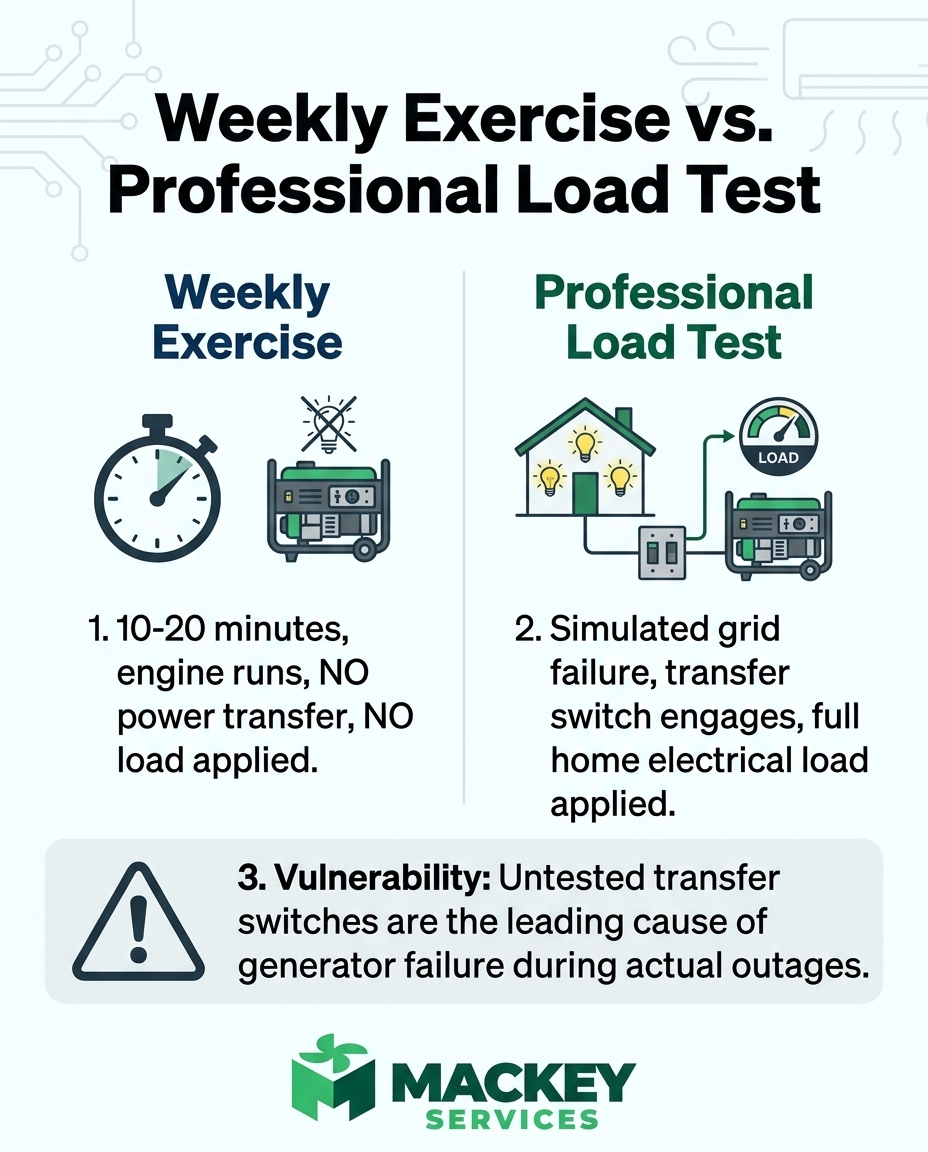
The Mechanics of a Simulated Power Outage
A professional load test is essentially a controlled, simulated power outage performed by a licensed technician. This procedure safely exposes any hidden weaknesses in your backup power system before an actual emergency strikes during the September peak Gulf Coast hurricane season. By intentionally cutting the grid power, technicians force the automatic transfer switch to engage exactly as it would during a severe storm.
What Technicians Monitor During the Test
When the simulated outage begins, the technician is not just listening to the engine. They are actively measuring the electrical output and the mechanical response of the entire system. This involves precise monitoring of several critical factors:
- Voltage Stability: Ensuring the generator produces a consistent flow of electricity without dangerous spikes or drops that could damage sensitive home electronics.
- Frequency Regulation: Verifying that the system maintains a steady 60 Hertz, which is vital for the safe operation of motors and compressors in your appliances.
- Engine Recovery: Watching how the generator's engine responds to sudden, heavy electrical demands. A healthy engine will experience a brief dip in RPMs before immediately recovering and stabilizing.
- Transfer Switch Action: Confirming that the physical switch moves cleanly and quickly, without hesitation or electrical arcing.
Working with Mackey Services means you benefit from our proven local expertise in safely executing these simulated outages for coastal homeowners. We understand exactly how these systems should perform under the stress of a Gulf storm, and we ensure your equipment is fully validated to handle the demand without putting your home at risk.
How Heavy HVAC Loads Expose Transfer Switch Failures
When an early-fall outage hits Dickinson and Galveston County coastal communities, the immediate priority for most homeowners is often still keeping the house cool during lingering warm days. Consequently, the air conditioning system remains one of the largest electrical draws on a standby generator. This massive demand is exactly what exposes underlying faults in an untested transfer switch.
The Problem: The Massive Draw of Air Conditioning
Air conditioners require a significant amount of power just to keep running, but that is only half the battle. The real stress on your backup power system occurs in the exact second your thermostat calls for cooling and the compressor kicks on.
The Cause: Inrush Current and Transfer Switch Stress
This initial surge is known as "inrush current." Starting an AC compressor can temporarily require three to five times more electricity than it takes to keep it running. When this massive surge hits the automatic transfer switch, it tests the physical integrity of the electrical contacts. If those contacts are weakened, pitted, or oxidized, the sudden heavy electrical load can cause the transfer switch to fail instantly. It is very similar to how an air conditioner might trip a circuit breaker if there is a hidden short circuit in the wiring.
The Solution: Verification Under Fire
A proper load test ensures the generator will not stall and the transfer switch will not fail when the thermostat calls for cooling. By simulating this exact scenario while a technician is present, any weaknesses in the ATS contacts or the engine's ability to handle the inrush current are exposed safely. If a component fails during a controlled test, it can be repaired immediately. If it fails during a hurricane, you are left in the dark.
The Impact of the Coastal Climate on Electrical Components
The environment along the Texas Gulf Coast creates unique challenges for exterior electrical equipment. The combination of salt-laden air, relentless high humidity, and intense heat accelerates hidden corrosion on electrical components far faster than in inland areas. For homeowners in Dickinson and Galveston County coastal communities, these climate factors make physical load testing highly urgent.
The Invisible Threat of Oxidation
The automatic transfer switch relies on heavy-duty metal contacts to bridge the connection between the generator and your home. Over months of sitting idle in the coastal humidity, these contacts can develop a layer of oxidation. This invisible layer of corrosion creates electrical resistance. Even if your generator engine runs perfectly and produces the right amount of power, that resistance can prevent a successful power transfer.
Signs of coastal wear on electrical systems include:
- Chalky white buildup on exterior metal housings or exposed grounding wires.
- Pitting or discoloration on internal copper or brass components.
- Stiff or sluggish mechanical action in the physical transfer relays.
Annual visual inspections are simply insufficient when dealing with coastal corrosion. You cannot always see the oxidation between tightly closed contacts. A physical load test forces high electrical current through those contacts, which can actually help break through minor oxidation and verify that the connection remains solid under heavy resistance.
NFPA Guidelines and the Dangers of DIY Testing
Because standby generators are classified as emergency power systems, their maintenance is governed by strict safety standards. The National Fire Protection Association (NFPA) 110 guidelines explicitly mandate regular load testing for these systems to ensure they function when life and property are on the line. While these guidelines are heavily enforced in commercial buildings, following them at home is the best way to guarantee your family's safety during the September peak Gulf Coast hurricane season.
The Severe Risks of Manual Testing
It can be tempting to try and test the system yourself by flipping the main breaker to your house. We strongly warn against any form of DIY load-testing. Manipulating a high-voltage transfer switch manually or opening the electrical panel to force a test exposes you to severe risks, including electrocution and arc flashes. An arc flash is a sudden, explosive release of electrical energy that can cause catastrophic burns and permanent damage to your home's electrical infrastructure.
Properly load-testing a generator requires specialized knowledge of high-voltage systems and the ability to safely monitor live current. This is not a weekend DIY project; it requires a licensed professional. Professional verification is the only safe and compliant way to ensure your system's readiness. If you have concerns about your panel or transfer switch, always rely on professional residential electrical services to handle the inspection and testing safely.
Integrating Load-Testing into Broader Late-Season Preparations
As the September peak Gulf Coast hurricane season reaches its height, most homeowners are busy reviewing their severe weather action plans. You might be trimming trees, clearing debris away from the exterior generator unit, and verifying that the oil and coolant levels are topped off. While these physical checks are incredibly important, verifying the electrical capacity of the system is the ultimate readiness step.
Discovering a transfer switch failure during the chaotic aftermath of a storm is a worst-case scenario. When the grid is down across the county, local technicians are overwhelmed with emergency calls, and replacement parts can take days or even weeks to arrive. A system that cannot transfer power is just as useless as a system with a dead engine.
We encourage homeowners to view the professional load test as the final, non-negotiable step in their storm preparation. Knowing that your system has been physically proven to handle your home's actual electrical demand allows you to fully appreciate the benefits of a standby generator for hurricane season. It shifts your mindset from hoping the system works to knowing it will perform flawlessly during prolonged grid failures.
Secure Your Home's Power Before the Next Storm Strikes
There is a profound sense of peace of mind that comes from knowing your home is truly protected. For residents in Dickinson and Galveston County coastal communities, relying on a green indicator light is a gamble you do not need to take. A professionally verified automatic transfer switch ensures that when the utility grid fails, your lights, air conditioning, and refrigerators will stay on without interruption.
Do not wait until the next major storm is forming in the Gulf to find out if your backup power system can carry the load. Take immediate action to schedule a simulated power outage test with local experts today. By validating your system's full capacity safely and professionally, you secure your home's comfort and safety no matter what the late-season weather brings.
Frequently Asked Questions
What is the difference between a generator exercise and a load test?
The short answer is that an exercise only runs the engine, while a load test powers the house. During a weekly exercise, the generator turns on for 10 to 20 minutes to circulate oil, but it does not disconnect from the utility grid or generate electricity for your home. A professional load test simulates a complete grid failure, forcing the transfer switch to engage and applying your home's full electrical demand to the generator to verify its capacity.
Why did my generator run but not power the house during an outage?
If your generator engine is running but your house is still dark, the problem usually lies in the automatic transfer switch (ATS). The ATS is responsible for physically disconnecting your home from the dead grid and connecting it to the generator's power supply. If the switch is corroded, damaged, or fails to receive the signal to switch over, the generator will continue to run without actually delivering power to your electrical panel.
How do you load test a standby generator safely?
Load testing must be performed by a licensed professional to ensure safety and prevent electrical damage. A technician will intentionally cut the utility power to the home, forcing the generator to start and the transfer switch to engage automatically. While the system is running the home's appliances, the technician monitors voltage, frequency, and engine stability to ensure the generator can handle the full electrical load without stalling.
Does a generator weekly test check the transfer switch?
No, the standard weekly self-test does not check the transfer switch. The weekly exercise is designed strictly to keep the engine lubricated and verify that the battery can start the motor. Because no power is transferred to the home during this brief run, the mechanical components of the transfer switch remain completely stationary and untested until a real outage or a professional load test occurs.
How often should a standby generator be load tested in coastal areas?
In coastal environments like Galveston County, standby generators should undergo a professional load test at least once a year, ideally right before peak hurricane season. The high humidity and salt-laden air accelerate corrosion on exterior electrical components and transfer switch contacts. Annual load testing ensures that this hidden oxidation has not compromised the system's ability to transfer power safely under heavy demand.
Can heavy air conditioning use cause a generator transfer switch to fail?
Yes, the sudden surge of electricity required to start an air conditioner can expose hidden weaknesses in a transfer switch. Air conditioning compressors require a massive initial draw of power, known as inrush current, to start up. If the contacts inside the transfer switch are worn, pitted, or oxidized from coastal humidity, this sudden heavy electrical load can cause the switch to fail instantly, preventing power from reaching the home.
Ready for a better day?
One call handles it all — HVAC, electrical, and generators across the Texas Gulf Coast. Less to pay. Better day. That's the Mackey way.
Mon–Fri: 7 AM – 8 PM · Sat: 8 AM – 5 PM · Licensed & insured · #TACLA 112769C · #TECL 558211