
Balancing Airflow and Filtration: Finding the Right MERV Rating for Ragweed Season
What we found about balancing airflow and filtration: finding the right MERV rating for ragweed season protects your older HVAC blower and your allergies.
Myth: The Highest MERV Rating Is Always the Best Choice for Allergies
A common myth our team typically sees among homeowners is that buying the thickest, most expensive air filter at the big box store will instantly solve indoor allergy problems. The truth is much more complicated. When balancing airflow and filtration: finding the right MERV rating for ragweed season requires a careful compromise between protecting your respiratory health and preserving your HVAC equipment. Many people assume that a higher rating automatically equals a better home environment. However, while incredibly dense filters do capture more microscopic particles, they also act like a solid brick wall against your heating and cooling system's airflow.
This severe airflow restriction often leads to disastrous mechanical consequences, especially as early fall weather and lingering late-summer heat force your HVAC system to work overtime. Instead of breathing easier, you might find yourself dealing with a completely broken system right in the middle of September ragweed season. Finding the right balance requires evaluating both your family's respiratory needs and your specific equipment's mechanical limits.
For comprehensive solutions to improve your home's indoor air quality, enrolling in a professional HVAC maintenance plan is the best way to ensure your system operates safely and effectively as we transition into the heating season.
Understanding the Mechanical Reality of MERV Ratings
To make an informed decision about your home's air quality, you first need to understand how filters are graded and what those grades actually mean for your equipment. The Minimum Efficiency Reporting Value (MERV) scale measures how effectively a filter traps microscopic particles as air passes through the media. The higher the number, the smaller the particles it can catch.
What the MERV Scale Actually Measures
Filters are tested against particles of varying sizes, measured in microns. To put this into perspective, a single strand of human hair is about 70 microns in diameter. Ragweed pollen particles typically measure between 10 and 30 microns. Because these pollen grains are relatively large on a microscopic scale, they do not strictly require hospital-grade, ultra-dense filtration to be captured effectively. A mid-range filter is often more than capable of trapping these allergens before they circulate back into your living space.
The Static Pressure Problem
As the MERV rating increases—particularly when you move into the MERV 13 and higher categories—the filter media becomes significantly denser. Manufacturers pack more fibers tightly together to catch smaller particles like smoke and bacteria. While this sounds great for air quality, this increased density dramatically raises the static pressure within your ductwork.
Static pressure is essentially the resistance to airflow. When resistance goes up, your system's blower motor has to work much harder to circulate the same volume of air throughout the house. This is a critical issue for older single-stage blower motors, which are designed to push a specific amount of air against a specific amount of resistance. When you introduce a highly restrictive premium filter, you alter that delicate mechanical balance, forcing the motor to strain against a barrier it was never designed to overcome.
Why Dense Filters Threaten Older AC Units
The danger of high-MERV filters is not distributed equally across all HVAC systems. The age and technology of your specific unit dictate how it handles airflow resistance.
The Problem: A Lack of Variable-Speed Technology
Modern variable-speed blower motors are incredibly advanced. They can sense an increase in static pressure and automatically ramp up their output to push air through a dense filter. Unfortunately, older single-stage blower motors cannot adjust their speed. They operate at one constant output. When you place a highly restrictive MERV 13 filter in front of a single-stage motor, the static pressure spikes, and the volume of air moving through the system drops exponentially. The motor suffocates.
The Cause: Starving the System of Return Air
HVAC systems require a massive, steady volume of return air from the house to function correctly. This airflow restriction is a pervasive issue that extends beyond just the filter itself. Our technicians at Mackey Services frequently see this during pre-heating-season tune-ups. Recently, we evaluated a system that was running incredibly inefficiently. The root cause wasn't just the equipment—it was poor ductwork and severely restricted return airflow. By replacing the outdated ducts, adding a second return, and rewrapping the return line, the efficiency and airflow throughout the home improved dramatically. Placing a dense filter over your intake creates the exact same type of restriction, choking off the air your system desperately needs to breathe.
The Solution: Recognizing the Symptoms
This lack of adequate return airflow causes the system to run longer, more stressful cycles without effectively conditioning the home. Homeowners often mistake this sudden drop in performance for a severe mechanical failure or a refrigerant leak. In reality, a pattern we see often is that the culprit is the premium allergy filter they just installed. Before assuming your compressor is failing, upgrading your HVAC filter setup to a more appropriate, balanced rating is often the most effective fix.
The Gulf Coast Trap: Restricted Airflow and Frozen Coils
Understanding the mechanical strain on the blower motor is only half the equation. The other half involves how restricted airflow interacts with regional weather patterns, creating a unique and expensive hazard for local homeowners.
How High Humidity Accelerates the Freeze
Air conditioners and heat pumps do much more than simply cool the air; they also extract latent moisture, which is an absolute necessity in coastal climates. In our years servicing homes in Dickinson TX, our team has seen firsthand how the high ambient humidity during the early fall transition creates a massive amount of condensation on the indoor evaporator coil. Under normal conditions, a steady stream of warm air blows across this coil, evaporating the refrigerant inside and allowing the condensation to drip safely into the drain pan.
The freezing process:
- Airflow drops: When a dense filter restricts the airflow, there isn't enough warm air blowing over the indoor coil to facilitate the heat transfer process.
- Temperatures plummet: Without that warm air, the evaporator coil gets dangerously cold.
- Condensation freezes: The heavy moisture pulled from the humid Dickinson air collects on the super-cooled metal and quickly turns to solid ice.
- System failure: This ice acts as an insulator, completely halting the conditioning process.
If left unchecked, a frozen coil can cause liquid refrigerant to flow backward through the suction line, a condition known as "liquid slugging." This can instantly destroy the outdoor compressor, turning a simple filter mistake into a catastrophic system failure.
Comparing Filtration Options: Efficiency vs. Equipment Safety
To safely navigate the September ragweed season, you need a clear understanding of what each tier of filtration offers and what risks it carries. The goal is to find the sweet spot that captures pollen without turning your evaporator coil into a block of ice.
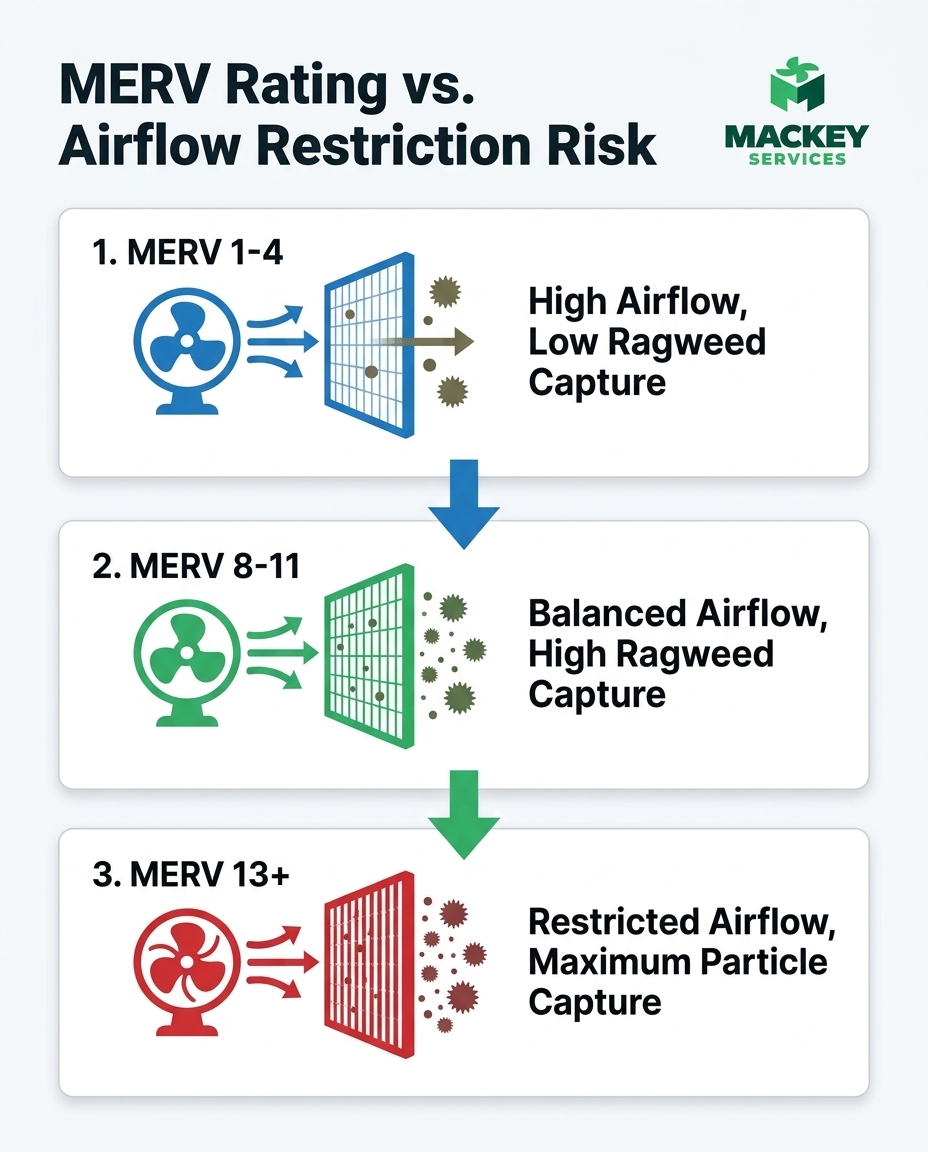
| MERV Rating Tier | Particle Capture Efficiency | Airflow Restriction Risk for Older Motors | Best Use Case |
|---|---|---|---|
| MERV 1-4 | Very Low (Catches dust bunnies and large debris) | Minimal to None | Basic equipment protection; zero allergy relief. |
| MERV 8-11 | High for Ragweed (Captures 10-30 micron particles) | Moderate (Safe for most maintained systems) | The ideal balance for seasonal allergies and system longevity. |
| MERV 13+ | Maximum (Captures smoke, bacteria, fine particles) | Severe | Modern variable-speed systems or dedicated media cabinets only. |
Choosing the right tier depends entirely on the mechanical capabilities of your specific HVAC unit. Forcing the highest possible rating into an incompatible system will always result in a breakdown rather than better air quality.
Finding the Perfect Compromise for Your System
If you are relying on older single-stage blower motors to keep your home comfortable, you need a practical strategy that provides respiratory relief without risking a frozen coil. Here is an expert-recommended approach our team uses to balance indoor air quality needs with a system's mechanical reality.
- Step down the rating: Instead of forcing a dense MERV 13 filter into an incompatible system, we recommend opting for a high-quality MERV 8 or MERV 10 filter. These ratings are highly effective at capturing ragweed pollen without creating a brick wall in your return duct.
- Increase the replacement frequency: Compensate for the slightly lower capture rate by changing the filter much more frequently. During peak pollen counts, replace your 1-inch filter every 3 to 4 weeks instead of waiting the standard 90 days. A fresh MERV 8 filter flows better and cleans better than a clogged MERV 13 filter.
- Keep the blower clean: Ensure your routine fall maintenance is up to date. A clean blower wheel can push air much more efficiently, helping to overcome the minor static pressure increases caused by mid-tier allergy filters.
- Schedule a static pressure test: The absolute safest way to determine exactly what rating your ductwork can handle is through professional evaluation. Our technicians at Mackey Services bring deep, hands-on mechanical expertise in evaluating older blower motors, helping Gulf Coast homeowners find the perfect balance between modern allergy filtration needs and long-term system longevity.
This compromise strategy keeps static pressure low, prevents the coil from freezing, and still removes a massive volume of allergens from your living space.
Beyond the 1-Inch Filter: Advanced Allergy Solutions
Sometimes, a standard 1-inch MERV 8 filter simply isn't enough. If you suffer from severe asthma or chronic respiratory conditions, you need high-level filtration. However, forcing a dense 1-inch filter into a standard return grille is still not the answer. There are advanced, dedicated solutions designed to provide hospital-grade air quality without compromising your equipment.
Upgrading to a Media Cabinet
One of the most effective upgrades we install is a wider media cabinet at the air handler. These cabinets accommodate thick, 4-inch or 5-inch pleated filters. Because these filters are so deep, they have a massive amount of surface area. This expanded surface area allows you to use a MERV 13 or even MERV 16 filter with significantly less airflow restriction than a standard 1-inch filter. The air moves through the deep pleats easily, protecting your older single-stage blower motors while capturing microscopic pollutants.
Dedicated HEPA Filtration Systems
For the ultimate in indoor air quality, bypass HEPA filtration systems offer a completely independent solution. These units are installed alongside your existing ductwork. They pull a small portion of air out of the return, push it through a true HEPA filter using their own internal fan, and then return the perfectly clean air to the supply side. Because the HEPA system has its own motor, it does not strain your primary blower.
Real-world results prove how effective this can be. For instance, our team recently helped a local homeowner struggling with terrible asthma symptoms during the fall allergy transition who needed a drastic improvement in their indoor air quality. By having us install a dedicated Lennox health climate HEPA filtration system alongside their new air conditioning systems, the indoor air quality improved significantly, bringing real respiratory relief without compromising the equipment's performance. These dedicated upgrades provide peace of mind for sensitive individuals right here in Dickinson TX.
Frequently Asked Questions
Is MERV 13 too restrictive for older AC units?
Yes, in most cases MERV 13 filters are too restrictive for older HVAC systems. These older units typically use single-stage blower motors that cannot adjust their speed to overcome the high static pressure created by dense filter media. Using a MERV 13 filter in these systems often leads to severely reduced airflow, longer conditioning cycles, and unnecessary wear and tear on the motor.
Why does my AC freeze with a new allergy filter?
Your AC freezes because the new allergy filter is blocking the necessary volume of warm return air from reaching the indoor evaporator coil. Without enough warm air blowing over it, the coil drops below freezing. The ambient humidity in the air then condenses on the super-cooled metal and quickly turns to solid ice, which eventually halts the entire process.
What is the best MERV rating compromise for allergies and airflow?
A MERV 8 to MERV 11 filter is generally the best compromise for balancing allergy relief and proper airflow. These ratings are dense enough to capture common allergens like ragweed pollen, pet dander, and dust mites, but porous enough to allow sufficient air to pass through to keep standard blower motors operating safely.
Can a high MERV rating damage my HVAC system?
Yes, consistently using a filter with a MERV rating that is too high for your specific system can cause significant damage. The restricted airflow forces the blower motor to overwork, which can lead to premature motor failure. Additionally, the resulting frozen evaporator coils can cause liquid refrigerant to flow backward, potentially destroying the outdoor compressor.
Does MERV 13 restrict airflow too much?
MERV 13 restricts airflow significantly more than standard filters, which is a major problem for systems not designed to handle it. While modern variable-speed systems can often accommodate the restriction by ramping up their fan speed, standard single-stage motors will experience a sharp drop in air volume. This makes the home less comfortable and strains the equipment.
What MERV rating is safe for older HVAC systems?
For most older HVAC systems, sticking to a MERV 8 filter is the safest choice to ensure proper airflow and prevent mechanical strain. If your family requires better filtration, you can sometimes safely step up to a MERV 10, provided you change it very frequently and have a technician verify your system's static pressure limits.
How often should I change my filter during peak pollen counts?
During peak pollen seasons, such as the early fall ragweed bloom, you should check and replace your 1-inch air filter every 3 to 4 weeks. Even a safe, mid-range filter will become restrictive once it is loaded with heavy pollen and dust. Frequent changes ensure your air stays clean and your HVAC system can breathe easily.
Protect Your Equipment and Your Air Quality This Fall
Don't let the pursuit of perfect air quality accidentally destroy your HVAC system during the September ragweed season. Achieving a healthy home environment doesn't have to come at the expense of a burnt-out blower motor or a frozen evaporator coil. Our team at Mackey Services can help you weigh your filtration options and accurately evaluate your specific equipment's mechanical capabilities.
Before you install a highly restrictive premium filter, schedule a professional inspection to ensure your system can handle the static pressure. Enrolling in a routine HVAC maintenance plan with us is the most reliable way to ensure your system survives the seasonal transition while keeping your home comfortable and your air clean.
Ready for a better day?
One call handles it all — HVAC, electrical, and generators across the Texas Gulf Coast. Less to pay. Better day. That's the Mackey way.
Mon–Fri: 7 AM – 8 PM · Sat: 8 AM – 5 PM · Licensed & insured · #TACLA 112769C · #TECL 558211