
Diagnosing Lukewarm Heat Pump Output During Mild Texas Autumns
Why we advise against panicking when diagnosing lukewarm heat pump output during mild Texas autumns. See why 90°F air is normal and when to call a pro.
Why Does My Heat Pump Feel Like It's Blowing Cool Air?
When diagnosing lukewarm heat pump output during mild Texas autumns, the first question you probably ask is: is my system actually broken, or just operating normally? It is a remarkably common experience. You switch your thermostat to heat for the very first time as the evening cools down during the September and October early fall transition. A few minutes later, you hold your hand over the nearest supply register and feel a stream of air that seems decidedly cool. Panic immediately sets in. You assume the compressor has failed, the refrigerant has leaked out, or the system is completely broken because it lacks the intense, skin-warming blast of heat you might remember from older homes.
Before you rush to the phone to book an emergency repair call, it is essential to understand that what you are feeling is likely a matter of basic human biology colliding with high-efficiency HVAC design. A heat pump does not operate like a roaring fireplace. Instead, it moves ambient thermal energy from one place to another, resulting in a steady, lower-temperature airflow that is mathematically proven to warm your living space. Over our years serving the Dickinson area, the Mackey Services team has walked hundreds of homeowners through this exact scenario. This guide will help you determine the difference between normal operation and a genuine mechanical failure, empowering you to decide whether you actually need heating services or simply a better understanding of how your modern climate control system functions.
The Biology of Heat: 90-Degree Air vs. 98.6-Degree Body Temperature
To understand why your heat pump feels like it is failing when it is actually working perfectly, you have to look at the science of human physiology. The sensation of "hot" and "cold" on your skin is entirely relative to your own body temperature.
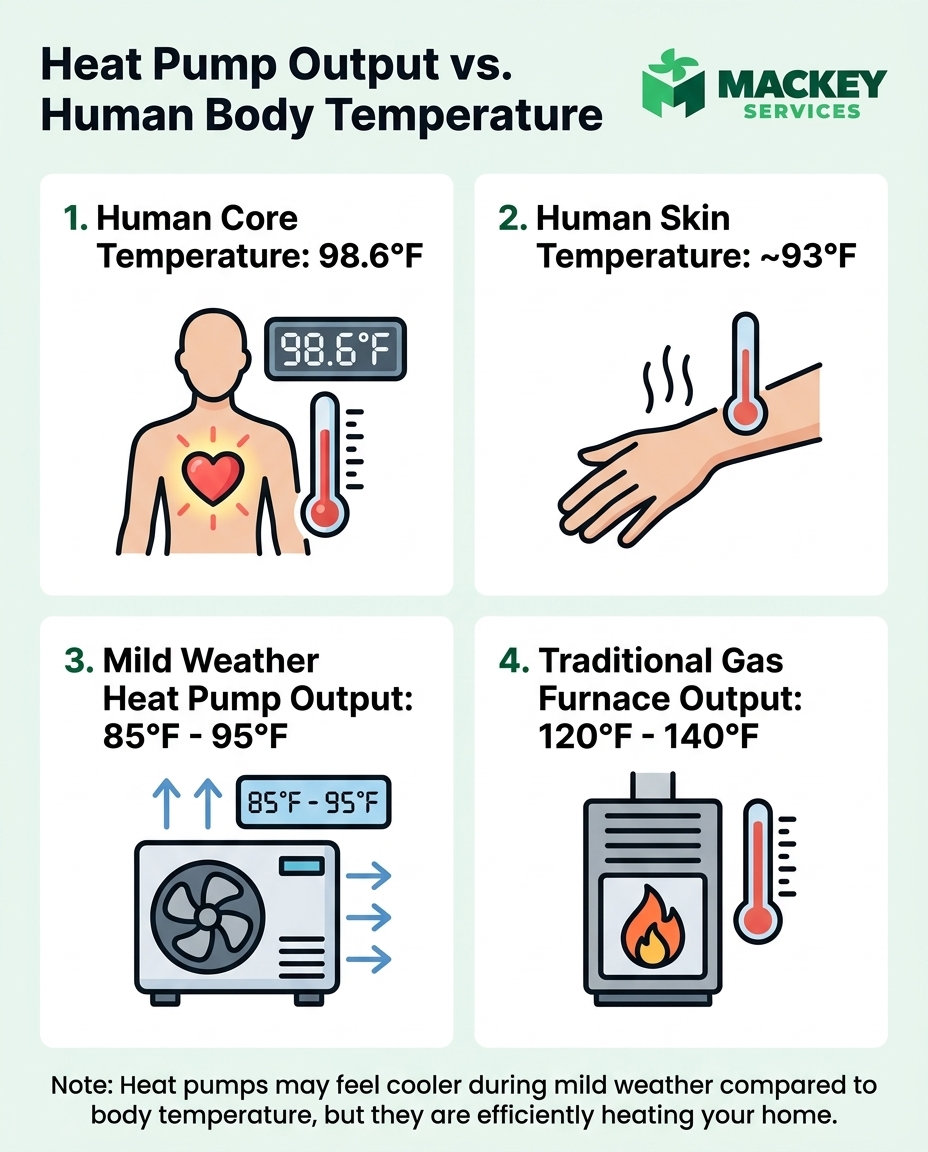
Normal human core body temperature sits at 98.6°F, and your skin temperature typically hovers around 91 to 93°F. In mild weather conditions, a properly functioning heat pump typically produces supply air between 85°F and 95°F. When a steady stream of 90°F air blows across your 93°F skin, the air is physically cooler than your body. Your nerve endings register this temperature differential as a cooling sensation, leading you to believe the system is blowing cold air.
The Math Behind Heating Your Home
Despite feeling lukewarm to the touch, that 90°F supply air vs 98.6°F human body temperature dynamic does not mean your house will stay cold. If your thermostat is set to a standard comfortable room temperature of 68°F to 72°F, a continuous flow of 90°F air is more than sufficient to raise the ambient temperature of the room. The system is adding thermal energy to the space, just at a slower, more deliberate pace than older heating technologies.
This steady, consistent delivery of warmth is a hallmark of modern energy efficiency. The system avoids massive temperature swings, gently elevating the room's climate until it reaches your desired set point. If you suspect your system is struggling, understanding this baseline is the first step in proper heat pump maintenance and repair diagnostics.
How Mild Gulf Coast Weather Lowers Your Heating Load
The performance of your HVAC system is heavily dictated by the environment outside your walls. In the HVAC industry, we measure this using a concept called "heating load." The heating load is the exact amount of thermal energy required to maintain your indoor set temperature against the outdoor weather conditions.
In our experience servicing Dickinson, TX and Gulf Coast area homes, our team consistently sees that the heating load during early autumn is exceptionally low. The region experiences high daytime humidity and only mild overnight temperature drops during the September and October early fall transition. If it is 60°F outside and you want it to be 70°F inside, your heat pump only needs to overcome a 10-degree differential.
Variable Capacity and Mild Weather
Modern heat pumps, especially variable-speed models, are essentially smart systems. They monitor the outdoor temperature and the indoor demand, scaling their output to match the exact heating load required. Because the Gulf Coast autumn is so mild, the system does not need to run at 100% capacity. It operates in a low-stage, highly efficient mode, which naturally results in supply air that hovers closer to that 85°F to 90°F range.
Later in the year, when genuine winter weather arrives and outdoor temperatures plummet toward freezing, the heating load increases dramatically. The system will ramp up its compressor speed to extract more heat, and you may notice the supply air feeling slightly warmer. Understanding how heat pumps handle extreme Texas temperatures—both hot and cold—reveals that their ability to scale output is a feature, not a flaw.
Heat Pumps vs. Traditional Gas Furnaces: A Matter of Degrees
A significant portion of homeowner anxiety surrounding heat pump output stems from past experiences with traditional gas furnaces. If you grew up in a home heated by natural gas, your baseline expectation for heating is fundamentally different from what a heat pump provides.
Gas furnaces rely on combustion. They ignite a physical flame inside a heat exchanger, creating a massive, rapid burst of thermal energy. As a result, the supply air blasting out of the vents from a gas furnace typically measures between 120°F and 140°F. Because this air is significantly hotter than your 93°F skin temperature, it feels instantly hot and comforting to the touch.
Comparing the Two Technologies
The difference between these two systems is best understood by looking at their mechanics and output profiles:
| Feature | Traditional Gas Furnace | Modern Heat Pump |
|---|---|---|
| Heating Method | Combustion (burning fuel) | Refrigeration cycle (moving heat) |
| Supply Air Temperature | 120°F - 140°F | 85°F - 95°F (in mild weather) |
| Sensation on Skin | Intensely hot | Cool or lukewarm |
| Efficiency Profile | Creates severe temperature swings | Provides steady, even climate control |
| Energy Consumption | Consumes fossil fuels directly | Uses electricity to transfer ambient heat |
While the 120°F blast of a furnace feels reassuring, it often results in a "yo-yo" effect in your home's temperature. The furnace blasts heat, overshoots the thermostat setting, shuts off, and allows the house to cool down before blasting heat again. A heat pump's steady, 90°F output eliminates these massive swings, keeping your home's temperature incredibly stable while using significantly less energy.
When Lukewarm Output Actually Signals a Malfunction
While 90°F supply air is completely normal during the September and October early fall transition, there are specific scenarios where cool air indicates a genuine mechanical failure. The key differentiator is not how the air feels on your hand, but whether the system is actually capable of reaching and maintaining the temperature set on your thermostat.
If your thermostat is set to 70°F, but the indoor temperature is stuck at 62°F and the system is running continuously for hours without making progress, you have a problem. Here are the most common culprits:
- A stuck reversing valve: Heat pumps use a specialized component called a reversing valve to switch the flow of refrigerant between cooling mode and heating mode. If this valve becomes physically stuck or experiences an electrical failure, the system may remain locked in air conditioning mode, actively pumping 55°F air into your home instead of heating it.
- Low refrigerant levels: The refrigeration cycle relies on a precise charge of chemical refrigerant to absorb and release heat. If a leak develops in the copper lines or coils, the system loses its ability to capture adequate thermal energy from the outside air, resulting in drastically reduced heating capacity.
- Severe airflow restrictions: A clogged air filter, blocked return registers, or collapsed ductwork can choke the system. Without adequate airflow over the indoor coil, the heat transfer process breaks down entirely.
Real-world failures often require immediate intervention. Our Mackey Services technicians frequently see this firsthand. Just last season, a Dickinson homeowner reached out to our team when their zoned system kept tripping breakers during an unexpected cold snap. Our technicians diagnosed the underlying problem, returned with the necessary parts, and made the repairs to keep the home warm during the harsh weather. If your system is failing to heat the house, securing comprehensive HVAC services is the safest course of action.
Why Professional Troubleshooting Beats Unnecessary Panic
Jumping to conclusions about your HVAC system's health based solely on the "hand test" over a vent can lead to unnecessary stress and premature service calls. Instead of panicking, the best approach is to monitor the system's actual performance metrics. Does the indoor temperature match the thermostat setting? Is the airflow strong and consistent? Are there any grinding, squealing, or rattling noises coming from the outdoor compressor?
If the system is maintaining your desired room temperature, it is functioning exactly as engineered. However, if you are still concerned, bringing in a professional for a pre-season evaluation provides unparalleled peace of mind. A licensed technician does not rely on how the air feels; they use calibrated digital gauges to measure the exact supply and return temperatures, evaluate the refrigerant pressures, and test the electrical amp draw of the compressor.
The Value of Local Expertise
Working with a team that possesses deep local expertise in Gulf Coast climate transitions means you get an honest assessment based on regional realities. At Mackey Services, our team focuses on helping our Dickinson neighbors understand their HVAC systems rather than just selling unnecessary repairs for a system that is actually operating normally.
Education is a core part of a trustworthy service visit for our technicians. In another instance, a customer needed a condenser replacement over the summer. Our technician not only replaced the unit but patiently answered all technical questions, ensuring the homeowner was completely comfortable with how the new equipment operated and what to expect from its performance. Booking a routine HVAC maintenance plan visit in the early fall allows our professionals to catch minor calibration issues, clear out summer debris, and ensure your system is fully prepared long before the genuine winter chill arrives.
Frequently Asked Questions About Heat Pump Temperatures
Why is my heat pump blowing lukewarm air?
A heat pump blowing lukewarm air is usually operating perfectly normally. During mild weather, a heat pump produces supply air between 85°F and 95°F. Because your normal skin temperature is around 93°F, this air feels cool or lukewarm to the touch, even though it is carrying enough thermal energy to warm your home to a standard 70°F thermostat setting.
What temperature should air coming out of a heat pump be?
The air coming out of a heat pump should typically measure between 85°F and 95°F during mild autumn weather. This output temperature can fluctuate slightly based on outdoor conditions; as the outside temperature drops closer to freezing, the system works harder, and the supply air may feel slightly warmer, but it will rarely exceed 100°F.
Do heat pumps blow hot air like a gas furnace?
No, heat pumps do not blow intensely hot air like a gas furnace. A traditional gas furnace uses combustion to create a blast of supply air that measures between 120°F and 140°F. A heat pump uses a refrigeration cycle to move ambient heat, resulting in a steady, lower-temperature flow of air that is much more energy-efficient but feels cooler to human skin.
How do I know if my heat pump is working properly in winter?
The most reliable way to know if your heat pump is working properly is to check your thermostat. If the room reaches and maintains the temperature you set, the system is operating correctly, regardless of how the air feels at the vent. You should also monitor the system for unusual noises or continuous, non-stop running without ever reaching the set point, which would indicate a problem.
Can a dirty filter cause a heat pump to blow cool air?
Yes, a severely dirty air filter can cause a heat pump to perform poorly and blow cooler air. A clogged filter restricts the volume of air moving over the indoor coil, disrupting the heat transfer process and causing the system to lose efficiency. Replacing your air filter regularly is the most important homeowner maintenance step you can take to ensure optimal heating performance.
Get Expert Answers for Your Heat Pump Concerns
Understanding the science behind your HVAC system is the key to maintaining a comfortable home without unnecessary anxiety. That 90-degree supply air you feel during the mild fall months is a sign of highly efficient, normal operation, gently warming your home against the low heating load of the Gulf Coast climate.
However, if your home is actively failing to reach the temperature set on your thermostat, or if you suspect a genuine malfunction like a stuck reversing valve or airflow restriction, professional help is always available. If you are still unsure about your system's performance, schedule an inspection with our team today to get a clear, scientific explanation of your system's health and ensure your home is ready for the upcoming winter season.
Ready for a better day?
One call handles it all — HVAC, electrical, and generators across the Texas Gulf Coast. Less to pay. Better day. That's the Mackey way.
Mon–Fri: 7 AM – 8 PM · Sat: 8 AM – 5 PM · Licensed & insured · #TACLA 112769C · #TECL 558211