
Managing Indoor Pollen Counts When You Finally Open the Windows in September
See why managing indoor pollen counts when you finally open the windows in September requires more than a standard HVAC filter. Find your IAQ options.
The Hidden Cost of the First Fall Cool Front
Managing Indoor Pollen Counts When You Finally Open the Windows in September requires a proactive strategy, especially when that long-awaited cool front finally breaks the intense summer heat. The temptation to turn off the air conditioning and let fresh air circulate through your home is entirely understandable. After months of relying on forced air to survive the extreme temperatures, feeling a natural breeze is a welcome relief. However, this exact seasonal transition introduces a sudden, severe indoor air quality problem that catches many homeowners off guard. At Mackey Services, we consistently field a wave of calls every early fall from local families suddenly struggling with unexplained indoor allergies.
The moment those windows slide open, millions of microscopic outdoor allergens flood into your living spaces. September and early fall cool fronts carry massive payloads of seasonal pollen and ragweed, directly bypassing the defenses your home normally relies on. You are immediately faced with a critical decision point: determining whether your current setup can handle this heavy particulate influx, or if you need a more robust strategy to protect your family's respiratory health while still enjoying the autumn weather.
If you want to maintain a healthy environment without sacrificing fresh air, you need to look beyond basic ventilation. Upgrading your HVAC system with dedicated whole-home air purifiers is the most effective way to capture these seasonal allergens before they settle into your home.
The Mechanical Reality: Bypassing Your Return Filtration
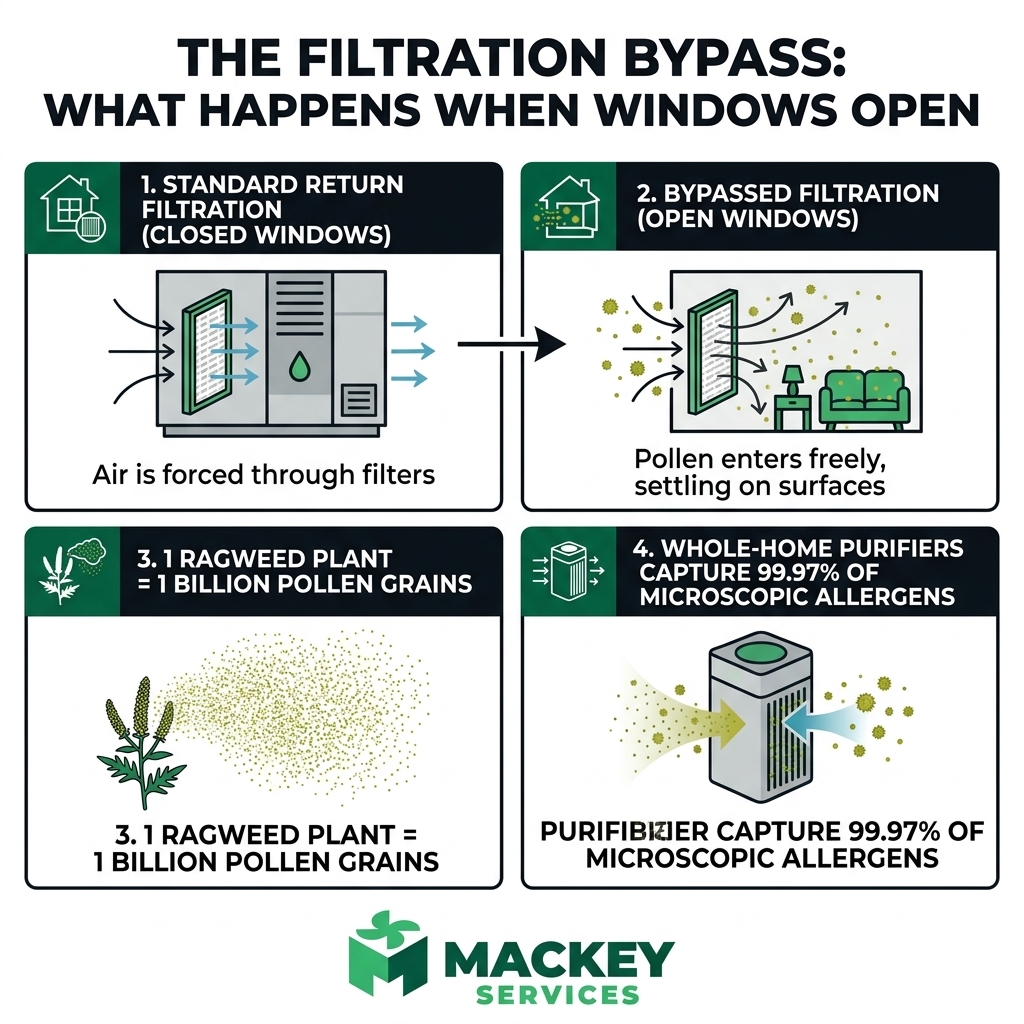
The problem: To understand why indoor allergy symptoms spike so aggressively during the fall, you have to look at the mechanical realities of how residential central air systems operate. Standard air filtration only occurs when air is actively drawn through your home's return ducts. Your blower motor pulls stagnant air from your rooms, forces it through the filter media, and pushes the newly scrubbed air back out through the supply vents. This continuous cycle is what keeps airborne dust and debris manageable during the summer months.
The cause: When you turn off the thermostat and open the windows during September and early fall cool fronts, you completely bypass this standard air-return filtration cycle. The mechanical circulation stops. Instead of being pulled toward a central filter, the outdoor air drifting into your home simply disperses. You are introducing a massive volume of raw, unfiltered outdoor air directly into your living room, bedrooms, and hallways, with no active mechanism running to capture the incoming contaminants.
The solution: Mitigating this requires an active approach to indoor air quality that operates independently of your cooling cycle, ensuring that even when the AC compressor is off, the air inside your home is still being continuously filtered and purified.
Why Bypassed Air Matters
The loss of forced-air circulation means your indoor air quickly becomes stagnant. Without the constant pull of the return vents, the heavy particulates carried by the autumn breeze do not stay suspended in the air for long. Instead, these allergens are allowed to drop out of suspension rapidly. They settle onto your countertops, embed themselves deep into your carpets, and cling to your upholstery. Once ragweed and pollen grains settle into these porous surfaces, they become incredibly difficult to remove, acting as a persistent source of irritation long after you have closed the windows again. Furthermore, as natural drafts move through the house, these settled particulates can easily drift into your stationary ductwork, waiting to be blown back out the next time the system kicks on.
Why the Texas Gulf Coast Ragweed Spike is Uniquely Challenging
The environmental threat during this specific season is not just a minor nuisance; it is a severe biological event. A single ragweed plant can produce up to 1 billion pollen grains over the course of its short lifecycle. These grains are incredibly lightweight and aerodynamic, designed by nature to travel hundreds of miles on a strong breeze. When the weather shifts, the concentration of these microscopic invaders reaches its absolute peak, creating a dense, invisible cloud of allergens.
Living in the Dickinson TX area adds a unique layer of complexity to this seasonal challenge. Our team at Mackey Services sees the effects of this coastal environment every single autumn. The Texas Gulf Coast climate is notorious for high humidity levels and strong, shifting coastal winds. These coastal winds act as a powerful delivery mechanism, driving massive quantities of ragweed pollen straight through your open window screens exactly when you want to enjoy the fresh air. Furthermore, the elevated humidity in the region causes these pollen grains to become slightly sticky, making them more likely to adhere to your indoor furnishings, window treatments, and bedding.
Because the Dickinson TX area experiences such prolonged and intense allergy seasons, relying on basic defenses is rarely enough. Understanding how Texas pollen and humidity affect indoor air is the first step toward realizing that you need a much more robust indoor defense strategy than simply closing the windows when your symptoms flare up.
Standard 1-Inch HVAC Filters vs. Dedicated IAQ Solutions
A common misconception among homeowners is that standard air conditioning filters are designed to improve human health or catch microscopic allergens. The reality is quite different. Standard 1-inch fiberglass filters, typically rated between MERV 1 and MERV 4, are engineered primarily to protect the delicate blower motor and evaporator coil from large, damaging debris like pet hair, heavy dust, and lint. They are highly porous by design to maintain optimal airflow, meaning microscopic ragweed pollen simply passes right through the fiberglass mesh and recirculates into your home.
To truly transform your respiratory comfort during these intense allergy spikes, you must contrast these basic filters with dedicated indoor air quality (IAQ) solutions. Advanced filtration systems, such as thick media cabinets or HEPA-grade purifiers, are specifically designed to capture up to 99.97% of microscopic allergens, including pollen, mold spores, and pet dander. Just last season, our technicians worked with a homeowner in the Dickinson TX area who reached out during the summer dealing with terrible asthma that was severely impacting their daily life. We ultimately installed a dedicated HEPA filtration system for them, and they reported that the new setup was performing amazingly well, finally providing the clean air necessary to keep their symptoms under control.
| Filtration Type | Primary Purpose | Particle Capture Size | Effectiveness on Ragweed |
|---|---|---|---|
| Standard 1-Inch Fiberglass (MERV 1-4) | Protecting HVAC equipment from large debris | 10.0+ microns (Dust bunnies, lint, hair) | Very Low - Pollen passes right through |
| Pleated 1-Inch Filter (MERV 8-11) | Basic residential air quality improvement | 3.0 to 10.0 microns (Mold spores, dust mites) | Moderate - Catches larger pollen grains |
| Deep Media Cabinet (MERV 13-16) | High-efficiency whole-home air scrubbing | 0.3 to 3.0 microns (Bacteria, fine smoke, sneeze droplets) | High - Captures the vast majority of fall allergens |
| Dedicated HEPA / Active Purifier | Maximum respiratory protection and health | 0.3 microns and smaller (Viruses, ultra-fine particulates) | Maximum - Captures up to 99.97% of all microscopic allergens |
Strategic Natural Ventilation: How to Open Windows Safely
Validating the desire to enjoy the crisp autumn weather is important. You shouldn't have to keep your house sealed like a vault just to avoid sneezing. If you want to utilize natural ventilation during September and early fall cool fronts, you can do so safely by implementing a few strategic, expert mitigation techniques.
- Time your natural ventilation carefully: Pollen counts follow a predictable daily rhythm. Plants typically release their pollen in the early morning hours, and winds peak around midday, making mornings and early afternoons the worst times for natural ventilation. Instead, time your window openings for the late afternoon, evening, or immediately following a heavy rainstorm, which naturally washes particulates out of the air.
- Implement daily physical cleaning routines: When windows are open, your window sills and screens act as primary collection points for outdoor debris. Wipe down these surfaces daily with a damp microfiber cloth to trap the pollen before a sudden breeze can blow it deeper into the room. Vacuum high-touch surfaces and soft furnishings frequently using a vacuum equipped with a HEPA filter.
- Manage personal pollen transfer: Your body acts like a magnet for airborne particulates. Hair and clothing trap millions of invisible grains throughout the day. Always shower and wash your hair before getting into bed to prevent transferring trapped pollen from your skin to your pillowcases and sleeping areas, which can trigger severe nighttime asthma and allergy attacks.
- Create cross-ventilation strategically: Instead of opening every window in the house, open specific windows to create a controlled cross-breeze. This allows you to enjoy the fresh air in one targeted zone while keeping the rest of the home's air relatively undisturbed and easier for your filtration system to manage once the windows are closed.
Deploying Your Ultimate Safety Net for Fall Allergies
Even with the best natural ventilation strategies, pollen will inevitably find its way indoors. This is where advanced indoor air quality systems step in as your ultimate, active safety net. Rather than passively waiting for air to pass through a standard return grill, modern whole-home air purifiers actively work to neutralize and capture contaminants. These systems integrate directly into your existing ductwork and continuously scrub the air, significantly mitigating the risk of particulates settling into your home's furnishings even while new air is being introduced.
Living in a coastal environment requires more than generic, off-the-shelf solutions. The sheer volume of particulate matter carried on the coastal breeze demands properly sized, high-capacity filtration. At Mackey Services, our team designs tailored IAQ solutions specifically for the challenging Texas Gulf Coast climate, ensuring that every system is appropriately sized to handle heavy, prolonged allergy seasons without restricting your system's essential airflow.
By deploying a combination of high-efficiency media filters, active ionization, or UV germicidal lamps, you create a multi-layered defense system. This ensures that the moment you close your windows in the Dickinson TX area, your home's air is rapidly scrubbed clean, returning your indoor environment to a safe, breathable baseline in a fraction of the time it would take a standard filter.
Transitioning Your System After the Summer Load
Bridging the gap between active indoor air quality management and routine seasonal maintenance is vital for overall system health. The extreme summer heat takes a massive toll on your cooling equipment and its filtration components. By the time September and early fall cool fronts arrive, your system has likely been running non-stop for months, accumulating a heavy layer of summer dust, pet dander, and general household debris.
Before you shift into the heating season, a comprehensive system transition is necessary to ensure optimal performance and clean air delivery. In our years of performing pre-season tune-ups, we frequently pull out blower wheels and filters completely caked in summer dust. Neglecting this step means you will be blowing months of accumulated debris directly into your living spaces the first time you turn on the furnace.
- Schedule a pre-heating season tune-up: Professional routine HVAC maintenance is essential to clear out summer dust before winter begins. Technicians will clean the blower assembly, check the heat exchanger, and ensure all electrical connections are secure.
- Inspect ductwork for bypassed pollen: Ask your technician to perform a visual inspection of your return and supply ducts. If you have been opening your windows frequently, pollen and dust may have settled inside the ductwork while the system was idle, which will need to be addressed to prevent ongoing contamination.
- Replace heavily soiled filters immediately: Start the new season with a fresh, high-quality filter. A filter that is already clogged from summer use will severely restrict airflow, forcing your system to work harder and drastically reducing its ability to capture new fall allergens.
- Verify thermostat staging and fan settings: Ensure your thermostat is programmed correctly for the changing weather. Utilizing the "circulate" fan setting can help keep air moving through your filtration system even when neither the heating nor cooling cycles are actively running.
FAQ
Does opening windows make allergies worse?
Yes, opening windows directly introduces outdoor allergens like pollen and mold spores into your home. This bypasses your HVAC system's filtration, allowing microscopic particulates to settle onto your furniture, carpets, and bedding, which can significantly trigger and worsen allergy symptoms.
How long does pollen stay in the house after the windows are closed?
Pollen can remain in your house indefinitely if it is not actively removed. Because pollen grains are heavy, they drop out of the air and embed themselves in soft surfaces like upholstery and carpets, where they can be continuously stirred back into the air by foot traffic for weeks or even months.
How do I get rid of pollen inside my house quickly?
The fastest way to remove indoor pollen is to close all windows, turn on your HVAC system's fan to circulate the air through a high-efficiency filter, and use a HEPA-equipped vacuum on all carpets and soft furnishings. Wiping down hard surfaces with a damp microfiber cloth will also immediately trap settled pollen.
Should I open my windows in the fall if I have asthma?
If you suffer from severe asthma, you should be extremely cautious about opening windows during the fall peak allergy season. If you must ventilate, do so only in the late afternoon or immediately after a heavy rain when outdoor pollen counts are at their lowest, and ensure your home is equipped with a high-quality air purifier.
How to reduce indoor pollen in the fall without keeping windows shut 24/7?
You can reduce indoor pollen by timing your window openings strategically, wiping down window sills and screens daily, and running a dedicated whole-home air purifier. Showering before bed to remove pollen from your hair and skin also prevents transferring outdoor allergens to your sleeping environment.
Can a whole-home air purifier completely eliminate ragweed indoors?
While no system can claim 100% elimination, a properly sized whole-home air purifier equipped with HEPA or high-efficiency media filtration can capture up to 99.97% of microscopic allergens, including ragweed. This drastically reduces the concentration of airborne pollen to levels that are highly unlikely to trigger severe allergic reactions.
Managing fall allergies doesn't mean you have to miss out on the beautiful autumn weather. By understanding how bypassed air affects your home and implementing a robust filtration strategy, you can enjoy the breeze without the constant sneezing. A clear, objective approach to your indoor air quality ensures that your home remains a safe, comfortable haven all season long.
Ready for a better day?
One call handles it all — HVAC, electrical, and generators across the Texas Gulf Coast. Less to pay. Better day. That's the Mackey way.
Mon–Fri: 7 AM – 8 PM · Sat: 8 AM – 5 PM · Licensed & insured · #TACLA 112769C · #TECL 558211