
Why Weather-Resistant Receptacles Are Mandatory for Extensive Holiday Lighting
Planning massive displays? See why weather-resistant receptacles are mandatory for extensive holiday lighting. Get clear answers before wet weather hits.
Preparing Your Home for Massive Holiday Light Displays
September is officially here, and while the major winter holidays are still a few months away, early fall is the perfect time to start planning your outdoor displays. At Mackey Services, a pattern we see often is homeowners waiting until November to realize their exterior power isn't up to the task. If you want to understand why weather-resistant receptacles are mandatory for extensive holiday lighting, you have to look at the realities of coastal autumn weather. Setting up thousands of LED bulbs, animated lawn figures, and synchronized light shows takes an incredible amount of time and effort. The last thing you want is to spend your weekends running extension cords, only to have the entire system shut down the moment a heavy rainstorm rolls through.
The concrete problem most homeowners face is that standard exterior outlets are highly vulnerable to driving rain, high humidity, and temperature fluctuations. When you plug heavy electrical loads into standard, unprotected outlets during wet weather, you risk constant ground fault trips, ruined displays, and serious electrical hazards. The smartest decision you can make for your September pre-holiday prep is to proactively upgrade your outdoor electrical infrastructure before you hang a single strand of lights. Getting ahead of the season ensures your home is safe, code-compliant, and ready to shine.
For comprehensive help with your home's infrastructure, explore our home comfort and electrical services to ensure your systems are ready for the season.
The Hidden Dangers of Standard Exterior Outlets in Wet Autumn Weather
When you look at a standard electrical outlet installed on the outside of an older home, it might look perfectly fine to the naked eye. However, standard receptacles lack the internal UV stabilization and heavy-duty corrosion resistance required to survive harsh outdoor environments over the long term. This is especially true in the Dickinson TX / Gulf Coast region. In our years of providing electrical services across the area, we've learned firsthand that high humidity, salt air, and heavy autumn rains create a uniquely aggressive environment for exposed electrical components.
Moisture intrusion is the primary enemy of outdoor electrical safety. When driving rain or heavy morning dew penetrates the plastic face of a standard outlet, it begins to corrode the internal brass and copper contacts. Over time, this corrosion increases electrical resistance, which generates heat and degrades the connection. Even worse, if you are relying on an older outlet to power your massive holiday display, that degraded connection can quickly become a fire hazard. While standard Ground Fault Circuit Interrupter (GFCI) protection is critical, it is simply insufficient if the physical receptacle itself is crumbling from weather exposure.
If you are planning your holiday layout, brushing up on outdoor electrical safety tips is a vital step in protecting your property and your family.
How Moisture Causes Nuisance Tripping
The mechanics of a ground fault: A GFCI outlet is designed to monitor the flow of electricity between the hot and neutral wires. If it detects an imbalance as small as 4 to 6 milliamps, it assumes electricity is leaking to the ground (potentially through a person or a puddle of water) and shuts off the power in a fraction of a second.
The water bridge effect: When heavy rain hits a standard outlet, microscopic amounts of water can bridge the gap between the hot and neutral or ground contacts. Water is an excellent conductor of electricity. The GFCI sensor immediately detects this tiny current leak and trips the circuit.
The frustration factor: If your holiday lights are plugged into a standard outlet during a coastal storm, the GFCI is doing its job by tripping—but the constant power failures ruin your display and indicate a severe underlying vulnerability in your electrical setup.
| Outlet Condition | Moisture Vulnerability | Holiday Lighting Impact |
|---|---|---|
| Standard Indoor-Rated Outlet (Outdoors) | Extremely High. Plastics become brittle from UV exposure; contacts rust rapidly. | Constant nuisance tripping, high risk of short circuits, severe shock hazard. |
| Older GFCI (No WR Rating) | High. While it offers shock protection, the hardware itself will corrode and eventually fail. | Frequent resets required during rain; potential for the test/reset buttons to jam from grit and rust. |
| WR-Rated Receptacle | Low. Built with nickel-plated contacts and UV-resistant materials. | Stable, reliable power delivery even in high humidity and damp coastal environments. |
Decoding NEC Rules: What Makes a Receptacle 'Weather-Resistant' (WR)?
To combat the widespread issues of outdoor electrical failures, the National Electrical Code (NEC) implemented strict guidelines for wet and damp locations. Understanding these rules is critical for anyone planning an extensive holiday light display. A Weather-Resistant (WR) receptacle is a specialized electrical outlet engineered specifically to withstand the brutal realities of outdoor environments, from blazing summer sun to freezing winter rain.
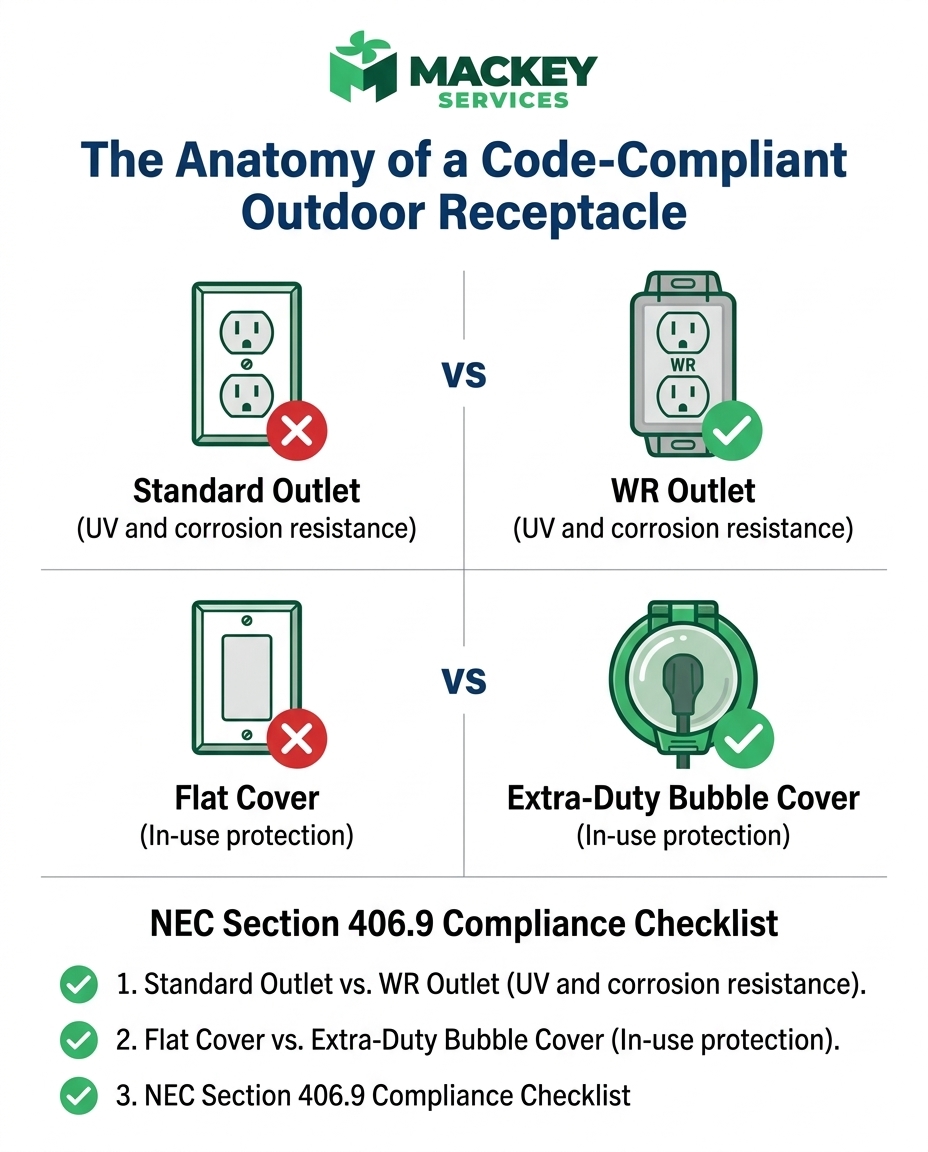
Under NEC Section 406.9, all 15- and 20-ampere, 125- and 250-volt nonlocking receptacles installed in wet locations must be listed as weather-resistant. This isn't a suggestion; it is a strict safety mandate. WR-rated receptacles with in-use 'bubble' covers are the gold standard for outdoor power because they combine advanced material science with physical shielding to keep moisture out of the electrical path.
The distinction between a standard GFCI and a WR GFCI is entirely about the physical build quality. Both will shut off power if they detect a ground fault, but only the WR GFCI is built to survive the environment it is installed in. If you are upgrading your home's exterior for the holidays, bringing in professional electrical services ensures that every outlet meets these exacting NEC standards.
The Anatomy of a WR Receptacle
What exactly makes these outlets so much tougher than the ones inside your living room? The differences are baked into the manufacturing process:
- Nickel-plated contacts: Unlike standard brass or copper contacts that oxidize and rust quickly in humid air, WR receptacles use specialized plating on the contacts and mounting straps to resist corrosion.
- UV-stabilized plastics: The faceplate and body of the outlet are manufactured with specialized polymers that won't become brittle, crack, or shatter after years of exposure to direct sunlight.
- Cold impact resistance: These outlets are tested to survive physical impacts even in freezing temperatures, ensuring they won't crack if accidentally bumped by a ladder or heavy extension cord plug.
- Clear identification: You can easily identify a compliant outlet by the "WR" stamped directly into the plastic face of the receptacle.
Why Extra-Duty 'Bubble' Covers Are a Mandatory Code Requirement
Our team frequently encounters a common misconception among homeowners: that simply installing a WR-rated outlet is the end of the job. However, a WR receptacle is only fully weather-resistant when nothing is plugged into it. The moment you plug in a heavy-duty extension cord for your holiday lights, the outlet is exposed to the elements. This is why WR-rated receptacles with in-use 'bubble' covers are a mandatory, inseparable pair under the National Electrical Code.
Historically, many homes were built with flat "flip" covers over their exterior outlets. These spring-loaded metal or plastic flaps do an excellent job of keeping rain out—but only when the outlet is not in use. If you want to run holiday lights, you have to prop that flap open, leaving the entire plug, the cord connection, and the receptacle face completely exposed to the weather. In the unpredictable coastal climate, a sudden downpour can hit while your lights are on, instantly soaking the live electrical connection.
To solve this, the NEC mandates the use of extra-duty in-use covers (commonly called bubble covers) for wet locations. These deep, domed enclosures are designed to close completely over the outlet even while a thick extension cord is plugged in. The cord routes safely out of a small gap at the bottom of the cover. This design shields the plug head and the receptacle face from direct rain, splashing water, and runoff from the siding above.
When you combine a WR receptacle with an extra-duty bubble cover, you create a watertight fortress for your electrical connections. This setup allows your holiday lights to run continuously, safely, and without nuisance tripping, no matter how severe the autumn or winter weather gets.
The September Advantage: Upgrading Before the Holiday Rush
When planning a massive holiday light display, timing is everything. Waiting until late November to test your outdoor outlets is a recipe for frustration. By taking advantage of the September pre-holiday prep window, you can ensure your electrical system is fully upgraded, tested, and ready to handle the heavy loads of the season without the stress of last-minute scrambling.
Here is why early fall is the optimal time to schedule your electrical upgrades:
- Beat the late-fall contractor rush: Electrical contractors book up incredibly fast once the weather turns cold and homeowners begin discovering their heating and lighting issues. Scheduling in September guarantees you get an appointment on your timeline.
- Allow time for thorough system testing: Upgrading your outlets early gives you weeks to test your timers, map out your extension cord routes, and ensure the WR receptacles are functioning perfectly before the physical labor of hanging lights begins.
- Handle complex code upgrades calmly: If your home requires new dedicated circuits to handle the massive lighting load, or if permits need to be pulled for extensive exterior electrical work, starting in September ensures the paperwork and labor are completed without rushing.
- Secure total peace of mind: Knowing that your exterior electrical infrastructure is safe, code-compliant, and weather-ready allows you to focus on the fun, creative side of holiday decorating rather than worrying about safety hazards.
Managing Power Loads and Total Electrical System Health
Upgrading to WR receptacles and bubble covers is critical for weather protection, but managing the actual power load of an extensive holiday display is equally important. Even the most robust, weather-proof outlet can become a severe fire hazard if you overload the circuit it is attached to. Massive holiday lighting setups can put an immense strain on existing outdoor circuits, especially on older homes in the Dickinson TX / Gulf Coast region.
During our pre-holiday service calls, one of the most dangerous practices we regularly correct is daisy-chaining multiple extension cords or plugging too many high-wattage decorations into a single WR receptacle. A standard 15-amp exterior circuit is only designed to handle a continuous load of 12 amps (about 1,440 watts). If you string together dozens of incandescent light strands, inflatable blower motors, and animated figures, you can easily exceed this limit. Overloading causes the wires inside your walls to heat up, which degrades the insulation and creates a significant risk of an electrical fire.
When planning your display, mapping out dedicated circuits is essential. A licensed professional can help you distribute the electrical load evenly across multiple breakers, ensuring no single outlet is pushed beyond its safe operating capacity. Furthermore, it is important to consider how extreme weather events might impact your overall home power reliability. If you are investing heavily in your home's electrical infrastructure, exploring standby generator services is a smart way to ensure your entire home remains powered, safe, and comfortable during severe coastal storms and unexpected grid outages.
The Critical Importance of Hiring Licensed Electrical Professionals
With all the excitement of holiday planning, it can be tempting to treat exterior outlet replacement as a quick weekend DIY project. However, replacing exterior receptacles and ensuring proper grounding is absolutely not a DIY task. Working with live electrical systems carries a high risk of lethal shock, and improper installation of WR-rated receptacles with in-use 'bubble' covers can result in severe electrical fires down the road.
Licensed professionals ensure strict adherence to the latest NEC updates. A common DIY mistake is reversing the line and load wires on a GFCI outlet, which completely disables its life-saving shock protection while still allowing power to flow to the plugged-in devices. Another frequent error is failing to properly seal the electrical box against the exterior siding, allowing water to bypass the weather-resistant cover entirely and flood the wall cavity.
At Mackey Services, our team has spent years upgrading exterior panels and outlets for local homeowners. Our commitment to up-to-date NEC code compliance and licensed electrical expertise ensures that families can enjoy safe, resilient outdoor setups. When one of our professional electricians assesses your exterior outlets, they aren't just swapping a piece of plastic; they are testing the grounding path, verifying the integrity of the wiring inside the exterior walls, and ensuring the entire circuit is safe to handle the heavy, continuous loads of your holiday display.
Frequently Asked Questions About Outdoor Electrical Safety
Do outdoor outlets need to be weather resistant?
Yes, outdoor outlets absolutely must be weather resistant. The National Electrical Code (NEC) requires that all 15- and 20-amp receptacles installed in wet or damp locations be specifically listed as Weather-Resistant (WR). These outlets are manufactured with UV-stabilized plastics and corrosion-resistant metal contacts to survive rain, snow, and extreme temperatures without failing or becoming a safety hazard.
Are bubble covers required by code for outdoor outlets?
Yes, extra-duty in-use covers (commonly known as bubble covers) are required by the NEC for receptacles installed in wet locations. Unlike flat covers, which only protect the outlet when it is unplugged, bubble covers allow the protective door to close completely over the outlet while an extension cord is actively plugged in, shielding the live connection from rain and runoff.
Why do my outdoor holiday lights keep tripping the breaker?
Holiday lights usually trip the breaker for one of two reasons: moisture intrusion or an overloaded circuit. If water gets into a standard, unprotected outlet or an exposed cord connection, the GFCI will detect the ground fault and trip to prevent a shock. Alternatively, if you have plugged too many high-wattage lights and inflatables into a single circuit, the main breaker will trip to prevent the wires from overheating.
What is the difference between standard GFCI and WR GFCI?
While both provide critical protection against electrical shocks by shutting off power when a ground fault is detected, a WR (Weather-Resistant) GFCI is physically built for the outdoors. A WR GFCI features nickel-plated internal components to prevent rust and specialized plastics that will not crack or degrade under intense UV sunlight, whereas a standard GFCI will quickly corrode and fail if exposed to the elements.
Can I install a weather-resistant receptacle myself?
Replacing exterior electrical receptacles is not a recommended DIY project. Improper installation—such as reversing the line and load wires, failing to establish a proper ground, or improperly sealing the enclosure against the siding—can disable the outlet's safety features and create severe fire and shock hazards. Always hire a licensed electrical professional to ensure the work is safe and code-compliant.
Ensure Your Holiday Lighting is Safe and Code-Compliant
When you invest the time and money into creating a massive, beautiful outdoor display, the last thing you want is for a preventable electrical failure to leave your home in the dark. WR receptacles paired with extra-duty bubble covers are your ultimate defense against wet weather electrical failures, ensuring your lights stay on safely through the harshest autumn and winter storms.
Reiterating the importance of September pre-holiday prep, proactively scheduling an electrical upgrade now guarantees a safer, stress-free holiday season. Don't wait until you are standing on a ladder in the cold rain to discover your outlets aren't up to the task. We encourage you to reach out for a professional electrical assessment today to evaluate your outdoor infrastructure, upgrade your receptacles, and ensure your home is ready to shine brightly and safely all season long.
Ready for a better day?
One call handles it all — HVAC, electrical, and generators across the Texas Gulf Coast. Less to pay. Better day. That's the Mackey way.
Mon–Fri: 7 AM – 8 PM · Sat: 8 AM – 5 PM · Licensed & insured · #TACLA 112769C · #TECL 558211