
Heating a Sunroom Addition: Duct Extension vs. Dedicated Mini-Split
Why extending central ducts is a trap. Decide with confidence on heating a sunroom addition: duct extension vs. dedicated mini-split in League City, TX.
The 50% Thermal Penalty: Why Sunrooms Demand a Different Approach
Nearly 50% more heat escapes from or penetrates into a sunroom compared to a standard, insulated living space. When you are finalizing the plans for heating a sunroom addition: duct extension vs. dedicated mini-split systems become the most critical debate you will face. Because of the massive thermal bridging effect created by glass walls, a sunroom operates under entirely different physical rules than the rest of your home.
As the early fall transition approaches, homeowners face a critical decision: how to keep this new addition comfortable without ruining the climate control in the primary bedrooms and living spaces. The most common debate centers on extending existing central ductwork versus installing an independent system.
Most central heating systems were precisely sized for the original square footage of the house. Relying on existing heating services to handle this uninsulated load often leads to unforeseen performance issues across the entire property. When you break the original thermal envelope to add hundreds of square feet of glass, the central blower and heating elements simply cannot keep up with the rapid temperature fluctuations.
- Solar heat gain: Glass amplifies the sun's rays, causing rapid heating during the day.
- Rapid heat loss: Without insulated wall cavities, warmth escapes almost instantly when the sun goes down.
- Infiltration drafts: Multiple window frames introduce tiny air leaks that central systems cannot counteract quickly.
The Physics of Glass and Manual J Load Calculations
HVAC systems are sized based on Manual J load calculations, which account for a home's specific square footage, insulation values, and window placement. These calculations determine exactly how many BTUs of heating and cooling are required to maintain a stable indoor temperature. Adding a glass-heavy room radically alters the home's thermal boundary, introducing a microclimate that the original central unit was never designed to support.
At Mackey Services, our years of hands-on experience handling HVAC installations for Dickinson and League City home renovations allows our team to identify how specific architectural styles interact with central air systems, preventing costly load calculation errors before the drywall goes up. Because glass lacks the insulating properties of traditional drywall and siding, the heating and cooling demands of a sunroom spike dramatically faster than the rest of the home.
In our experience, attempting to force an older, centrally sized system to absorb this new load typically results in inadequate heating and accelerated equipment wear. The blower motor runs continuously, trying to satisfy the demand of the glass room, which strips humidity from the air and drives up utility bills.
Understanding Thermal Boundaries
The Department of Energy defines a home's thermal boundary as the line separating conditioned indoor space from unconditioned outdoor space. When you build a sunroom, you push that boundary outward. However, because the new boundary is primarily constructed of glass, it offers almost no resistance to heat transfer.
Breaking the original thermal envelope compromises central efficiency because the central unit expects a certain level of insulation to hold the conditioned air inside. When that conditioned air rapidly escapes through the sunroom glass, the system registers a continuous drop in temperature, forcing the furnace or heat pump to run non-stop.
The Static Pressure Trap: Why Duct Extensions Fail
Airflow in a central system operates on delicate static pressure balances. You can think of it like a municipal water system: if you add too many open faucets to the end of the line, the water pressure drops everywhere else. Extending a duct run into a new addition without resizing the central blower alters this carefully calibrated pressure.
Adding a vent to a new sunroom acts like a major leak in the system. It drops the velocity of air reaching the bedrooms and living areas at the end of the original duct runs. You might get a trickle of warm air into the sunroom, but your master bedroom will suddenly become freezing cold because the air lacks the force to reach it.
Our technicians recently worked with a Dickinson homeowner who discovered exactly how sensitive these systems are when their older ductwork proved highly inefficient. Because the original return was located on the far end of the home, airflow was severely restricted whenever interior doors were closed. Resolving the restriction required our team to completely replace all old ducts and add a second return, rewrapping the return line with UV-resistant foam just to meet city code requirements. If a poorly placed return can choke a system, pushing air through a brand-new, 20-foot supply duct into an uninsulated glass room guarantees a massive pressure drop.
Poorly planned duct extensions often lack adequate return air pathways, creating pressure imbalances that pull unconditioned outdoor air into the home through gaps in doors and windows. Resolving these airflow restrictions often requires completely replacing old ducts or adding secondary returns, making a simple extension much more complex and invasive than anticipated.
The Central Thermostat Dilemma in Microclimates
In our daily service calls across the Gulf Coast, we frequently see the control failure created when a central thermostat reads the ambient temperature of the interior hallway or living room, completely blind to the rapid temperature swings happening inside the sunroom. This creates a situation where the system operates based on the needs of the insulated house, ignoring the extreme conditions in the glass addition.
If the sunroom is freezing on a brisk morning, the central thermostat will not trigger the heat unless the main house is also cold. Conversely, if the sunroom overheats from direct sunlight on a mild afternoon, the main house may freeze as the system attempts to cool the glass room based on a single, centralized reading.
The Temperature Disconnect:
| Time of Day | Sunroom Temperature | Main House Temperature | Central System Response |
|---|---|---|---|
| Early Morning | Very Cold (Heat escapes through glass) | Comfortable (Well-insulated) | System stays off; sunroom remains freezing. |
| Mid-Afternoon | Very Hot (Solar heat gain) | Comfortable (Shaded walls) | System stays off; sunroom becomes a sauna. |
| Late Evening | Cooling rapidly | Warm from daily activities | System runs AC; sunroom becomes uncomfortably cold. |
This lack of independent zoning guarantees that one part of the home will always be uncomfortable. You cannot effectively manage two vastly different thermal zones with a single control point.
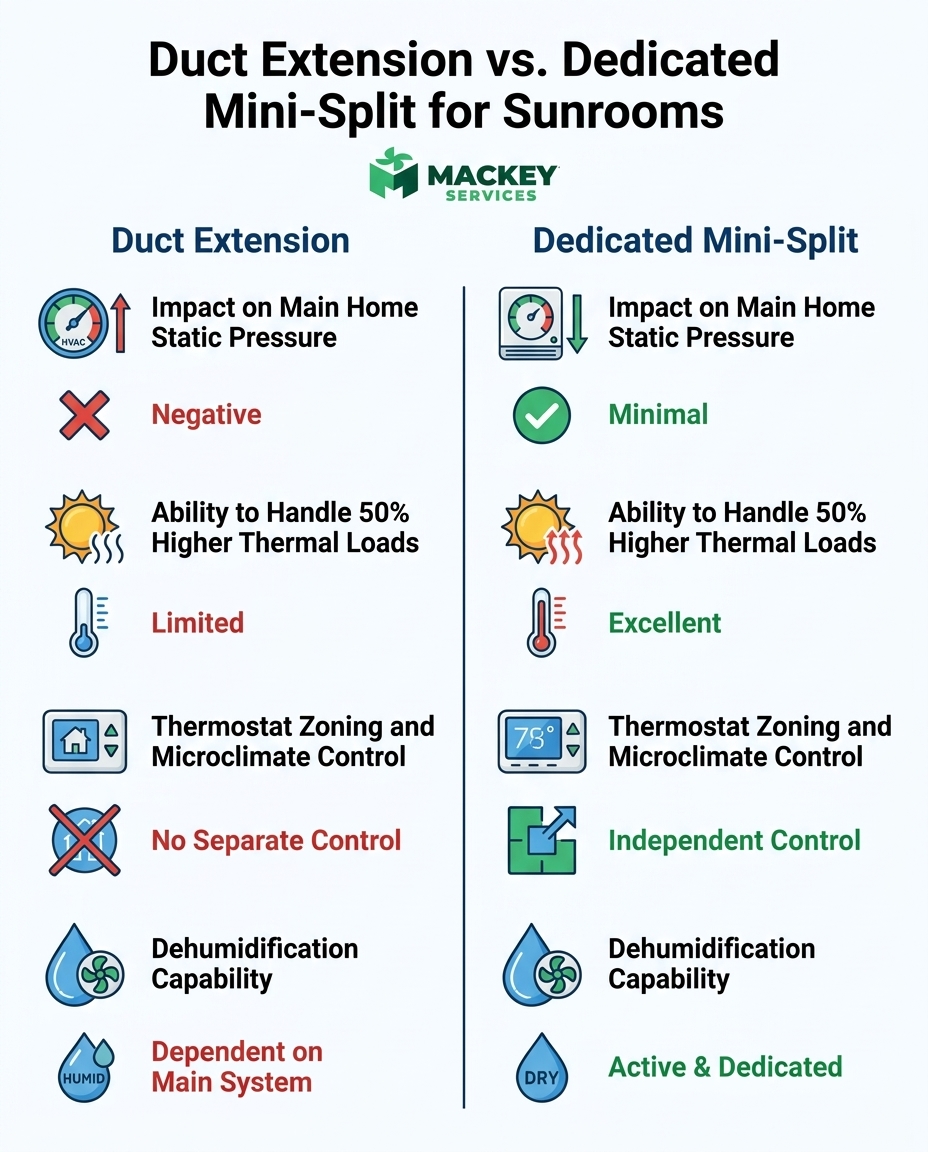
Why a Ductless Mini-Split Heat Pump is the Logical Solution
Whenever we are asked for our professional recommendation, our team at Mackey Services consistently advises that a ductless mini-split heat pump is the logical solution. It operates entirely independently of the home's central ductwork, preserving the delicate static pressure and airflow of the main system. By separating the sunroom from the primary HVAC network, you eliminate the risk of starving your main living areas of conditioned air.
These units feature their own built-in thermostats, allowing them to react instantly to the rapid thermal changes unique to glass-heavy rooms. When the sun goes behind a cloud and the room temperature drops, the mini-split senses the change locally and provides immediate warmth without waiting for the hallway thermostat to catch up.
Installing a dedicated mini-split ensures the sunroom remains a comfortable oasis year-round without forcing the primary equipment to work outside its design parameters. Because they utilize advanced inverter technology, they can ramp up or down precisely to meet the exact load requirement without short-cycling.
The Role of Inverter Technology
Traditional central systems operate on a single-stage compressor—they are either running at 100% capacity or turned off completely. This causes massive temperature swings in a small space. Inverter technology allows the mini-split compressor to operate at variable speeds. It can run at 20% capacity just to maintain the temperature, or ramp up to 100% when a sudden cold front hits. This precise modulation is exactly what a thermally volatile sunroom requires to stay comfortable without wasting electricity.
Navigating the Unpredictable Gulf Coast Fall Transition
Serving Dickinson, TX, we know firsthand that the Texas Gulf Coast fall transition is notorious for requiring heating in the early morning and active cooling or dehumidification by the afternoon. You might wake up to a brisk chill that demands a reliable heat source, only to face heavy humidity and rising temperatures by 3:00 PM.
A standard residential HVAC system struggles to pivot between these extremes efficiently, especially when trying to balance a highly conductive sunroom against a well-insulated house. The central unit often ends up fighting itself, leading to short-cycling and poor humidity control.
Independent systems excel in this environment because they can actively dehumidify the sunroom during humid fall afternoons while providing targeted warmth on chilly mornings. During the early fall transition, rapid temperature swings require a highly responsive system to maintain comfort without overworking the main equipment.
Combating Condensation and Humidity
This responsiveness is critical for preventing condensation buildup on sunroom glass, which can lead to indoor air quality issues. When warm, humid indoor air meets cold glass, moisture forms instantly. Over time, this condensation drips down to the window sills, encouraging mold growth and wood rot. A dedicated mini-split constantly circulates and dehumidifies the air, keeping the glass clear and the indoor air quality pristine, regardless of the unpredictable coastal weather outside.
Efficiency Ratings and Extreme Temperature Performance
Modern ductless systems boast exceptionally high SEER2 (Seasonal Energy Efficiency Ratio) and HSPF2 (Heating Seasonal Performance Factor) ratings, meaning they draw minimal electricity even when running continuously. These metrics indicate how effectively the system converts electricity into heating and cooling power throughout the season.
Unlike older auxiliary heating methods like electric baseboard heaters, heat pumps transfer heat rather than generating it, maximizing energy efficiency. A baseboard heater uses raw electrical resistance to create heat, which is notoriously expensive to operate. A heat pump simply absorbs ambient heat from the outside air and moves it indoors, using a fraction of the electricity.
Homeowners often worry about performance during severe weather spikes, but advanced compressors are engineered to maintain capacity even during extreme temperature fluctuations. If you are curious about how heat pumps handle extreme Texas temperatures, modern models are rigorously tested to provide uninterrupted comfort when you need it most.
Qualifying high-efficiency installations may also be eligible for various energy rebates or federal tax credits, making the long-term investment highly cost-effective. Always check with your local utility provider or a tax professional to see which generic incentive programs apply to your new installation, as these can significantly offset the initial setup costs.
Frequently Asked Questions
Can you extend ductwork to a sunroom?
While it is physically possible to run a new duct to a sunroom, it is rarely recommended by HVAC professionals. Extending ductwork without resizing the central blower acts like a leak in your system, dropping the static pressure and reducing airflow to the rest of the house. Furthermore, the central thermostat cannot accurately monitor the sunroom's unique microclimate, leading to poor temperature control.
Why is my sunroom always cold in the winter?
Your sunroom is always cold in the winter because glass walls offer almost zero insulation compared to standard drywall and siding. This massive thermal bridging effect allows indoor heat to escape rapidly as soon as outdoor temperatures drop. If the room relies on a central thermostat located inside the main, insulated house, the heating system will not recognize that the sunroom is freezing.
What is the best way to heat a sunroom?
The best way to heat a sunroom is by installing an independent ductless mini-split heat pump. These systems operate separately from your home's central ductwork, ensuring they do not disrupt the airflow in your main living areas. They feature built-in thermostats and variable-speed compressors that react instantly to the rapid temperature swings common in glass-heavy rooms.
Do I need a mini split for my sunroom?
Yes, a mini-split is generally required if you want your sunroom to be usable year-round without drastically increasing your utility bills or ruining your home's central airflow. Because sunrooms experience up to 50% more heat loss or gain than standard rooms, they require a dedicated system that can handle their specific thermal loads without short-cycling your primary central air unit.
How do you heat an uninsulated sunroom?
Heating an uninsulated sunroom requires a highly efficient, targeted heat source that doesn't rely on the main home's ductwork. A ductless heat pump is the most effective solution because it provides localized, continuous heat transfer specifically sized for the room's square footage and glass exposure. Avoid space heaters or baseboard units, as they rely on expensive electrical resistance and pose safety hazards.
Will adding a mini-split to my sunroom affect my home's central AC?
No, adding a mini-split to your sunroom will not negatively affect your home's central AC. In fact, it protects your central system by taking the extreme thermal load of the glass room off the main unit's shoulders. Because the mini-split operates on its own independent circuit and refrigerant lines, your central blower maintains perfect static pressure and operates exactly as it was originally designed to.
Make the Right Choice for Your Home Addition
Keeping a new sunroom comfortable shouldn't mean sacrificing the airflow and efficiency of your entire home. By choosing a dedicated mini-split over a risky duct extension, you guarantee precise temperature control and protect your primary HVAC equipment from unnecessary strain. Ensure your new space remains a relaxing retreat by investing in the right independent climate solution today.
Ready for a better day?
One call handles it all — HVAC, electrical, and generators across the Texas Gulf Coast. Less to pay. Better day. That's the Mackey way.
Mon–Fri: 7 AM – 8 PM · Sat: 8 AM – 5 PM · Licensed & insured · #TACLA 112769C · #TECL 558211