
Managing Indoor Humidity Spikes When Gulf Coast Dew Points Hit 75+
Is your house cold but clammy? Managing indoor humidity spikes when Gulf Coast dew points hit 75+ requires more than lowering the AC. Get clear answers here.
When Your Home Feels Cold but Uncomfortably Clammy
At Mackey Services, our technicians answer calls every July from Dickinson homeowners facing the exact same problem: their house feels like a cold cave. When meteorologists report oppressive outdoor moisture, managing indoor humidity spikes when Gulf Coast dew points hit 75+ becomes the ultimate test of your home's cooling system. You walk through the front door expecting relief, and while the thermometer reads a cool 70 degrees, your skin immediately feels sticky and clammy. The air feels heavy, your floors might feel slightly slick, and the environment resembles a damp cavern rather than a comfortable living space. This is a highly specific, concrete problem that frustrates families throughout our service area every single peak summer season.
Faced with this discomfort, the most common pattern we see is homeowners walking straight to the thermostat and dropping the temperature to 68 degrees or lower in a desperate attempt to dry out the air. But true comfort relies on proper equipment sizing and dedicated moisture extraction, not just blasting freezing air into a damp room. If you are struggling with a damp, clammy house, having our team evaluate your air conditioning system and exploring dedicated indoor air quality solutions is the first step toward lasting comfort.
Sensible Heat vs. Latent Heat: The Subtropical Climate Challenge
To understand why your home feels like a swamp even when the AC is running, you have to understand the two different types of heat your system battles every day. The first is sensible heat. This is the heat you can actually feel and measure with a standard thermometer. When the temperature outside rises from 80 degrees to 90 degrees, that is an increase in sensible heat.
The second, and far more challenging factor in our region, is latent heat. Latent heat refers to the amount of moisture suspended in the air. In our years of optimizing HVAC systems across the Gulf Coast, we've found that latent heat is often a much heavier burden on your home than sensible heat during mid-summer. Standard cooling metrics and generic HVAC advice often fail to account for the heavy moisture load of a subtropical environment. In arid climates, an air conditioner only has to lower the sensible heat. In Dickinson, HVAC systems must prioritize dehumidification—stripping the latent heat out of the air—just as heavily as cooling.
The ideal indoor environment our team targets:
- Temperature: Usually comfortable between 72 and 76 degrees.
- Relative Humidity: Should sit strictly between 30 and 50 percent.
- The Danger Zone: Anything above 60 percent relative humidity encourages mold growth, dust mite proliferation, and severe physical discomfort.
When you have a high latent heat load, your sweat cannot evaporate off your skin. Evaporation is your body's natural cooling mechanism. If the air is already saturated with moisture, that mechanism shuts down, leaving you feeling hot and sticky regardless of what the thermostat says.
The Mechanical Truth: How Cooling Extracts Moisture
Our technicians frequently have to explain that air conditioners do not actually create cold air; they remove heat and moisture from the existing air inside your house. The mechanical process of dehumidification is a byproduct of the refrigeration cycle, and it requires specific conditions to work effectively, especially when dealing with a 75+ dew point.
- Warm Air Return: Your system pulls warm, humid air from your living spaces through the return vents and passes it through the air filter.
- The Freezing Coil: The blower motor pushes this humid air over the indoor evaporator coil. This coil is filled with extremely cold chemical refrigerant.
- Condensation Occurs: Because the coil is significantly colder than the air passing over it, the moisture in the air condenses directly onto the metal fins of the coil. Think of a glass of ice water sitting on a patio table in July—water beads up on the outside of the glass. The exact same physics apply to your evaporator coil.
- Moisture Removal: The condensed water drips off the coil into a drain pan and flows safely outside through a condensate line, effectively removing water from your indoor air.
The 15-Minute Dehumidification Threshold
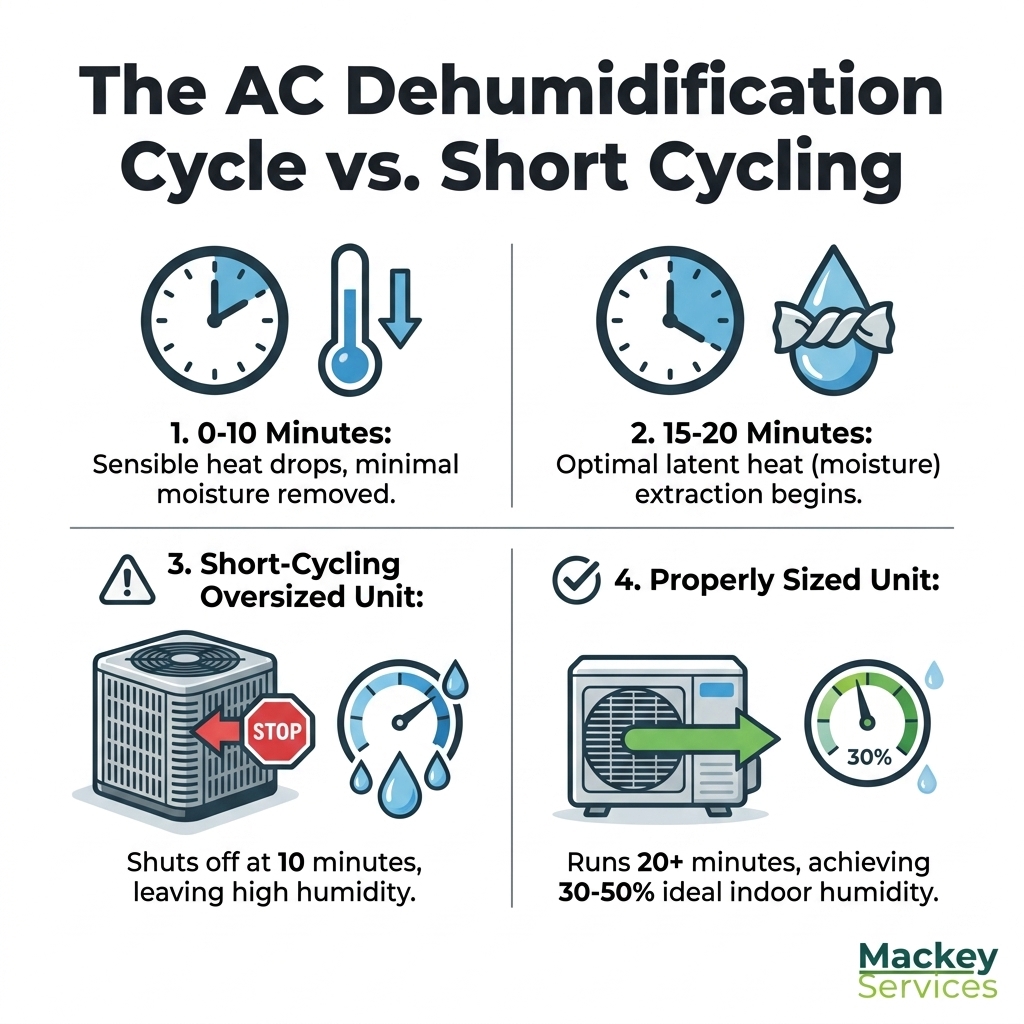
Here is the critical timing metric that we always look for during a service call: a system must run for a continuous 15 to 20 minutes per cycle to meaningfully extract moisture. There is a significant lag time between when cooling starts and when effective dehumidification actually begins in the cycle.
During the first 5 to 10 minutes of a cooling cycle, the system is almost exclusively reducing sensible heat. The coil is getting cold, and the air temperature is dropping, but the coil has not been cold long enough to pull a substantial amount of water out of the air. It is only around the 15 to 20-minute mark that latent heat reduction peaks. If your system shuts off before hitting this threshold, the moisture stays trapped inside your home.
The Short-Cycling Trap: Why Oversized Units Fail at Dehumidification
The mechanical necessity of long run times brings us to one of the most widespread issues we correct in Dickinson TX and the Gulf Coast: the oversized air conditioner. There is a stubborn misconception that "bigger is better" when purchasing a new cooling system. Homeowners often assume a massive unit will cool the house faster and better. While it certainly cools faster, that speed is exactly what ruins your indoor comfort.
Short-cycling occurs when an oversized unit blasts a massive volume of cold air into the home, satisfying the thermostat's temperature requirement in under 10 minutes, and then abruptly shuts off. Because the unit only ran for 8 or 9 minutes, it never reached the 15-minute dehumidification threshold. The sensible heat (temperature) dropped rapidly, but the latent heat (moisture) was entirely ignored.
The resulting environment is a cold, dark, and damp home. To solve this root-cause issue, our team at Mackey Services utilizes strict load calculations to match system capacity perfectly to the home. By measuring windows, insulation, and square footage, we ensure the unit runs long enough to extract moisture without overcooling the space, preventing short-cycling entirely.
The Thermostat Fallacy: Why Lowering the Temperature Doesn't Help
When you are sitting on your couch during mid-summer and your skin feels sweaty despite the AC running, your natural instinct is to get up and drop the thermostat from 72 degrees down to 68 degrees. It seems logical—if you are hot and sticky, you need more cold air. Unfortunately, this is a fallacy we see constantly that actually exacerbates the problem.
Lowering the set point forces an oversized or struggling system to run slightly longer, but still inefficiently. You are essentially trying to use a temperature-control device (a thermostat) as a moisture-control device (a dehumidistat). The system will blast even more cold air, eventually driving the indoor temperature down to a freezing 68 degrees, but because the run times are still disjointed, the heavy moisture load remains.
The consequences of the thermostat fallacy:
- Massive energy waste: Your compressor works significantly harder to maintain 68 degrees than 74 degrees, driving up your utility bills without solving the comfort issue.
- Excessive wear-and-tear: Forcing a system to short-cycle repeatedly at lower temperatures degrades the contactors, capacitors, and compressor much faster than steady, long cycles.
- Frozen evaporator coils: Pushing the system too hard during high-moisture days can cause the condensation on the coil to literally freeze into a block of ice, shutting down your cooling entirely.
Optimizing Airflow and Coils for Maximum Moisture Removal
Before assuming your equipment is completely oversized, there are actionable, mechanical maintenance steps that ensure your existing system can extract as much moisture as physically possible, even against a 75+ dew point. Proper airflow and clean components are non-negotiable for latent heat removal. While you handle the filters, our licensed professionals handle the internal mechanics:
- Replace dirty air filters (Homeowner Task): A clogged filter restricts airflow across the evaporator coil. This alters the temperature of the coil and disrupts the condensation process. The coil gets too cold, freezes over, and stops pulling moisture from the air.
- Professional evaporator coil cleaning: If your indoor coil is covered in a layer of household dust, pet hair, or grime, that debris acts as an insulated blanket. Our technicians safely clean these coils so the warm, moist air can actually touch the freezing metal, allowing moisture to condense effectively.
- Professional blower motor calibration: Sometimes, the blower motor is pushing air across the coil too fast. We can safely adjust blower motor speeds to give the moisture more time to condense and drip away, extracting significantly more latent heat.
- Professional condensate drain clearing: The water your system extracts has to go somewhere. We clear drain lines of algae or sludge to ensure water doesn't back up in the drain pan and re-evaporate right back into your home's air supply.
Keeping these components pristine is exactly why scheduling routine AC maintenance with our team is the most cost-effective way to fight indoor humidity.
Comprehensive Moisture Control Strategies for High-Dew-Point Days
Sometimes, our team finds that even a perfectly sized and flawlessly maintained air conditioner needs backup. In Dickinson TX and the Gulf Coast, the outdoor moisture load can be so extreme that relying solely on the AC leaves you vulnerable to humidity spikes on mild, rainy days when the system doesn't need to run for temperature control. This is when whole-home solutions become necessary to improve indoor air quality at home.
| Moisture Control Strategy | How It Works | Effectiveness in High Humidity |
|---|---|---|
| Standard Air Conditioning | Removes moisture as a byproduct of cooling the air during a cycle. | Good, but only works when the thermostat calls for cooling. Fails on mild, damp days. |
| Portable Dehumidifiers | Standalone units plugged into a wall that pull moisture from a single room. | Poor for whole-house issues. Acts as a band-aid fix and requires constant manual emptying. |
| Whole-Home Dehumidifier | Integrated directly into the HVAC ductwork, running independently of the cooling cycle. | Excellent. Removes moisture even when the house is already cold, providing total control. |
When to Consider a Whole-Home Dehumidifier
A whole-home dehumidifier works in tandem with your existing HVAC system. Its sole job is to monitor and extract latent heat. If the house is perfectly cool at 74 degrees but the humidity creeps up to 60 percent, the whole-home dehumidifier turns on without activating the AC compressor. This separates temperature control from moisture control, providing massive energy efficiency. We often recommend this upgrade to homeowners if your home constantly smells musty, if your hardwood floors cup or warp, or if you find yourself constantly adjusting the thermostat just to feel dry.
Furthermore, sealing the home envelope is critical. If your weatherstripping is degraded, your windows are drafty, or your attic bypasses are unsealed, heavy outdoor moisture will constantly infiltrate your living space, forcing whatever equipment you have to work overtime.
Common Questions About Summer Humidity and AC Performance
Here are the most common questions our dispatchers and technicians hear during the peak of summer:
Why is my house cold but sticky?
Your house feels cold but sticky because your air conditioner is lowering the sensible heat (temperature) without running long enough to remove the latent heat (moisture). This usually happens when an AC unit is oversized for the square footage of the home. It blasts cold air and shuts off quickly, leaving the humidity trapped indoors.
How long should an AC run to dehumidify?
An air conditioner needs to run for a continuous 15 to 20 minutes per cycle to effectively pull moisture out of the air. During the first 10 minutes, the system is primarily focused on dropping the temperature. Only after that threshold does heavy condensation and moisture extraction occur on the evaporator coil.
Does an oversized AC cause high humidity?
Yes, an oversized AC is one of the leading causes of high indoor humidity. Because a larger unit cools the space too rapidly, it satisfies the thermostat and shuts off before it has time to dehumidify the air. This rapid on-and-off process is known as short-cycling.
Does lowering the AC reduce humidity?
Lowering the thermostat will force the AC to run longer, which can extract a bit more moisture, but it is an inefficient and ineffective long-term strategy against a 75+ dew point. It causes excessive wear and tear on your equipment, wastes energy, and often results in a freezing cold house that still feels slightly damp.
What is a comfortable indoor humidity in summer?
The ideal indoor relative humidity during the summer should be kept between 30 and 50 percent. Keeping the moisture levels in this range prevents mold growth, deters dust mites, and allows your body's natural cooling mechanisms to function properly so you feel comfortable at higher temperatures.
Can a whole-home dehumidifier work with my existing HVAC system?
Yes, a whole-home dehumidifier is designed to integrate seamlessly into your existing ductwork. It works independently of your air conditioner's cooling cycle, meaning it can pull moisture out of the air on mild, rainy days without turning your house into an icebox.
Reclaiming Your Comfort Without Overworking Your System
The short answer we give every customer is that true comfort is a delicate balance of temperature and humidity, not just a low number on your thermostat. When mid-summer weather pushes the limits of your home's envelope, ignoring the latent heat load will leave you frustrated, uncomfortable, and paying for energy you aren't benefiting from. Addressing equipment sizing, optimizing airflow, and committing to proactive maintenance is the only permanent fix to a clammy house.
Do not wait until your system is freezing over or your home smells like a damp basement to take action. Have our team at Mackey Services evaluate your system's load capacity and airflow before the peak heat of the season worsens. Schedule an inspection today to explore tailored solutions that will keep your home perfectly balanced, dry, and consistently comfortable all summer long.
Ready for a better day?
One call handles it all — HVAC, electrical, and generators across the Texas Gulf Coast. Less to pay. Better day. That's the Mackey way.
Mon–Fri: 7 AM – 8 PM · Sat: 8 AM – 5 PM · Licensed & insured · #TACLA 112769C · #TECL 558211