
Rust Never Sleeps: Why Gulf Coast Weather is Your AC's Worst Enemy
Discover how salt air and humidity shorten AC lifespan on the Gulf Coast. Learn signs, prevention tips & coastal maintenance strategies now!
Why Gulf Coast Weather Cuts Your AC's Life Short
How salt air and humidity shorten AC lifespan is one of the most important things Gulf Coast homeowners need to understand — because the damage starts long before you notice it. If you live near the Texas coast, your AC is fighting a battle every single day against two of the most corrosive forces in nature: marine salt particles and relentless humidity.
Here is the short answer:
- Salt air carries tiny sodium chloride particles that settle on your outdoor unit's metal surfaces, strip away protective oxide layers, and trigger rapid corrosion
- Humidity acts as a catalyst, keeping those salt particles wet and chemically active around the clock
- Together, they corrode aluminum fins, condenser coils, electrical connections, and cabinet hardware 4 to 8 times faster than in dry inland climates
- Inland AC systems often last 12 to 15 years with good maintenance; coastal systems near the Gulf frequently fail in 7 to 10 years — sometimes as few as 8 to 12 years for units very close to the water
- Florida and Texas Gulf Coast systems can log 2,500 to 3,500 operating hours per year, compared to just 1,000 to 1,500 hours in northern states, adding mechanical wear on top of corrosion
The Greater Houston area sits squarely in this danger zone. Communities like Seabrook, Friendswood, Dickinson, and League City are close enough to Galveston Bay and the Gulf that onshore breezes carry salt particles miles inland — affecting homes that aren't even on the waterfront. Add in Houston's notoriously high humidity levels and near-year-round cooling season, and your AC system is under constant stress that most standard maintenance plans simply aren't designed to address.
The good news is that understanding why this happens is the first step to doing something about it.
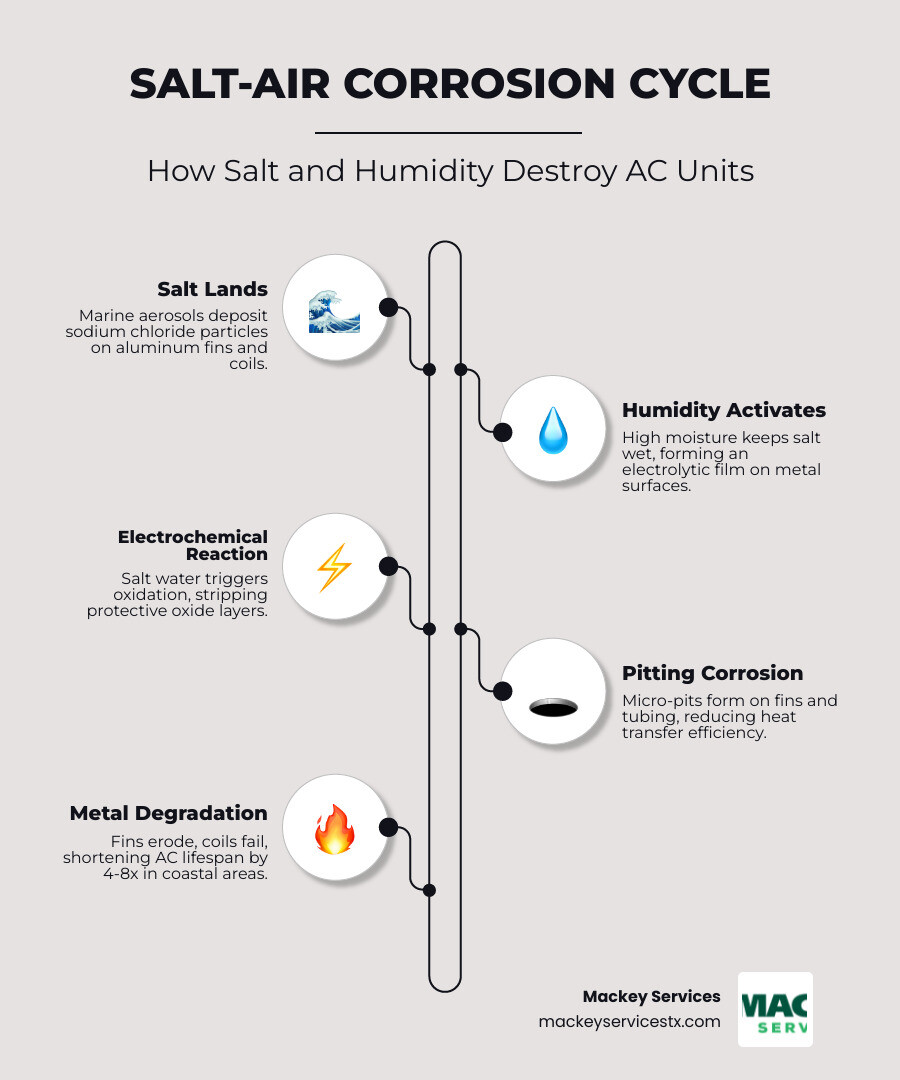
The Science of How Salt Air and Humidity Shorten AC Lifespan
To understand why your Air Conditioning system struggles in our 2026 climate, we have to look at the chemistry happening on a microscopic level. It isn't just "bad weather"; it is a specific electrochemical process that targets the very materials your AC is made of.
The Corrosive Chemistry of Coastal Air
The Gulf breeze feels great, but it is loaded with marine aerosols. These are tiny droplets of seawater containing sodium chloride, magnesium chloride, and sulfate compounds. Because these salts are "hygroscopic," they literally pull moisture out of the air.
When these particles land on your AC’s aluminum fins and copper tubing, they create an electrolytic film. This film allows electricity to flow between different types of metal (like where copper meets aluminum). This leads to galvanic corrosion, where the "weaker" metal—usually the aluminum fins—sacrifices itself and dissolves. You may also see pitting corrosion, which creates tiny holes in the refrigerant lines, leading to those frustrating leaks that seem to happen every summer.
How Humidity Acts as a Catalyst for Damage
In the Greater Houston Area, we live in what ASHRAE calls Climate Zone 1A—very hot and humid. Humidity is the "fuel" for the salt's "fire." Without moisture, salt is just a dry crystal. But in our 80% humidity, that salt stays wet 24/7. This constant moisture saturation means the chemical reaction never stops, even at night.
Furthermore, high humidity increases the "latent heat" load on your system. Your AC has to work twice as hard just to pull the water out of the air before it can even start lowering the temperature. For many homeowners in places like West University Place, supplemental Whole House Dehumidification West University Place TX is often necessary just to give the AC a fighting chance.
Vulnerable Components: Where Coastal Damage Hits Hardest
Not every part of your AC is equally at risk. Some components are "front-line" soldiers that take the brunt of the coastal assault.
| Component | Inland Lifespan | Coastal Lifespan (Unprotected) |
|---|---|---|
| Condenser Coils | 15+ Years | 5–7 Years |
| Cabinet Panels | 20 Years | 7–10 Years |
| Fan Motor Bearings | 12–15 Years | 6–8 Years |
| Electrical Terminals | 15 Years | 5–8 Years |
Critical Failure Points in High-Salt Environments
The outdoor unit is the most exposed. We often see cabinet seams and fasteners (screws and bolts) rust through completely, causing the unit to vibrate or even fall apart. Inside the unit, the electrical control boards and terminals are highly sensitive. Salt residue can cause "intermittent failures"—those annoying times when your AC stops working for an hour and then starts again. If you're seeing these signs in places like Friendswood, it’s time to look into AC Repair Friendswood TX before a small electrical glitch turns into a blown compressor.
Even the refrigerant lines aren't safe. Coastal air can cause "formicary corrosion," which creates microscopic, spider-web-like tunnels through the copper. This is a primary reason why AC Service Seabrook TX professionals often find systems low on Freon despite no visible damage.
Why Heat Pumps Face Double the Risk
If you use a heat pump for year-round comfort in the Houston area, your system is at even higher risk. While a standard AC might rest during our brief Texas winters, a heat pump keeps running. This means it is pulling salty air through its coils for 3,000+ hours a year. The defrost cycles—where the unit heats up to melt ice—can actually accelerate the chemical reaction of the salt, leading to even faster metal fatigue.
Identifying the Signs of Coastal Environmental Damage
You don't need a lab kit to tell if your system is losing the battle. There are several visual and performance-based "red flags" that every homeowner from Pearland to Galveston should watch for.
Warning Signs That Salt Air and Humidity Shorten AC Lifespan
- White Rust: This looks like a powdery, crusty white substance on your aluminum fins. It’s actually the aluminum oxidizing and turning into dust.
- Brittle Fins: If you touch the silver "grill" on your outdoor unit and the metal flakes off like dry leaves, your heat transfer capacity is gone.
- Peeling Paint: Bubbling or peeling paint on the steel cabinet is a sign that rust is forming underneath.
- Noisy Operation: If your fan sounds like it’s grinding gravel, salt and sand have likely penetrated the motor bearings.
- Frequent Repairs: If you find yourself calling for 8 Things That Happen During AC Checks more than once a year, your system is likely suffering from environmental stress.
Measuring the Lifespan Gap: Inland vs. Coastal
The data is clear: proximity to the Gulf matters. While an AC in a dry climate like Arizona might easily cruise past the 15-year mark, a unit in Texas City or Bacliff faces "accelerated depreciation." Research shows that metal in coastal environments can corrode 4 to 8 times faster. Without intervention, a beachfront unit might only last 8 years before the coils are so perforated that the system can no longer hold a charge.
How to Extend Your System’s Life in a Coastal Climate
Just because you live near the water doesn't mean you have to replace your AC every seven years. Proactive care can bridge the "lifespan gap" and keep your home cool for much longer.
Professional Strategies to Prevent How Salt Air and Humidity Shorten AC Lifespan
At Mackey Services, we recommend a multi-layered defense. For homes within 5 miles of the coast, standard cleaning isn't enough. We utilize specialized phenolic epoxy or electrofin coatings. These are factory-applied or field-applied protective layers that seal the metal away from the salt air.
Additionally, a standard annual checkup isn't sufficient for the Gulf Coast. We suggest a Maintenance Plan that includes semi-annual inspections. This allows us to catch "Level 1" surface fouling before it turns into "Level 3" coil perforation. For our neighbors in Crosby, specialized Air Conditioning Maintenance Crosby TX is the most cost-effective way to avoid a premature $10,000 replacement.
Choosing Equipment Built for the Gulf Coast
If you are currently looking to replace your unit, don't just buy the cheapest model. Look for:
- Coastal-Rated Units: These often feature all-aluminum coils (to prevent galvanic corrosion between different metals) or specially coated "Seacoast" coils.
- Stainless Steel Hardware: Prevents the screws and panels from rusting shut.
- Variable-Speed Compressors: These are excellent for Indoor Air Quality and humidity control, as they run longer at lower speeds to pull more moisture out of the air.
DIY Tip: You can help! Once a month, turn off your AC at the thermostat and gently rinse the outdoor coils with a garden hose. This washes away the salt film before it can eat into the metal. Just be sure to use low pressure—never use a power washer, as it will crush the delicate fins.
Frequently Asked Questions about Coastal AC Lifespan
How much shorter is an AC lifespan near the ocean?
Inland units often last 15 years, while coastal systems without specialized care typically fail between 7 and 10 years. This is because the corrosion rates in high-aerosol areas (within 1,500 feet of tidal water) are significantly higher than inland.
Can I protect my existing AC from salt air?
Yes! Even if your unit is a few years old, you can start a protection regimen. Monthly fresh-water rinses, keeping vegetation at least two feet away for better airflow, and having a professional apply an anti-corrosion treatment can add years to the system's life.
What are the first signs of salt air damage?
The very first sign is usually "white rust"—a powdery deposit on the fins. You might also notice your energy bills creeping up because the corroded fins can't release heat as efficiently, forcing the compressor to run longer.
Conclusion
Living on the Gulf Coast offers an incredible lifestyle, but it demands a different approach to home maintenance. How salt air and humidity shorten AC lifespan is a reality for every resident in the Greater Houston Area, but it doesn't have to be your reality.
With 30 years of experience serving communities from Dickinson to League City, Mackey Services understands the unique "Rust Never Sleeps" challenge of our region. As an A+ BBB-rated company, we pride ourselves on providing reliable, family-like service that keeps your Air Conditioning running efficiently despite the salt and heat. Whether you need a specialized coastal maintenance plan or a new, salt-resistant installation, we are here to ensure your comfort remains unwavering. Don't let the Gulf air eat your investment—take action today to protect your home.
Ready for a better day?
One call handles it all — HVAC, electrical, and generators across the Texas Gulf Coast. Less to pay. Better day. That's the Mackey way.
Mon–Fri: 7 AM – 8 PM · Sat: 8 AM – 5 PM · Licensed & insured · #TACLA 112769C · #TECL 558211