
Cooling a Texas Garage: The Case for Ductless Mini-Splits Over Window Units
Why is your workshop still hot? When cooling a Texas garage, the case for ductless mini-splits over window units is clear. Compare your options for relief.
The Struggle to Cool an Uninsulated Texas Garage Workshop
Your window AC has been running nonstop for three hours, but the air inside your workspace still feels thick, stale, and suffocatingly hot. At Mackey Services, our technicians hear this exact frustration every July. If you are researching cooling a Texas garage: the case for ductless mini-splits over window units usually begins with this exact frustration. You wanted a dedicated space to handle woodworking, wrench on a project car, or set up a home gym. Instead, you have a 400-square-foot oven where your tools are hot to the touch and the air is too heavy to breathe comfortably.
Before you spend another sweltering afternoon standing in front of a struggling fan, it helps to understand why standard air conditioning services approach uninsulated spaces differently.
During the peak of a Texas summer, heat indices routinely exceed 105 degrees. A standard two-car garage acts as a giant thermal trap. The sun beats down on the roof, the driveway radiates heat into the foundation, and the uninsulated metal garage doors transfer outside temperatures directly into your workspace. Many homeowners attempt a quick fix by sliding a standard window unit into the wall or window frame, expecting it to perform just like it does in a small bedroom. Unfortunately, the physical realities of an uninsulated garage quickly overwhelm these lightweight systems. The realization that a window unit simply cannot keep up is the crucial decision point where you must evaluate a more robust, dedicated cooling strategy.
The Physics of Cooling: Latent Heat vs. Sensible Heat
To understand why standard cooling rules of thumb fail in a garage, you have to look at the physics of how air conditioners actually work. Cooling an indoor space involves managing two completely different types of heat: sensible heat and latent heat. When you try to cool a raw workspace in Dickinson, TX and the Texas Gulf Coast, you are fighting a massive battle on both fronts.
Sensible heat is the temperature you can actually read on a thermometer. It is the ambient heat inside the room. Latent heat, on the other hand, refers to the thermal energy stored in airborne moisture—better known as humidity. Because the Gulf Coast region frequently experiences humidity levels hovering between 70 and 80 percent, the air inside your garage is packed with water vapor.
Here is the critical problem: an air conditioner must remove the latent heat (moisture) from the air before it can effectively lower the sensible heat (temperature). If your cooling system is constantly fighting an overwhelming tide of humidity, it will never actually cool the room down. This is exactly why upgrading to a dedicated mini-split system changes the equation. These systems are engineered to handle aggressive moisture removal without faltering under the pressure of coastal humidity.
| Heat Type | What It Measures | How It Affects Your Garage |
|---|---|---|
| Sensible Heat | Raw temperature (thermometer reading) | Makes surfaces, tools, and the air feel physically hot. |
| Latent Heat | Airborne moisture (humidity level) | Makes the air feel heavy, stifles sweat evaporation, and strains AC equipment. |
| Radiant Heat | Heat transfer from solid objects | Metal garage doors act as giant radiators, pumping heat into the space. |
Why Uninsulated Garages Defy Standard BTU Charts
If you look at a standard sizing chart at a hardware store, it will tell you that a 400 to 600 square foot room requires a specific number of BTUs (British Thermal Units) to cool. Those charts assume the room has drywall, fiberglass insulation, a ceiling, and climate-controlled rooms on the other side of the walls. A typical two-car garage has none of those advantages.
The lack of insulation allows extreme ambient heat to continuously infiltrate the space. The radiant heat from uninsulated metal garage doors acts as a thermal amplifier, constantly pushing the temperature back up. Because the heat load is continuous and aggressive, an uninsulated garage requires significantly more cooling power and moisture-removal capacity than an equivalent indoor bedroom. Standard BTU charts simply do not apply.
Why Window Units Mechanically Fail in High-Heat Environments
Standard window units are built for moderate, supplemental cooling in well-insulated rooms. In our years of replacing failed cooling systems across Dickinson, we consistently see window units suffer rapid mechanical failure when subjected to the extreme thermal loads of a local uninsulated two-car garage. The root of this problem lies in how their compressors operate.
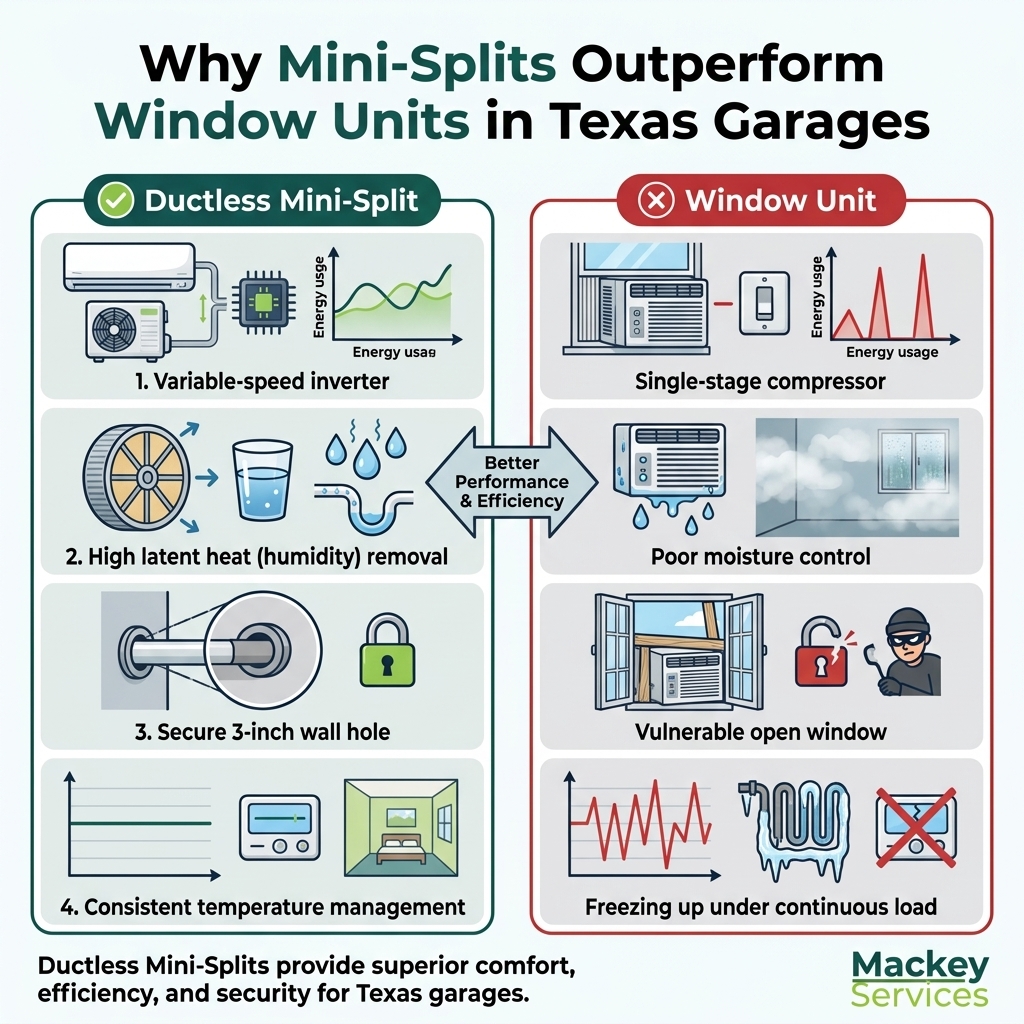
Most window units utilize a single-stage compressor. This means the system only has two settings: 100 percent on, or 100 percent off. There is no middle ground. When the outside temperature spikes during a Texas summer, the window unit registers that the room is too hot and kicks on at full blast. Because the garage is uninsulated and the heat is constantly replenishing, the unit never reaches its target temperature. As a result, the single-stage compressor runs continuously for hours on end without a break.
The mechanical consequences of continuous running:
- Frozen evaporator coils: Because the unit is running constantly in a high-humidity environment, condensation builds up on the coils faster than it can drain. The continuous blast of refrigerant eventually freezes this water into a solid block of ice, stopping all airflow.
- Compressor burnout: Single-stage motors are not designed for 100 percent duty cycles. Running without a break overheats the motor windings, leading to premature electrical failure.
- Poor dehumidification: Because the unit is struggling just to lower the sensible temperature, it pushes air across the coils too quickly to pull the heavy moisture out of the air, leaving you with a cold, clammy, and uncomfortable workspace.
Local building styles in our region heavily feature uninsulated two-car garages facing the afternoon sun. Dropping a basic window unit into this environment is asking a lightweight machine to do heavy-duty industrial work. It is only a matter of time before the system gives out completely.
Security Risks and Installation Limitations of Window ACs
Beyond the mechanical shortcomings and poor cooling performance, window units introduce significant secondary pain points that many homeowners overlook until it is too late. The most glaring issue is home security.
To install a window unit, you have to leave a ground-floor window permanently open. Even with side panels screwed into the frame, a determined intruder can easily push the unit inward or pry it out of the window entirely, granting them free access to your home. For a hobbyist or DIY mechanic, the garage is often home to thousands of dollars worth of expensive power tools, diagnostic equipment, and materials. Placing a vulnerable window unit in a street-facing garage window essentially advertises an easy entry point to anyone walking by.
Furthermore, many local neighborhoods enforce strict Homeowner Association (HOA) regulations. A large, noisy metal box hanging out of a front-facing window is a common violation that can result in swift fines and nasty letters from the neighborhood board. Window units are an eyesore, and they often drip rusty condensation down the side of your home's siding or brickwork.
This contrasts sharply with the minimal structural impact of ductless systems. If you are exploring other clever places to install a ductless mini split, the garage is one of the most practical spaces precisely because it requires almost no exterior modification. The connection between the indoor air handler and the outdoor compressor requires nothing more than a small, three-inch hole drilled through the wall. This hole is completely sealed, maintaining the structural integrity and security of your home while keeping the HOA perfectly happy.
How Variable-Speed Inverter Technology Overcomes Garage Heat
The mechanical solution to the intense heat of a Texas summer lies in the advanced engineering of ductless mini-splits. Unlike the crude on/off operation of a window unit, modern ductless systems utilize variable-speed inverter technology. This fundamental difference in how the compressor operates is exactly what allows them to conquer uninsulated spaces.
Think of a single-stage window unit like driving a car by either slamming the gas pedal to the floor or slamming on the brakes. It is inefficient, jerky, and hard on the engine. An inverter compressor operates like cruise control. It can dynamically adjust its speed, ramping up to 100 percent power to quickly cool down a sweltering garage, and then smoothly dialing back to 30 or 40 percent power to maintain that temperature perfectly.
This variable-speed operation prevents the system from short-cycling. Because the compressor can run continuously at a low, steady speed, it constantly passes air over the indoor coils. This extended run time at lower speeds provides vastly superior moisture removal (latent cooling). The system pulls the heavy Gulf Coast humidity out of the air efficiently, leaving your workspace crisp, dry, and comfortable, rather than cold and damp.
Efficiency Under Load
According to data from the Department of Energy (DOE), inverter technology uses significantly less electricity than traditional single-stage compressors, even when operating in extreme environments. Because the system avoids the massive electrical spikes required to constantly stop and start a heavy motor, it delivers better cooling performance while drawing less power. You get a colder workshop without a shocking spike in your summer utility bills.
Designing a Dedicated Cooling Strategy for Your Workshop
Understanding the technology is only half the battle. To actually achieve a comfortable workspace in Dickinson, TX and the Texas Gulf Coast, the system must be meticulously designed and sized for your specific building. DIY sizing often leads to disastrous results. If you buy a unit that is too small, it will run constantly and burn out. If you buy a unit that is too large, it will short-cycle—cooling the air too quickly without running long enough to remove the humidity.
Here is how a proper cooling strategy is designed for a challenging space:
- Calculate the Unique Thermal Dynamics: A professional load calculation does not just look at square footage. It accounts for the height of the ceiling, the direction the garage doors face, the lack of wall insulation, and the heat generated by the tools or machinery you plan to use inside.
- Select the Right Tonnage: Based on the thermal load, the equipment is selected to ensure the variable-speed compressor has enough overhead to handle peak afternoon heat spikes while still being able to dial down for efficient dehumidification.
- Determine Optimal Air Handler Placement: The indoor unit must be mounted high on the wall in a location that promotes completely unobstructed airflow. Placing it in a corner or behind storage racks will cause the unit to read the wrong temperature and short-cycle.
- Professional Installation and Refrigerant Charging: The copper lines connecting the indoor and outdoor units must be flared perfectly, vacuumed down to remove non-condensables, and charged with the exact correct weight of refrigerant.
Because every uninsulated space behaves differently, relying on professional residential HVAC solutions ensures the system is sized correctly from day one. Our team at Mackey Services brings extensive hands-on local experience in designing custom cooling solutions for challenging, uninsulated spaces. We know exactly how Gulf Coast weather interacts with local garage construction because we tackle these exact humidity and peak-heat challenges every single day in Dickinson, and we design systems that actually work when the heat index peaks.
Frequently Asked Questions About Garage Cooling
Why is my window unit not cooling my garage?
Your window unit is likely struggling because it lacks the capacity to overcome the radiant heat from uninsulated walls and metal garage doors. Furthermore, single-stage window units cannot efficiently remove the high levels of humidity found in a garage. When they run continuously in high heat, their internal coils often freeze over, completely stopping the flow of cold air.
Are mini splits worth it for a garage workshop?
Yes, a mini-split is widely considered the most effective way to cool a workspace. Their variable-speed inverters handle high thermal loads without burning out, and they excel at pulling heavy moisture out of the air. Additionally, they operate quietly and do not require you to sacrifice a window or compromise your home's security.
How do you cool an uninsulated garage in Texas?
The most reliable method is installing a ductless mini-split system sized specifically for the high ambient heat load. You can also improve the system's efficiency by adding foam insulation panels to your metal garage doors and ensuring the weather stripping around the door frames is sealed tight against outside air infiltration.
How many BTUs do I need to cool a 2-car garage?
While a standard 400-square-foot indoor room might only need 9,000 to 12,000 BTUs, an uninsulated two-car garage often requires 18,000 to 24,000 BTUs or more. The exact number depends heavily on the direction the garage faces, ceiling height, and whether the space is shaded, making a professional load calculation highly recommended.
Can you put a mini split in a garage with no insulation?
Yes, you can absolutely install a mini-split in an uninsulated space. However, the unit must be upsized to account for the continuous heat transfer through the walls and doors. A variable-speed system is ideal for this scenario because it can ramp up to high power to fight the heat without wasting energy when the ambient temperature drops.
Reclaim Your Garage Workshop from the Summer Heat
Trying to work in a sweltering garage is a miserable experience, and while throwing a cheap window unit in the wall is a common first attempt, the physics of an uninsulated space demand a much more robust solution. The intense heat and heavy moisture of Dickinson, TX and the Texas Gulf Coast quickly overwhelm single-stage compressors, leaving you with a noisy, frozen, and ineffective machine.
A ductless mini-split provides the targeted cooling, aggressive moisture removal, and variable-speed efficiency required to actually transform a hot garage into a comfortable, usable workshop. You do not have to abandon your hobbies or projects just because the calendar says July. Explore your professional cooling options, properly size a dedicated system for your space, and finally reclaim your garage from the brutal summer heat.
Ready for a better day?
One call handles it all — HVAC, electrical, and generators across the Texas Gulf Coast. Less to pay. Better day. That's the Mackey way.
Mon–Fri: 7 AM – 8 PM · Sat: 8 AM – 5 PM · Licensed & insured · #TACLA 112769C · #TECL 558211