
Tackling Texas Humidity: Variable-Speed Compressors vs. Traditional Single-Stage ACs
Tackling Texas Humidity: Variable-Speed Compressors vs. Traditional Single-Stage ACs? See what our local IAQ testing reveals before you replace your system.
Why Your Home Feels Cold But Clammy During Peak Texas Heat
At Mackey Services, when we talk to homeowners researching the best methods for tackling Texas humidity: variable-speed compressors vs. traditional single-stage ACs, one persistent myth needs to be busted right away: installing a larger, more powerful unit will not solve your indoor moisture issues. In fact, oversizing your equipment often makes the problem significantly worse. If your thermostat reads a cool 70 degrees but your skin feels sticky and the air feels heavy, you are experiencing the classic "cold but clammy" phenomenon.
This uncomfortable indoor environment happens when your equipment lowers the temperature without adequately extracting the moisture from the air. For our neighbors here in Dickinson, TX and the surrounding Gulf Coast, managing this heavy moisture load is a daily battle for more than half the year. Upgrading your comfort means making a crucial decision between traditional technology that simply blasts cold air, and advanced systems specifically engineered for continuous moisture removal.
Most standard air conditioning systems are designed primarily to lower the temperature, treating dehumidification as an afterthought. However, our team typically sees that achieving true comfort requires comprehensive indoor air quality solutions that balance both temperature and airborne moisture. To understand why your house feels like a damp cave, you first need to understand the two different types of heat your system is fighting to remove.
Sensible vs. Latent Heat: The Physics of Gulf Coast Cooling
To properly cool a home, an air conditioner must address two distinct types of heat. The first is sensible heat. This is the heat you can actually feel and measure with a standard thermometer. When your thermostat says the room has dropped from 78 degrees to 72 degrees, it is measuring a reduction in sensible heat.
The second type is latent heat, which represents the thermal energy stored in airborne moisture. You cannot measure latent heat with a basic thermometer, but your body certainly feels it. When the air is saturated with water vapor, your sweat cannot evaporate, leaving you feeling hot, sticky, and miserable even in a cold room.
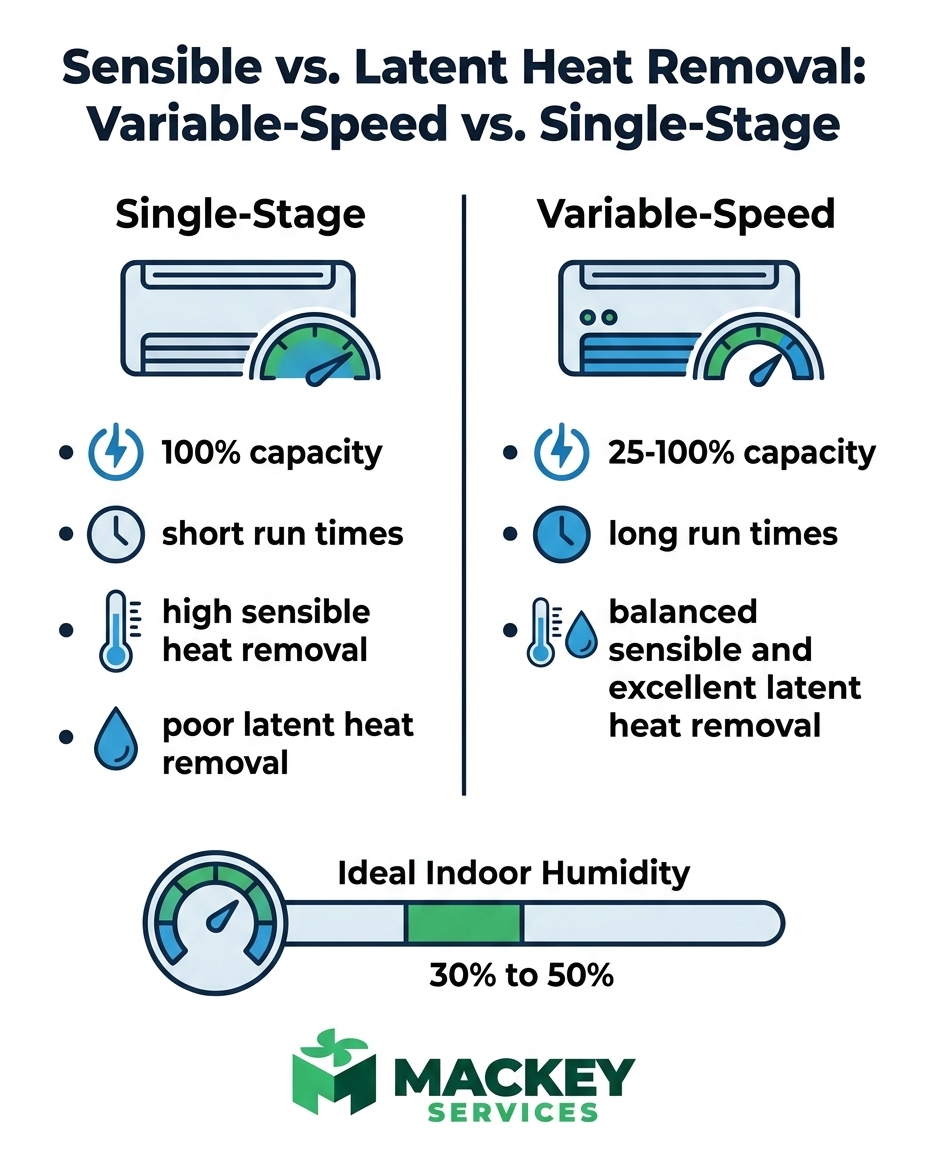
For optimal comfort and health, your ideal indoor relative humidity should sit firmly between 30% and 50%. When indoor humidity creeps past 60%, the environment becomes a breeding ground for biological growth, dust mites, and musty odors. Here on the Gulf Coast, our team at Mackey Services regularly battles extreme summer heat with dew points frequently exceeding 75 degrees, creating an oppressive latent heat load that pushes residential cooling equipment to its absolute limits.
During these high-humidity months, removing latent heat requires significantly more system energy and mechanical capability than just lowering the sensible temperature. Your equipment has to work overtime to condense that airborne water vapor into liquid and drain it out of your house. If your system is not designed to handle a massive latent heat load, it will only address the sensible heat, leaving all that sticky moisture trapped inside your living spaces.
The Short-Cycling Trap of Traditional Single-Stage Systems
When our technicians are called out to fix a "cold but clammy" house, the culprit is almost always short-cycling. To understand why older equipment struggles with heavy moisture, you have to look at how the compressor operates. Traditional single-stage compressors are incredibly basic machines: they only have one speed. When the thermostat calls for cooling, a single-stage unit turns on at 100% capacity. It blasts maximum cold air into your rooms until the target temperature is reached, and then it shuts off completely. There is no middle ground.
The problem: Because these units operate at maximum capacity, they cool the sensible air temperature very quickly. This rapid temperature drop satisfies the thermostat, causing the system to power down before it has done the heavy lifting of dehumidification. This phenomenon is known as "short-cycling."
The cause: Dehumidification takes time. As warm, moist indoor air blows over your indoor evaporator coil, the coil absorbs the heat and the moisture condenses into water droplets. If the system only runs for ten minutes before shutting off, the evaporator coil simply doesn't have enough time to condense a meaningful amount of water vapor. The air gets cold, but the moisture stays suspended in your rooms.
The solution: Overcoming the short-cycling trap requires a fundamental shift in how the compressor operates. Aside from leaving your home feeling sticky and uncomfortable, the rapid on-and-off cycling of a single-stage unit puts immense wear and tear on your mechanical components. Every time that heavy compressor surges to life, it draws a massive amount of electricity and strains the electrical contacts. To truly wring out the air, the system needs to run longer, not harder.
How Variable-Speed Compressors Wring Out Texas Humidity
Unlike traditional units that operate like a simple light switch, variable-speed compressors function more like the gas pedal in your car. They can modulate their cooling output to precisely match the exact conditions inside your home. This technology fundamentally changes the physics of how your home is cooled and dehumidified.
Here is how variable-speed technology systematically eliminates indoor moisture:
- Continuous, low-capacity operation: Instead of blasting at 100% capacity, a variable-speed compressor can dial itself down to run at capacities as low as 25% to 30%. This allows the system to run almost continuously throughout the day without overcooling your rooms.
- Extended coil contact time: Because the system runs in longer, slower cycles, the indoor air is continuously moving over the cold evaporator coil. This maximizes the time available for the coil to extract water vapor, literally wringing the moisture out of the air drop by drop.
- Elimination of temperature swings: By constantly adjusting its output, the system maintains your exact target temperature within half a degree. You never experience the noticeable hot and cold swings associated with single-stage units turning on and off.
- Drastic energy reduction: It takes far less electricity to keep a compressor running at a low, steady speed than it does to constantly surge a single-stage compressor on and off at maximum power.
At Mackey Services, we see the impact of this technology constantly. Just last July, during the peak summer heat, a local Dickinson homeowner reached out to us because their severe asthma was being aggravated by poor indoor air quality and high humidity. We replaced their aging, short-cycling equipment with a new 19-SEER variable-speed system paired with HEPA filtration. Because the new unit runs continuously at lower speeds, it effectively filters the air and pulls out the heavy moisture. The system drastically improved their indoor air quality while reducing their energy consumption by roughly 30 percent.
Local Validation: What Our IAQ Testing Reveals
It is easy to read manufacturer brochures praising new technology, but real-world performance is what actually matters. In our methodology-driven approach at Mackey Services, we rely on hands-on findings from diagnosing local comfort issues. Through our rigorous Indoor Air Quality (IAQ) testing in Dickinson area homes, we deploy specialized data loggers to track temperature and humidity fluctuations over 24-hour cycles.
The Indoor Air Quality (IAQ) moisture removal metrics we gather tell a very clear story. Homes equipped with variable-speed units maintain incredibly tight humidity control, rarely fluctuating outside the ideal 45% to 50% range, even during the hottest parts of the afternoon. The continuous air circulation prevents moisture from pooling in stagnant corners or upstairs bedrooms.
Conversely, our testing consistently shows that homes relying on single-stage equipment frequently spike above 60% relative humidity during peak afternoon heat. Because the single-stage unit easily satisfies the thermostat's temperature request, it shuts down right when the latent heat load is at its worst. Managing indoor humidity spikes becomes nearly impossible when the mechanical equipment refuses to run long enough to address the moisture.
What our team has learned diagnosing humidity issues across the region is that sheer cooling power is not the answer. Precision control is the only reliable way to conquer the heavy moisture loads rolling off the Gulf.
Head-to-Head Comparison: Variable-Speed vs. Single-Stage
When our Mackey Services team helps you plan HVAC system upgrades, choosing the right compressor technology is the most critical part of the process. To help you weigh your options, here is a direct comparison of how these two systems handle the demands of our extreme climate.
| Performance Metric | Traditional Single-Stage AC | Variable-Speed AC |
|---|---|---|
| Moisture Removal (Latent Heat) | Poor. Rapid cooling cycles shut the system down before moisture can be adequately extracted. | Excellent. Continuous, low-speed operation maximizes condensation on the evaporator coil. |
| Temperature Consistency | Noticeable swings of 2 to 4 degrees as the system cycles on and off. | Precise control, generally maintaining within 0.5 degrees of the thermostat setting. |
| Energy Efficiency | Lower efficiency due to high-amperage power surges every time the compressor starts. | High efficiency. Uses lower, steady power draws to maintain comfort without constant restarting. |
| Operating Noise | Loud. The compressor and blower fan operate at 100% maximum capacity at all times. | Quiet. Operates at a whisper-quiet low capacity for the majority of the day. |
Frequently Asked Questions About AC Dehumidification
Why does my house feel humid when the AC is running?
If your house feels damp while the AC is on, your unit is likely short-cycling. A pattern we see often is that the system is cooling the sensible air temperature too fast and shutting off before the airborne moisture can be extracted over the evaporator coils. Oversized units are especially prone to this issue, as they blast cold air and satisfy the thermostat in minutes, leaving all the sticky humidity trapped inside your living spaces.
Does a variable speed AC dehumidify better?
Yes, we recommend variable-speed technology because it provides vastly superior dehumidification compared to traditional units. Because it can ramp down to lower capacities, it runs for longer, uninterrupted cycles. This allows continuous air circulation over the cold evaporator coil, giving the system the necessary time to wring out heavy moisture without freezing you out of the room.
What is AC short cycling in hot weather?
Short cycling occurs when an air conditioning system turns on and off rapidly without completing a full, effective cooling cycle. In hot weather, this wastes a tremendous amount of energy, increases wear and tear on the compressor, and completely fails to remove humidity. In our experience, it is usually caused by an oversized unit, a clogged air filter restricting airflow, or a malfunctioning thermostat.
Is a variable speed AC worth it in Texas?
For our customers dealing with extreme Gulf Coast humidity, the long-term value of a variable-speed system is exceptional. Beyond the significant energy savings gained by avoiding constant power surges, the unparalleled comfort of controlled indoor humidity completely changes how your home feels. When the air is dry, you can set your thermostat a few degrees higher and still feel perfectly comfortable. Additionally, highly efficient variable-speed models may qualify for generic federal tax credits or utility incentive programs (we advise checking with your utility provider or a tax professional for current eligibility).
Can I just lower my thermostat to remove more humidity?
Lowering your thermostat will force the system to run longer, but it is a highly inefficient way to tackle moisture. "Overcooling" your home wastes immense amounts of electricity and often just creates a colder, equally clammy environment. Instead of masking the problem by freezing your family, the goal should be utilizing equipment that actively removes the moisture at a comfortable temperature.
Ready to Eliminate the Sticky Indoor Feeling?
True comfort in the Gulf Coast requires actively managing moisture, not just lowering the temperature on a thermostat. If your current equipment leaves your home feeling cold but clammy, it is time to look at solutions designed for our specific climate challenges. At Mackey Services, our methodology-backed approach to indoor air quality ensures you get the exact right system to handle heavy latent heat loads. Reach out to our Dickinson team for a professional evaluation, and let's weigh your upgrade options so you can finally enjoy a dry, comfortable home.
Ready for a better day?
One call handles it all — HVAC, electrical, and generators across the Texas Gulf Coast. Less to pay. Better day. That's the Mackey way.
Mon–Fri: 7 AM – 8 PM · Sat: 8 AM – 5 PM · Licensed & insured · #TACLA 112769C · #TECL 558211