
Why Your Main Breaker Trips When the AC Kicks On During Peak Afternoon Heat
Find out why your main breaker trips when the AC kicks on during peak afternoon heat. Get clear answers on whether you need an HVAC tech or an electrician.
Losing Power When You Need It Most: Diagnosing Afternoon AC Breaker Trips
Does your home suddenly plunge into darkness the exact moment your thermostat calls for cooling? If you are desperately trying to figure out exactly why your main breaker trips when the AC kicks on during peak afternoon heat, you are certainly not alone. It is a highly frustrating experience that leaves your house sweltering and your family uncomfortable during the most brutal part of the day. More importantly, a tripping breaker is not a nuisance to be ignored; it is a critical safety mechanism doing its exact job to prevent catastrophic electrical fires.
When you lose power in the middle of the July peak afternoon heat in Dickinson, TX, our team at Mackey Services knows you face an immediate and confusing decision point. Is the root cause a mechanical failure inside your air conditioning unit, or is your home's electrical panel degrading and failing to support the load? Finding the correct answer dictates who you should call and how the problem must be fixed. When you are stuck deciding between calling an AC technician or needing professional electrical services, getting an accurate dual diagnosis is the only way to restore your home's safety and comfort.
Understanding Locked Rotor Amps (LRA) and Startup Surges
To understand why your breaker cuts power, you first need to understand the immense electrical demand required to start an air conditioning compressor. Air conditioners do not draw a flat, consistent amount of electricity. Instead, they require a massive, temporary surge of power just to get the heavy internal motors spinning.
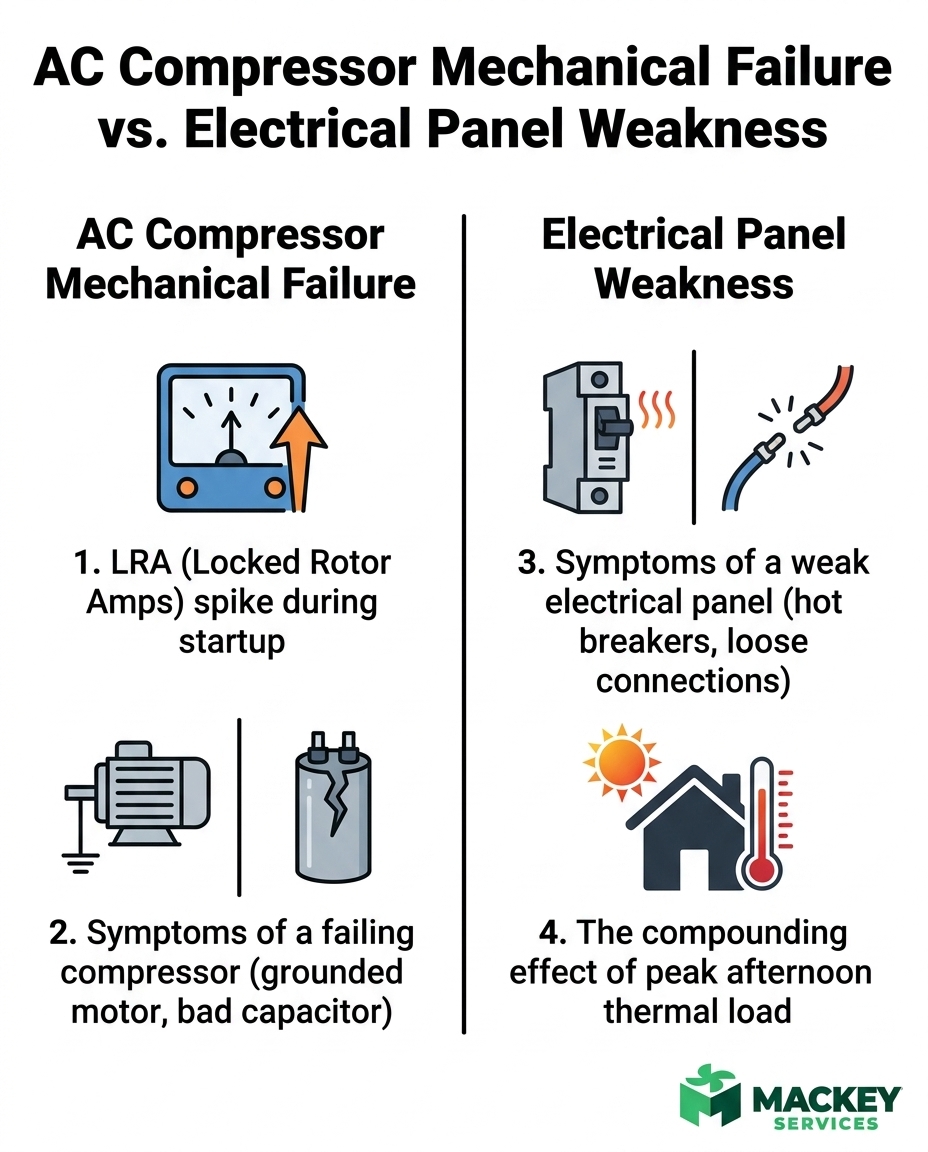
This initial surge is known as a Locked Rotor Amps (LRA) spike. When a compressor is resting, its internal rotor is stationary. Overcoming that resting inertia requires a tremendous amount of electrical energy. In fact, a typical residential AC compressor requires three to five times its normal running amperage just to start up. A healthy electrical system easily handles this temporary LRA spike, allowing the surge to pass through the breaker for a fraction of a second without tripping it. However, when HVAC components begin to fail or the electrical panel weakens, this LRA spike exceeds the circuit breaker's maximum safety threshold, severing the power instantly.
What Happens During a Normal AC Startup?
When your system is functioning correctly, a specific sequence of events takes place the moment your home gets too warm. Understanding this normal baseline helps clarify why things go wrong when you need air conditioning repair.
- The thermostat sends the signal: The indoor thermostat detects the rising temperature and sends a low-voltage electrical signal to the outdoor condenser unit.
- The contactor closes the circuit: This signal energizes a magnetic coil inside the contactor, pulling a heavy metal plate shut to allow high-voltage electricity to flow into the unit.
- The capacitor delivers a jolt: Because the electrical grid cannot supply enough instant energy to start the motor, the run capacitor discharges a massive jolt of stored energy.
- The compressor overcomes inertia: Powered by the grid and the capacitor, the compressor pushes through the Locked Rotor Amps (LRA) spike, begins pumping refrigerant, and settles down to its much lower running amperage.
How Extreme Thermal Load Pushes Your System Over the Edge
Many homeowners notice that their breaker never trips in the cool morning hours, but fails predictably at 4:00 p.m. In our years of servicing Dickinson and the surrounding Gulf Coast, we always explain that this is not a coincidence. High ambient temperatures directly alter the physical operating conditions inside your air conditioning condenser, creating what industry professionals refer to as extreme thermal load.
When intense, prolonged Gulf Coast heatwaves strike the region, they force AC units to run continuously at peak capacity. This creates the perfect storm for electrical overload. As the outdoor temperature climbs, the pressure of the refrigerant inside the condenser coils rises exponentially. Higher refrigerant pressure means the compressor motor faces significantly more physical resistance when it tries to start. It has to push much harder against that high-pressure gas, which forces the motor to draw even more electricity from your breaker panel to get moving.
Furthermore, ambient heat physically warms the breaker panel itself. Most residential electrical panels use thermal-magnetic breakers. These devices contain a bimetallic strip that bends as it heats up, eventually tripping the breaker to stop the flow of electricity. During the July peak afternoon heat in Dickinson, TX, the ambient air is already baking the breaker panel. When the AC compressor demands a massive electrical surge, the added electrical heat is enough to push the already-hot breaker past its tripping point.
| Operating Condition | Morning Operation (75°F) | Peak Afternoon Operation (98°F+) |
|---|---|---|
| Refrigerant Pressure | Moderate to low pressure | Extremely high pressure |
| Compressor Resistance | Low physical resistance | High physical resistance to starting |
| Electrical Draw (LRA) | Standard startup surge | Extended, maximum startup surge |
| Breaker Panel Temperature | Cool ambient temperature | Hot ambient temperature (highly sensitive) |
Mechanical HVAC Failures That Overload Your Circuit
If your breaker trips exactly when the AC tries to turn on, the most common culprit is a mechanical failure within the outdoor condenser. When these components fail, they force the system to pull a dangerous amount of electricity from your home's grid. Diagnosing these specific issues requires specialized meters and professional expertise.
- Failing Run Capacitor or Hard Start Kit: The capacitor acts as a highly powerful battery that helps jump-start the compressor. If the capacitor loses its ability to store energy, the compressor is forced to pull all of its starting power directly from the electrical panel. This creates an abnormally long and high Locked Rotor Amps (LRA) spike that immediately trips the breaker.
- Grounded or Shorted Compressor Motor: Inside the compressor, copper windings are insulated to keep electricity flowing in the correct path. Over time, heat and acidic refrigerant can burn away this insulation. If the bare electrical wire touches the metal casing of the compressor, it creates a "short to ground." This causes a massive, instantaneous surge of electricity that trips the breaker in milliseconds. During a recent summer, our very own technicians, Chris and Felix, responded to a local homeowner experiencing severe cooling issues that traced back to a failing condenser causing heavy electrical strain. They replaced the condenser and took the time to explain the technical details behind the mechanical failure, ensuring the homeowner understood exactly why the system was struggling under the intense seasonal load.
- Severe Lack of Maintenance: If the outdoor condenser coils are blanketed in dirt, grass clippings, or pollen, the system cannot release heat. The compressor rapidly overheats, causing the internal wiring to draw excessive amperage. Regular HVAC system services prevent this entirely by keeping the coils clean and the system running within its designed electrical limits.
Electrical Infrastructure Weakness: Aging Panels and Breakers
It is entirely possible for your air conditioner to be in perfect mechanical health, yet still trip the breaker. In these scenarios, the fault lies within your home's electrical infrastructure. Circuit breakers are mechanical devices, and like all mechanical devices, they wear out over time—especially when subjected to the continuous, heavy electrical loads required by modern cooling systems.
As a breaker ages, the internal springs and bimetallic strips weaken. A breaker rated for 40 amps might begin tripping at 30 amps or even 25 amps. When the AC compressor calls for its normal startup surge, the weak breaker falsely senses an overload and cuts the power. Additionally, the physical connection where the breaker snaps onto the panel's bus bar can loosen over time. A loose electrical connection generates severe heat due to electrical arcing. Because thermal-magnetic breakers are designed to trip when they get too hot, this localized heat will cause the breaker to trip prematurely, even if the AC is running perfectly.
In our experience upgrading electrical systems across the area, older homes may also suffer from undersized wiring or an overloaded main electrical panel that simply cannot support the high-efficiency cooling demands of today's systems. If an HVAC technician tests your air conditioner and finds that it is drawing the correct amount of amperage, the next mandatory step is an electrical inspection. Recognizing the signs your home needs an electrical panel upgrade is vital for maintaining a safe environment during the July peak afternoon heat in Dickinson, TX.
The Hidden Fire Hazards of Resetting a Hot Breaker
When the power goes out on a hot afternoon, the immediate instinct is to march out to the garage and firmly flip the breaker back to the "ON" position. If the breaker trips again, many homeowners will stand there and force it back on repeatedly, hoping the AC will eventually catch and start cooling. This is one of the most dangerous actions a homeowner can take.
A circuit breaker is not a switch; it is a critical safety device designed to prevent the wires inside your walls from melting and starting an electrical fire. When a breaker trips, it is loudly communicating that a dangerous electrical fault exists. Repeatedly forcing a tripped breaker back on degrades its internal safety mechanism. Worse, every time you reset it, you are forcing another massive surge of electricity through a compromised circuit. This allows dangerous heat to build up rapidly in the wiring, breaking down the rubber insulation and creating a severe fire hazard.
Crucial safety warnings regarding tripped breakers:
- Never force a reset: If a breaker trips instantly the moment you reset it, leave it off immediately. This indicates a direct short circuit.
- Check for heat: If the plastic face of the breaker feels physically hot to the touch, or if you smell burning plastic near the panel, leave the power off and call a professional.
- Avoid DIY testing: Diagnosing a Locked Rotor Amps (LRA) spike requires specialized, high-voltage multimeters. Never attempt dangerous DIY electrical testing on a live panel.
Why Dual Electrical and HVAC Diagnostics Save Time and Money
One of the most common frustrations homeowners face when dealing with a tripping AC breaker is the "finger-pointing" game. You call an AC technician, they test the unit, and they tell you to call an electrician because the panel is bad. You pay for that service call, hire an electrician, and the electrician tells you the panel is fine, but the AC compressor is pulling too many amps. You are left sweating, paying for multiple service calls, and still lacking a resolution.
Because this specific issue sits exactly at the intersection of mechanical cooling and high-voltage electricity, comprehensive diagnostics are required to solve it efficiently. A technician must be able to test the compressor's amp draw under load while simultaneously inspecting the breaker panel's integrity, bus bar connections, and temperature.
This is where working with a dual-licensed provider makes a massive difference. At Mackey Services, we hold unique capabilities as a dual-licensed provider, allowing our technicians to comprehensively diagnose both the AC unit and the breaker panel in a single visit without needing to call a second company. This unified approach ensures the root cause—whether it is the July peak afternoon heat in Dickinson, TX straining a bad capacitor, or a degrading electrical panel—is fixed accurately, safely, and without wasting your time or money on comprehensive home services that miss the mark.
Frequently Asked Questions About AC Breaker Trips
Why does my main breaker trip when the AC turns on?
The compressor is pulling too many amps due to mechanical failure, or the electrical breaker is weak and tripping below its rated capacity. When the thermostat calls for cooling, the system demands a massive surge of power to start the heavy compressor motor. If the capacitor is failing, the motor is shorted, or the breaker itself has worn out from age and heat, that initial power surge will exceed the safety limits and instantly trip the breaker to prevent an electrical fire.
What are Locked Rotor Amps (LRA)?
LRA is the maximum electrical current a motor draws when starting from a complete stop. It is significantly higher than the running amps required to keep the motor spinning once it has started. Because the compressor's internal rotor is locked in a stationary position when the unit is off, it takes a massive jolt of electricity to overcome that physical inertia. A Locked Rotor Amps (LRA) spike typically requires three to five times the normal operating power, which tests the absolute limits of your electrical panel.
Is it dangerous to keep resetting a tripped AC breaker?
Yes, it creates a severe fire hazard. It forces electricity through a compromised circuit, risking melted wires and electrical fires inside your walls. A circuit breaker is specifically designed to stop the flow of electricity when it detects unsafe heat or amperage levels. By repeatedly forcing the breaker back on, you degrade the internal safety springs and allow dangerous temperatures to build up at the connection points, which can quickly lead to catastrophic damage.
How do I know if my AC compressor or breaker is bad?
A professional must measure the amp draw at the compressor and inspect the panel simultaneously. Without specialized tools, guessing can lead to unnecessary replacements and wasted money. An expert will use a multimeter to measure the exact amperage the compressor pulls during startup and compare it to the manufacturer's data plate. If the amperage is normal but the breaker still trips, the electrical panel is the culprit; if the amperage spikes dangerously high, the mechanical AC components are failing.
Can a dirty air filter cause my breaker to trip?
Yes, restricted airflow causes the system to overheat rapidly. Overheating forces the compressor to work much harder, increasing the electrical draw beyond safe limits. When an air filter is entirely clogged, the blower motor struggles to pull air through the system, and the indoor coil can freeze over. This puts immense physical strain on the outdoor compressor, causing it to run hotter and pull more amperage until the breaker finally trips to protect the wiring.
Why does the breaker only trip in the afternoon?
Afternoon heat maximizes ambient temperatures and refrigerant pressures inside the outdoor condenser. This creates the highest possible physical resistance for the compressor to overcome during startup. Furthermore, the ambient afternoon heat physically warms the breaker panel in your garage or on your exterior wall. Because most breakers are thermal-magnetic and designed to trip when they get hot, the combination of a hot panel and a struggling compressor easily pushes the system past its breaking point.
Get Safe, Comprehensive Diagnostics for Your Home's Cooling and Power
Understanding why your main breaker trips when the AC kicks on during peak afternoon heat is the first step toward restoring your home's safety. A tripping breaker is never a random glitch; it is a clear symptom of a larger mechanical failure inside your air conditioner or a dangerous weakness in your electrical panel. Ignoring the issue or repeatedly resetting the breaker only increases the risk of permanent system damage or an electrical fire. When you are facing the July peak afternoon heat in Dickinson, TX without power, you need a clear, safe explanation of the root cause. Schedule a comprehensive diagnostic inspection with our dual-licensed team today to accurately pinpoint the fault and resolve the issue safely, ensuring you have reliable cooling and safe power all summer long.
Ready for a better day?
One call handles it all — HVAC, electrical, and generators across the Texas Gulf Coast. Less to pay. Better day. That's the Mackey way.
Mon–Fri: 7 AM – 8 PM · Sat: 8 AM – 5 PM · Licensed & insured · #TACLA 112769C · #TECL 558211