
Can a Heat Pump Actually Keep Up With a 100-Degree Texas Afternoon?
Can a heat pump actually keep up with a 100-degree Texas afternoon? See why modern units rival traditional ACs. Decide with confidence before summer hits.
Are Heat Pumps Truly Effective Against 100-Degree Texas Heat?
Are you wondering if a heat pump can actually keep up with a 100-degree Texas afternoon? Yes, a heat pump can easily keep up with a 100-degree Texas afternoon. During the summer, a heat pump functions exactly like a high-efficiency air conditioner. Modern variable-speed heat pumps are actually better equipped to handle extreme Texas heat and Gulf Coast humidity than older traditional AC units.
If you are staring down a failing air conditioner right now, you are facing a major decision point. Do you stick with a traditional central air conditioning unit, or do you make the leap to modern heat pump technology? Skepticism is completely natural when 100-degree afternoon temperatures become the daily norm. You need absolute certainty that your next cooling system will not leave you sweating in your own living room. The truth is, the name "heat pump" is incredibly misleading. In cooling mode, these systems are formidable air conditioners built to conquer the harshest southern climates.
If you are evaluating new heat pump systems or need general HVAC services, our team is ready to help you navigate your options.
The Mechanics of Cooling: How a Heat Pump Chills Your Home
To understand why a heat pump is so effective during the summer, you have to look at the underlying mechanics. Every air conditioner cools your home by moving heat from the inside to the outside. This process relies on a closed loop of chemical refrigerant. A heat pump uses this exact same refrigeration cycle. It does not generate cold air out of nothing; rather, it actively absorbs the heat trapped inside your living space and pumps it outdoors.
The Reversing Valve: The only mechanical difference between a standard air conditioner and a heat pump is a component called the reversing valve. This simple valve dictates the direction the refrigerant flows. During the summer, the valve shifts to cooling mode. The indoor coil becomes cold, absorbing heat from your indoor air, while the outdoor coil becomes hot, releasing that absorbed heat into the outside air. The process is completely identical to how a traditional central AC operates.
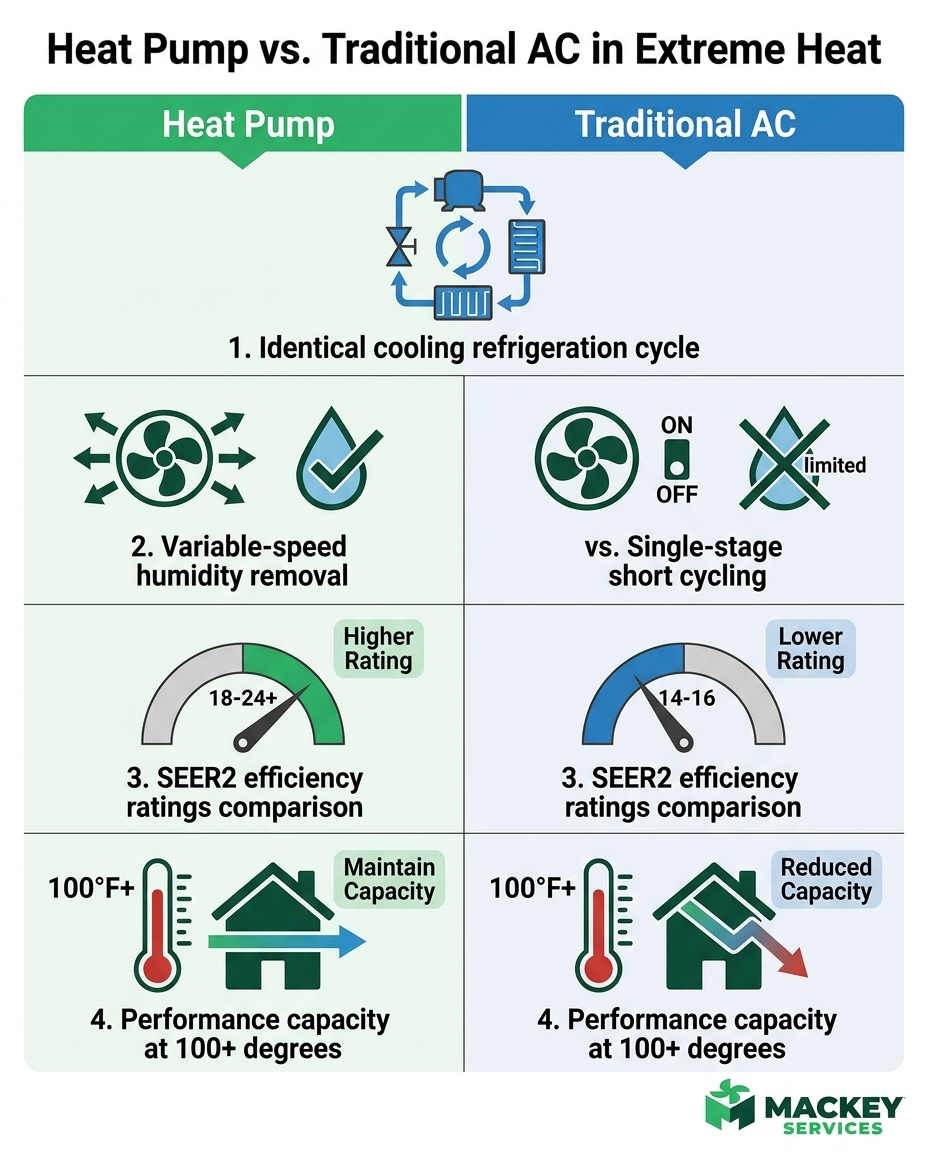
Tonnage and SEER2: A system's ability to cool your home is based entirely on its capacity (measured in tonnage) and its efficiency (measured by its SEER2 rating). A 3-ton heat pump has the exact same cooling capacity as a 3-ton traditional air conditioner. When you compare a modern, high-efficiency heat pump to an older, outdated single-stage AC unit, the heat pump will almost always outperform the older unit in both speed and comfort.
The Refrigeration Cycle Explained:
- Absorption: Warm indoor air blows across the indoor evaporator coil. The cold liquid refrigerant inside the coil absorbs this heat, turning into a warm gas.
- Compression: The warm gas travels outside to the compressor, which squeezes the gas, raising its temperature and pressure significantly.
- Rejection: The hot, pressurized gas moves through the outdoor condenser coil. The outdoor fan blows ambient air over the coil, pulling the heat out of the refrigerant and dispersing it into the yard.
- Expansion: The refrigerant, now a cooler liquid, passes through an expansion valve. This drops the pressure rapidly, turning it back into a super-chilled liquid ready to enter the house and start the cycle over.
Conquering Gulf Coast Humidity with Variable-Speed Technology
The Problem: Cooling a home in Dickinson TX requires more than just dropping the temperature. We experience heavy Gulf Coast humidity alongside extreme heat. If an HVAC system only lowers the temperature without pulling enough moisture out of the air, your home will feel cold but uncomfortably clammy. This is the difference between sensible cooling (dropping the temperature on the thermostat) and latent cooling (removing moisture from the air).
The Cause: Traditional, single-stage air conditioners operate on a basic on-and-off cycle. They blast at 100% capacity until the thermostat hits the target temperature, then shut down completely. Because they blast so much cold air so quickly, they satisfy the thermostat before they have enough time to draw significant moisture out of the indoor air. This "short-cycling" leaves the heavy humidity lingering in your living room.
The Solution: Modern heat pumps utilize variable-speed compressor technology. Instead of blasting at 100% and shutting off, a variable-speed compressor ramps up and down like the gas pedal in a car. It can run continuously at a lower capacity—say, 30% or 40%—for much longer periods. Because the air is constantly moving over the cold indoor coil, the system continuously strips humidity from the air without overcooling the space.
When you manage humidity effectively, your home actually feels cooler at higher thermostat settings, which drastically reduces overall energy strain. One Dickinson TX homeowner reached out during the summer needing a more efficient cooling setup to handle this exact problem. They replaced their old AC units with a 19-SEER variable-speed heat pump system and added HEPA filtration. The outcome was a vastly more comfortable home, better air quality, and a 30% reduction in their energy consumption. Mackey Services brings deep local expertise in installing these variable-speed systems that specifically combat Dickinson's unique coastal humidity profile.
These variable-speed principles also apply to smaller, targeted setups for specific rooms. If you have a sunroom, a garage workshop, or a master bedroom that never stays cool enough, ductless mini split options use this same advanced heat pump technology to provide precise, dehumidified cooling exactly where you need it.
Maintaining Efficiency During Peak Summer Extremes
When July peak summer hits, the continuous, unyielding strain of afternoon heat pushes every mechanical system to its limit. Maintaining efficiency under this maximum cooling load is where modern heat pumps truly shine. The Department of Energy sets strict SEER2 (Seasonal Energy Efficiency Ratio) standards for the Southern region, recognizing that our cooling demands are drastically higher than the rest of the country. Modern heat pumps easily meet and frequently exceed these rigorous standards.
Why Variable-Speed Saves Energy:
- Eliminating Amp Spikes: The most energy-intensive part of an air conditioner's operation is the startup. Single-stage units constantly turn on and off, drawing massive spikes of electricity every time the motor kicks on. Variable-speed heat pumps turn on once and stay on at a low, steady hum, avoiding those massive power draws.
- Lower Running Wattage: Running a compressor at 40% capacity for an hour uses significantly less electricity than running a compressor at 100% capacity for 20 minutes.
- Better Air Mixing: Continuous fan operation prevents hot and cold spots from forming in your home, meaning the system doesn't have to suddenly surge to correct a temperature imbalance.
Because these systems are so highly efficient, upgrading your home's cooling infrastructure often qualifies for generally applicable federal tax credits or local utility incentive programs. While you should always verify current programs with your utility provider or a tax professional, these incentives can make the initial investment highly competitive. The long-term energy savings compound year after year, proving the incredible benefits of heat pumps for Texas homeowners.
Why the 'Heating Only' Myth Persists in Texas
If heat pumps are such exceptional air conditioners, why do so many people still believe they are only meant for mild or cold climates? The "heating only" myth is a persistent misunderstanding rooted in outdated technology.
The Legacy of Early Generation Units
Decades ago, early generation heat pumps struggled to perform efficiently in extreme temperatures. They were often marketed as a compromise—a system that could handle moderate spring and fall weather, but required a backup furnace for deep freezes and struggled to keep up during intense heat waves. Homeowners who experienced these older systems passed down their skepticism, leading to the assumption that you sacrifice cooling power when you choose a heat pump.
Modern Compressor Advancements
Today, advancements in compressor technology have completely eliminated this performance gap. Inverter-driven compressors and advanced refrigerants allow modern systems to transfer heat with incredible efficiency, regardless of how hot it gets outside. The technology has evolved so drastically that a heat pump is no longer a compromise; it is often the premium cooling option on the market.
Uncompromised Cooling Capacity
While heat pumps do provide highly efficient winter heating, their summer cooling capacity is completely uncompromised. Manufacturers design the cooling cycle to handle the exact same thermal loads as their dedicated air conditioning units. As long as your HVAC contractor performs a proper load calculation and sizes the equipment correctly for your square footage and insulation levels, a modern heat pump will never leave you sweating in July.
Frequently Asked Questions About Texas Heat Pumps
Does a heat pump cool as well as an AC?
Yes, a heat pump cools exactly as well as a traditional air conditioner because they use the exact same refrigeration cycle. In cooling mode, a heat pump absorbs heat from inside your house and releases it outside, just like a central AC. A heat pump with the same SEER2 rating and tonnage will provide identical, if not superior, cooling power to a traditional unit. The only difference is that a heat pump can reverse this process in the winter.
Are heat pumps good for Texas summers?
Absolutely, modern heat pumps are exceptionally well-suited for Texas summers. Their variable-speed technology makes them ideal for managing both the intense heat and the heavy, lingering humidity of the Gulf Coast. Because they can run longer, slower cycles, they provide a much more consistent indoor temperature without the constant on-and-off disruptions of older systems. They are built specifically to handle southern climate demands.
How do heat pumps handle high humidity?
Heat pumps handle high humidity by running longer, lower-capacity cooling cycles that continuously draw moisture out of the indoor air. This provides superior latent cooling compared to single-stage units that blast cold air and shut off too quickly. By keeping the indoor coil cold for extended periods, condensation continuously forms and drains away, leaving your indoor air crisp and dry. This humidity control makes your home feel cooler even at a higher thermostat setting.
At what temperature does a heat pump lose efficiency in summer?
Modern heat pumps are designed to maintain high efficiency well beyond 100 degrees and do not "lose" their ability to cool in triple digits. While any HVAC system works harder when the outdoor temperature climbs, a properly sized heat pump will simply run longer cycles to maintain your set temperature. They are rigorously tested to perform under extreme southern heat loads without failing or freezing up.
Will a heat pump save money during a Texas summer?
Yes, upgrading from an older single-stage AC to a high-efficiency variable-speed heat pump significantly reduces energy consumption. By eliminating the massive power spikes that occur when a single-stage motor kicks on and off, the variable-speed compressor uses electricity much more efficiently. Over the course of a long, brutal summer, this streamlined operation translates directly into noticeable savings on your monthly cooling bills.
Ready to Upgrade Your Cooling Strategy?
The verdict is clear: modern heat pumps easily handle 100-degree weather and heavy Gulf Coast humidity. If you are tired of paying high energy bills for a struggling air conditioner, it is time to look at the technology that is proven to work in our local area. A definitive, localized explanation of how modern heat pumps handle triple-digit Texas heat and high humidity just as well as traditional ACs should give you the confidence to make the switch. Contact our team today to schedule an inspection and discuss the best replacement options for your home.
Ready for a better day?
One call handles it all — HVAC, electrical, and generators across the Texas Gulf Coast. Less to pay. Better day. That's the Mackey way.
Mon–Fri: 7 AM – 8 PM · Sat: 8 AM – 5 PM · Licensed & insured · #TACLA 112769C · #TECL 558211