
The Ins and Outs of Protecting Coastal Homes from Corrosion
Protect your coastal home with best hvac and electrical practices for coastal homes to fight salt air and humidity damage.
Why the Gulf Coast Is Tough on HVAC and Electrical Systems
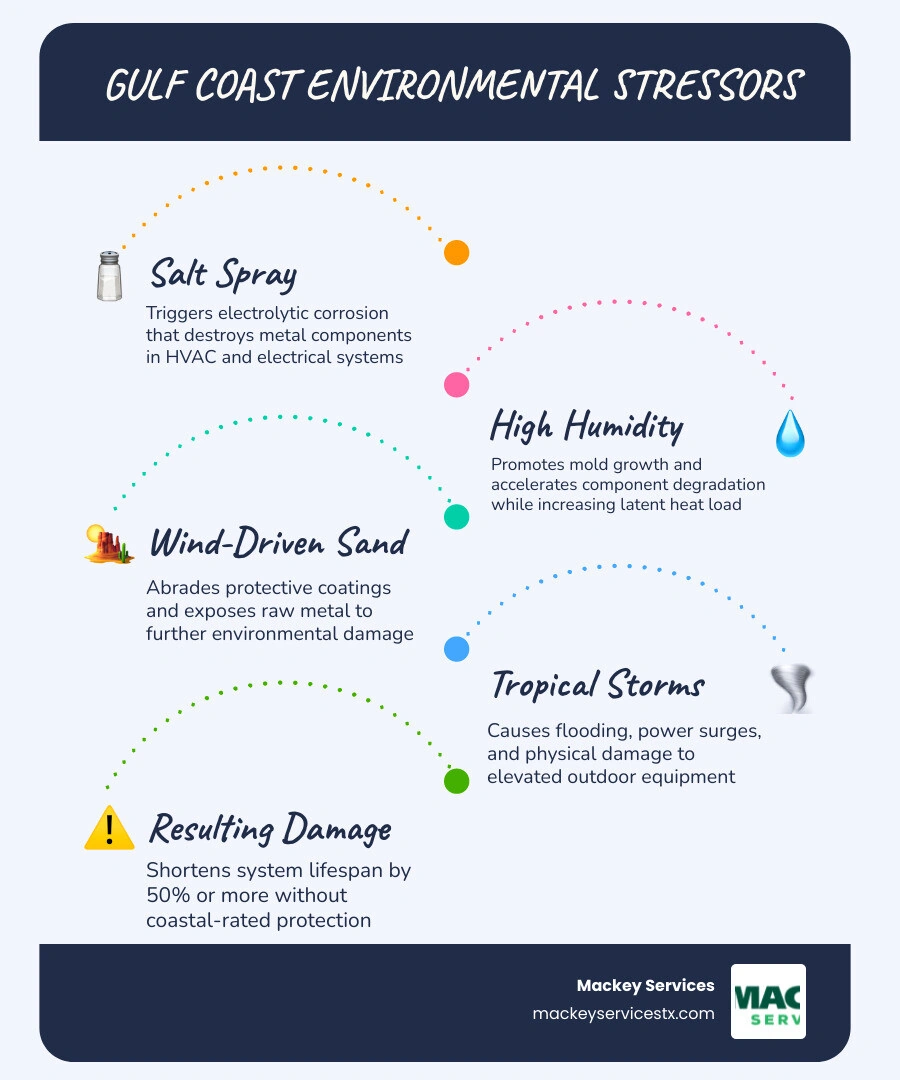
The best hvac and electrical practices for coastal homes start with understanding one hard truth: the Gulf Coast environment is one of the most demanding in the country for home systems. Salt-laden air, relentless humidity, wind-driven sand, and the ever-present threat of tropical storms combine to create conditions that can cut the life of an unprotected HVAC or electrical system nearly in half.
Here is a quick look at the most important practices for coastal homeowners:
- Choose coastal-rated or marine-grade equipment with epoxy-coated coils and stainless-steel hardware
- Install NEMA 4X sealed electrical enclosures and surge protection to guard against corrosion and lightning
- Elevate outdoor units above base flood elevation and anchor them to code
- Rinse outdoor coils with fresh water every two to four weeks during peak salt season
- Change air filters every 30 to 45 days in high-humidity, salty conditions
- Schedule professional inspections twice a year rather than the standard once-a-year interval
- Use variable-speed systems for better dehumidification and energy efficiency in humid Gulf Coast climates
- Apply anti-corrosion coatings to exposed metal parts and inspect electrical connections quarterly
Without these protections, a standard HVAC system near the water can fail in as few as 5 to 7 years — compared to 15 to 20 years with the right equipment and care. For homeowners in Dickinson, League City, Friendswood, and communities around Galveston Bay, that difference represents thousands of dollars and years of comfort on the line.
At Mackey Services, we have been helping Greater Houston area homeowners protect their homes from these exact challenges since 1992. In this guide, we walk you through everything you need to know — from choosing the right equipment to building a maintenance routine that keeps your systems running strong, season after season.
Primary Environmental Challenges for Gulf Coast Systems
Living in areas like Galveston, Seabrook, or Texas City means enjoying the breeze, but that same breeze carries salt and sand that act like fine sandpaper on your home's mechanical "lungs." When we talk about how Gulf Coast climate affects your HVAC system, we are dealing with four main antagonists: salt spray, humidity, sand, and storms.
Salt spray is particularly aggressive. It doesn't just sit on the surface; it triggers an electrolytic reaction. This is a fancy way of saying the salt creates a bridge for electricity to move between different types of metals, causing them to break down at a molecular level. Meanwhile, wind-blown sand can strip away the protective finishes on your outdoor condenser, leaving the raw metal vulnerable to the elements.
Then there is the humidity. In the Greater Houston Area, our humidity often stays above 80% in the mornings. This creates a high "latent heat" load. Your AC doesn't just have to lower the temperature (sensible heat); it has to work overtime to wring the moisture out of the air. If your system isn't designed for this, it will short-cycle, leading to a home that feels clammy and a system that wears out years too early.
Salt Air and Humidity Impact on Lifespan
The combination of salt and moisture creates a "brine" that is incredibly conductive. When this brine settles on your AC's aluminum fins or copper coils, it leads to rapid corrosion. You might notice a white powdery residue or pitting on the metal—these are the first signs of component failure.
Research shows that coastal HVAC systems without specific corrosion protection typically last only 5–7 years. However, when we implement the best hvac and electrical practices for coastal homes, including proper coatings and maintenance, that lifespan can extend to 15–20 years. Understanding how salt air and humidity shorten AC lifespan is the first step toward preventing a premature (and expensive) replacement.
Best HVAC and Electrical Practices for Coastal Homes
When we install or service systems in coastal communities, we don't use "off-the-shelf" inland equipment. Protecting your investment requires a specialized approach.
Selecting Corrosion-Resistant HVAC Systems
If you are wondering when should you replace your AC in a coastal climate, the answer often depends on the level of corrosion currently present. When it is time for an upgrade, we recommend systems with marine-grade materials.
- Epoxy or Phenolic Coatings: These factory-applied coatings on the condenser coils act as a shield against salt air.
- Stainless Steel Fasteners: Standard screws will rust shut in a single season. Stainless steel or polymer hardware is a must for any unit within a few miles of the Gulf.
- Variable-Speed Compressors: These are a game-changer for our climate. Unlike old-school units that are either "on" or "off," variable-speed systems ramp up and down. This allows them to run longer at a lower speed, which is significantly better at removing humidity.
- SEER2 Ratings: High-efficiency systems (SEER2 16 or higher) are not just about lower bills; they are built with modern components that tend to handle the stress of our climate more effectively.
If you are in need of AC service in Katy, TX or near the coast, our technicians can evaluate if your current unit has the necessary protection or if a "coastal kit" can be retrofitted.
Essential Electrical Components for Salt-Air Environments
Electrical systems are just as vulnerable to salt as HVAC units. Salt air is conductive, which means it can cause "tracking" or short circuits in your outdoor electrical panels.
To prevent this, we use NEMA 4X enclosures. These are specifically designed to be watertight and corrosion-resistant. We also recommend sealed conduits and weather-rated gaskets for all outdoor connections. Inside the home, the high humidity can lead to "flash rust" on electrical terminals. This is why whole home rewiring in Houston, TX for older coastal homes often involves upgrading to modern, better-sealed components.
Additionally, coastal storms bring lightning. Protecting your electronics with surge protection in League City, TX is essential. A single surge can fry the sensitive control boards in a modern, high-efficiency HVAC system.
Strategic Installation and Storm Preparedness
Where and how your equipment is placed is just as important as what equipment you buy. In flood-prone areas like Galveston or Dickinson, we have to think vertically.
| Feature | Standard Inland Installation | Coastal/Flood Zone Installation |
|---|---|---|
| Foundation | Ground-level concrete pad | Elevated platform (6–12" above BFE) |
| Anchoring | Gravity/Standard bolts | Hurricane straps & wind-rated mounts |
| Coil Protection | Open louvers | Salt-shielded or coated fins |
| Electrical | Standard NEMA 3R box | NEMA 4X corrosion-resistant box |
Best HVAC and Electrical Practices for Coastal Homes in Flood Zones
FEMA and local building codes often require HVAC equipment to be installed at or above the Base Flood Elevation (BFE). We use heavy-duty equipment platforms or wall-mounted brackets to get your condenser out of harm's way.
Anchoring is another critical step. During a tropical storm or hurricane, high winds can actually shift a heavy condenser unit off its pad, snapping refrigerant lines and causing a total system loss. We use stainless steel hurricane straps to secure the unit. If you've experienced storm damage, seeking electrical repair in Katy, TX or coastal areas quickly is vital to prevent further corrosion from salt-water intrusion. Similarly, if your heater was exposed to water or high winds, you may need heating repair in League City, TX before the first cold snap.
Maintenance Routines to Extend Equipment Longevity
You wouldn't drive your car through saltwater and then leave it in the garage without a wash. Your AC deserves the same courtesy.
The most effective thing a homeowner can do is perform a freshwater rinse of the outdoor unit every 2 to 4 weeks. Use a gentle flow from a garden hose—never a pressure washer, which can flatten the delicate fins. This simple act washes away the salt crystals before they can turn into a corrosive brine.
Best HVAC and Electrical Practices for Coastal Homes Maintenance
Beyond the garden hose, professional care is what keeps a system alive for 15+ years. We focus on:
- Coil Cleaning: Using specialized, non-acidic cleaners to remove salt and sand buildup deep within the coils.
- Electrical Scans: We check for the "greenish" corrosion on terminals that signals a future failure.
- Anti-Corrosion Treatments: Applying aftermarket polymer or epoxy sprays to parts that show early signs of wear.
- Filter Changes: In our humid, salty air, filters clog faster. We recommend checking them every 30 days.
Regular maintenance can prevent up to $1,500 in compressor failures and can keep your energy bills from skyrocketing due to restricted airflow. If you are curious about how long an AC system lasts on the Gulf Coast, the answer is almost always tied to the consistency of these maintenance routines. For those already seeing rust or hearing strange noises, prompt air conditioning repair in Rosharon, TX can often save a system that would otherwise need to be scrapped.
Frequently Asked Questions about Coastal Home Protection
How often should I rinse my outdoor AC unit?
If you live within a mile of the water, we recommend a gentle freshwater rinse every two weeks during the summer and once a month during the winter. If there has been a major storm with onshore winds, rinse the unit as soon as it is safe to go outside. This removes the salt before it can bond to the metal.
Do I need a whole-home surge protector near the coast?
Yes. Coastal areas are prone to frequent thunderstorms and grid instability during high-wind events. A whole-home surge protector acts as a gatekeeper, protecting your HVAC control boards, smart thermostats, and expensive appliances from voltage spikes that occur when power flickers or lightning strikes nearby.
What is the benefit of a variable-speed system in humid climates?
In the Greater Houston area, humidity is often a bigger comfort issue than temperature. A variable-speed system can run at 30% or 40% capacity for a longer period. This "low and slow" approach keeps air moving across the cold evaporator coil longer, pulling significantly more moisture out of the air than a standard system that turns off as soon as the temperature hits the setpoint.
Conclusion
Protecting a coastal home requires a blend of the right technology and the right habits. By following the best hvac and electrical practices for coastal homes, you can enjoy the beauty of the Gulf without the constant worry of equipment failure. From selecting marine-grade units to keeping up with freshwater rinses, every step you take adds years to your system's life.
At Mackey Services, we’ve spent 30 years perfecting the art of coastal home protection. Whether you are in Dickinson, League City, or anywhere in the Greater Houston Area, our family-owned team is ready to help you stay cool and safe. More info about our air conditioning services is just a click away—let us help you build a home that stands up to the salt and the storms.
Ready for a better day?
One call handles it all — HVAC, electrical, and generators across the Texas Gulf Coast. Less to pay. Better day. That's the Mackey way.
Mon–Fri: 7 AM – 8 PM · Sat: 8 AM – 5 PM · Licensed & insured · #TACLA 112769C · #TECL 558211