
The Hidden Mold Trap in Ductless Mini-Splits and How We Clean It
Musty AC? See the hidden mold trap in ductless mini-splits and how we clean it. What we found inside these cassettes proves why you need a pro teardown.
Diagnosing the Musty Odor in Your Wall Cassette
At Mackey Services, we often tell our customers that understanding The Hidden Mold Trap in Ductless Mini-Splits and How We Clean It is essential when your home's cooling system suddenly starts blowing foul-smelling air. You turn on your unit for relief from the heavy late summer (August) humidity, but instead of fresh, crisp cooling, you are hit with a wave of a distinct "dirty sock" smell. This musty odor is one of the most common complaints our technicians hear from homeowners after their systems have been running continuously for months. Learning how to properly maintain your mini-split systems is the first step toward reclaiming your indoor air quality and ensuring your home remains a comfortable refuge.
When that musty smell hits, your first instinct is likely to grab a flashlight and inspect the unit. When you look up at the air output, you might notice visible symptoms: small black spots or a thick layer of dark dust accumulating on the outer vanes and louvers. These visible signs often prompt a critical decision. Do you attempt to wipe the visible spots away yourself, or do you call a professional for a deep clean? While grabbing a damp cloth might seem like a quick fix, those black spots on the exterior plastic are merely a symptom of a much deeper, hidden issue inside the unit.
The Illusion of a Clean Exterior
We see many homeowners fall into a frustrating "wipe-and-wait" cycle. You clean the visible louvers, the unit looks better for a few weeks, and then the dark spots inevitably return. This happens because the outer vanes are simply the exit point for the conditioned air. The actual source of the biological growth is buried deep inside the mechanical components of the wall cassette, far beyond the reach of standard household cleaning tools.
What you are actually seeing:
- Airborne spores: Microscopic biological growth being pushed out from inside the unit.
- Clumping dust: Particulates that have bypassed the filters and mixed with moisture.
- Surface transfer: Growth that has spread from the internal blower wheel directly onto the directional vanes.
To truly eliminate the odor and stop the cycle, you have to understand exactly why these ductless systems create such a perfect environment for biological growth in the first place.
The Anatomy of a Hidden Trap: Why Mini-Splits Sweat
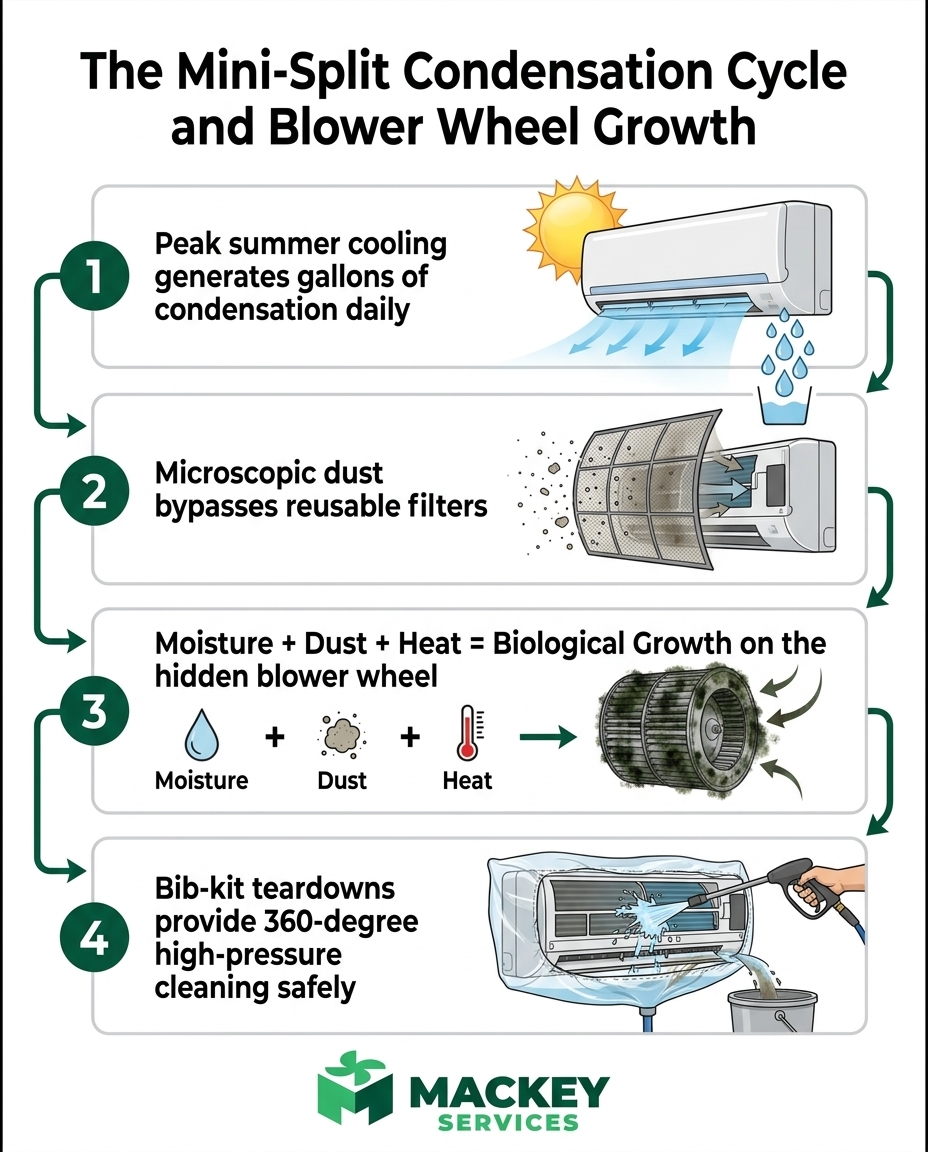
To understand why your wall cassette is developing biological growth, you first have to understand how the cooling process naturally strips moisture from the indoor air. Air conditioning does not just lower the temperature; it actively dehumidifies your home. As warm, humid room air is pulled over the freezing cold evaporator coils inside the unit, the moisture in that air condenses into liquid water. This results in constant condensation, turning the inside of your ductless unit into a very wet environment.
The sheer volume of water a single unit can produce is staggering. During peak operation, a standard wall cassette can generate several gallons of condensation per day. In our years of serving the local community, we've seen firsthand how the extreme Dickinson TX Gulf Coast humidity forces these units to run constantly, producing immense condensation that struggles to dry out between cooling cycles. The Environmental Protection Agency (EPA) recommends keeping indoor humidity below 60% to inhibit biological growth. However, achieving and maintaining this inside a dark, enclosed, constantly wet plastic box is a massive mechanical challenge.
The Science of Sweating Systems
When this moisture fails to drain rapidly or dry completely, it creates the perfect breeding ground for biological growth. Ductless mini-split wall cassettes rely on a sloped drain pan to catch this water and funnel it outside. But when humidity levels remain high around the clock, the internal components never get a chance to completely dry out.
| Operating Condition | Condensation Level | Biological Growth Risk |
|---|---|---|
| Mild Spring Weather (Low Humidity) | Light condensation, dries quickly between cycles | Low risk of hidden growth |
| Average Summer Day (Moderate Humidity) | Steady dripping, pan remains wet | Moderate risk; requires regular filter cleaning |
| Gulf Coast August (Extreme Humidity) | Gallons of water daily, system never fully dries | High risk; perfect environment for the hidden trap |
Because the internal environment of the unit stays wet, any organic material that enters the system becomes an immediate food source. This is why our team stresses that exploring comprehensive indoor air quality solutions requires looking beyond just the temperature of the air and addressing the moisture management happening inside your equipment.
The Blower Wheel: Ground Zero for Biological Growth
The actual ground zero for this hidden mold trap is a component you rarely see: the blower wheel. Hidden deep inside the wall cassette, behind the filters and beneath the evaporator coil, sits a long, cylindrical fan. This wheel is lined with dozens of small, curved blades designed to quietly scoop up the conditioned air and push it out into your room. Because of its location, the blower wheel sits directly in the path of the cold, wet air coming off the coils.
While your unit has reusable mesh air filters on top, these filters are designed to catch large debris like pet hair and heavy dust. Microscopic dust particles easily bypass these reusable filters. When this fine dust enters the wet environment of the wall cassette, it acts as a food source. The mixture of constant moisture, warm ambient temperatures when the unit cycles off, and organic dust creates an ideal habitat for biological growth right on the blades of the blower wheel.
How the Blower Wheel Becomes a Hazard
Over time, the biological growth thickens, turning the clean plastic blades into a fuzzy, caked cylinder. The "black dust" you eventually see blowing out onto your outer vanes is actually pieces of this biological growth breaking off from the hidden wheel and being forcefully ejected into your living space. Our team at Mackey Services sees this pattern frequently. Just last summer, one Dickinson homeowner experienced this firsthand. After moving into a new home, they noticed unexplained eye and skin irritation. One of our technicians inspected their ductless unit, found the hidden biological growth caked on the blower wheel, and explained the necessary fixes to safely restore their air quality.
The cascading effects of a caked blower wheel:
- Restricted airflow: The growth fills the gaps between the fan blades, severely reducing the volume of air the unit can move.
- Increased system strain: Because it cannot move air efficiently, the system is forced to work much harder to reach your target temperature.
- Degraded indoor air quality: Every cubic foot of air pushed into your room is forced directly over a layer of active biological growth.
For homeowners in Dickinson TX and surrounding Gulf Coast areas, we find this buildup is almost inevitable without proactive, specialized deep cleaning.
Why Superficial Wiping and Consumer Sprays Fail
Once you understand that the blower wheel is the true source of the problem, it becomes clear why superficial wiping fails to solve the issue. Wiping the outer louvers only addresses the symptom, leaving the root cause entirely untouched. The musty smell will persist, and the biological growth will continue to restrict your system's airflow and efficiency.
Many homeowners, desperate to eliminate the "dirty sock" smell, turn to consumer-grade coil cleaning sprays found at local hardware stores. As experienced HVAC professionals, our technicians strongly warn against using these products on ductless mini-split wall cassettes. These foaming sprays are often highly caustic and are designed for heavy-duty outdoor condenser coils, not the delicate plastics and thin aluminum fins inside your indoor unit. Worse, spraying foam blindly into the wall cassette often pushes the biological growth deeper into the unit's mechanical crevices, creating clogs in the drain pan that lead to indoor water leaks.
The Risks of DIY Teardowns
Realizing that a deep clean is necessary, some ambitious homeowners attempt a DIY teardown. This is highly risky and strongly discouraged. Ductless units house sensitive electronics, control boards, and delicate temperature sensors directly adjacent to the moisture collection areas. Understanding how proper HVAC maintenance prevents mold growth means recognizing when specialized equipment is required.
| DIY Cleaning Method | What It Actually Does | The Hidden Risk Level |
|---|---|---|
| Wiping Outer Vanes | Removes visible spots temporarily | Low risk, but highly ineffective at solving the root cause. |
| Consumer Coil Sprays | Pushes debris deeper into the unit | High risk of clogging the drain pan and causing indoor leaks. |
| DIY Teardown | Exposes internal components | Extreme risk of electrical hazards, voided warranties, and crushed fins. |
Without specialized equipment and professional training, a homeowner cannot safely access, isolate, or sanitize the hidden blower wheel without risking severe damage to the system or their home.
The Professional Solution: What is a Bib-Kit Teardown?
Because the biological growth is tightly bonded to the fragile plastic blades of the blower wheel, it cannot be simply brushed off. It requires high-pressure sanitization. But how do you safely pressure wash a component that is permanently mounted to the drywall inside your living room? The answer is a highly specialized process known as a bib-kit teardown.
At Mackey Services, our specialized bib-kit teardown process is a massive trust-building differentiator, showing exactly how our team protects your home during this messy but necessary deep clean. A bib-kit is a heavy-duty, custom-fitted waterproof funnel that attaches directly to the wall cassette. It creates a complete seal around the unit, allowing our technicians to use pressurized water and specialized, non-caustic sanitizing agents right there on the wall.
Protecting Your Home During the Deep Clean
The bib-kit teardown is a meticulous process designed to protect your property while eradicating the biological growth. When you schedule professional air conditioning services with us for a deep clean, the process generally follows these safe, controlled steps:
- Safe Isolation: The technician completely powers down the system at the breaker and carefully removes the outer plastic housing, exposing the internal coil and blower wheel.
- Electronic Protection: All sensitive control boards, wiring harnesses, and sensors are heavily wrapped and sealed in waterproof protective casing.
- The Bib-Kit Installation: The waterproof funnel is mounted securely around the unit, with a long drainage tube routing directly into a heavy-duty collection bucket on the floor.
- High-Pressure Sanitization: Using a specialized wand, the technician safely pressure washes the blower wheel and coils, spinning the wheel to ensure 360-degree cleaning. Every ounce of debris and runoff is safely caught by the funnel.
- Reassembly and Testing: Once the unit is thoroughly sanitized and dried, the housing is reassembled, and the system is tested for proper airflow and temperature output.
This thorough, high-pressure sanitization stands in stark contrast to superficial wiping. It completely protects your walls, floors, and surrounding furniture from water damage while ensuring the hidden mold trap is entirely eliminated.
Restoring Your Indoor Air Quality and System Efficiency
The positive outcomes of a proper bib-kit deep clean are immediate and highly noticeable. The moment you turn the system back on, the distinct "dirty sock" smell is completely gone. Because the blower wheel is no longer caked with biological growth, the physical gaps between the fan blades are clear, resulting in massively restored airflow. Your unit will push air further across the room, cooling the space much faster and dramatically improving your overall indoor air quality.
Another local homeowner reached out to our office recently because their AC simply was not cooling effectively anymore. One of our polite technicians troubleshot the problem, discovering that a severely restricted blower wheel was suffocating the airflow. Once the necessary deep cleaning repairs were performed, the AC was cooling perfectly again, proving that biological growth is not just an odor issue—it is a major mechanical bottleneck.
The Long-Term Benefits of a Clean Blower Wheel
A clean blower wheel operates much more efficiently, significantly reducing the strain on your system's expensive components like the compressor and blower motor. When the system doesn't have to fight against its own restricted airflow, it uses less energy and experiences far less wear and tear.
Signs your system is running efficiently again:
- Quieter operation: The blower motor doesn't have to strain to spin a heavy, caked wheel.
- Faster cooling times: Restored airflow means the room reaches your target temperature much quicker.
- Crisp, clean air: The total elimination of musty odors during startup and operation.
To prevent the biological growth from returning to critical levels, ongoing, proactive care is essential. We highly recommend enrolling in a routine HVAC maintenance plan. Regular professional check-ups allow our technicians to monitor your condensation drainage, inspect the blower wheel, and catch early signs of buildup before it impacts your comfort or air quality.
Breathe Easier with Professional Mini-Split Care
Dealing with the hidden mold trap inside your ductless mini-split comes down to recognizing that a hidden problem requires a specialized, hidden solution. The late summer (August) humidity is relentless, and the condensation it creates inside your wall cassette makes biological growth on the blower wheel a near certainty over time. Wiping the outer vanes will never solve the root cause, and attempting a DIY teardown puts your equipment and your safety at risk.
Addressing the root cause safely through a professional bib-kit teardown is the only way to permanently eliminate musty odors and restore your system's efficiency. Our team at Mackey Services encourages you to seek professional help rather than attempting risky cleaning methods. If your system is blowing black dust or smells like dirty socks, it is time to explore professional indoor air quality and deep cleaning solutions so you can finally breathe easier in your own home.
Frequently Asked Questions
Why does my ductless mini split smell musty?
A musty smell usually indicates biological growth inside the unit. As your system cools the air, it creates continuous condensation. When dust bypasses the filters and mixes with this standing moisture, it creates the perfect environment for growth, resulting in a distinct "dirty sock" odor when the fan blows.
How do you clean the blower wheel on a mini split?
Cleaning the blower wheel safely requires a professional bib-kit teardown. A technician isolates the electronics, wraps the unit in a waterproof funnel, and uses a specialized high-pressure wand to wash the wheel right on the wall. This ensures 360-degree sanitization without causing water damage to your home.
Can biological growth in a mini split affect indoor air quality?
Yes, it directly impacts the air you breathe every day. Because the blower wheel forces air into your room, any growth on the blades is pushed directly into your living space. This can lead to unpleasant odors and may cause eye or skin irritation for sensitive individuals in the home.
How often should a mini split be professionally cleaned?
Most units require a professional deep clean every one to two years, depending on usage. In highly humid climates where the system runs constantly, condensation levels are much higher, meaning you may need a bib-kit teardown annually to keep the blower wheel completely clear.
Why is black dust blowing out of my mini split?
The black dust you see on the outer louvers is rarely regular household dust. It is typically pieces of biological growth breaking off from a severely caked blower wheel deep inside the unit. When this happens, superficial wiping will not stop the dust from returning.
Is it safe to use consumer coil cleaner on a wall cassette?
No, consumer-grade coil sprays are highly discouraged for indoor wall cassettes. These foaming sprays can push biological growth deeper into the mechanical crevices, potentially clogging the drain pan and causing indoor water leaks. They can also be too caustic for the delicate internal plastics and sensors.
Ready for a better day?
One call handles it all — HVAC, electrical, and generators across the Texas Gulf Coast. Less to pay. Better day. That's the Mackey way.
Mon–Fri: 7 AM – 8 PM · Sat: 8 AM – 5 PM · Licensed & insured · #TACLA 112769C · #TECL 558211