
The Hidden Fire Risks of 1970s Aluminum Wiring Under Modern Electrical Loads
The hidden fire risks of 1970s aluminum wiring under modern electrical loads are real. See why we recommend targeted retrofits over a full home rewire today.
Uncovering the Silent Threat in Aging Electrical Systems
You upgrade your home comfort equipment for the upcoming season, completely unaware that the connections hidden behind your walls are slowly overheating. The hidden fire risks of 1970s aluminum wiring under modern electrical loads represent a growing danger for older properties, especially as today's high-efficiency systems demand more continuous power. Many homeowners are completely unaware that the electrical infrastructure meant to power a few basic appliances decades ago is now degrading under the heavy strain of modern living.
Homes built with aluminum branch circuits face unique thermal expansion challenges that create highly dangerous connection points over time. Upgrading your home comfort systems, such as installing a new electric furnace or heat pump for the fall, can inadvertently push aging electrical systems far past their safe operational limits. When these hidden vulnerabilities are finally discovered, homeowners often feel trapped, believing they face a critical decision: endure a massive, wall-destroying whole-home rewire, or risk an electrical fire. Fortunately, you do not always have to tear your house apart. By partnering with our team for professional home services, you can utilize targeted, code-compliant retrofits at the degrading connection points to restore safety without the extreme disruption of a complete rewire.
The core issue at hand:
- Hidden degradation: The wiring itself often looks fine within the walls, but the connection points are actively failing.
- Increased modern demand: Today's appliances draw sustained power for longer periods than vintage equipment.
- Thermal stress: Continuous electrical current generates heat, causing older materials to expand and contract dangerously.
Understanding exactly how and why this degradation occurs is the first step in protecting your property from a hidden, preventable disaster.
Why the Alvin and Dickinson 1970s Housing Stock is Particularly Vulnerable
To understand why this specific electrical threat exists, you have to look at the historical context of residential construction. Between 1965 and 1973, the United States faced a severe copper shortage, driving the price of traditional copper wire to record highs. In response, builders nationwide constructed over two million homes using aluminum branch circuit wiring as a cost-effective alternative. Because this era coincided with a massive suburban development boom, our electricians frequently encounter a high concentration of this wiring in the Alvin and Dickinson 1970s housing stock.
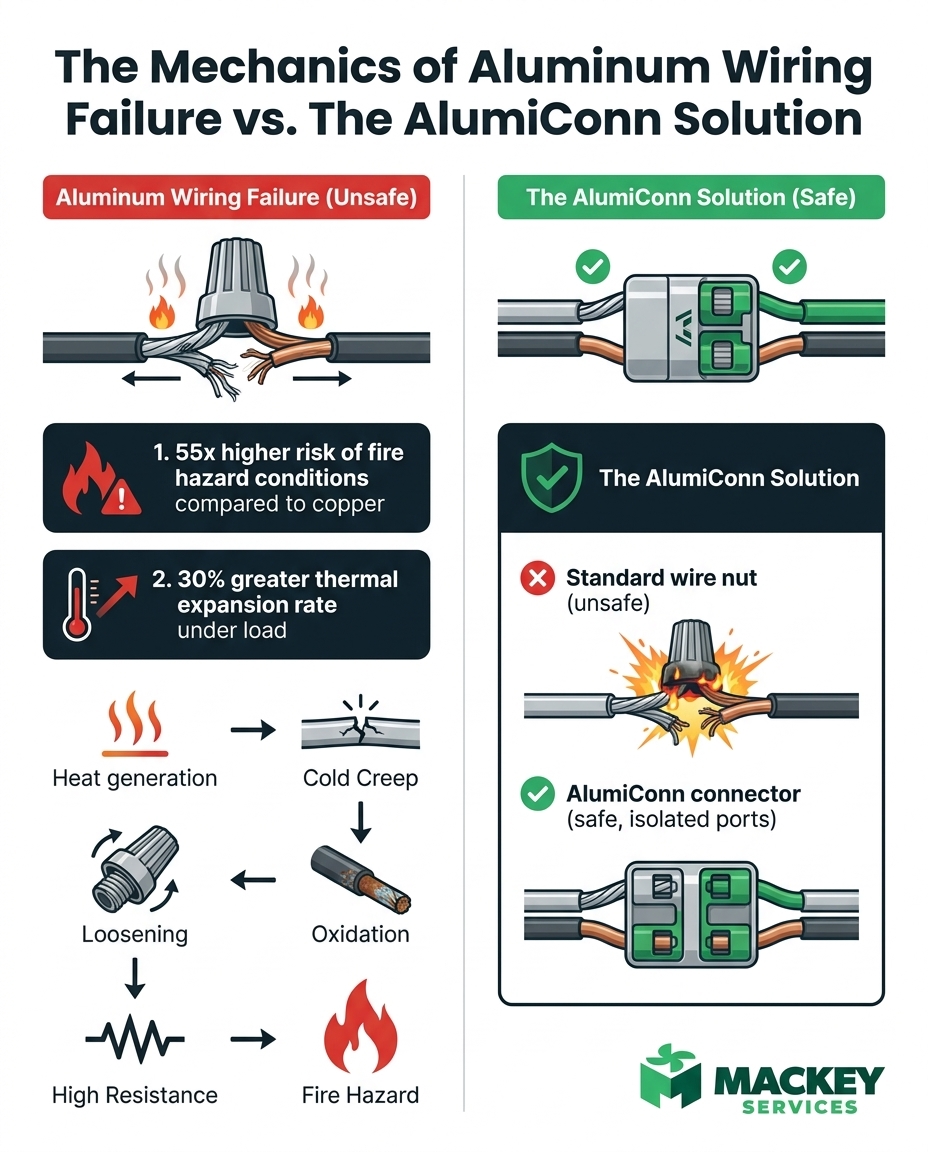
According to the U.S. Consumer Product Safety Commission (CPSC), homes wired with pre-1972 aluminum wire are 55 times more likely to have one or more connections reach fire hazard conditions than homes wired with copper. In our years of servicing homes in Dickinson, Alvin, and surrounding areas, we have seen firsthand how this staggering statistic highlights the severe vulnerability of properties built during this specific window of time.
The critical distinction to remember: The primary issue is not the long runs of aluminum wire resting undisturbed inside your walls. The danger lies entirely in how the aluminum behaves at the connection points—specifically at receptacles, light switches, breaker panels, and junction box splices. Decades of daily use, combined with the unique physical properties of aluminum, turn these everyday connection points into localized fire hazards.
The Mechanics of Failure: Cold Creep, Oxidation, and Thermal Expansion
Why does aluminum fail where copper succeeds? The answer lies in the fundamental physics and metallurgy of the two materials. When electrical current flows through a wire, it naturally encounters resistance, which generates heat. Aluminum expands roughly 30% more than copper when subjected to this heat. This dramatic difference in thermal expansion is the root cause of the failures we routinely see in older homes.
With summer temperatures regularly exceeding 90°F along the Texas Gulf Coast, modern, high-draw HVAC systems are forced to run continuously to maintain indoor comfort. This sustained electrical load drastically accelerates the cycles of thermal expansion and contraction inside your walls. This constant shifting causes a phenomenon known as "cold creep." As the aluminum wire heats up and expands, it pushes against the terminal screws holding it in place. Because it has nowhere else to go, the soft metal slightly deforms. When the current stops and the wire cools, it contracts, leaving a microscopic gap between the wire and the screw.
Once the wire becomes loose, a secondary, far more dangerous chemical reaction occurs: oxidation. When exposed to air, the surface of the aluminum rapidly oxidizes. While copper oxide remains a capable conductor of electricity, aluminum oxide is a highly resistive insulator. As electricity attempts to push through this newly formed layer of resistance, it generates intense, localized heat.
| Material Property | Copper Wiring | Aluminum Wiring (Pre-1972) |
|---|---|---|
| Thermal Expansion | Expands moderately under electrical load | Expands roughly 30% more than copper |
| Oxidation Behavior | Copper oxide conducts electricity safely | Aluminum oxide acts as an insulator, creating resistance |
| Cold Creep Susceptibility | Holds shape firmly under terminal screws | Deforms and loosens over repeated heating/cooling cycles |
| Heat Generation | Remains stable at connection points | Generates intense localized heat as connections loosen |
This escalating cycle of loosening, oxidizing, and heating can easily melt the plastic insulation surrounding the wire and ignite surrounding building materials long before a standard circuit breaker detects a problem and trips.
The Impact of the September Pre-Heating Season HVAC Load
The transition from summer cooling to fall heating places a unique and shifting strain on an older home's electrical infrastructure. As the weather begins to shift, the September pre-heating season HVAC load becomes a critical window for evaluating system safety. Transitioning from heavy summer AC use to fall heating modes—especially when engaging electric furnaces, heat strips, or heat pumps—places sustained, high-amperage loads on aging branch circuits.
Just recently, a local homeowner reached out to our team at Mackey Services needing a professional estimate for a new HVAC system and ductwork. During our consultations for comprehensive equipment replacements like this, we always emphasize that it becomes vital to evaluate more than just the airflow. Installing a modern, high-efficiency comfort system requires an electrical foundation capable of supporting it safely. If the existing wiring is compromised, the new equipment cannot operate as designed.
Intermittent system malfunctions, strange behavior when switching thermostat modes, or equipment that struggles to start can often be traced directly back to voltage drops caused by failing aluminum splices. When a connection point degrades and resistance increases, the voltage delivered to your HVAC equipment drops, forcing the motors to work harder and draw even more current. Pre-season electrical inspections are absolutely vital to ensure your home's infrastructure can safely handle the sustained draw of winter heating modes without risking a thermal event inside the walls.
Identifying the Warning Signs of Degrading Aluminum Connections
Because the most dangerous electrical activity occurs hidden behind drywall and faceplates, you must remain vigilant for the subtle physical symptoms of a failing connection. If your home was built between 1965 and 1973, our experts recommend that you never ignore the following warning signs:
- Flickering or dimming lights: If your lights dim significantly when a heavy appliance (like a vacuum, microwave, or AC compressor) turns on, it indicates a severe voltage drop, often caused by a loose, highly resistive connection. If you notice this happening frequently, diagnosing flickering lights and faulty wiring should be your immediate priority.
- Unusually warm faceplates: Receptacle faceplates or light switches that feel warm or hot to the touch are a major red flag. This indicates that electrical resistance is actively generating heat just millimeters from the plastic cover.
- Odors of burning plastic or ozone: A faint, metallic, or burning plastic smell near an outlet means the insulation is actively melting. The distinct smell of ozone (similar to an approaching thunderstorm) indicates electrical arcing behind the wall.
- Sizzling, crackling, or buzzing sounds: Electricity should be completely silent. Any audible buzzing or crackling coming from a switch or outlet means current is jumping across a loose gap, creating microscopic sparks.
- Frequently tripping breakers: While circuit breakers are designed to trip during an overload, breakers that trip constantly without an obvious cause may be detecting the erratic current flow caused by degrading aluminum splices.
If you observe any of these symptoms in a home suspected of having vintage aluminum wiring, shut off the power to that specific circuit at the main panel immediately and contact a licensed professional.
Modern Appliances and Sustained High-Draw Loads
The electrical panels and branch circuits installed in the 1970s were simply not designed for the continuous loads required by today's technology. Fifty years ago, a home's electrical demand consisted of basic lighting, a refrigerator, a television, and perhaps a window air conditioner. Today, that same infrastructure is expected to support smart appliances, electric vehicle (EV) chargers, high-capacity water heaters, and high-efficiency whole-home HVAC systems.
Adding heavy-draw equipment forces maximum current through degrading aluminum connections for extended periods. For example, when our technicians perform standby generator installations, we require a robust, flawless electrical panel and connection network to safely distribute emergency power during an outage. Pushing backup power through heavily oxidized, loose aluminum splices is a recipe for disaster.
| Era | Typical Household Electrical Demand | Impact on Aluminum Wiring |
|---|---|---|
| 1970s | Basic lighting, single TV, standard appliances | Low sustained load; slow, gradual thermal expansion |
| 2020s | EV chargers, multiple smart TVs, high-efficiency HVAC, home offices | High sustained load; rapid, aggressive cold creep and oxidation |
Homeowners often upgrade their comfort systems or add major appliances without evaluating the capacity and safety of the underlying wiring. Ensuring connection integrity is a mandatory prerequisite before installing any high-amperage modern appliance. Failing to do so not only voids warranties but places the entire property at severe risk.
The Professional Solution: AlumiConn Connectors vs. Complete Rewiring
Discovering vintage aluminum wiring during a routine inspection often triggers immediate panic. Many homeowners fear that this discovery means a mandatory, wall-destroying whole-home rewire that will force them to relocate for weeks. However, the U.S. Consumer Product Safety Commission (CPSC) recognizes specific, targeted retrofitting methods as safe, permanent repairs that do not require tearing out the drywall.
The most reliable and cost-effective method we deploy is the installation of AlumiConn connectors. These specialized, multi-port lugs are engineered specifically to isolate aluminum and copper wires from one another. By placing each wire into its own separate port coated with a specialized antioxidant paste, the connector prevents galvanic corrosion. Furthermore, the robust design of the AlumiConn lug absorbs the thermal expansion of the aluminum, preventing the cold creep that causes standard connections to loosen.
Working with our team at Mackey Services means you benefit from our extensive local experience. As licensed electricians handling older housing stock in Dickinson and Alvin, we utilize safe, code-compliant retrofitting methods like AlumiConn connectors instead of defaulting to aggressive whole-home rewire sales pitches. This targeted approach focuses strictly on the vulnerable connection points, saving significant time and preserving the structural integrity of your home.
Why Standard Pigtailing Fails
It is crucial to understand that not all retrofitting methods are safe. Using standard twist-on wire nuts—even those colored purple and marketed specifically for aluminum—is not a permanent or CPSC-approved fix. Standard pigtailing fails to address the differing expansion rates of aluminum and copper. Over time, the wires will still expand, contract, and eventually loosen inside the nut, recreating the exact fire hazard you attempted to fix.
Furthermore, AlumiConn retrofitting must never be attempted as a DIY project. Securing these connectors requires highly specific torque screwdrivers calibrated to exact manufacturer specifications. Over-tightening crushes the soft aluminum, while under-tightening leaves it loose. This precise work must always be executed by professionals providing licensed electrical services—like our dedicated electrical team—to guarantee compliance and safety.
Securing Your Home's Electrical Infrastructure for the Future
Understanding exactly why aluminum connection points are dangerous is the first, most vital step in protecting your property. The physics of thermal expansion and oxidation cannot be reversed, and ignoring the problem will only allow the connections to degrade further. As modern life continues to introduce more high-draw appliances into our homes, the demand on this aging infrastructure will only increase, making proactive retrofitting essential.
You do not have to live in fear of the wiring behind your walls, nor do you necessarily need to commit to a full-scale home rewire. Our licensed professionals can safely evaluate your electrical system, identify the degrading connection points, and implement safe, CPSC-approved alternatives. Before you upgrade your HVAC system or add new heavy appliances, schedule a comprehensive electrical inspection with Mackey Services to ensure your home is fully prepared and protected for the demands of the upcoming season.
Frequently Asked Questions
Why does aluminum wiring fail at the connection points?
Aluminum expands roughly 30% more than copper when heated by electrical current. This constant expansion and contraction causes the soft metal to deform and loosen from terminal screws, a process called "cold creep." Once loose, the exposed aluminum oxidizes, creating high resistance that generates dangerous amounts of localized heat.
Is aluminum wiring from the 70s safe to leave alone?
No, it is not generally safe to ignore. The U.S. Consumer Product Safety Commission states that homes with pre-1972 aluminum wiring are 55 times more likely to reach fire hazard conditions. The connections will continue to degrade over time, especially as modern appliances place heavier continuous loads on the circuits.
What is the safest way to fix aluminum wiring without replacing it?
The safest, CPSC-approved method is retrofitting the connection points using specialized lugs like AlumiConn connectors. These connectors isolate the aluminum wire from the copper wire in separate ports, preventing galvanic corrosion and absorbing the thermal expansion that causes standard wire nuts to fail.
Are AlumiConn connectors safe for older homes?
Yes, AlumiConn connectors are widely recognized as a safe, permanent, and code-compliant repair for older homes. However, they must be installed by a licensed electrician using a calibrated torque screwdriver, as precise tightening is mandatory to ensure the connection remains secure without crushing the wire.
Can you insure a house with aluminum wiring?
Securing homeowners insurance for a property with vintage aluminum wiring can be difficult, and many carriers require proof of remediation before issuing a policy. Having a licensed electrician properly retrofit the home using CPSC-approved methods like AlumiConn connectors is often required to satisfy insurance underwriters.
How does modern HVAC equipment affect older electrical systems?
Modern HVAC equipment, particularly high-efficiency heat pumps and electric furnaces, draws sustained, high-amperage current for long periods. This continuous load forces aging aluminum connections to heat up and expand more frequently, rapidly accelerating the degradation and increasing the risk of a thermal event.
Ready for a better day?
One call handles it all — HVAC, electrical, and generators across the Texas Gulf Coast. Less to pay. Better day. That's the Mackey way.
Mon–Fri: 7 AM – 8 PM · Sat: 8 AM – 5 PM · Licensed & insured · #TACLA 112769C · #TECL 558211