
Comparing Active vs. Passive Air Purification for Gulf Coast Mold Spores
Musty August air? When comparing active vs. passive air purification for Gulf Coast mold spores, a basic filter often fails. Compare your options.
The Myth of the 'Perfect' Filter for Musty Odors
Upgrading a standard air filter is often touted as a cure-all, but when comparing active vs. passive air purification for Gulf Coast mold spores, a simple filter swap rarely solves the root problem. A persistent myth in home maintenance is that buying the thickest, highest-rated pleated filter at the hardware store will automatically eliminate musty odors and stop organic growth in its tracks. The reality is far more complex. After months of heavy AC usage, homes often develop stale air and a noticeable accumulation of mold spores. This happens because standard filters are designed to capture dry dust and debris, not rapidly multiplying biological contaminants thriving in a damp environment.
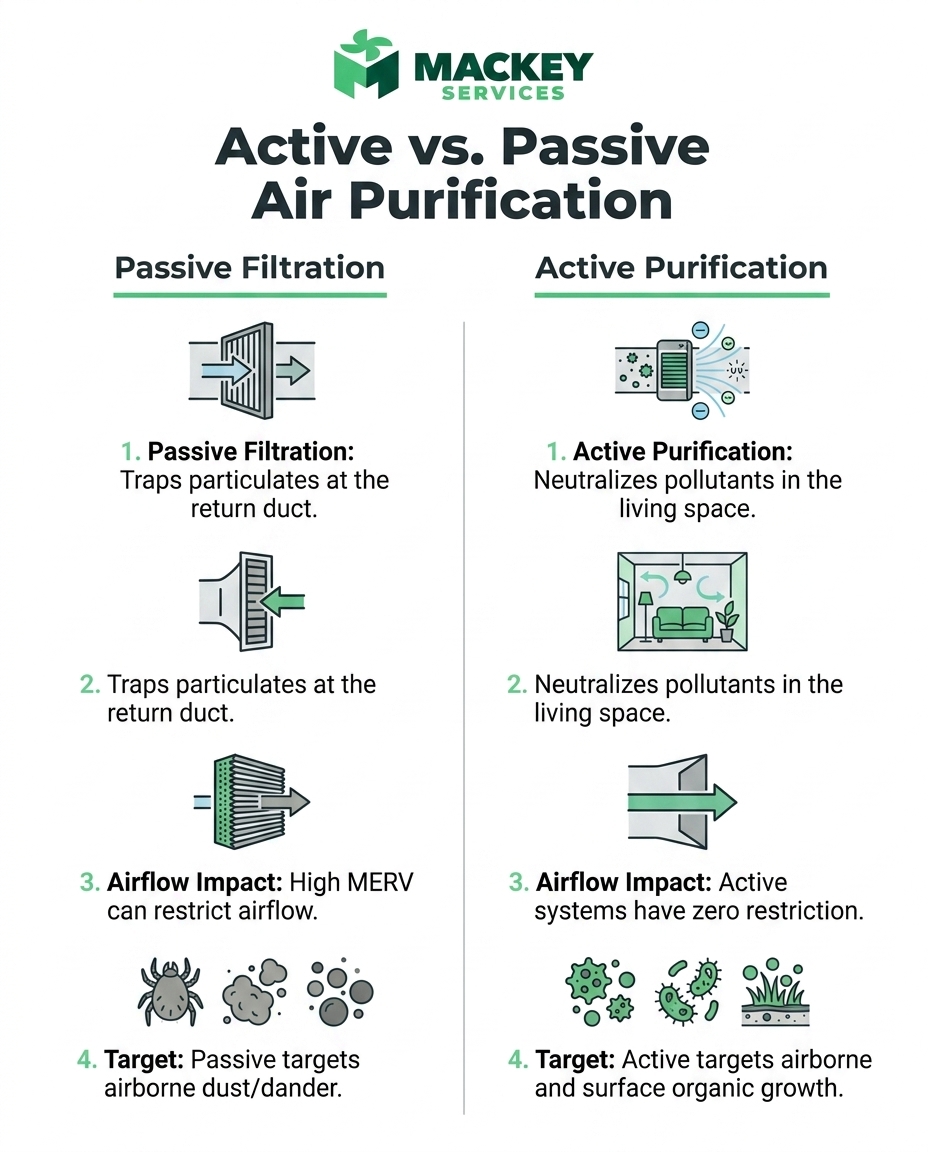
As we navigate the August late-summer cooling season, the limitations of standard filtration become glaringly obvious. Homeowners are faced with a critical decision point: determining whether a high-MERV passive media filter is truly sufficient for their home's specific humidity load, or if the environment demands an active purification system that neutralizes threats before they circulate. Understanding this distinction is essential for long-term comfort and respiratory health. When evaluating your HVAC systems and exploring indoor air quality solutions, the fundamental difference lies in how the technology operates. Passive systems wait for the air to come to them, trapping particles as they pass through a physical barrier. Active systems, on the other hand, send neutralizing agents out into the living space, actively seeking out and dismantling pollutants at the source.
The Reality of Late-Summer Coastal Humidity
To understand why indoor air quality is such a unique challenge in this region, we have to look at the environmental baseline. The climate in Dickinson / Gulf Coast creates a perfect storm for biological growth inside a home's ductwork and living spaces. Standard national advice often fails here because it assumes a relatively dry indoor environment, which simply does not exist during a coastal summer.
- Heavy AC Condensation: Peak cooling demand forces your air conditioner to run almost constantly. This continuous operation generates massive amounts of condensation on the evaporator coil, creating a dark, perpetually damp environment inside the air handler and adjacent ductwork.
- Extreme Moisture Fluctuations: With average summer humidity regularly exceeding 75%, the indoor dew point frequently hits levels that are ideal for organic growth. Even minor air leaks around windows or doors introduce heavy, moisture-laden air into the home.
- Rapid Spore Reproduction: Mold spores reproduce exponentially in warm, damp conditions. The speed at which these spores multiply often outpaces the lag time of waiting for that specific volume of air to circulate back through the return vent to be filtered.
- Settling on Surfaces: In high-humidity environments, airborne spores become heavy with moisture. Instead of remaining suspended in the air where the HVAC blower can pull them into a filter, they quickly settle onto surfaces, furniture, and inside ductwork where passive filters can never reach them.
This combination of high moisture and rapid biological reproduction means that relying entirely on a return-duct filter is often a losing battle against the coastal climate.
Understanding Passive Air Filtration Mechanics
Passive air filtration relies entirely on the mechanical action of the HVAC blower motor pulling air through a physical media. These filters are rated by their Minimum Efficiency Reporting Value (MERV), which indicates the size of the particles they can successfully trap. High-efficiency particulate air (HEPA) filters represent the top tier of passive filtration, capable of capturing microscopic particles with incredible efficiency.
There is no denying that passive systems excel at specific tasks. They are highly effective at trapping dry particulates like pet dander, pollen, and household dust. When properly sized and installed, they provide significant relief for allergy and asthma sufferers. For example, one local homeowner reached out during the summer experiencing terrible asthma symptoms. After evaluating the home's airflow and existing equipment, a Lennox health climate HEPA filtration system was installed alongside new AC units. The HEPA filtration system significantly improved the indoor air quality, effectively trapping the airborne particulates and alleviating the asthma symptoms.
However, the core limitation of passive filtration in the Dickinson / Gulf Coast region remains: these filters only capture pollutants that pass directly through the return duct. If a spore never makes it into the return airstream, it cannot be filtered. Waiting for spores to reach the filter is often insufficient in high-humidity environments because heavy, wet air causes spores to drop out of the airstream and attach to surfaces long before they complete the journey back to the HVAC unit.
The Hidden Danger of High-MERV Filters During Peak Cooling
The Problem: Attempting to solve a humidity-driven mold spore problem simply by installing the most restrictive, highest-MERV passive filter available often backfires spectacularly. Many homeowners assume that a denser filter means cleaner air, but they fail to account for the mechanical strain it places on the system.
The Cause: There is a direct relationship between higher MERV ratings and increased airflow restriction. A dense filter media acts like a thick blanket over your return vent. During the August late-summer cooling season, your air conditioner requires a massive, uninhibited volume of air to function correctly. When you choke off that airflow with a highly restrictive filter, the blower motor has to work significantly harder to pull air through the dense pleats. This reduces the overall volume of air passing over the evaporator coil. Without enough warm household air moving across the coil to absorb the cooling energy, the coil's temperature drops rapidly, leading to excess condensation that quickly freezes into a solid block of ice.
The Solution: Relying solely on restrictive filters is a flawed strategy for managing humidity-driven spore problems. Instead of forcing the equipment to struggle, homeowners need a balanced approach. If you notice your system struggling to keep up after installing a thick filter, it is critical to consult professionals for proper air conditioning services to evaluate the static pressure and ensure the equipment isn't being damaged.
Airflow Restriction and System Strain
When dense filter media forces blower motors to work harder, the entire HVAC system suffers. The compressor outside runs longer cycles trying to satisfy the thermostat, drawing excess amperage that can easily trip breakers. Furthermore, the reduced air circulation means the system is no longer effectively dehumidifying the home. Poor air circulation leaves pockets of stagnant, humid air in distant rooms, which actually encourages more mold spore growth—the exact opposite of what the high-MERV filter was intended to achieve.
How Active Air Purification Neutralizes Threats at the Source
Active air purification takes an entirely different approach to indoor air quality. Instead of waiting passively for pollutants to travel through the ductwork, active systems distribute neutralizing agents directly into the living space. Systems like the REME Halo utilize advanced technologies, such as proprietary hydro-peroxide plasma, to actively seek out and destroy contaminants.
These systems are integrated directly into the supply side of the ductwork. As the HVAC blower pushes conditioned air into the home, the active purifier charges that air with safe, naturally occurring oxidizing agents. These hydro-peroxides sweep through the entire home, attacking pollutants at the source. This means they neutralize airborne mold spores, bacteria, and viruses before they ever have a chance to reach the return vent. Even more importantly for coastal homes, these active agents settle on surfaces, neutralizing organic growth on countertops, furniture, and walls.
This proactive approach is highly effective against rapid spore reproduction in muggy environments. Because the purification happens out in the room rather than inside a dark duct, it breaks the cycle of musty odors at their origin point. Understanding how this technology integrates with your system is a key part of knowing what happens during routine AC checks, as technicians will verify that the active purifier is producing the correct output to keep the home's air pristine.
Head-to-Head: Trapping vs. Neutralizing
To make an informed decision about your home's air quality, it helps to look at a direct comparison of how these two methodologies handle the specific challenges of coastal humidity and mold spores.
| Feature | Passive Filtration (High-MERV/HEPA) | Active Purification (e.g., REME Halo) |
|---|---|---|
| Mechanism of Action | Pulls air through a physical barrier to trap particles. | Sends purifying agents into the home to neutralize threats. |
| Target Area | Limited strictly to the air passing through the return duct. | Treats the entire living space, including airborne and surface areas. |
| Airflow Impact | High potential for restriction; can strain blower motors. | Zero restriction; does not impede HVAC system airflow. |
| Effectiveness on Spores | Good for dry dust; struggles with fast-growing organic matter. | Highly effective at neutralizing rapid humidity-driven organic growth. |
| Maintenance | Requires frequent physical filter replacements (every 1-3 months). | Requires periodic cell/bulb replacement (typically every 1-2 years). |
Tailoring Your IAQ Strategy for Coastal Extremes
When dealing with the unique climate of the Dickinson / Gulf Coast area, off-the-shelf solutions rarely deliver the promised results. Standard national IAQ advice often fails to account for extreme coastal humidity, leading homeowners to invest in equipment that isn't suited for their specific environmental challenges. Mitigating severe humidity requires deep local expertise and a tailored approach.
In many cases, the most effective strategy involves using active and passive systems in tandem. A moderately rated pleated filter (MERV 8 to 11) can be used to protect the HVAC equipment from heavy dust and debris without choking off the airflow, while an active purification system handles the microscopic mold spores, bacteria, and musty odors out in the living space. This hybrid approach ensures maximum air quality without compromising the efficiency or lifespan of the air conditioner.
Because every home has unique ductwork, varying AC capacity, and different moisture loads, a professional assessment is critical. An expert can calculate the static pressure of your ductwork to ensure any added passive filtration won't cause freezing, while properly sizing an active purifier to match the square footage of the home. Integrating these systems flawlessly should be a core component of your comprehensive HVAC maintenance plan.
Frequently Asked Questions About Managing Indoor Spores
What is the difference between active and passive air purifiers?
The main difference lies in how they interact with pollutants. Passive air purifiers rely on the HVAC system's blower to pull air through a physical filter, trapping particles only if they enter the ductwork. Active air purifiers generate neutralizing agents, such as hydro-peroxide plasma, and distribute them throughout the living space. This allows active systems to attack pollutants in the air and on surfaces before they ever reach the return vent.
Will a MERV filter catch mold spores?
Yes, higher-rated MERV filters can physically catch mold spores, but only if those spores are pulled into the return duct. In highly humid environments, spores often become heavy with moisture and settle on surfaces rather than staying airborne. Additionally, relying on extremely high-MERV filters can restrict your system's airflow, which may lead to poor dehumidification and actually create a better environment for mold to grow elsewhere in the home.
How does an active air purifier like REME Halo work?
The REME Halo works by utilizing reflective electro-magnetic energy to create hydro-peroxide plasma. This plasma is distributed through the HVAC ductwork and into the conditioned spaces of the home. Once in the living area, these naturally occurring oxidizers actively break down and neutralize airborne and surface-level pollutants, including mold spores, bacteria, and viruses, effectively purifying the entire home.
Do active air purifiers restrict HVAC airflow?
No, active air purification systems do not restrict HVAC airflow. Unlike dense passive media filters that force the blower motor to work harder to pull air through tiny pleats, active units are installed directly into the supply plenum and allow air to flow freely around them. This makes them an excellent choice for improving air quality without putting mechanical strain on the air conditioner or reducing system efficiency.
Why does my house smell musty even after changing the AC filter?
A musty smell usually indicates active organic growth inside the home or ductwork, which a standard filter cannot fix. Standard filters only trap dry dust and debris; they do not neutralize odors or kill biological contaminants. If you have changed the filter and the smell persists, the spores are likely reproducing on the evaporator coil, inside the dark ductwork, or on damp surfaces in the living space, requiring an active purification solution to neutralize the source.
Find the Right Solution for Your Home's Air Quality
Understanding the fundamental difference between trapping particles at the return vent and neutralizing them in the living space empowers you to make better decisions for your home's comfort. As we move through the demanding August late-summer cooling season, relying on a restrictive filter to solve humidity-driven odors is a gamble that often leads to strained equipment and lingering air quality issues. Before peak humidity causes further strain on your system or your respiratory health, we encourage you to seek an expert evaluation of your current HVAC setup. Finding the right balance of filtration and active purification ensures your home remains a clean, comfortable sanctuary regardless of the coastal weather outside.
Ready for a better day?
One call handles it all — HVAC, electrical, and generators across the Texas Gulf Coast. Less to pay. Better day. That's the Mackey way.
Mon–Fri: 7 AM – 8 PM · Sat: 8 AM – 5 PM · Licensed & insured · #TACLA 112769C · #TECL 558211