
All About Whole Home Generators on the Gulf Coast
Learn why you need a whole home generator on the Gulf Coast and how it protects your home during hurricane season power outages.
Do You Need a Whole Home Generator on the Gulf Coast?
If you're wondering whether do you need a whole home generator on the Gulf Coast, the short answer is: for most homeowners in this region, yes — and here's why that matters right now.
Quick Answer: Should Gulf Coast Homeowners Get a Whole Home Generator?
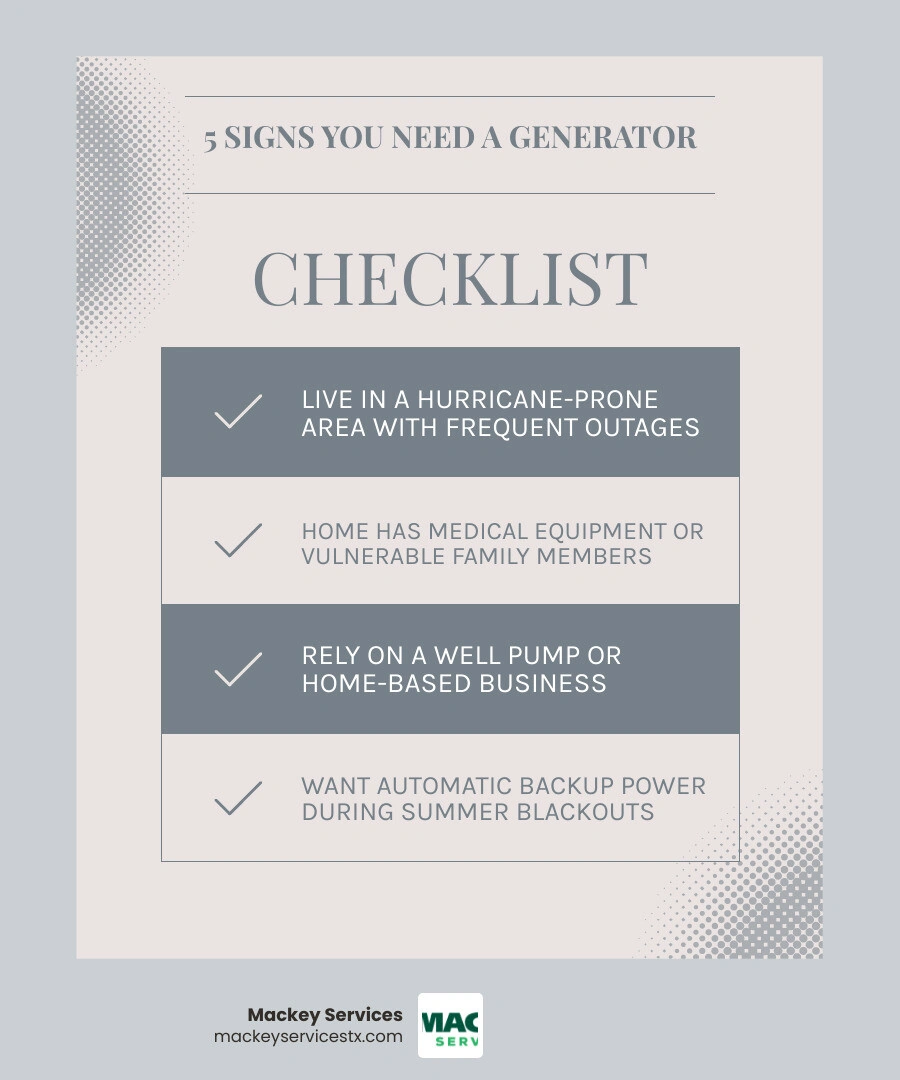
| Your Situation | Whole Home Generator Recommended? |
|---|---|
| Hurricane-prone area (Houston, Galveston, League City) | Yes — strongly |
| Home with medical equipment or vulnerable family members | Yes — essential |
| Remote workers or home-based businesses | Yes — critical |
| Homes on well water | Yes — pump requires power |
| Occasional short outages only | Consider battery backup instead |
Living on the Gulf Coast means living with hurricane season — June through November, every single year. Florida ranks number one in the U.S. for hurricane landfalls, and the broader Gulf Coast averages 25 to 30 major storm events annually. When Hurricane Milton hit in 2024, more than 3.2 million customers lost power statewide. Some counties saw nearly every single customer go dark.
That's not a rare worst-case scenario. That's Tuesday on the Gulf Coast.
And it's not just hurricanes. The region logs 50 to 60 thunderstorm days each year. Heat, humidity, and an aging grid mean outages happen even on calm days. When the power goes out here in summer, temperatures inside a home can climb dangerously fast — especially for kids, elderly family members, or anyone depending on medical equipment.
A whole home standby generator changes that. Instead of scrambling for extension cords or sweating through a five-day blackout, your home stays powered automatically — lights, AC, refrigerator, and all.
Why Gulf Coast Homeowners Need a Whole Home Generator
When storms hit the Gulf Coast, power loss isn’t a question of if – it’s when. We’ve seen it time and again in communities like Pearland and Pasadena. A tropical system forms in the Gulf, and within 48 hours, the local big-box stores are completely sold out of portable units.
The 2024 season was a stark reminder of our vulnerability. During Hurricane Milton, millions were left in the dark, and in some areas like Polk County, nearly half of all residents lost power. For us here in the Greater Houston area, we remember the 2021 freeze and the 2024 windstorms that turned "camping at home" into a miserable, week-long ordeal.
But it's not just about the lights. On the Gulf Coast, the heat is a safety issue. Without air conditioning, indoor temperatures can hit 90 degrees or higher in hours. This is especially dangerous for those with medical equipment that requires a constant power supply or for families with infants and elderly members who can't regulate their body temperature well in extreme heat. Furthermore, if you are working from home in a place like West University Place or Bellaire, a reliable connection isn't a luxury—it's your livelihood.
To get ahead of the rush, check out our Hurricane Season Home Preparation Guide to see how backup power fits into your total safety plan.
Protecting Your Home from Extended Blackouts
One of the biggest hidden dangers of a power outage on the Gulf Coast isn't the darkness—it's the moisture. When your AC stops running, the humidity inside your home skyrockets. This creates a breeding ground for mold and mildew, which can begin to grow in as little as 24 to 48 hours.
A whole home generator keeps your HVAC system running, which acts as a massive dehumidifier for your house. This is a critical part of protecting your investment. Beyond mold, there is the issue of food preservation. A single extended outage can lead to hundreds of dollars in spoiled groceries. If you're on a well water system in more rural parts of our service area, like Rosharon or Alvin, no power means no water for showers, toilets, or drinking.
We often get asked, How Long Does an AC System Last on the Gulf Coast? While salt air and heat take their toll, keeping your system maintained and protected from the electrical surges that often accompany storm-related outages can help extend its life.

Comparing Standby Generators to Battery Backup Systems
When deciding how to protect your home, you'll likely weigh the pros and cons of traditional standby generators versus modern battery backup systems. Both have their place, but for the long-duration outages we face during hurricane season, there is usually a clear winner.
| Feature | Standby Generator | Battery Backup (Solar) |
|---|---|---|
| Power Source | Natural Gas or Propane | Stored Solar/Grid Energy |
| Outage Duration | Days to Weeks (Indefinite on NG) | 8–12 Hours (Typically) |
| Maintenance | Annual Service & Self-Tests | Very Low |
| Noise Level | Moderate (Like an AC unit) | Silent |
| Best For | Multi-day hurricane recovery | Short grid flickers/Daily savings |
Is a whole home generator a wise investment? For most of our neighbors in Dickinson and League City, the answer is yes. According to industry data, the cost-versus-value (CvV) rating on a back-up generator is around 60%, but the peace of mind it provides during a two-week blackout is priceless. You can read more about the ROI here: Is a Whole House Generator a Wise Investment?.
Long-Duration Performance During Storms
The primary limitation of battery systems is their "fuel" source. Once a battery is drained, it needs to be recharged. If the sky is overcast for three days following a hurricane (which is common), solar panels won't be able to keep up with the demand of a central AC system.
Standby generators, however, are the heavy lifters of the backup world. If your home is connected to a natural gas line, your generator has a virtually infinite fuel supply. If you use liquid propane, a typical 500-gallon tank can run a generator for 7 to 10 days at a moderate load. This continuous power is what keeps your home a sanctuary while the rest of the neighborhood is waiting for the grid to be rebuilt.
Portable Generators vs. Standby Systems
We’ve all seen the portable units—the ones you have to drag out of the garage, fill with gasoline in the pouring rain, and snake extension cords through a cracked window. While they are better than nothing, they come with significant risks.
- Carbon Monoxide Safety: Portable generators are a leading cause of CO poisoning when used too close to the home.
- Fuel Management: During a major storm, gas stations often lose power or run out of fuel. A portable unit can burn 12 to 20 gallons of gas a day.
- Manual Setup: You have to be home and physically able to set it up.
A standby system uses an Automatic Transfer Switch (ATS). This "brain" of the system detects a power loss and switches your home to generator power in about 10 to 30 seconds—even if you aren't home. This is particularly vital for our coastal neighbors; if you need a Whole House Generator in Galveston, TX, you know that being able to evacuate while knowing your home's systems (like sump pumps) will keep running is a game-changer.
Sizing and Load Analysis for Your Property
One of the biggest mistakes we see is homeowners buying a generator based solely on their home's square footage. Square footage doesn't draw power—appliances do. A 2,000-square-foot home with all gas appliances has a much lower power demand than a 2,000-square-foot home that is all-electric with a pool pump and an older, power-hungry AC unit.
When we perform a load analysis, we look at two numbers:
- Running Watts: What the appliance needs to stay on.
- Starting Watts (Surge): The huge burst of energy a motor (like your AC compressor) needs just to get spinning.
For a deeper dive into how these numbers work for specific models, check out our Kohler 12.5 kW Generator Guide.
Choosing the Right Size: Do You Need a Whole Home Generator on the Gulf Coast for Every Appliance?
You don't necessarily have to power every single light bulb in the house, but in our climate, the AC is non-negotiable.
- 10kW–14kW: Good for small homes or condos with gas appliances.
- 18kW–22kW: The "sweet spot" for the average 2,500 sq. ft. suburban home. This can usually handle a 5-ton AC, kitchen appliances, and lights.
- 24kW–48kW+: Necessary for large estates, homes with multiple AC units, or those with luxury loads like heated pools and elevators.
We generally recommend a 20% "safety buffer." If your home needs 18kW to run everything, installing a 22kW unit ensures the engine isn't constantly running at its absolute limit, which extends the life of the machine and improves fuel efficiency.
Professional Load Evaluation
This isn't a DIY project. A professional load evaluation involves checking your amperage matching and your electrical panel's capacity. Many older homes in places like Houston or Texas City may need a panel upgrade to safely handle a modern generator and its transfer switch.
We also look at your gas meter. A whole home generator pulls a significant amount of fuel; if your meter isn't sized correctly, the generator might "starve" for fuel just when it needs to kick on the AC. Our Generator Services team handles these technical details so you don't have to.
Installation, Safety, and Maintenance Requirements
Installing a whole home generator is a major home improvement project that requires plumbing (for fuel) and electrical permits. On the Gulf Coast, we have specific challenges, like the need to elevate the unit on a concrete pad or platform to keep it above potential floodwaters.
Safety is our top priority. Clearance codes are strict—typically, a generator must be at least 5 feet from windows and doors to prevent exhaust fumes from entering the home. We also have to consider our local weather; for instance, do you know How Lightning Can Affect Your Home's Backup Generator? Proper grounding and surge protection are essential in a region that sees as much lightning as we do.
Keeping Your System Storm-Ready: Do You Need a Whole Home Generator on the Gulf Coast to Run Self-Tests?
A generator is a machine with an engine, just like your car. If it sits for six months without running, the battery might die or the oil might settle. That’s why these units are programmed to perform a weekly self-test. They’ll turn themselves on, run for about 10–20 minutes to circulate fluids and charge the battery, and then shut back down.
Do Backup Generators Require Maintenance? Absolutely. To ensure it starts when the sky turns grey, you need to stay on top of:
- Oil and Filter Changes: Usually every 12 months or every 200 hours of runtime.
- Battery Health: Generator batteries usually last 2–3 years in our heat.
- Enclosure Care: The salt air in places like Kemah or Seabrook can cause corrosion. We recommend keeping the unit clear of debris and checking for rust.
Frequently Asked Questions about Gulf Coast Generators
How long can a standby generator run continuously during a hurricane?
If connected to a natural gas line, it can run indefinitely, provided you shut it down for a few minutes every 24 hours to check the oil levels. On a 500-gallon propane tank, you can typically expect 7 to 10 days of continuous use depending on the load.
Does a whole home generator increase property value on the Gulf Coast?
Yes. In our region, a generator is a highly sought-after feature. It makes a home much more attractive to buyers and can lead to a faster sale, with a typical return on investment of around 60% of the installation cost.
What is the difference between a manual and an automatic transfer switch?
A manual switch requires you to physically flip a breaker to move your home from grid power to generator power. An automatic transfer switch (ATS) does this for you instantly the moment it senses the grid has failed.
Conclusion
At the end of the day, deciding do you need a whole home generator on the Gulf Coast comes down to how much you value your comfort and safety. We’ve seen enough "once-in-a-century" storms happen every few years to know that being prepared isn't just a good idea—it's a necessity.
At Mackey Services, we’ve been helping our neighbors in Dickinson, League City, Friendswood, and across the Greater Houston area stay comfortable since 1992. As a family-owned business, we treat your home like our own, offering 24/7 emergency readiness and 30 years of expertise in electrical and generator systems.
Don't wait until the next named storm is churning in the Gulf. Contact us today for a professional load analysis and let us help you find the perfect power solution for your family. Explore our Generator Services to get started.
Ready for a better day?
One call handles it all — HVAC, electrical, and generators across the Texas Gulf Coast. Less to pay. Better day. That's the Mackey way.
Mon–Fri: 7 AM – 8 PM · Sat: 8 AM – 5 PM · Licensed & insured · #TACLA 112769C · #TECL 558211