
How Late Summer Overgrowth Around Your Condenser Chokes Cooling Efficiency
Why we urge clearing a 2-foot zone when late summer overgrowth around your condenser chokes cooling efficiency. See how to safely restore airflow.
The Hidden Threat in Your Late Summer Yard
As August brings peak heat and heavy rains to the Gulf Coast, many homeowners do not realize exactly how late summer overgrowth around your condenser chokes cooling efficiency. Your outdoor unit might have had plenty of breathing room back in May, but by the time late August peak overgrowth sets in, the landscape often tells a different story. Aggressive shrubs, tall ornamental grasses, and creeping vines can completely swallow the metal cabinet in a matter of weeks.
When vegetation blocks the louvered side panels of the condenser, it severely restricts the critical airflow needed to release heat from your home. The system is designed to pull fresh air through those side panels, but a thick wall of leaves acts like a heavy blanket. This suffocating layer forces the internal compressor to work much harder just to maintain basic indoor comfort levels.
Recognizing that your system is struggling to keep up is the first step toward preventing a major breakdown. By taking action to safely cut back the surrounding landscaping, you can restore proper airflow before the compressor overheats and shuts down. Keeping this exterior perimeter completely clear is a vital part of maintaining all types of air conditioning systems, especially when the late summer weather is at its most demanding.
The Mechanics of Heat Dissipation: Why Your Condenser Needs to Breathe
To understand why a few overgrown bushes cause so much mechanical trouble, you have to look at the basic function of the outdoor condenser coil. The entire cooling process relies on the system's ability to move heat from inside your living room to the outside air.
The Journey of Indoor Heat
Your air conditioner does not actually "create" cold air. Instead, the indoor evaporator coil absorbs the existing heat and humidity from your rooms into the chemical refrigerant. That hot, pressurized refrigerant then travels through copper lines out to the condenser unit in your yard. The large fan on top of the outdoor unit pulls ambient air through the side panels, across the hot coils, and blows the exhausted heat straight up into the sky. If that heat cannot escape, the cycle breaks down.
The Danger of Elevated Head Pressure
When vines and dense leaves block those side panels, the system experiences restricted airflow. The fan spins continuously, but it cannot pull enough fresh air across the coils to cool the refrigerant. Because the heat remains trapped inside the copper lines, the temperature and pressure of the refrigerant remain far too high. This dangerous condition is known as elevated head pressure.
As head pressure climbs, the compressor has to work exponentially harder to push the heavy, hot refrigerant through the cycle. This consumes significantly more electrical energy and generates excessive internal friction. Eventually, a suffocated unit can trigger a thermal overload, causing the system to shut itself down completely to protect the motor from burning out. Inspecting the surrounding area for adequate airflow and checking for signs of elevated pressure is a critical part of what happens during AC checks.
Gulf Coast Climate Factors Accelerating AC Strain
Living in the Gulf Coast region means dealing with a unique set of climate challenges that accelerate mechanical strain on outdoor equipment. The combination of heavy summer downpours and sustained extreme heat creates an environment where vegetation thrives aggressively.
In Dickinson, TX, prolonged periods of 90-plus degree days with high humidity in August demand maximum heat dissipation capability from your outdoor unit. During these late summer months, your AC unit is already running near its maximum capacity just to fight the ambient weather. The margin for error is incredibly thin.
| Seasonal Phase | Yard Conditions | AC Workload & Airflow |
|---|---|---|
| Early Summer (June) | Plants are freshly trimmed; clearance is generally open. | Moderate run times; system dissipates heat efficiently. |
| Late Summer (August) | Explosive growth; vines and shrubs encroach on the unit. | Peak run times; high humidity makes heat transfer difficult. |
When high humidity blankets the region, the air is already thick with moisture, making it naturally more difficult for the condenser to transfer heat into the atmosphere. Adding a physical barrier of leaves and branches to an already taxing environment turns a tough job into an impossible one. Under these conditions, unrestricted airflow becomes a critical necessity to keep the house cool, rather than just a cosmetic best practice for your yard.
Warning Signs of a Suffocating AC Unit
Before a complete breakdown occurs, your system will usually give you warning signs that it is suffocating from restricted airflow. Paying attention to these physical symptoms can help you catch the problem before the compressor suffers permanent damage.
- Constant running without cooling: The thermostat is set to 72 degrees, but the house stays at 78 degrees while the system runs non-stop for hours.
- Unusually high energy bills: The compressor draws much more electrical amperage when fighting elevated head pressure, causing a sudden spike in your monthly utility costs.
- Lack of cool air at the registers: The air coming from the vents feels lukewarm or room-temperature instead of crisp and cold.
- Hot exterior cabinet: If you place your hand near the metal cabinet outside, it feels exceptionally hot to the touch, indicating trapped internal heat.
The Electrical Toll of Restricted Airflow
Severe strain from overgrown landscaping often translates into electrical failures. A typical pattern we see involves the system repeatedly tripping the electrical breakers. One local homeowner reached out for help during the summer heat when their AC kept tripping the breakers at the main panel. A technician arrived, diagnosed a short circuit caused by severe system strain, and repaired the electrical issue to get the unit back online safely. Catching airflow symptoms early and addressing the root cause—like a blocked condenser—can prevent catastrophic compressor failure and keep those breakers from tripping in the first place.
The 2-3 Foot Rule: Exact Clearance Requirements for Optimal Cooling
Guesswork is not enough when clearing the area around your outdoor equipment. The Department of Energy (DOE) and ASHRAE have established exact clearance requirements to ensure optimal cooling efficiency and prevent mechanical failure.
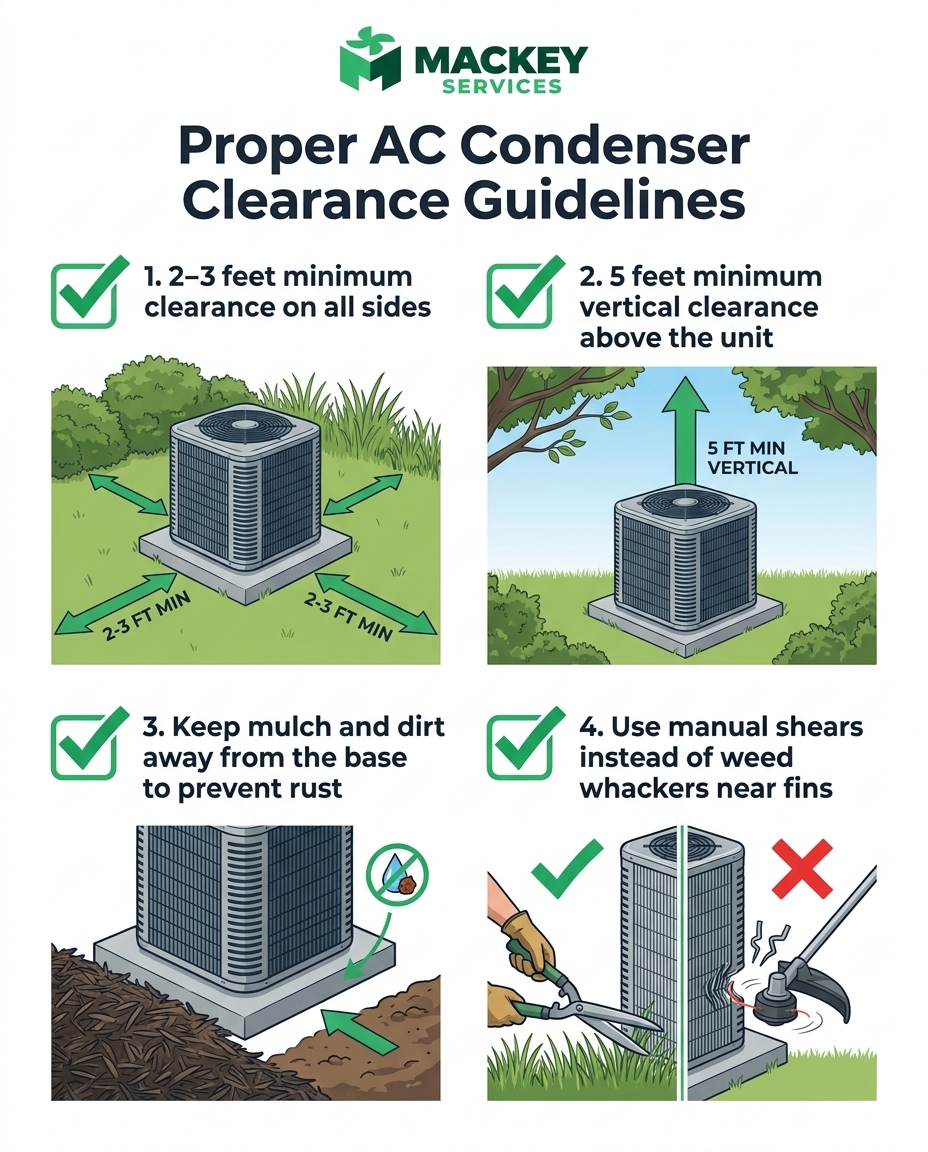
- Maintain 2 to 3 feet of horizontal clearance: Every single side of the condenser needs a minimum of 24 to 36 inches of completely open space. This allows the fan to pull in sufficient ambient air from all directions without resistance.
- Provide 5 feet of vertical clearance: The large exhaust fan blows hot air straight up. You need at least 5 feet of unobstructed vertical space above the unit. Low-hanging tree branches or deck overhangs will trap the exhausted heat, forcing the unit to pull that same hot air right back in.
- Prevent the micro-climate effect: When hot air gets trapped by dense foliage around the unit, it creates a localized pocket of extreme heat. The AC is forced to try and cool the house using 115-degree trapped air instead of 95-degree ambient air.
- Apply universally to all properties: These guidelines apply universally across Dickinson TX residential lots to ensure optimal performance, regardless of the system's age, brand, or efficiency rating.
Professional Pruning vs. Mechanical Care: Bridging the Gap
There is a unique overlap between landscaping care and HVAC mechanical safety that often gets overlooked by homeowners. Standard HVAC contractors might ignore the landscaping entirely, focusing only on the wires, capacitors, and refrigerant inside the cabinet. On the other hand, standard landscapers might not understand the delicate nature of AC components, aggressively weed-whacking right up to the metal and causing irreversible damage to the fins.
This is where having commercial landscaping expertise makes a significant difference. Evaluating how to manage aggressive vines and shrubs around sensitive mechanical equipment requires an understanding of both plant biology and HVAC airflow dynamics. Understanding local plant growth patterns helps in creating a long-term clearance strategy rather than just a temporary trim.
For example, knowing which local Gulf Coast shrubs will aggressively grow back within a few weeks versus which ones will stay dormant allows for smarter property management. This dual approach protects both the health of your yard and the lifespan of your air conditioning unit.
Safe Landscaping Practices to Protect Delicate Coil Fins
If you are ready to tackle the overgrowth yourself, you must follow safe landscaping practices to protect the delicate aluminum coil fins on the outside of your unit. These fins are incredibly thin and easily bent or crushed by flying debris.
Power off the AC unit first: Before doing any trimming, completely turn off the system at the indoor thermostat and pull the outdoor disconnect box. This prevents the powerful fan from sucking loose leaves, dirt, and clipped branches into the cabinet while you work.
Never use weed whackers or heavy machinery: String trimmers throw rocks, thick mulch, and hard debris directly into the coil fins. This bends them flat and permanently blocks airflow, requiring a specialized tool to comb them back into place.
Use manual hand pruners or shears: For the 2-3 foot zone immediately surrounding the condenser, always use manual tools. Carefully snip away encroaching branches and pull creeping vines away by hand to maintain total control over the blades.
| Recommended Perimeter Elements | Elements to Avoid Near the AC |
|---|---|
| Decorative river rock or gravel | Thick wood mulch (traps moisture and causes rust) |
| Slow-growing, drought-tolerant succulents | Fast-growing creeping vines (jasmine, ivy) |
| Potted plants that can be easily moved | Plants that drop excessive leaves or seed pods |
Consider rethinking your perimeter entirely. Replacing aggressive, fast-growing shrubs near the unit with decorative stone or gravel in a 3-foot radius permanently eliminates the need for trimming and keeps the area clean year-round.
Frequently Asked Questions About AC Clearance
How much space should be around an outside AC unit?
The standard rule is to maintain a minimum of 2 to 3 feet of horizontal clearance on all sides of the outdoor condenser. Additionally, you need at least 5 feet of unobstructed vertical clearance directly above the unit. This open space allows the system to pull in fresh ambient air and exhaust hot air upward without any restriction, ensuring the equipment operates at peak efficiency.
What happens if my AC condenser is blocked?
When the condenser is blocked, airflow is severely restricted, causing the system's internal head pressure to rise dramatically. The compressor is forced to work much harder to dissipate heat, which directly increases your monthly energy bills. If left unaddressed, this severe strain can cause the compressor to overheat, trip your electrical breakers, and risk a complete thermal overload.
Can I plant bushes around my air conditioner?
Yes, you can plant bushes around your air conditioner, but they must be planted far enough away to maintain the 3-foot clearance zone even at full maturity. It is best to avoid plants that shed excessive leaves, drop seed pods, or have aggressive root systems that could interfere with the concrete pad. Opt for slow-growing, drought-tolerant varieties that will not require constant pruning during the peak summer growing season.
Why does my AC unit need airflow?
Your AC unit needs unrestricted airflow to successfully dissipate the heat it has removed from the inside of your home. The refrigerant carries indoor heat to the outdoor coil, where the large fan pulls outside air across the fins to cool the refrigerant down. Without adequate airflow, that heat remains trapped inside the system, the refrigerant cannot cool down, and your home will stay warm regardless of how long the unit runs.
How often should I trim the vegetation around my AC?
You should inspect the perimeter of your outdoor unit at least once a month during the active growing season. For homes on the Gulf Coast, you will need to prune actively in late spring and again in late summer when regional plant growth peaks. Regular monthly checks ensure that fast-growing vines or tall grasses do not silently choke the system between your scheduled professional maintenance visits.
Restore Your System's Breathability Before the Heat Peaks
Taking a few minutes to clear the vegetation around your outdoor equipment is one of the most effective steps you can take to protect your home's comfort. Maintaining that 2-3 foot clearance zone is the easiest way to immediately improve cooling efficiency, lower head pressure, and reduce the mechanical strain on your compressor.
There is a deep satisfaction in knowing your system can breathe properly and will not succumb to the intense late summer heat. Once the exterior perimeter is clear, it is equally important to ensure the internal components are just as clean and unrestricted. Consider scheduling a comprehensive HVAC maintenance plan to keep the coils, electrical connections, and blower motors operating at their absolute best.
Ready for a better day?
One call handles it all — HVAC, electrical, and generators across the Texas Gulf Coast. Less to pay. Better day. That's the Mackey way.
Mon–Fri: 7 AM – 8 PM · Sat: 8 AM – 5 PM · Licensed & insured · #TACLA 112769C · #TECL 558211