
The Ultimate Guide to HVAC Repair vs Replacement Cost
Decide HVAC repair vs replacement cost guide with expert tips for Texas homeowners facing system failures.
Should You Repair or Replace Your HVAC System? Here's How to Decide
This HVAC repair vs replacement cost guide helps you cut through the confusion and make a confident decision — fast. Here's the quick answer most homeowners need:
Repair your HVAC system if:
- The system is under 10 years old
- The repair is a minor component (capacitor, thermostat, drain line)
- The repair cost is less than 30% of a new system's price
- The unit is still under manufacturer warranty
Replace your HVAC system if:
- The system is 15 years or older
- The repair cost multiplied by the system's age exceeds $5,000
- The repair cost exceeds 50% of what a new system would cost
- The system uses R-22 refrigerant and needs a significant repair
- You've had two or more major repairs in the past two years
- The heat exchanger is cracked (a safety issue — act immediately)
When your heating or cooling system breaks down in the middle of a Houston-area summer, you rarely have the luxury of a calm, unhurried decision. One minute the house is comfortable, and the next a technician is handing you a repair quote that makes you wonder whether fixing the old unit even makes sense anymore.
That question — repair or replace? — is one of the most common and most stressful decisions homeowners in Dickinson, Friendswood, League City, and the greater Houston area face. The stakes are real: choose wrong and you either overpay for a dying system or spend money on a new unit you didn't actually need yet.
The good news is there are proven financial frameworks and clear warning signs that take the guesswork out of this decision. Whether your AC is struggling through another brutal Texas summer or your furnace is acting up on a rare cold night, the right answer comes down to a handful of concrete factors — system age, repair cost, component type, refrigerant, and local climate — all of which we break down in detail below.
For homeowners already wondering about their specific situation, Should I Repair or Replace My AC is a great companion resource to start with.
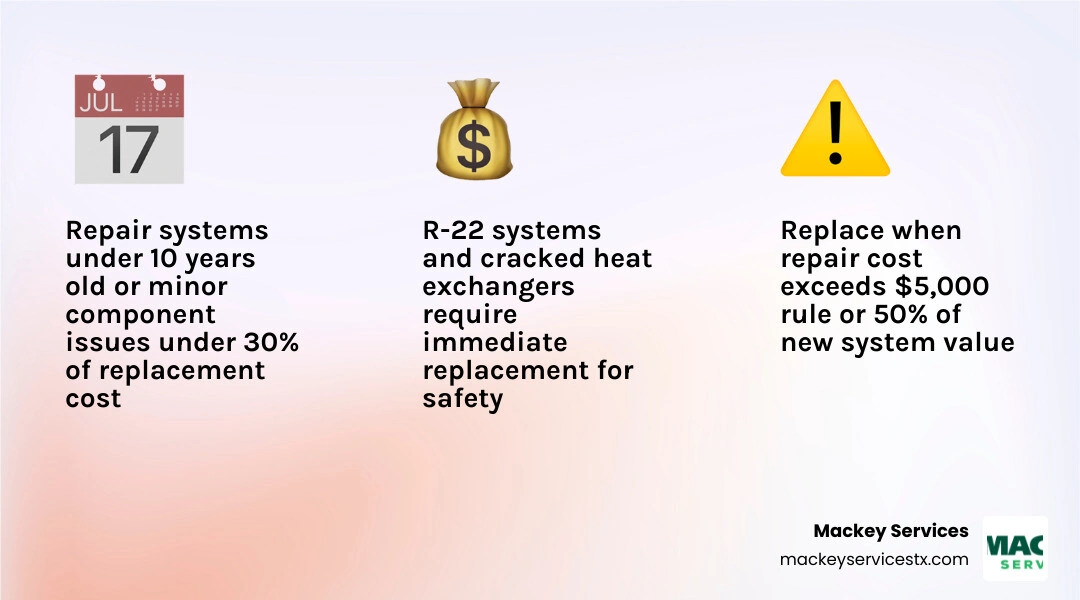
Financial Frameworks: The $5,000 Rule and 50% Rule

When we are faced with an unexpected system breakdown, our emotions can easily get the better of us. Nobody wants to spend their hard-earned savings on a new heating and cooling system if a quick fix will do. To keep our decisions grounded in objective reality, we rely on two industry-standard financial formulas: the $5,000 Rule and the 50% Rule.
These rules act as a mathematical gut check, helping us look past the immediate stress of a breakdown and focus on the long-term cost of ownership.
| Decision Rule | How It Works | Best Used For | Verdict Trigger |
|---|---|---|---|
| The $5,000 Rule | Multiply the age of the system (in years) by the active repair quote. | Older systems facing moderate-to-major repairs. | If the total is over $5,000, replace the unit. If under, repair it. |
| The 50% Rule | Compare the repair quote directly to the cost of a brand-new system. | Major component failures (compressors, coils) on mid-life units. | If the repair cost is more than 50% of a new system, replace it. |
Applying the $5,000 Rule to Your HVAC Repair vs Replacement Cost Guide
The $5,000 Rule is a simple, time-tested calculation that has helped thousands of homeowners decide when to finally retire an aging air conditioner or furnace. To use this rule in your own decision-making process, you only need two numbers: the exact age of your equipment and the written repair estimate from your technician.
The formula is incredibly straightforward:
Age of Equipment (Years) × Estimated Repair Cost = Decision Index
If your calculated index exceeds the $5,000 threshold, investing in a replacement is almost always the smarter financial choice.
For example, let's look at two different scenarios:
- Scenario A: You have a 12-year-old air conditioner that needs a repair. Your technician quotes you a repair. Under the rule, we multiply 12 by that repair quote. If the resulting number is well over $5,000, the math strongly signals that you should replace the system rather than sinking money into a unit that is already past its prime.
- Scenario B: You have a 5-year-old system that needs the exact same repair. Multiplying 5 by the repair quote yields a number well under the $5,000 limit. In this case, repairing the unit is the clear winner because the system still has plenty of useful life ahead.
While this rule is a fantastic starting point, we must remember that it is a simplified triage tool. It doesn't account for rising energy bills, safety hazards, or outdated refrigerants, which is why we always pair it with other vital considerations.
The 50% Rule for Major Component Failures
The 50% Rule takes a slightly different approach by focusing on the direct ratio between the repair cost and the total replacement value of the system. This rule states that if any single repair—or a combination of repairs needed at the same time—costs more than 50% of what a brand-new, fully installed system would cost, you should put that money toward a replacement instead.
Sinking a massive sum into an older, out-of-warranty system is often referred to as the "repair spiral." Once one major component fails on an aging system, the remaining parts are still subjected to the same wear and tear. It is incredibly common for a homeowner to pay for an expensive repair, only to have a completely different component fail just a few months later.
By applying the 50% Rule, we draw a hard line in the sand. If your system is approaching the end of its typical lifespan and a critical component like a compressor or evaporator coil fails, paying to fix it is rarely a sound investment. If you are currently weighing options on a failing heat pump, checking out our Affordable Heat Pump Repair Texas City Guide can help you determine if your repair quote is reasonable or if it's time to consider an upgrade.
Key Factors Influencing Your HVAC Repair vs Replacement Cost Guide
Every home in our service area—from the historic properties in Galveston to the newer builds in League City—has a unique heating and cooling profile. When we evaluate whether to repair or replace, we have to look beyond the immediate price tag of the repair and consider the structural, environmental, and physical factors of your specific home.
- System Capacity and Sizing: Many older homes in our area have systems that were never sized correctly in the first place. If your current unit is oversized, it will cycle on and off rapidly, wearing out components prematurely and failing to remove humidity. Replacing the system allows us to perform a proper load calculation to ensure perfect comfort.
- Ductwork Condition: An HVAC system is only as good as the ductwork distributing its air. If your home has leaky, uninsulated, or collapsed ducts, even a brand-new system won't perform efficiently. When replacing a system, we can address these underlying ductwork issues at the same time, maximizing your return on investment.
- Installation Complexity: Some systems are tucked away in tight attics or crawlspaces, while others are easily accessible. The labor required to safely remove and install equipment plays a massive role in overall replacement timelines.
To navigate these complex variables, we always recommend consulting with professionals who understand the nuances of local homes. You can read more about why this matters in our guide on the Advantages of Working with a Certified HVAC Dealer.
System Age and Lifespan Thresholds in Texas
In our humid, coastal Texas climate, heating and cooling systems work significantly harder than they do in milder parts of the country. Consequently, we must adjust our expectations for equipment lifespans downward.
While a central air conditioner or heat pump might last 15 to 20 years in a northern state, a system in Dickinson or Friendswood typically reaches its retirement age between 10 and 15 years. The heavy cooling demands of our long, scorching summers mean these units rack up double or triple the annual operating hours of systems in other regions.
Furnaces, on the other hand, tend to last a bit longer—often 15 to 20 years—simply because our heating seasons are short and mild. However, as a furnace ages, its safety risks increase, making regular inspections vital. If you are currently operating an older system and want to explore modern, highly reliable alternatives, consider reading about a Ductless Heat Pump Replacement Smart Upgrade 2025 to see how zoning can transform your home's comfort.
Energy Efficiency and SEER2 vs AFUE Savings
One of the most compelling arguments for choosing replacement over repair is the immediate and dramatic reduction in your monthly energy bills. If you are replacing a system that is 10 to 12 years old, you are likely upgrading from a system rated under older, less stringent efficiency standards to a modern SEER2 (Seasonal Energy Efficiency Ratio 2) or high-AFUE (Annual Fuel Utilization Efficiency) system.
Older systems operating in our hot climate might have a SEER rating of 10 or lower, especially after years of natural efficiency degradation. Upgrading to a modern, high-efficiency SEER2 system can cut your cooling costs by 20% to 40% immediately.
For heating, upgrading an older, standard-efficiency furnace (typically rated at 80% AFUE) to a high-efficiency condensing model (rated at 95% AFUE or higher) means that nearly all the fuel you pay for is converted directly into heat for your home, rather than wasting energy up the flue. Furthermore, local utility companies frequently offer rebates for homeowners who make high-efficiency upgrades, helping to offset the initial investment. To learn more about how modern system designs benefit local homes, explore our article on Heat Pump Benefits for Texas Homeowners.
Common Component Failures and Refrigerant Considerations
When our technicians perform diagnostics on a struggling system, we look closely at which specific part has failed. Some components are simple, inexpensive fixes that we can complete in under an hour. Others are "heart of the system" failures that signal the end of the unit's economic life.
Understanding which category your repair falls into is essential for making an informed choice. For Friendswood residents, our Heat Pump Repair Friendswood TX Guide provides an excellent breakdown of what to expect during a diagnostic visit.
High-Risk Repairs: Compressors, Coils, and Heat Exchangers
There are three major component failures that we categorize as high-risk, meaning they almost always tip the scales in favor of system replacement:
- Compressor Failure: The compressor is the heart of your outdoor unit. If it fails on a system that is out of warranty (typically older than 5 to 10 years), the labor and material required to replace it are incredibly intensive. Sinking that much money into an old outdoor unit while keeping an aging indoor coil is rarely a wise financial move.
- Evaporator Coil Leaks: The indoor evaporator coil is responsible for absorbing heat from your home. If it develops a leak, replacing the coil is a major job. If your system is older and uses phased-out refrigerant, replacing the coil alone can be an expensive, temporary patch. If you are facing an emergency system failure in Texas City, our Emergency Heat Pump Repair Texas City Guide is available to help you navigate your immediate options safely.
- Cracked Heat Exchanger: In a gas furnace, the heat exchanger keeps toxic combustion gases, including carbon monoxide, separated from the air circulating through your home. If a heat exchanger cracks, it is a severe life-safety hazard. Because replacing a heat exchanger is incredibly labor-intensive and expensive, a cracked heat exchanger on any furnace out of warranty is an automatic trigger for immediate system replacement.
The R-22 and R-410A Refrigerant Phase-Out Impact on Your HVAC Repair vs Replacement Cost Guide
Environmental regulations have a massive, direct impact on our hvac repair vs replacement cost guide. If your air conditioner was installed before 2010, there is a very high probability that it uses R-22 refrigerant (commonly known as Freon). The EPA completely banned the production and import of R-22, meaning the remaining supply is incredibly scarce and expensive. If an older R-22 system develops a refrigerant leak, simply recharging the system can cost a fortune, and there is no guarantee it won't leak out again.
Even if your system is newer and uses R-410A, we are currently in the midst of a multi-year phasedown of R-410A to make way for lower-GWP (Global Warming Potential) refrigerants. While R-410A remains legal to service and own, the tightening supply will naturally cause refrigerant costs to rise over the coming years.
If you own an older commercial property or residential system that relies on outdated refrigerants, it is highly beneficial to read our Commercial Heat Pump Repair Texas City Guide to understand how these environmental transitions affect commercial and residential operations alike.
How Climate and Location Affect System Longevity
Living along the Texas Gulf Coast is wonderful, but our unique geography is incredibly tough on outdoor mechanical equipment. Homeowners in coastal communities like Galveston, Texas City, Seabrook, and Kemah deal with environmental factors that simply don't exist further inland.
- Salt Air Corrosion: The salt air carried by our coastal breezes is highly corrosive to the delicate aluminum fins and copper tubing inside your outdoor condenser unit. Over time, salt corrosion eats away at these metals, causing refrigerant leaks and reducing the system's ability to shed heat.
- Extreme Humidity: High humidity levels mean our air conditioners must work twice as hard. Not only do they have to lower the temperature, but they must also condense and remove gallons of water from the air every single day. This constant moisture increases the risk of rust, clogged condensate drain lines, and electrical component failures.
- Unrelenting Heat Waves: During our long summer stretches, outdoor temperatures regularly soar. This forces systems to run almost continuously, accelerating mechanical wear and tear.
Because our local climate is so demanding, routine preventative care is the single most effective way to protect your investment and postpone an expensive replacement. To see how structured maintenance pays off in our unique environment, take a look at our detailed analysis: Do HVAC Maintenance Plans Save Money in Hot Climates. For a broader look at how regular care keeps your system running efficiently, check out the Benefits of Routine AC Maintenance.
Frequently Asked Questions about HVAC Repair and Replacement
How long do HVAC systems typically last in hot climates?
In hot, humid coastal regions like the Greater Houston Area, the useful lifespan of a central air conditioner or heat pump is typically 10 to 15 years. The combination of salt air, high humidity, and extreme summer temperatures forces these systems to operate for significantly more hours per year than the national average, leading to faster mechanical degradation.
Should I replace both my AC and furnace at the same time?
In most cases, yes. Replacing both the indoor and outdoor units at the same time ensures that they are a perfectly matched system. When components are matched, they achieve their laboratory-tested SEER2 and AFUE efficiency ratings. Mixing a brand-new outdoor unit with an old, inefficient indoor blower motor can lead to premature system failure, reduced comfort, and voided manufacturer warranties. Additionally, combining the installation allows us to save you money on duplicate labor and permits.
What are the signs that my HVAC system needs immediate replacement?
The most urgent sign is a cracked heat exchanger in your furnace, which poses an immediate carbon monoxide safety risk. Other clear indicators include frequent, compounding breakdowns (needing multiple major repairs within a two-year window), steadily climbing energy bills despite regular maintenance, and a system that can no longer keep your home comfortable during peak summer heat.
Conclusion
Deciding whether to repair or replace your heating and cooling system doesn't have to be a stressful guessing game. By applying objective financial tools like the $5,000 Rule and the 50% Rule, and by considering critical factors like equipment age, refrigerant type, and our demanding Gulf Coast climate, you can make a choice that protects both your home's comfort and your family's budget.
At Mackey Services, we have spent over 30 years helping our neighbors in Dickinson, League City, Friendswood, and the surrounding communities stay comfortable in every season. As a family-owned business with an A+ BBB rating, we pride ourselves on providing honest, transparent advice without high-pressure sales tactics. Whether you need a highly skilled repair, custom ductwork fabrication, or a complete system replacement, our licensed technicians are ready to serve you 24/7.
To keep your current system running at peak performance and catch minor issues before they turn into costly breakdowns, we invite you to take advantage of our professional $49 AC tune-up.
Ready to make your decision with confidence? Schedule your professional HVAC assessment with Mackey Services today, and let us help you find the perfect solution for your home.
Ready for a better day?
One call handles it all — HVAC, electrical, and generators across the Texas Gulf Coast. Less to pay. Better day. That's the Mackey way.
Mon–Fri: 7 AM – 8 PM · Sat: 8 AM – 5 PM · Licensed & insured · #TACLA 112769C · #TECL 558211