
Why Adding a Level 2 EV Charger Often Requires a Heavy-Up to 200 Amps
See what we found inside 100-amp panels: why adding a Level 2 EV charger often requires a heavy-up to 200 amps when combined with heavy summer AC demand.
The Hidden Power Struggle in Your Older Electrical Panel
You finally brought home your new electric vehicle, but you quickly discover a frustrating roadblock: your older home simply cannot support the power demands. If you are wondering why adding a Level 2 EV charger often requires a heavy-up to 200 amps, the answer lies hidden inside your electrical panel. Connecting a high-draw device to an aging electrical system creates a severe bottleneck that can compromise the safety of your entire property.
At Mackey Services, our team has spent years providing comprehensive home service solutions across the Gulf Coast. We consistently see how critical it is to ensure your electrical system is safe, modern, and ready for the future.
Many older homes were built with 100-amp electrical panels, which were perfectly adequate for the appliances of previous decades. In the 1970s and 1980s, a household's electrical demand consisted mostly of incandescent lighting, a refrigerator, a standard electric oven, and perhaps a basic air conditioning unit. These devices rarely ran all at once, and when they did, they drew manageable amounts of power. The 100-amp panel was the gold standard for residential construction, offering plenty of overhead for the average family.
Fast forward to today, and the electrical landscape of the modern home has drastically changed. We now rely on high-definition home theaters, multiple refrigerators, smart home technology, and high-efficiency HVAC systems. Adding a modern, high-draw device like a Level 2 EV Charger to this already burdened system pushes the panel past its safe operational limits.
Understanding why an upgrade is necessary requires looking beyond the basic plug on the wall. You have to analyze exactly how your home consumes power on a minute-by-minute basis. Electrical panels are not just distribution centers; they are carefully calibrated safety devices designed to prevent wires from overheating. When you ask a 100-amp panel to perform a 200-amp job, the system will actively resist, leading to tripped breakers, damaged electronics, and serious safety hazards.
Understanding the 80% Rule and Continuous Electrical Loads
To understand the limitations of your current electrical panel, you first need to understand how the National Electrical Code (NEC) classifies different types of power consumption. The NEC defines a "continuous load" as any device that operates at its maximum electrical current for three hours or more. This classification is crucial because continuous loads stress electrical components far more than devices that cycle on and off quickly.
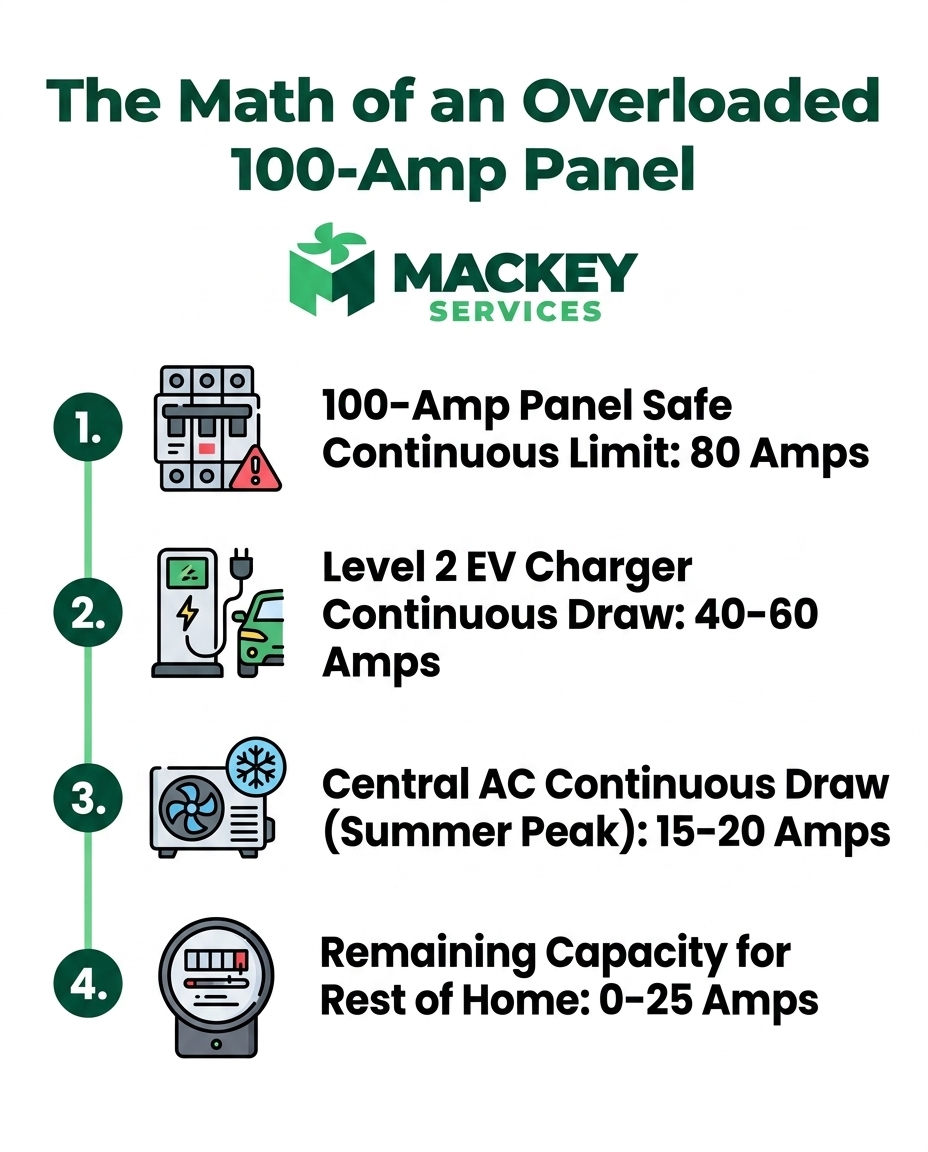
Under the NEC's strict safety guidelines, known as the 80% rule, an electrical panel or circuit can only safely handle 80% of its total rated capacity for continuous loads. This means a 100-amp panel can only safely handle 80 amps of continuous electrical draw at any given time. Pushing past this 80% threshold for extended periods causes the internal metal components of the panel and the wiring insulation to heat up to dangerous temperatures.
When factoring in the massive draw of charging an electric vehicle, the math quickly reveals the limitations of an older system. You are looking at a hard limit of a 100-amp total capacity vs 40-60 amp continuous EV draw. If your charger is pulling 60 amps continuously, you only have 20 amps of safe continuous capacity left for the entire rest of your house. Homeowners often wonder about workarounds, such as using a dryer outlet to charge your EV, but high-draw charging ultimately demands a dedicated, robust circuit that a 100-amp panel simply cannot support.
How EV Chargers Consume Power
Not all electrical appliances consume power in the same way. Understanding the difference between intermittent and continuous loads highlights exactly why EV chargers are so demanding.
- Intermittent loads: Appliances like microwaves, toasters, or hair dryers pull a high amount of power, but only for a few minutes. The wiring has plenty of time to cool down after the device shuts off.
- Continuous loads: An EV charger pulls maximum power for several hours at a time, usually overnight. This sustained draw generates significant, compounding heat within the electrical panel, the circuit breaker, and the wiring running through your walls.
Because of this sustained heat generation, the NEC mandates that the circuit must be rated for 125% of the charger's maximum draw. If your EV charger draws 40 amps, it must be installed on a 50-amp circuit breaker with appropriately sized wiring to prevent overheating and potential fire hazards.
| Appliance Type | Load Classification | Typical Amperage Draw | Heat Generation Risk |
|---|---|---|---|
| Microwave Oven | Intermittent | 10-15 Amps | Low (runs for minutes) |
| Electric Toaster | Intermittent | 10-12 Amps | Low (runs for minutes) |
| Central Air Conditioner | Continuous | 15-20+ Amps | High (runs for hours) |
| Level 2 EV Charger | Continuous | 40-60 Amps | Very High (runs for 3+ hours) |
The Gulf Coast Climate Factor: When Heavy AC Usage Meets EV Charging
Electrical capacity is not just about the appliances inside your home; it is heavily influenced by where you live. In regions with extreme summer heat, central air conditioning systems act as another massive continuous electrical load that directly competes with your new vehicle.
For homeowners in Dickinson and surrounding areas, the brutal late-summer heat makes a 100-amp panel upgrade a mathematical necessity. Our electricians routinely explain that during the August peak cooling season, central AC units run almost constantly just to maintain basic indoor comfort against the intense Gulf Coast humidity. Because these cooling cycles last well over three hours during the hottest parts of the day and into the evening, your HVAC system becomes a primary continuous load.
A standard central air conditioning system can draw 15 to 20 amps continuously. If we apply the 80% rule to a 100-amp panel, you have 80 amps of safe continuous capacity. Subtract the 20 amps for the AC, and you are left with 60 amps. If your Level 2 charger requires 40 to 60 amps, your panel is instantly maxed out.
This simultaneous demand leaves absolutely zero available capacity for other essential household appliances. If your AC is running and your car is charging, what happens when the electric water heater kicks on? What happens if the refrigerator compressor starts, or someone turns on the oven to cook dinner? The mathematical reality is that a 100-amp panel cannot support the cumulative demands of Gulf Coast climate control and modern electric vehicle charging.
Warning Signs of an Overloaded 100-Amp System
Attempting to force too much power through an undersized electrical panel is not just an inconvenience; it is a severe safety risk. When a panel exceeds its designed capacity, the system relies on circuit breakers to cut the power before the wires melt or catch fire. Frequent tripped breakers are the system's primary failsafe mechanism, actively warning you that the electrical demand is too high.
During the late-summer heatwaves we frequently experience here in Texas, this issue becomes incredibly apparent. Just recently, as families were transitioning back to school in August, our Mackey Services technicians responded to a local homeowner whose air conditioner kept tripping the circuit breakers. When our team arrived to inspect the system, we found and repaired a dangerous short circuit caused by the overloaded electrical demand. This type of failure highlights a pattern we see often: heavy summer loads already stress older systems to their breaking point, even before adding new, high-demand technology like an EV charger.
Continuous overloading can lead to degraded wire insulation, damaged sensitive electronics, and severe fire hazards due to overheating connections inside the walls. If you are noticing signs of electrical stress, your home requires an immediate professional electrical panel upgrade.
Watch for these critical warning signs of an overloaded panel:
- Tripping breakers: If resetting a breaker becomes a weekly or daily routine, the circuit is pulling more amperage than it can safely handle.
- Dimming or flickering lights: When a heavy appliance (like an AC compressor or EV charger) turns on and the lights dim, it means the system is struggling to distribute enough voltage.
- Warm or hot breaker switches: A circuit breaker should never feel hot to the touch. Heat indicates that the internal components are operating at or beyond their maximum continuous capacity.
- Buzzing sounds from the panel: A faint humming or buzzing noise from the breaker box often points to a loose connection or a breaker that is failing to trip under a heavy load.
- Burning odors: Any smell of melting plastic or ozone near your electrical panel is an emergency sign of actively melting wire insulation.
How Professionals Calculate Your Home's True Electrical Load
Because the consequences of overloading a panel are so severe, determining your home's capacity is not something that can be done with guesswork or simple addition. A proper load calculation evaluates the entire home's electrical footprint to determine the true peak demand of the household.
At Mackey Services, our expert electricians perform thorough, code-compliant load calculations to ensure the electrical system can safely handle modern high-draw demands without risking tripped breakers or fire hazards. This calculation follows the strict guidelines set forth in NEC Article 220, which dictates exactly how different types of electrical loads must be weighed and measured.
The professional load calculation process involves several critical steps:
- Measuring General Lighting and Receptacle Loads: Professionals start by calculating the total square footage of the home. The NEC assigns a specific volt-ampere (VA) requirement per square foot to account for basic lighting and standard wall outlets.
- Accounting for Small Appliance Circuits: Kitchens, pantries, and dining rooms require dedicated 20-amp circuits for small appliances like blenders and coffee makers. These are factored into the baseline calculation at a specific mandated value.
- Evaluating Fixed Appliances: Every heavy appliance that is permanently installed—such as electric ranges, electric dryers, water heaters, and dishwashers—must be added to the calculation based on their specific nameplate power ratings.
- Calculating HVAC and Continuous Loads: The calculation compares the heating load against the cooling load (since they typically do not run simultaneously) and takes the larger of the two. Finally, continuous loads, like the proposed Level 2 EV charger, are factored in at 125% of their actual draw to account for heat generation.
This mathematical assessment provides definitive proof of whether an existing panel can safely support additional demands. Guessing at your electrical capacity can lead to severe code violations, failed municipal inspections, and dangerous safety risks. Only a licensed professional can perform this calculation accurately.
Why a 200-Amp Heavy-Up is a Safety Standard, Not a Luxury
When our load calculation proves that a 100-amp panel is insufficient, upgrading to a 200-amp service—often referred to as a heavy-up—becomes a necessary step. This upgrade is not an unnecessary luxury or a simple convenience; it is a critical safety standard designed to protect your home from electrical fires and equipment failure.
Upgrading to a 200-amp service effectively doubles the home's total electrical capacity. This massive increase provides the necessary headroom for modern electrical demands, ensuring that simultaneous continuous loads can operate safely. With a 200-amp panel, you can confidently run your central air conditioning during a brutal late-summer heatwave while simultaneously charging your electric vehicle overnight, without ever worrying about exceeding the 80% safety threshold.
Furthermore, a modernized panel prepares the home for future high-draw additions. As homes transition away from fossil fuels, electrical demands will only increase. Whether you plan to take advantage of generic federal tax credits for an electric heat pump installation, add an induction cooktop, or schedule a backup generator installation with our team, a 200-amp panel provides the foundational infrastructure required to support these upgrades. Investing in the proper electrical infrastructure protects your home, keeps your family safe, and ensures your expensive electric vehicle charges reliably every single time you plug it in.
Frequently Asked Questions About EV Chargers and Panel Upgrades
Can a 100 amp panel handle an EV charger?
In our experience, a 100-amp panel can only handle an EV charger under very specific, low-load conditions. If the home has gas heating, gas appliances, and no central air conditioning, there might be enough capacity for a lower-amperage EV charger. However, for most modern homes with electric appliances and central HVAC systems, a 100-amp panel does not have the necessary capacity. A professional load calculation is required to know for certain.
Do I need a 200 amp panel for a Level 2 EV charger?
In the vast majority of cases, yes, a 200-amp panel is required to safely support a Level 2 EV charger alongside normal household appliances. Because Level 2 chargers pull a massive continuous load for several hours, they quickly consume the available capacity of older 100-amp systems. Upgrading to 200 amps provides the necessary safety buffer to prevent overheated wires and tripped breakers.
How many amps does a Level 2 charger use continuously?
A typical Level 2 EV charger uses between 32 and 60 amps of continuous power, depending on the specific model and the vehicle's onboard charging capabilities. Because the National Electrical Code classifies EV charging as a continuous load, the circuit breaker must be sized at 125% of the charger's actual draw. Therefore, a charger pulling 40 amps requires a dedicated 50-amp circuit breaker to operate safely.
What happens if I overload my electrical panel?
If you overload your electrical panel, the immediate result is usually a tripped circuit breaker, which shuts off power to prevent the wires from overheating. If the breaker fails to trip or if the panel is continuously pushed past its safe limits, the internal wiring insulation can melt. This leads to severe short circuits, permanent damage to expensive appliances, and a very high risk of electrical fires hidden inside your walls.
Is a load calculation required by code before installing an EV charger?
Yes, municipal building codes and the National Electrical Code (NEC) require a formal load calculation before adding significant new electrical loads like a Level 2 charger. This calculation proves to local inspectors that the existing electrical service can safely handle the new equipment. Skipping this calculation can result in code violations, failed safety inspections, and potential issues with your homeowner's insurance.
Safely Power Your EV Charging Station
Understanding your home's electrical capacity is the very first step to safely enjoying the convenience of your new electric vehicle. The math is clear: balancing heavy summer air conditioning loads with the massive continuous draw of an EV charger is simply too much for an aging 100-amp panel to handle.
A professional evaluation removes the guesswork, ensures your installation meets all local safety codes, and protects your property from severe electrical hazards. Reach out to local experts to learn more about your home's current capabilities, request a professional load calculation, and explore your panel upgrade options so you can charge your vehicle with complete confidence.
Ready for a better day?
One call handles it all — HVAC, electrical, and generators across the Texas Gulf Coast. Less to pay. Better day. That's the Mackey way.
Mon–Fri: 7 AM – 8 PM · Sat: 8 AM – 5 PM · Licensed & insured · #TACLA 112769C · #TECL 558211