
Sizing Standby Generators for Texas Gulf Coast Hurricane Outages
Why we prioritize sizing standby generators for Texas Gulf Coast hurricane outages over portable units. See what your central AC truly demands to stay running.
The Myth of the 'Big Enough' Portable Generator
Buying the biggest portable unit at the hardware store might seem like a quick fix, but when it comes to sizing standby generators for Texas Gulf Coast hurricane outages, a heavy-duty portable generator rarely has the muscle to run your central air conditioner. A common misconception among homeowners is that if the running wattage listed on their AC's faceplate matches the output of a portable generator, the system will work perfectly. The reality is far more complex, and discovering your portable unit cannot handle the load during a multi-day blackout is a stressful, uncomfortable experience.
If you are exploring generator services to keep your family safe and comfortable, you have likely reached a critical decision point: trying to make a portable unit work, or investing in dedicated Kohler standby generators. When the July hurricane season arrives and the power grid fails, you need a cooling solution that actually works, rather than one that constantly trips your breakers. To make the right choice for your home, you have to look past the basic wattage numbers and understand exactly what your air conditioning system demands to operate.
Why Central Cooling is a Necessity, Not a Luxury
In many parts of the country, losing air conditioning for a few days is merely an inconvenience. In Dickinson TX and the Texas Gulf Coast, it rapidly becomes a serious health and safety hazard. When a severe summer storm knocks out the power, the cloud cover often clears the next day, leaving the region baking under intense sunlight with humidity levels frequently exceeding 90 percent. Without a functioning central cooling system, your home stops being a shelter and starts acting like a greenhouse.
Rapid temperature spikes: Modern homes are built with tight insulation to keep conditioned air inside. However, once the AC stops running, that same insulation traps heat and humidity. Within just a few hours of an outage, indoor temperatures can climb into the upper 80s or low 90s. For the elderly, young children, or anyone with respiratory issues, these conditions are physically dangerous.
The hidden threat of moisture: Temperature is only half the battle. Your air conditioner also serves as your home's primary dehumidifier. When you lose power for multiple days on the Texas Gulf Coast, the stagnant, heavily saturated air creates the perfect breeding ground for rapid indoor mold growth. Moisture settles into drywall, carpets, and upholstery. By the time the utility company restores the grid, you could be facing extensive property damage and costly remediation.
Because of these severe climate realities, calculating your backup power needs cannot be treated as a luxury upgrade. It is a fundamental property protection measure. Relying on a few box fans powered by an undersized generator simply will not combat the crushing heat and moisture of a coastal summer.
The Hidden Hurdle: Starting Watts and Locked Rotor Amps (LRA)
To understand why portable generators struggle with central cooling, you have to understand the difference between running watts and starting watts. Running watts refer to the continuous power your air conditioner needs to keep operating once it is already turned on. Starting watts, on the other hand, represent the massive, instantaneous surge of electricity required to wake the system up and get the heavy compressor motor spinning.
This initial surge is measured in Locked Rotor Amps (LRA). When your AC first kicks on, the compressor is at a dead stop (locked). To overcome the physical resistance of the internal mechanical components and the pressurized refrigerant gas, the motor pulls an enormous amount of electrical current for a fraction of a second. For a standard 3-to-5 ton central AC unit, this starting spike is typically two to three times higher than the running wattage.
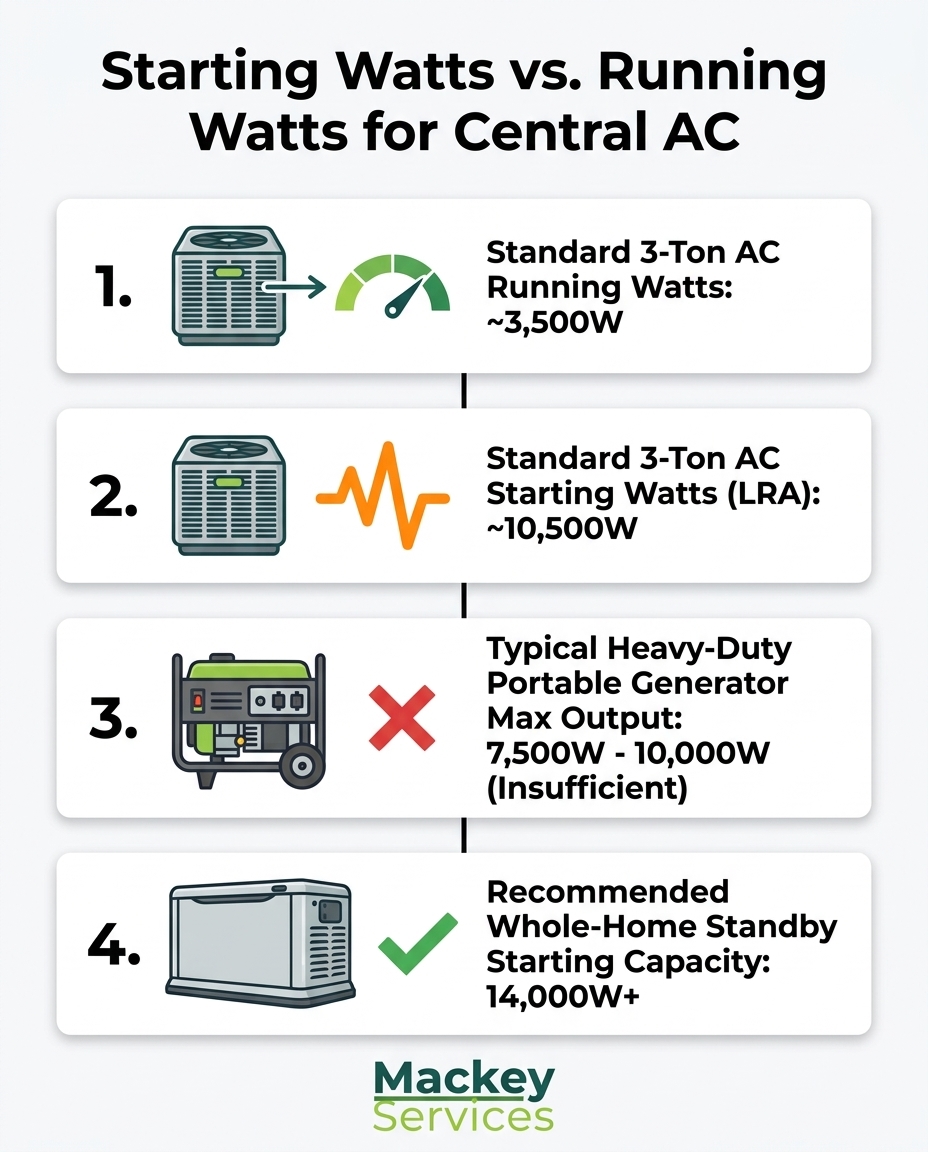
- The math in action: A typical 3-ton air conditioner might only require 3,500 watts to run continuously. However, based on its LRA rating, it could demand over 10,500 watts just to cycle on.
- The portable generator problem: Most heavy-duty portable generators max out between 7,500 and 10,000 starting watts. When the 3-ton AC tries to pull 10,500 watts, the portable unit is instantly overloaded. The generator's breaker trips, the engine bogs down, and your house stays hot.
This massive power draw is the primary reason homeowners find themselves frustrated during the July hurricane season. They purchase a portable generator thinking it has plenty of capacity for a 3,500-watt running load, completely unaware of the hidden LRA hurdle.
How Extreme Heat Amplifies Power Demand
The electrical strain on your generator gets even worse when the weather is at its hottest. Compressors work significantly harder when ambient temperatures are extreme. As the outdoor temperature climbs past 95 or 100 degrees, the pressure of the refrigerant inside your AC system increases. These higher head pressures require the compressor motor to generate even more electrical torque to overcome the resistance during startup. An air conditioner that starts fine on a mild 75-degree morning might pull an even higher LRA surge during a sweltering afternoon outage, pushing an already strained portable generator past its breaking point.
Portable vs. Whole-Home Standby: A Side-by-Side Comparison
When preparing for a multi-day outage in Dickinson TX and the Texas Gulf Coast, you need a clear picture of what each type of generator can actually accomplish. While portable units have their place for running a few essential items, comparing them directly against a standby system reveals stark differences in capability, safety, and convenience.
| Feature | Heavy-Duty Portable Generator | Whole-Home Standby Generator |
|---|---|---|
| Power Capacity | Usually maxes out around 10,000 starting watts. Insufficient for the LRA spike of a standard central AC. | Ranges from 14,000 to 26,000+ watts. Specifically engineered to handle heavy motor loads and massive starting spikes. |
| Activation & Transfer | Requires manual setup. You must roll it out, plug in heavy extension cords, or manually flip a transfer switch in the dark. | Equipped with an automatic transfer switch (ATS). Detects the outage and restores power automatically within seconds. |
| Fuel Source & Reliability | Runs on gasoline or small propane tanks. Requires you to scavenge for fuel at local gas stations during widespread outages. | Connects directly to your home's natural gas line or large liquid propane tank for continuous, uninterrupted operation. |
| Cooling Viability | Limited to running small window units or portable ACs in a single room. Cannot cool the whole house. | Easily powers your central HVAC system, keeping the entire home cool, dry, and safe from mold growth. |
The comparison makes the reality clear: if your goal is to maintain a normal, safe living environment with central cooling during a severe storm, a portable generator falls short. Standby systems are purpose-built to handle the heavy lifting that keeps your home habitable.
Protecting Your Compressor from Voltage Drops
Undersizing a generator isn't just about the inconvenience of a tripped breaker; it poses a severe mechanical risk to your HVAC equipment. When a portable generator tries to start a heavy motor but cannot supply enough starting wattage, it creates a voltage drop, commonly known as a brownout condition. This is one of the most dangerous scenarios for an electrical motor.
When voltage drops, the compressor motor tries to compensate by pulling in even more electrical current (amperage) to keep spinning. This excessive amperage generates intense heat inside the motor windings. If the compressor is subjected to these low-voltage starts repeatedly, the insulation around the electrical windings will melt, causing the motor to short out and die. A ruined compressor is a catastrophic failure that often requires completely replacing the outdoor unit—a devastating and entirely avoidable expense immediately following a storm.
This is why proper sizing requires more than a quick Google search. Because Mackey Services brings dual expertise in both HVAC systems and electrical work, we understand exactly how these two systems interact. Our team doesn't just look at the electrical panel; we evaluate the precise draw of your central air conditioning system to ensure the generator we recommend will protect your compressor from dangerous voltage drops. Having a professional calculate the exact electrical draw is the only way to safeguard your most expensive home appliances.
Factoring in Your Essential Appliance Load
Your central air conditioner does not operate in a vacuum. During a July hurricane season outage, you will inevitably need to run other critical items in your home simultaneously. Every device you turn on consumes a portion of your generator's total capacity, leaving less available power to handle the AC's massive starting spike.
Common essential draws include:
- Refrigerators and freezers: Essential for preventing food spoilage, these appliances also have compressors that require starting surges.
- Medical devices: CPAP machines, oxygen concentrators, and refrigerated medicine storage require uninterrupted, clean power.
- Well pumps: If you live in an area without municipal water, your well pump needs significant power to maintain your home's water supply.
- Basic lighting and communication: Keeping a few lights on, charging phones, and running the Wi-Fi router.
If your generator is already dedicating 2,000 watts to keep the refrigerator and a few lights running, a portable unit will have absolutely no reserve capacity left when the thermostat calls for cooling. Standby generators solve this problem through sheer capacity and intelligent load management. A properly sized standby unit tied into your electrical system can handle the baseline running watts of your household while keeping plenty of reserve power ready to absorb the AC's starting spike without missing a beat.
Making the Right Investment Before the Next Storm
Attempting to cool a whole home with a portable generator is a losing battle against physics. Between the massive Locked Rotor Amps required to start a compressor, the extreme heat amplifying the power demand, and the need to run other household appliances simultaneously, portable units simply cannot keep up. They are excellent tools for camping or running a few power tools, but they are not designed for whole-home survival during a multi-day blackout.
Investing in a standby system is about securing long-term value and property protection. It ensures your home remains safe from heat exhaustion and moisture damage, while automatically managing the heavy electrical loads your HVAC system requires. If you are weighing the benefits of installing a backup generator, the peace of mind that comes from knowing your cooling system will activate instantly is at the top of the list. We strongly urge homeowners to finalize their sizing calculations and secure their installations before the peak of the July hurricane season forces the issue.
Frequently Asked Questions About Generator Sizing for Central AC
Can a portable generator run a central air conditioner?
In most cases, a standard portable generator cannot safely run a central air conditioner. While a portable unit might produce enough watts to keep the AC running, it usually lacks the massive surge capacity required to start the compressor. Attempting to force a portable unit to start a heavy central AC can cause severe voltage drops, tripping the generator's breaker or permanently damaging the air conditioner's motor. For central cooling, a dedicated standby generator is the recommended standard.
How big of a generator do I need to run a 4-ton AC?
To run a 4-ton central AC, you typically need a whole-home standby generator rated for at least 20,000 to 24,000 watts. A 4-ton unit requires a massive amount of starting power—often exceeding 13,000 watts just to turn on the compressor. You must also factor in the power needed for the indoor blower motor, plus any other essential appliances you plan to run simultaneously in the house. A professional electrical assessment is the only way to get an exact sizing recommendation for your specific equipment.
What is the starting wattage of a central AC unit?
The starting wattage of a central AC unit is usually two to three times higher than its continuous running wattage. For a standard 3-ton air conditioner, the running wattage might be around 3,500 watts, but the starting wattage can easily spike to 10,500 watts or more for a fraction of a second. This surge is necessary to overcome the mechanical resistance of the compressor and the pressurized refrigerant gas inside the system.
Will a 22kw generator run my whole house?
Yes, for most average-sized homes in Dickinson TX and the Texas Gulf Coast, a 22kW standby generator is sufficient to power the entire house, including a central air conditioner. A 22kW unit provides enough starting capacity to handle the heavy surge of an AC compressor while leaving plenty of reserve power for refrigerators, lights, televisions, and well pumps. However, homes with multiple central AC units, electric furnaces, or large electric water heaters may require a larger unit or specialized load-management modules.
How do I find the Locked Rotor Amps (LRA) on my air conditioner?
You can find the Locked Rotor Amps (LRA) rating printed directly on the manufacturer's data plate, which is usually a metal or heavy foil sticker located on the side of your outdoor condenser unit. Look for a line labeled "LRA" followed by a number, such as "LRA 73." To estimate the starting wattage, you can multiply the LRA by your home's voltage (typically 240 volts). If the data plate is worn or unreadable, an HVAC technician can look up the exact specifications based on your system's model number.
Get Expert Help Sizing Your Standby Generator Today
You do not have to guess at your air conditioner's starting wattage or cross your fingers hoping a portable unit will survive the next major storm. Protecting your home and your HVAC equipment requires precision, and the stakes in Dickinson TX and the Texas Gulf Coast are simply too high to leave to chance. Rely on local professionals who understand both the electrical demands of your home and the mechanical needs of your central cooling system. Reach out today to schedule a comprehensive assessment, calculate your exact load requirements, and confidently choose a standby generator that will keep your family safe and comfortable no matter what the weather brings.
Ready for a better day?
One call handles it all — HVAC, electrical, and generators across the Texas Gulf Coast. Less to pay. Better day. That's the Mackey way.
Mon–Fri: 7 AM – 8 PM · Sat: 8 AM – 5 PM · Licensed & insured · #TACLA 112769C · #TECL 558211