
The Repair-or-Replace Math for R-22 Air Conditioners in 2026
Understand the repair-or-replace math for R-22 air conditioners in 2026 before paying steep premiums for scarce refrigerant. Decide with confidence today.
Facing a Late-Summer Breakdown? The 2026 Decision Point
Are you currently weighing a steep repair quote for an aging AC unit that has stopped cooling, forcing you to calculate the repair-or-replace math for R-22 air conditioners in 2026? It is a frustrating position for any homeowner. Here at Mackey Services, we see this scenario play out constantly across Dickinson TX as families transition into the back-to-school season. You rely on your cooling system to provide a sanctuary from the relentless heat, but when a legacy unit suffers a catastrophic failure, you are suddenly faced with a complex choice. The breakdown usually happens at the worst possible time, heavily influenced by August 2026 late-summer wear after the system has been running almost non-stop for months.
If you find yourself in this situation, you are standing at a critical decision point. You must choose between paying an exorbitant premium for increasingly scarce R-22 refrigerant just to limp through the rest of the season, or investing those funds into a modern, highly efficient cooling system. Making this choice requires looking past the immediate panic of a hot house and evaluating the long-term viability of your equipment. For comprehensive HVAC services and guidance on air conditioning replacement, our team believes that understanding the objective criteria behind this decision is your best defense against throwing good money after bad.
Key factors to consider immediately:
- The age of your system: Most R-22 units are now well over a decade old, pushing past their expected mechanical lifespan.
- The frequency of recent repairs: If you have called a technician more than once in the past two years, the system is actively degrading.
- The severity of the current failure: A failed capacitor is a minor fix; a ruptured coil leaking obsolete refrigerant is a major structural failure.
The 2026 Reality of R-22 Refrigerant Scarcity
To make an informed decision, you must first understand why repairing an older system has become so prohibitively difficult. The Environmental Protection Agency (EPA) officially banned the production and import of virgin R-22 refrigerant in 2020. This phaseout was driven by the severe environmental impact of hydrochlorofluorocarbons (HCFCs), which are known ozone-depleting substances. The industry was given time to transition, but as we navigate 2026, the grace period is entirely over. The market has fundamentally shifted.
Our technicians constantly remind homeowners that today, there is no "new" R-22 being manufactured. Every single ounce of R-22 used to service legacy systems must come from recovered and reclaimed stockpiles. When comparing legacy R-22 systems vs modern R-454B units, the most glaring difference is resource availability. Modern systems use refrigerants that are actively produced and widely accessible. Legacy systems rely on a finite, rapidly shrinking pool of recycled chemicals. Consequently, "topping off" a leaking system is no longer a standard, inexpensive maintenance step. It is a highly restricted, premium service that acts as a temporary bandage rather than a permanent solution.
Why Reclaimed Supplies Are Dwindling
The mechanics of refrigerant reclamation explain why supplies are disappearing. When an old R-22 system is decommissioned, licensed technicians recover the remaining refrigerant. It is then sent to specialized facilities to be filtered, purified, and tested before it can be resold as reclaimed R-22. However, this supply chain depends entirely on people retiring old systems that still have refrigerant left in them.
The supply and demand problem:
- Fewer legacy units exist: As more homeowners upgrade to modern systems, the pool of old units available for recovery shrinks every year.
- Leaks deplete the source: Systems that are replaced because of severe leaks have very little R-22 left to recover, meaning less refrigerant enters the reclamation pipeline.
- Increasing demand for a shrinking resource: The homeowners who stubbornly hold onto their failing R-22 units are all competing for a smaller and smaller stockpile, driving the premium sky-high.
The Conceptual Math: Calculating Diminishing Returns
When assessing whether to repair or replace, our team at Mackey Services relies on objective formulas rather than guesswork. The most reliable benchmark is the "5000 rule." This conceptual math involves multiplying the age of the equipment by the severity or scale of the repair. If the resulting number exceeds 5000, repairing the unit offers diminishing returns, and replacement is the financially sound choice. For example, applying a major repair scale to a 15-year-old unit will almost always cross that threshold, indicating that the investment would be better spent on new technology.
Beyond the immediate repair severity, you must factor in the compounding effect of efficiency losses. A legacy system that was rated at 10 SEER when it was installed fifteen years ago has suffered significant mechanical degradation. Today, it might be operating at a fraction of that efficiency, meaning you are paying substantially more in monthly utility bills for far less cooling power. Sinking funds into patching obsolete technology means accepting those high utility costs indefinitely, whereas investing in modern reliability pays dividends in monthly energy savings.
There is also the critical risk of sequential failures. Fixing a refrigerant leak today does not reset the clock on the rest of the system. The blower motor, the electrical relays, and the compressor are all still aging components. We recently worked with a local Dickinson homeowner who faced a similar dilemma when their condenser needed replacement; rather than simply pushing a quick fix, our responding technician patiently explained the technical details and the underlying math of the system's age. This transparent approach ensured our customer was fully comfortable with the repairs and understood the long-term trajectory of their equipment. For proactive steps to monitor your system's health, reviewing a reliable 24-hour AC maintenance guide can help you spot these sequential warning signs early.
Evaluating the True Scope of a Refrigerant Leak
A common misconception is that air conditioners naturally "use up" refrigerant over time. This is false. Air conditioning systems are entirely closed loops. The refrigerant cycles continuously between a liquid and a gas state, absorbing heat from inside your home and releasing it outside.
Our repair crews often encounter systems with a low charge, which means there is a physical hole in the copper lines or the coils. Simply adding scarce, reclaimed R-22 without locating and brazing the leak is a wasteful measure. The expensive refrigerant will inevitably leak out again, leaving you right back where you started. When comparing legacy R-22 systems vs modern R-454B units, modern installations benefit from pristine, factory-sealed coils that do not suffer from the microscopic corrosion that plagues decade-old copper.
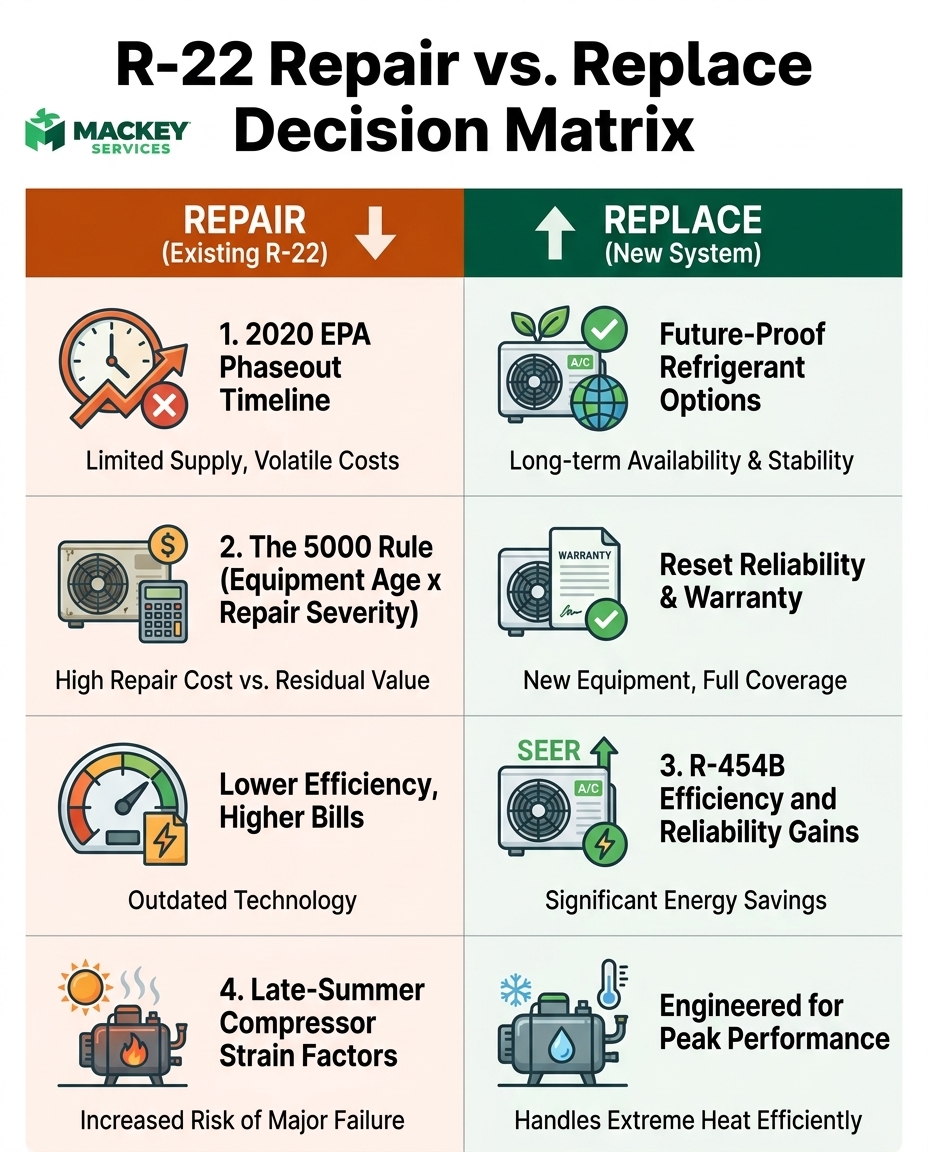
How Extreme Heat Accelerates R-22 Compressor Failure
The timing of a system failure is rarely a coincidence. In our experience keeping Gulf Coast homes comfortable, by the time late summer arrives, your air conditioning unit has been enduring immense mechanical strain for months. The compressor, which acts as the heart of the system by pumping refrigerant through the lines, is particularly vulnerable to this cumulative wear. August 2026 late-summer wear means the internal components have been expanding and contracting under high temperatures continuously, weakening seals and stressing electrical connections.
What many homeowners do not realize is that the refrigerant itself plays a crucial role in cooling the compressor motor. The cold gas returning from the indoor evaporator coil passes over the compressor windings to keep them from overheating. When an R-22 system develops a leak and the refrigerant charge drops, the compressor loses its primary cooling mechanism. It begins to run hotter and longer, desperately trying to meet the thermostat setting. This friction and heat rapidly degrade the lubricating oils inside, leading directly to catastrophic mechanical seizing or electrical burnout.
This mechanical reality is uniquely punishing in our specific regional climate. Serving Dickinson TX, we know firsthand that brutal summer heat is coupled with extreme humidity. An air conditioner does not just lower the temperature (sensible heat); it must also extract heavy moisture from the air (latent heat). A properly charged system is required for reliable latent heat removal. When an R-22 system is leaking and undercharged, the evaporator coil cannot reach the precise temperature needed to pull humidity out of the air. The result is a home that feels cold but damp, or worse, hot and sticky, creating severe indoor comfort and air quality crises. Staying ahead of this strain requires a dedicated routine maintenance plan to ensure coils are clean and airflow is unobstructed before the heaviest heat arrives.
Transitioning from Legacy R-22 to Modern R-454B Standards
When the math dictates that replacement is the only logical path, understanding the technology you are transitioning to helps ease the process. The HVAC industry has moved far beyond the capabilities of legacy R-22 systems. Modern refrigerants, including the widely used R-410A and the newer R-454B standard, operate at significantly higher pressures than R-22. Because of this intense pressure difference, you cannot simply flush an old system and put new refrigerant into it. The existing copper lines, the evaporator coil, and the compressor would rupture under the strain. An entirely new equipment configuration is required.
The silver lining to this required equipment upgrade is the massive leap in energy efficiency. When comparing legacy R-22 systems vs modern R-454B units, the difference in SEER (Seasonal Energy Efficiency Ratio) ratings is staggering. Modern systems frequently utilize variable-speed compressors that adjust their cooling output in tiny increments, rather than blasting on and off at full capacity. For example, our installation team recently replaced two aging units during late summer for a homeowner who suffered from severe asthma, upgrading them to a modern 19-SEER variable-speed system paired with HEPA filtration. The transition not only vastly improved their indoor air quality but also resulted in a remarkable 30% reduction in overall energy consumption.
Why R-454B is the New Benchmark
The industry is currently undergoing another transition, moving toward R-454B. This shift is driven by the need for refrigerants with a drastically lower Global Warming Potential (GWP). Investing in the latest R-454B standard future-proofs your home against upcoming regulatory changes, ensuring your new system will be easily serviceable for decades to come. Additionally, upgrading to high-efficiency heat pumps and AC installations often qualifies homeowners for generic federal tax credits and utility rebates. While you should always verify current programs with your utility provider or a tax professional, these incentives can help offset the initial investment.
| Feature | Legacy R-22 Systems | Modern R-454B Systems |
|---|---|---|
| Refrigerant Availability | Restricted to dwindling reclaimed stockpiles | Widely produced and fully accessible |
| Operating Pressure | Low pressure (obsolete component design) | High pressure (requires modern, robust coils) |
| Energy Efficiency | Degraded SEER ratings, high utility draw | High SEER2 ratings, variable-speed savings |
| Environmental Impact | High ozone depletion potential | Low Global Warming Potential (GWP) |
Making the Transition Manageable with Honest Guidance
Navigating the end of an air conditioner's lifespan is stressful, especially when a sudden breakdown occurs during a relentless heatwave. The urgency of a hot house can make homeowners feel pressured into making rapid, uninformed decisions. This is where working with a trusted local professional becomes your greatest asset. At Mackey Services, our primary focus is on providing transparent, objective assessments rather than relying on high-pressure sales tactics. We believe a true professional will always explain the "why" behind a replacement recommendation, walking you through the conceptual math and the physical condition of your equipment so you can see the reality for yourself.
Using objective criteria, like the 5000 rule and measurable efficiency metrics, protects homeowners from throwing good money after bad. The primary goal is to save you money over the long term. Patching a failing system with premium reclaimed refrigerant might seem like a quick fix, but it rarely holds up against the brutal demands of the Dickinson TX climate. When the data clearly shows that a unit is beyond saving, transitioning to a new system is the most responsible financial move.
To ensure that these necessary upgrades do not cause undue financial strain, accessible solutions are critical. Exploring HVAC financing options allows homeowners to break up the investment into manageable monthly portions, preserving cash flow while immediately restoring home comfort. Furthermore, relying on professional installations guarantees that your new, high-efficiency system meets all current city codes, manufacturer specifications, and safety requirements, giving you total confidence in your home's cooling infrastructure.
2026 R-22 Phaseout and Replacement FAQs
Can you still get R-22 refrigerant in 2026?
Yes, but it is entirely limited to reclaimed and recovered supplies. The EPA banned the production and import of virgin R-22 in 2020. Because the industry now relies solely on recycling refrigerant from decommissioned legacy units, the available stockpiles are severely dwindled, making it a highly restricted and premium resource.
What happens if my R-22 AC leaks?
If an R-22 system leaks, it loses its ability to cool your home and properly cool the compressor motor, leading to rapid overheating. Because AC systems are closed loops, a low charge means a physical hole must be located and sealed by a licensed professional before any scarce reclaimed refrigerant can be added.
Is it illegal to repair an R-22 air conditioner?
It is not illegal to repair an existing R-22 system, but it is illegal to vent the refrigerant into the atmosphere or to manufacture new R-22. Only licensed professionals with EPA certification can legally handle, recover, and charge the system using the dwindling supplies of reclaimed refrigerant.
Can I put R-410A or R-454B in an older R-22 system?
No, you absolutely cannot mix refrigerants or use modern refrigerants in a legacy system. Modern refrigerants operate at significantly higher pressures than R-22. Attempting a "drop-in" replacement would cause the older compressor, coils, and copper lines to rupture or fail catastrophically.
What is the new refrigerant replacing R-410A?
The HVAC industry is transitioning to R-454B (and similar A2L refrigerants) as the new benchmark. This shift is mandated to reduce Global Warming Potential (GWP) and improve overall environmental safety, while also allowing manufacturers to design highly efficient, variable-speed cooling systems.
How does the 5000 rule apply to aging R-22 systems?
The 5000 rule is a conceptual formula where you multiply the age of the equipment by the severity scale of the required repair. If the resulting number is greater than 5000, repairing the unit offers diminishing returns, and replacing the system is considered the more financially sound, long-term decision.
Why do R-22 systems fail more frequently during late-summer heatwaves?
August 2026 late-summer wear means the system's components have been expanding, contracting, and running continuously for months. This immense mechanical strain, combined with the extreme heat, exploits any weaknesses in aging seals or electrical relays, often triggering a catastrophic failure just when the unit is working its hardest.
Secure Your Home's Comfort with a Modern Cooling Solution
While replacing a central air conditioning system is undeniably a major decision, moving away from obsolete technology is the most financially sound choice you can make for the long term. Sinking funds into scarce reclaimed refrigerant offers rapidly diminishing returns, especially when an aging compressor is already showing signs of severe wear. As your local Dickinson TX comfort specialists, we believe you deserve a system that operates efficiently and dependably.
You do not have to navigate this complex transition alone. Our team at Mackey Services is ready to provide a clear, objective breakdown of your options to satisfy your immediate end-of-season cooling needs without the stress of high-pressure sales. Talk to our local experts today for a transparent assessment of your aging system, and take the first step toward securing lasting, energy-efficient comfort for your home.
Ready for a better day?
One call handles it all — HVAC, electrical, and generators across the Texas Gulf Coast. Less to pay. Better day. That's the Mackey way.
Mon–Fri: 7 AM – 8 PM · Sat: 8 AM – 5 PM · Licensed & insured · #TACLA 112769C · #TECL 558211