
Diagnosing the 'Always On' AC During Dickinson's July Heatwaves
Why your system runs non-stop in 100-degree heat. See the exact criteria for diagnosing the 'always on' AC during Dickinson's July heatwaves and avoid panic.
Is It Normal for Your AC to Run Non-Stop in the Dickinson Heat?
Are you stuck diagnosing the 'always on' AC during Dickinson's July heatwaves, wondering if your system is about to fail completely? Is your air conditioner running for hours on end without ever shutting off? When the thermostat reads 78 degrees but the machine outside sounds like it has been humming since sunrise, it is easy to assume the worst. You hear that fan spinning all afternoon and immediately worry about a massive energy bill or a total mechanical breakdown. However, diagnosing continuous operation starts with understanding one simple fact: an air conditioner that never cycles off is not automatically a broken air conditioner.
To get the most out of your HVAC system, you need to know how it behaves under extreme environmental stress. When 100-degree weather hits the region, your cooling equipment is forced to work at its absolute maximum capacity. The immediate panic of hearing the unit run for four, five, or six hours straight is a common reaction for homeowners. We are conditioned to think that appliances should run in short, efficient bursts. If the microwave or the washing machine ran all day, something would be terribly wrong. Air conditioning, however, operates on a different set of physical principles.
The Fear of the Non-Stop Cycle
The psychological toll: Listening to a machine run constantly creates a sense of impending doom. You might find yourself standing near the air return, listening for strange noises, or hovering over the thermostat waiting for the blessed click that signals the end of a cycle. This anxiety often leads to unnecessary emergency service calls.
Modern residential cooling units are actually designed to run in long, sustained cycles rather than short bursts. A system that turns on and off every ten minutes is experiencing "short cycling," which causes massive wear and tear on the compressor and spikes your electrical usage. A long, steady run cycle is generally much healthier for the internal components. Setting the expectation that understanding your system's physical limits can save you a costly weekend dispatch fee is the first step in troubleshooting. Before you reach for the phone, you have to look at the math behind how your system was built to perform.
Understanding HVAC Design Temperatures and the 20-Degree Rule
Every air conditioning unit is manufactured and installed based on specific mathematical formulas. The most important metric to understand during July heatwaves is the "design temperature." This is not a random number; it is a calculated baseline used by engineers and installers to determine the appropriate size of the equipment for a specific geographical region.
In Texas, residential cooling systems are generally sized based on a design temperature of around 95 degrees Fahrenheit. This means the equipment is engineered to keep a house comfortable on a typical summer day that peaks at 95 degrees. When local temperatures push past that 95-degree mark, the system enters a state of maximum exertion. It is no longer operating in its ideal comfort zone; it is fighting a defensive battle against the outdoor heat.
The Math Behind the 20-Degree Rule
The industry standard: The 20-degree differential rule dictates that a perfectly functioning residential system is built to cool the indoor air by approximately 20 degrees compared to the outdoor temperature. Professional air conditioning services size and calibrate units based on this exact limitation.
Here is how that math plays out in the real world:
- A standard summer day: If it is 90 degrees outside, your system can easily achieve and maintain a crisp 70 degrees indoors. It will run its cycle, hit the target, and shut off.
- An extreme heat event: If it is 100 degrees outside, the 20-degree rule means the system is doing an outstanding job if it can cool the house to 80 degrees.
If you set your thermostat to 72 degrees on a 100-degree afternoon, the air conditioner will simply run forever. It will never reach 72 degrees because the physical laws of heat transfer and the mechanical limits of the compressor will not allow it. The system is not failing; it is just being asked to perform a task outside of its design parameters. Understanding this 20-degree gap explains why the unit runs continuously from 2:00 PM until the sun finally goes down.
How Gulf Coast Humidity Changes Your System's Workload
Temperature is only half of the battle. The other half is moisture. To understand why your unit refuses to shut off, you have to differentiate between sensible cooling and latent cooling. Sensible cooling is the process of lowering the actual temperature in the room—the number you see dropping on the thermostat. Latent cooling is the process of removing moisture and humidity from the air.
Dickinson TX sits in a unique climate zone. Proximity to the Gulf Coast creates extreme latent heat loads. The air is thick, heavy, and saturated with water vapor. Before your air conditioner can effectively lower the temperature of your living room, it first has to act as a giant dehumidifier. It must wring the water out of the air like a wet sponge. Only after a significant amount of humidity has been removed will the sensible temperature begin to drop.
Why Long Cycles Win Against Humidity
The dehumidification process: When warm, moist indoor air blows across the freezing cold evaporator coils inside your unit, condensation forms. This water drips into a pan and drains outside. This process takes time. If an air conditioner only runs for ten minutes, it cools the air quickly but leaves all the moisture behind, resulting in a cold but clammy house.
Longer, continuous run cycles are actually much better for dehumidification. By running constantly, the system continuously pulls moisture out of your home, making an 78-degree room feel comfortable and dry rather than sticky and oppressive. Mackey Services deeply understands this dynamic. Our local expertise on the Gulf Coast means we know exactly how regional humidity and salt air impact residential cooling systems. We see firsthand how extreme latent heat forces extended run times, and we know that a system running for hours to fight off Gulf moisture is often doing exactly what it was designed to do.
Working Hard vs. Broken: How to Tell the Difference
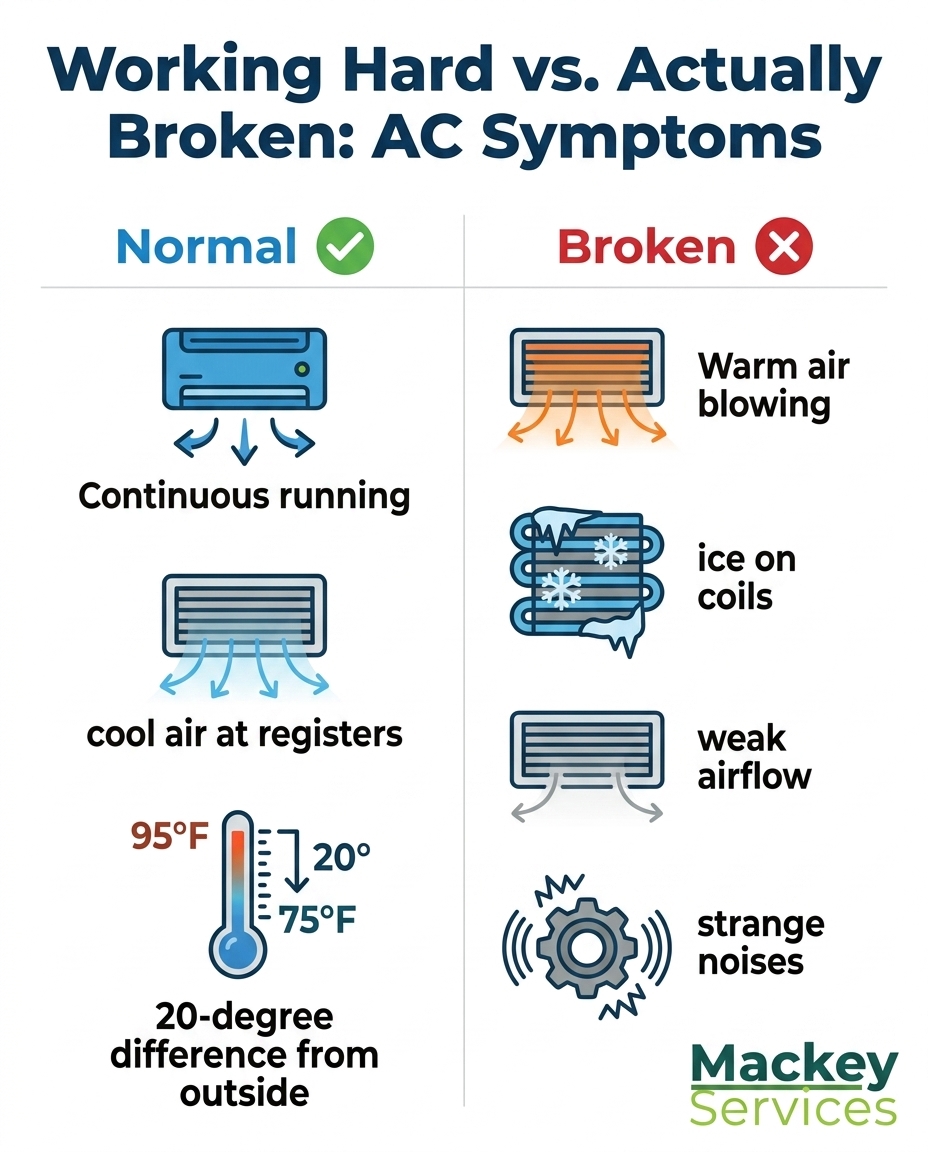
Knowing that continuous operation can be normal in 100-degree weather is reassuring, but you still need a way to verify that your specific unit is healthy. There is a distinct line between a system operating at its maximum design limit and a system experiencing a mechanical failure. You can perform a few clear, non-technical tests to check the status of your equipment.
The Homeowner's Diagnostic Check
The most revealing test requires nothing more than your hand and a few minutes of observation. Go to the air register (the vent blowing air into the room) closest to your indoor unit. Hold your hand up to the airflow. If the air feels distinctly, sharply cold, the system is actively removing heat. If the air is blowing cold but the house is still warm, the unit is simply working hard against an overwhelming heat load.
Conversely, look for warning signs of actual distress. If the air blowing from the register feels lukewarm or room temperature, the cooling process has stopped. If you see ice forming on the copper refrigerant lines outside, or if you hear unusual grinding, squealing, or banging noises from the condenser, the system has crossed the line from working hard to actively breaking down.
| Symptom | Working Hard (Normal) | Actually Broken (Needs Repair) |
|---|---|---|
| Air Temperature at Vent | Distinctly cold to the touch | Lukewarm or room temperature |
| Run Cycle Length | Continuous during peak afternoon heat | Short cycles (on/off every 5 minutes) |
| Outdoor Unit Appearance | Normal condensation, clear lines | Thick ice buildup on copper pipes |
| Airflow Strength | Strong, steady breeze from vents | Weak, barely noticeable airflow |
| Operating Sounds | Steady, consistent humming | Loud grinding, screeching, or rattling |
Monitoring airflow strength is also critical. Sometimes the system is producing cold air, but a restriction is preventing it from reaching the rooms. If you want to dive deeper into these symptoms, you can troubleshoot common AC problems by checking your thermostat settings and breaker panel before assuming a major component has failed.
Safe Steps to Help Your Air Conditioner Keep Up
If your system passes the diagnostic checks and is blowing cold air but still struggling to shut off during July heatwaves, there are actionable, safe tasks you can perform to ease its burden. You do not need to open electrical panels or handle refrigerant to make a massive difference in your system's efficiency. Lowering the heat load inside the house gives the equipment a fighting chance to catch up.
Daily Habits to Reduce Cooling Load
Every bit of heat generated or allowed inside your home is heat the air conditioner has to mechanically remove. By managing your indoor environment, you directly reduce the runtime of your cooling equipment.
- Replace dirty air filters: A clogged filter acts like a wall, choking the system. The blower motor has to work twice as hard to push air through a layer of dust. Swap out standard filters monthly during peak summer to ensure maximum airflow.
- Close blinds and curtains: Solar heat gain is a massive contributor to indoor temperatures. Keep window coverings closed on the south and west-facing sides of your house during peak afternoon sun.
- Shift appliance usage: Avoid using heat-generating appliances like ovens, stovetops, and clothes dryers during the hottest parts of the day. Run the dishwasher or dryer late at night when the outdoor temperature has dropped.
- Adjust ceiling fans: Ensure your ceiling fans are spinning counter-clockwise to push air straight down. The wind-chill effect makes you feel cooler, allowing you to comfortably raise the thermostat a degree or two.
Outdoor Unit Care
The exhaust system: The outdoor condenser is responsible for exhausting all the heat pulled from your house into the outside air. Ensure this unit is completely clear of debris. Trim back bushes, pull tall weeds, and remove any leaves or branches resting against the coils. The unit needs at least two feet of clear space in all directions to breathe properly. Combining these daily homeowner habits with routine AC maintenance ensures your equipment operates as efficiently as possible, even when pushed to its limits.
Frequently Asked Questions About Continuous AC Operation
Is it normal for my AC to run all day in 100 degree heat?
Yes, if the outdoor temperature exceeds the design temperature by several degrees, continuous operation is completely expected. Residential systems are typically engineered for a maximum outdoor temperature of around 95 degrees. When the heat index pushes past 100, the system must run constantly just to maintain a 20-degree difference between the inside and outside air.
Why does my AC run constantly but cool the house?
The system is successfully removing heat and humidity at exactly the rate it enters the home, achieving a state of equilibrium. It is not broken; it has simply reached its maximum output capacity. As long as the air coming from the vents is cold and the indoor temperature is holding steady (even if it isn't quite as cold as your thermostat setting), the equipment is functioning properly.
How long should an AC run before shutting off?
In mild weather, a cycle of 15 to 20 minutes is standard and indicates a properly sized system. However, in extreme heat, running for hours without cycling off is very common. The length of the cycle is directly tied to the outdoor temperature and the amount of humidity the system has to process.
At what outside temperature does an AC struggle to cool?
Most residential systems begin to struggle when outdoor temperatures surpass 95 degrees, relying heavily on the 20-degree differential rule. Once the outside air hits 100 degrees or more, expecting the indoor temperature to drop below 80 degrees is asking the system to perform beyond its physical design limits.
Can running constantly damage my air conditioner?
Continuous operation is actually less stressful on mechanical parts than constant starting and stopping, provided the system is clean and well-maintained. The highest amount of wear and electrical draw occurs when the compressor first kicks on. A long, steady run cycle is perfectly safe for a healthy system.
When to Call a Dickinson Cooling Expert
The line between normal heavy operation and a system failure ultimately comes down to the temperature of the air leaving your vents. If your system is blowing cold air continuously during a 100-degree afternoon, it is likely fine. You can rest easy knowing it is just fighting a tough battle against the Texas heat.
However, if the air is warm, the airflow is exceptionally weak, or the outdoor unit is making unusual grinding noises, it is time to seek professional help. Do not let a struggling system run itself to death if it is showing clear signs of mechanical distress. If your unit fails the basic homeowner diagnostic tests, reach out to schedule an inspection across the Dickinson service area. Having a technician verify your refrigerant levels and clear your coils ensures you have the clear, technical criteria needed to keep your home comfortable for the rest of the summer.
Ready for a better day?
One call handles it all — HVAC, electrical, and generators across the Texas Gulf Coast. Less to pay. Better day. That's the Mackey way.
Mon–Fri: 7 AM – 8 PM · Sat: 8 AM – 5 PM · Licensed & insured · #TACLA 112769C · #TECL 558211