
Why Smart Facility Managers Schedule Boiler Inspections in August
Why smart facility managers schedule boiler inspections in August to avoid cold snap crises. See what an off-season teardown involves to protect your building.
Avoiding the First Cold Snap Crisis: The Logic Behind Off-Season Boiler Care
Your building's temperature is dropping rapidly, the forecast shows an unexpected freeze, and your heating equipment is entirely unresponsive—this is exactly why smart facility managers schedule boiler inspections in August. Waiting for the first major temperature drop to test commercial heating equipment is a gamble that frequently ends in operational disaster. When a commercial boiler sits idle for months, seals dry out, scale hardens, and electrical contacts gather dust. Firing up a dormant system during a sudden cold front without prior testing often reveals these hidden vulnerabilities all at once.
For comprehensive commercial heating services and to secure a proactive maintenance plan, preparing your building early is critical.
Here at Mackey Services, we know firsthand that on the Texas Gulf Coast, August means peak extreme heat, making it the absolute best off-season window before unpredictable winter cold snaps arrive. While the outside temperatures are sweltering and back-to-school transitions are underway, the heating infrastructure inside Dickinson TX commercial facilities has been completely offline for months. This creates a rare, highly controlled environment where our technicians can safely dismantle, inspect, and repair heavy-duty heating components without disrupting the building's daily operations.
Proactive operators understand that risk mitigation is about timing. The decision point is clear: you can either schedule a comprehensive teardown now while the system is cool and contractors have logistical bandwidth, or you can risk catastrophic emergency service delays when every other unprepared building in the region loses heat simultaneously. Taking control of your maintenance calendar in late summer ensures that when the weather inevitably turns, your facility remains stable, safe, and fully operational.
The High Cost of Reactive Winter Heating Repairs
The logistical nightmare of waiting until the first freeze to discover a commercial heating failure cannot be overstated. When a boiler fails in the middle of winter, the immediate problem is temperature, but the secondary problem is time. Emergency commercial heating repairs during peak winter demand carry significantly higher operational disruptions because contractor schedules are entirely saturated. You are no longer in control of the timeline; you are at the mercy of the weather and the service queue.
Consider the broader implications of what happens if you skip HVAC maintenance until the busy season. A pattern we see often at Mackey Services involves facilities scrambling when temperatures finally drop. For example, when our team helped a local commercial client plan a major system replacement during the winter, the process demanded a thorough inspection where our technicians had to explain all aspects of the complex overhaul before proceeding. While we handled that specific overhaul expertly and the client felt confident moving forward, the reality is that executing major heating work during peak winter months adds immense stress to facility operations. It requires navigating freezing temperatures while the building is temporarily without heat during the repair process.
The cascading costs of winter failures:
- Productivity losses: Employees cannot work efficiently in freezing indoor temperatures, leading to potential facility closures or drastically reduced output.
- Equipment strain: When a primary boiler fails, secondary systems overcompensate, increasing the risk of a total cascading failure across the HVAC network.
- Expedited shipping fees: Commercial boiler parts are rarely off-the-shelf items. Ordering specialized components in winter often requires massive overnight shipping premiums.
- Overtime labor rates: Emergency dispatches during a freeze frequently incur after-hours or holiday labor rates.
Understanding the Ripple Effects of Facility Downtime
Sudden facility temperature drops do more than just make the building uncomfortable. For many commercial operations, consistent ambient temperatures are required for safety compliance, temperature-sensitive inventory, and specialized mechanical equipment. A sudden drop in heat can freeze internal plumbing, ruin stored materials, and create hazardous working conditions. By shifting the maintenance focus to late-summer August, facility managers completely bypass these compounding logistical challenges, ensuring that any necessary repairs are completed long before the building actually needs the heat.
Why Late-Summer Provides the Perfect Operational Window
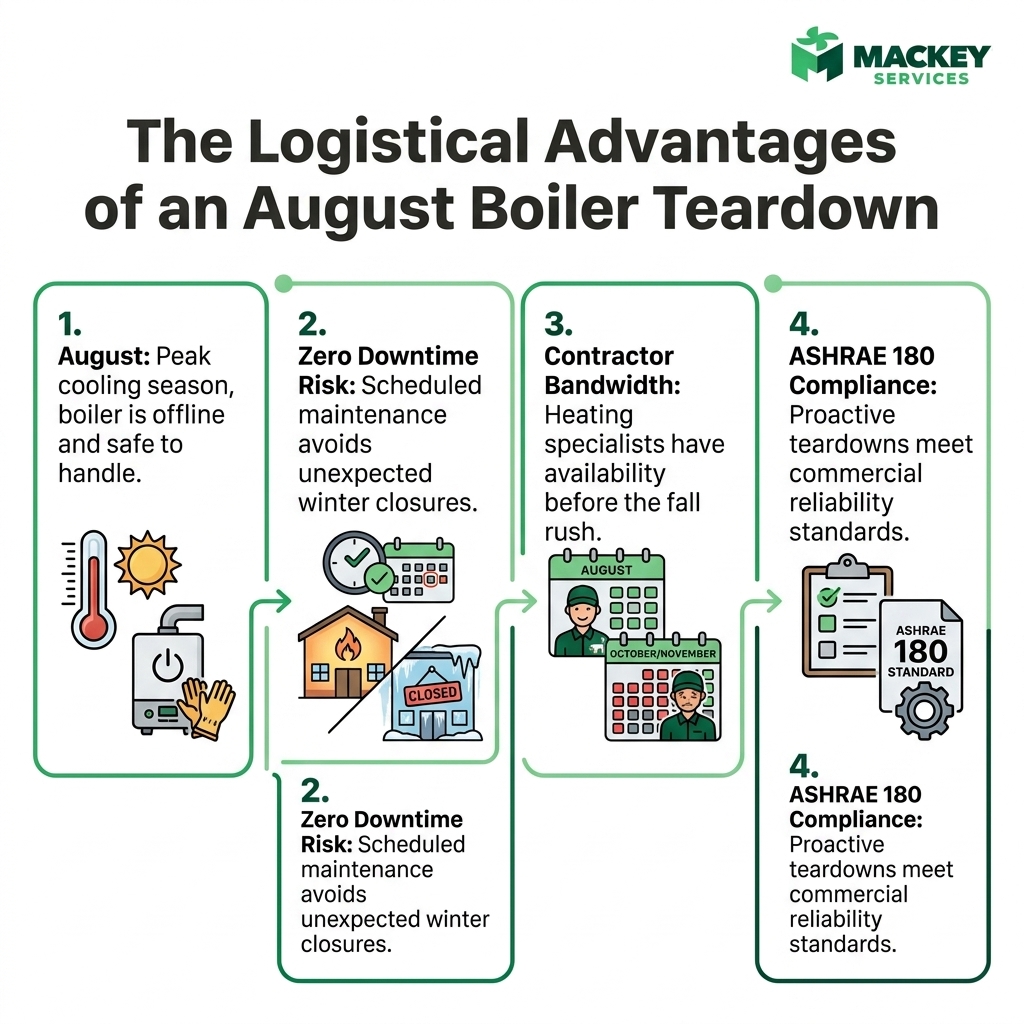
August is strategically the best time for invasive maintenance because the system is entirely cool and offline. The extended extreme summer heat in the region means heating systems are entirely idle, providing a rare, safe opportunity for invasive teardowns. You cannot perform deep internal maintenance on a boiler that is actively firing to keep a building warm.
Here is how the late-summer operational window benefits commercial facilities:
- Safe Handling Temperatures: Commercial boilers operate at extreme temperatures and pressures. When they have been offline for months during the summer, the internal refractory materials, heat exchangers, and burner assemblies are completely cool. This allows technicians to perform deep physical inspections safely.
- Logistical Bandwidth: Heating contractors have the capacity for complex boiler work during peak cooling season. While their emergency dispatch teams are handling AC calls, their heavy-commercial heating specialists often have the dedicated time necessary for methodical, unhurried boiler teardowns.
- Controlled Environments: A scheduled summer shutdown is a controlled event. You choose the day, you choose the time, and the building's occupants are unaffected because the heating system isn't needed anyway.
- Supply Chain Buffers: If an inspection reveals a cracked heat exchanger or a failing ignition control module, late-summer August gives you weeks or even months to order specialized replacement parts without paying expediting fees.
When you invest in commercial HVAC solutions during the off-season, you are buying time. You are replacing the chaos of a winter failure with the predictable structure of a scheduled summer project.
| Maintenance Factor | August Scheduled Teardown | Winter Emergency Repair |
|---|---|---|
| System Status | Completely cool, safe to dismantle | Hot, pressurized, requires cooldown time |
| Facility Impact | Zero impact (heating not needed) | High impact (building loses heat) |
| Contractor Availability | High availability for heating specialists | Severely limited due to freeze demand |
| Parts Procurement | Standard shipping, ample lead time | Expedited shipping, potential backorders |
Inside a Professional Off-Season Boiler Teardown
A true commercial boiler teardown is vastly different from a basic visual inspection. A visual walk-around might catch a loose wire or a surface-level water leak, but it cannot reveal the internal degradation that causes catastrophic mid-winter failures. A professional teardown involves opening the unit, removing access panels, and physically inspecting the internal components that endure the most thermal stress.
This level of invasive maintenance is impossible to perform safely while the boiler is actively heating a building. The system must be completely offline, depressurized, and cool to the touch. During this process, technicians look for micro-fractures in the metal that expand under heat. They check for scale buildup inside the water tubes, which acts as an insulator and forces the boiler to burn significantly more fuel to achieve the same temperature. They also test for carbon monoxide risks, ensuring that the ventilation pathways and flues are completely clear of soot, bird nests, or structural blockages.
In our experience servicing Dickinson TX commercial facilities, our team considers this proactive off-season teardown process the primary defense against unexpected downtime. It is a methodical, highly technical procedure that resets the equipment's baseline reliability before the heating season begins.
Critical Components Evaluated During a Teardown
- Burner assembly and ignition systems: Technicians clean the burner nozzles and test the electronic ignition sequences to ensure the system fires smoothly without delayed ignition (which can cause dangerous mini-explosions inside the chamber).
- Heat exchanger integrity and scaling: The heat exchanger is physically examined for stress cracks. Even a hairline fracture can allow deadly carbon monoxide to mix with the building's air supply.
- Safety controls and interlocks: Every commercial boiler has multiple safety switches, including low-water cutoffs, high-pressure limits, and flame sensors. These are manually tripped and tested to ensure they will actually shut the system down in an emergency.
- Refractory material condition: The heavy insulation inside the combustion chamber is inspected for crumbling or heat damage, which can lead to localized overheating and equipment failure.
Aligning with ASHRAE Standards for Commercial Reliability
Maintaining commercial heating systems is not just about avoiding a cold building; it is about adhering to established industry guidelines for safety and efficiency. ASHRAE Standard 180 provides the definitive standard practice for the inspection and maintenance of commercial building HVAC systems. This standard emphasizes that consistent, proactive maintenance is fundamentally necessary to minimize unexpected equipment failures and maintain intended energy efficiency.
When facility managers schedule their boiler teardowns in late-summer August, they are directly aligning with these authoritative best practices. Adhering to ASHRAE standards prevents the premature degradation of heavy commercial equipment. Boilers that receive invasive, off-season cleaning and calibration operate closer to their original factory specifications. They burn fuel more completely, transfer heat more effectively, and produce fewer harmful emissions.
Furthermore, connecting your maintenance schedule with standard compliance creates long-term operational budget stability. Instead of dealing with massive, unpredictable capital expenditures to replace a ruined boiler in December, facility managers can accurately forecast minor repair costs and extend the lifespan of their existing equipment by years. It transforms heating maintenance from an unpredictable liability into a managed, predictable line item.
Minimizing Facility Downtime Through Proactive Logistics
The transition from reactive repair to proactive logistical management is what separates struggling facilities from highly efficient ones. Establishing a dependable relationship with a commercial contractor during the off-season pays massive dividends when unpredictable weather shifts occur. When you already have a contractor who intimately knows your building's infrastructure, you eliminate the learning curve during future service calls.
For instance, when our Mackey Services team recently performed a complex condenser replacement for a commercial property, our technicians patiently explained the technical details of the new equipment to the facility management team, ensuring everyone felt comfortable with the repairs and the future operational requirements. That level of dedicated, patient explanation is much easier to provide during the late-summer off-season when technicians aren't rushing to the next freezing building. Building this relationship in August means that if an anomaly does occur in January, you are already an established priority client.
Steps to integrate an August teardown into your facility calendar:
- Audit your current maintenance logs: Review when the boiler was last opened and physically cleaned, not just visually inspected.
- Schedule before Labor Day: Lock in your contractor's time while their heating specialists are still operating on summer schedules.
- Plan for minor repairs: Allocate a small portion of the Q3 budget to cover any minor worn parts discovered during the teardown, such as igniters or gaskets.
This approach provides the ultimate operational confidence. Knowing that your heavy heating equipment in Dickinson TX commercial facilities has been thoroughly vetted gives you the peace of mind that your building is fully prepared for whatever the winter weather brings.
Frequently Asked Questions About Commercial Boiler Maintenance
When is the best time to service a commercial boiler?
Late summer, specifically August, is the optimal time to service a commercial boiler. During this period, the system is completely offline and cool, allowing technicians to perform invasive inspections safely. Scheduling in the off-season also guarantees better contractor availability before the fall heating rush begins.
What happens during a commercial boiler teardown?
A teardown involves a comprehensive, invasive inspection of internal components that cannot be accessed while the system is running. Technicians open the boiler to physically inspect the heat exchanger for cracks, clean the burner assemblies, remove interior scale buildup, and manually test all safety interlocks. It is a deep reset of the equipment's operational baseline.
How often should commercial boilers be inspected?
Commercial boilers should be thoroughly inspected and serviced at least annually, ideally before the heating season begins. Adhering to ASHRAE Standard 180 ensures that the equipment maintains its energy efficiency, operates safely, and avoids premature mechanical failure.
Can you inspect a boiler while it is running?
You can only perform surface-level operational checks while a boiler is running, such as verifying pressure gauges or listening for unusual noises. A true, comprehensive teardown requires the system to be completely off, depressurized, and cool to the touch so technicians can safely access the combustion chamber and heat exchangers.
Why is off-season maintenance critical for facility managers?
Off-season maintenance mitigates the risk of catastrophic downtime and avoids emergency service delays during winter spikes. By addressing wear and tear in late-summer August, facility managers secure operational budget stability and ensure their building remains safe and functional during unpredictable winter freezes.
Secure Your Facility's Winter Reliability Today
An August teardown is the smartest logistical move a facility manager can make to protect their building's infrastructure. By utilizing the off-season cooling months to address heating vulnerabilities, you completely bypass the chaos, elevated costs, and operational downtime associated with winter heating failures. Now is the time to review your late-summer maintenance schedules and take action before the weather changes. That proactive strategy is exactly why smart facility managers schedule boiler inspections in August, ensuring total reliability when the first cold snap finally arrives.
Ready for a better day?
One call handles it all — HVAC, electrical, and generators across the Texas Gulf Coast. Less to pay. Better day. That's the Mackey way.
Mon–Fri: 7 AM – 8 PM · Sat: 8 AM – 5 PM · Licensed & insured · #TACLA 112769C · #TECL 558211