
Choosing Between Underground Propane and Municipal Natural Gas for Standby Power
Decide with confidence when choosing between underground propane and municipal natural gas for standby power. See which is best before late-summer storms hit.
Securing Reliable Backup Power Before Late-Summer Storms
August marks the peak of the Gulf Coast storm season, making it the critical window for choosing between underground propane and municipal natural gas for standby power before severe weather threatens the grid. As late-summer heat waves give way to unpredictable tropical systems, the vulnerability of utility infrastructure becomes a pressing concern for homeowners. Installing a whole-home backup generator offers unparalleled peace of mind, but the physical equipment is only half of the equation. The engine powering that system requires a robust, uninterrupted fuel source to keep your lights, air conditioning, and refrigeration running during extended outages.
If you are evaluating options for your property, our comprehensive generator services can help you design a system that meets your exact demands.
For permanent standby installations, homeowners generally face a primary dilemma: tapping into an existing municipal natural gas line or burying a dedicated liquid propane tank on the property. Both options are highly capable of running heavy-load systems, but they carry vastly different logistical, environmental, and technical requirements. Making the right choice depends heavily on your property's location, the local utility infrastructure, and the specific demands of your electrical load. Before the next major storm system forms in the Gulf, understanding the core differences between these two fuel sources is essential for a seamless installation.
Understanding BTU Output and Standby Power Demands
To make an informed decision about generator fuel, you first need to understand how these systems consume energy. Generators do not create electricity out of nothing; they convert the chemical energy stored in fuel into mechanical energy, which turns an alternator to generate electrical current. The energy density of your chosen fuel directly impacts how the system operates, which is measured in British Thermal Units (BTUs). A BTU represents the amount of energy required to heat one pound of water by one degree Fahrenheit, and it serves as the standard metric for fuel efficiency.
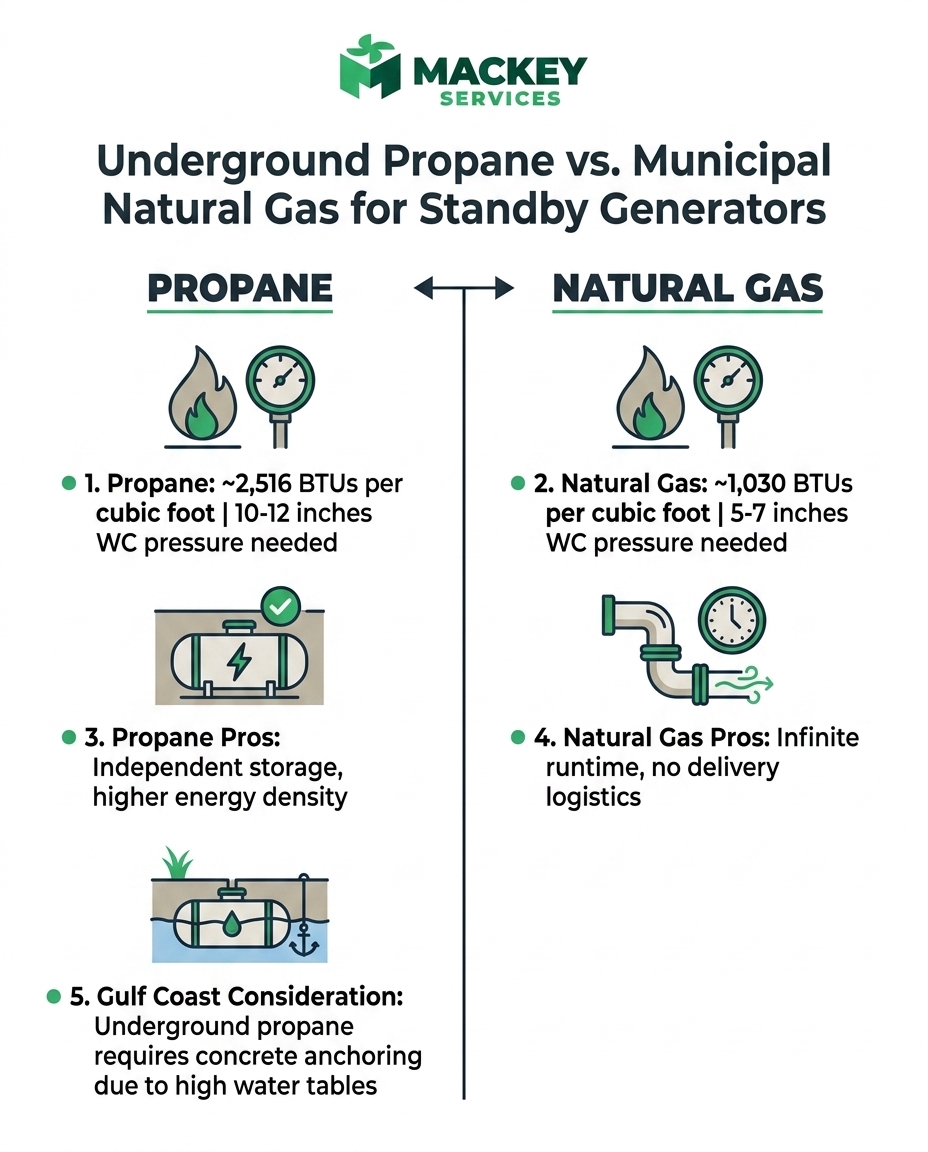
There is a significant difference in energy density between the two primary fuel options. Liquid propane contains approximately 2,516 BTUs per cubic foot, making it an incredibly energy-dense fuel. In contrast, municipal natural gas provides about 1,030 BTUs per cubic foot. Because natural gas contains less than half the energy by volume compared to propane, a generator must consume a significantly larger volume of natural gas to produce the same electrical output.
This difference in energy density dictates the physical requirements of the installation. To deliver the higher volume of natural gas required for heavy electrical loads, the fuel delivery system must maintain strict pressure parameters. This is why verifying the specific water column (WC) pressure requirements for standby generators is a mandatory first step in any installation. If you are curious about how this energy conversion translates into electricity for your breaker panel, understanding how a whole home backup generator works provides vital context for why fuel volume and pressure are so critical.
Navigating Municipal Natural Gas Lines in Semi-Rural Areas
The problem: Many homeowners assume that if they have a natural gas line running to their stove or water heater, they automatically have enough gas to run a standby generator. Unfortunately, this is rarely the case, especially for semi-rural properties outside the main Dickinson municipal grid. While the appeal of natural gas is the promise of infinite runtime without ever needing to schedule a fuel delivery, the reality of utility infrastructure is much more complex. A standby generator demands a massive, sudden influx of fuel the moment it activates.
The cause: Municipal gas systems operate on a pressurized grid. As neighborhoods expand outward into semi-rural areas, the utility lines are stretched further from the main distribution hubs. This expansion often leads to fluctuating gas pressure at the edges of the grid. While a slight pressure drop won't affect a standard gas furnace, it can completely stall a high-capacity generator. Most whole-home natural gas generators require a strict delivery pressure of 5 to 7 inches of water column (WC). If the municipal line cannot sustain this pressure under load, the generator's engine will starve for fuel, sputter, and shut down just when you need it most.
The solution: Relying on municipal natural gas requires a thorough evaluation of your existing utility service. In almost all cases involving whole-home backup power, the standard residential gas meter is undersized and must be upgraded by the utility provider to handle the increased volume. Mackey Services brings deep local expertise in verifying Dickinson municipal gas logistics and pressure requirements before any installation begins. By conducting precise load calculations and pressure tests, professionals can determine whether the local grid can support your generator or if an independent fuel source is required.
The Logistics of Buried Propane Tanks in High-Water-Table Zones
When municipal natural gas is unavailable, or the local grid pressure is deemed insufficient for a heavy electrical load, on-site storage becomes the most reliable choice. Liquid propane systems operate at a higher pressure—typically requiring 10 to 12 inches of water column—and having a dedicated tank on your property guarantees that this pressure remains stable, regardless of what is happening with the local utility grid. However, installing a propane tank in the Gulf Coast region introduces a unique set of environmental challenges.
Due to the risk of flying debris and high winds during the August / peak Gulf Coast storm season, burying the propane tank underground is the safest and most aesthetically pleasing option. A whole-home generator typically requires a 500-gallon or 1,000-gallon tank to ensure multiple days of continuous operation. Burying a vessel of this size requires significant yard space, heavy excavation equipment, and strict adherence to environmental safety codes.
Securing Tanks Against Coastal Flooding
The most critical logistical hurdle for underground tanks in our region is the soil itself. The Gulf Coast is notorious for heavy clay soils and exceptionally high water tables. When severe storms bring torrential rain and hurricane-induced flooding, the ground quickly becomes saturated. This creates a dangerous physics problem: buoyancy.
- The Physics of Buoyancy: A 500-gallon propane tank displaces a massive amount of soil and water. When the ground floods, the tank acts like a giant steel balloon. If the tank is partially empty, the upward buoyant force can exceed thousands of pounds.
- The Risk of Eruption: Without proper mitigation, a buried tank in saturated soil will literally float upward, breaking through the surface of the yard, rupturing fuel lines, and creating a severe hazardous materials emergency.
- Professional Anchoring Solutions: To counteract this, licensed installers utilize specialized concrete anchoring systems. The excavation trench is fitted with heavy concrete pads or collars, and the tank is strapped down using corrosion-resistant industrial banding. This concrete anchoring is a non-negotiable safety standard in flood-prone coastal areas, ensuring the infrastructure remains secure even under standing water.
Site Preparation and Electrical Integration Requirements
Regardless of whether you choose municipal natural gas or an underground propane tank, the site preparation and final integration of the generator follow a strict, highly regulated process. The physical location of the generator pad must comply with local clearance codes, keeping the unit a safe distance from operable windows, doors, and property lines to prevent exhaust infiltration.
Once the pad is poured and the generator is set, trenching is required to connect the system to both the fuel source and the home's electrical panel. Fuel lines must be buried at specific depths, bedded in protective sand, and marked with warning tape to prevent future excavation accidents. Simultaneously, high-voltage electrical conduits must be run from the generator to the automatic transfer switch (ATS). The ATS is the brain of the operation; it constantly monitors the utility grid, and when it detects a drop in voltage, it isolates your home from the grid, signals the generator to start, and opens the fuel valves.
Because these systems involve highly pressurized combustible gases and massive amounts of electrical current, DIY installation is strictly prohibited by building codes. Both the gas line modifications and the high-voltage integrations require specialized licensing, permits, and inspections. Coordinating these complex connections safely is why utilizing professional electrical services is mandatory for a reliable, code-compliant backup power system.
Weighing On-Site Fuel Storage Against Utility Runtimes
Ultimately, the decision between natural gas and propane comes down to balancing the convenience of the utility grid against the independence of on-site storage. If you live in a well-established urban or suburban area with robust utility infrastructure, natural gas offers a hands-off experience. But for semi-rural properties outside the main Dickinson municipal grid, the independence of a propane tank often outweighs the logistics of fuel delivery.
| Fuel Source | Primary Advantage | Primary Challenge | Best Suited For |
|---|---|---|---|
| Municipal Natural Gas | Infinite runtime; no delivery scheduling required. | Vulnerable to grid pressure drops; requires meter upgrades. | Urban/suburban homes with verified, high-pressure utility lines. |
| Underground Propane | Independent from utility failures; highly energy-dense. | Requires yard excavation, concrete anchoring, and fuel monitoring. | Semi-rural properties, heavy electrical loads, or areas with poor gas infrastructure. |
Before committing to a specific generator model, we strongly encourage homeowners to have their property's specific water column pressure tested. Assuming your gas line is sufficient without a diagnostic test can lead to costly delays and system malfunctions during the installation process.
Consult a Local Expert to Plan Your Backup Power Strategy
Late-summer storms are notoriously unpredictable, and properly engineering a standby power system takes careful planning and time. From verifying gas pressure to securing permits for underground tanks, the preparation phase is just as critical as the installation itself. Do not wait until a storm is actively entering the Gulf to begin thinking about your family's backup power needs.
We recommend scheduling a professional site evaluation to measure your existing gas pressure, assess your yard's viability for a buried tank, and calculate your home's exact electrical load. Once your fuel strategy is clearly defined, you can confidently explore premium equipment options, such as Kohler generators, to ensure your home remains safe, powered, and comfortable no matter what the August / peak Gulf Coast storm season brings.
Frequently Asked Questions
What is the gas pressure requirement for a standby generator?
Most whole-home standby generators require a strict fuel delivery pressure to operate smoothly under heavy loads. For natural gas systems, this is typically between 5 and 7 inches of water column (WC), while liquid propane systems generally require a higher pressure of 10 to 12 inches of WC. A licensed professional must verify these pressures using specialized gauges before installation to ensure the engine will not stall during an outage.
Can I bury a propane tank in an area with a high water table?
Yes, but it requires specialized installation techniques to prevent catastrophic failure. In areas with high water tables, saturated soil can cause a buried tank to become buoyant and float to the surface. To prevent this, professional installers secure the tank to heavy concrete pads or collars at the bottom of the excavation trench, safely anchoring it against the upward force of floodwaters.
Does a whole house generator require a larger gas meter?
In the vast majority of cases, yes. A standard residential gas meter is designed to supply relatively low-volume appliances like stoves and water heaters. When a whole-house generator activates, it demands a massive surge of fuel that standard meters simply cannot pass, requiring the utility company to install an upgraded, high-capacity meter.
Is it better to run a generator on propane or natural gas?
Neither fuel is universally better; the right choice depends entirely on your local infrastructure. Natural gas is highly convenient because it offers infinite runtime without the need for fuel deliveries, provided your municipal grid can sustain the required pressure. Propane is often the better choice for rural or semi-rural properties because it is highly energy-dense and provides an independent, on-site fuel supply that isn't reliant on utility pipelines.
How long will a 500-gallon propane tank run a whole house generator?
Runtime depends heavily on the size of the generator and the electrical load it is supporting. On average, a standard whole-home generator running under a moderate load will consume roughly 2 to 3 gallons of propane per hour. Based on the fact that tanks are only filled to 80% capacity for safety expansion, a 500-gallon tank (holding 400 gallons) can typically power a home for 5 to 7 days continuously.
How do coastal properties secure underground fuel tanks against flooding?
Coastal properties face unique risks from hurricane-induced flooding and saturated soil. Installers utilize the principles of weight and displacement by pouring concrete at the base of the installation trench. The propane tank is then strapped to this concrete foundation using heavy-duty, corrosion-resistant banding, ensuring the tank remains firmly anchored underground even if the yard is completely submerged.
Ready for a better day?
One call handles it all — HVAC, electrical, and generators across the Texas Gulf Coast. Less to pay. Better day. That's the Mackey way.
Mon–Fri: 7 AM – 8 PM · Sat: 8 AM – 5 PM · Licensed & insured · #TACLA 112769C · #TECL 558211