
How Proper HVAC Maintenance Prevents Mold Growth
Discover how proper HVAC maintenance prevents mold growth in Houston homes with expert tips on humidity control and system care.
"I'm Worried About the Air Quality in My House." Here's How Proper HVAC Maintenance Prevents Mold Growth
How proper HVAC maintenance prevents mold growth comes down to one thing: controlling moisture. When your system is well-maintained, it pulls humidity out of your air, keeps airflow moving, and stops the damp, dark conditions that mold needs to take hold. When it's neglected, it can do the opposite — quietly turning into a mold factory that pushes spores through every room in your home.
Here's a quick look at the key ways HVAC maintenance keeps mold out:
| Maintenance Task | How It Prevents Mold |
|---|---|
| Regular filter changes | Stops dust buildup that feeds mold on damp surfaces |
| Clearing condensate drain lines | Prevents standing water in drain pans |
| Cleaning evaporator coils | Removes the mold-friendly mix of moisture and organic debris |
| Controlling indoor humidity (30-50%) | Keeps conditions below the threshold mold needs to grow |
| Sealing leaky ductwork | Blocks humid outdoor air from entering the system |
| Twice-yearly professional tune-ups | Catches problems before mold gets a foothold |
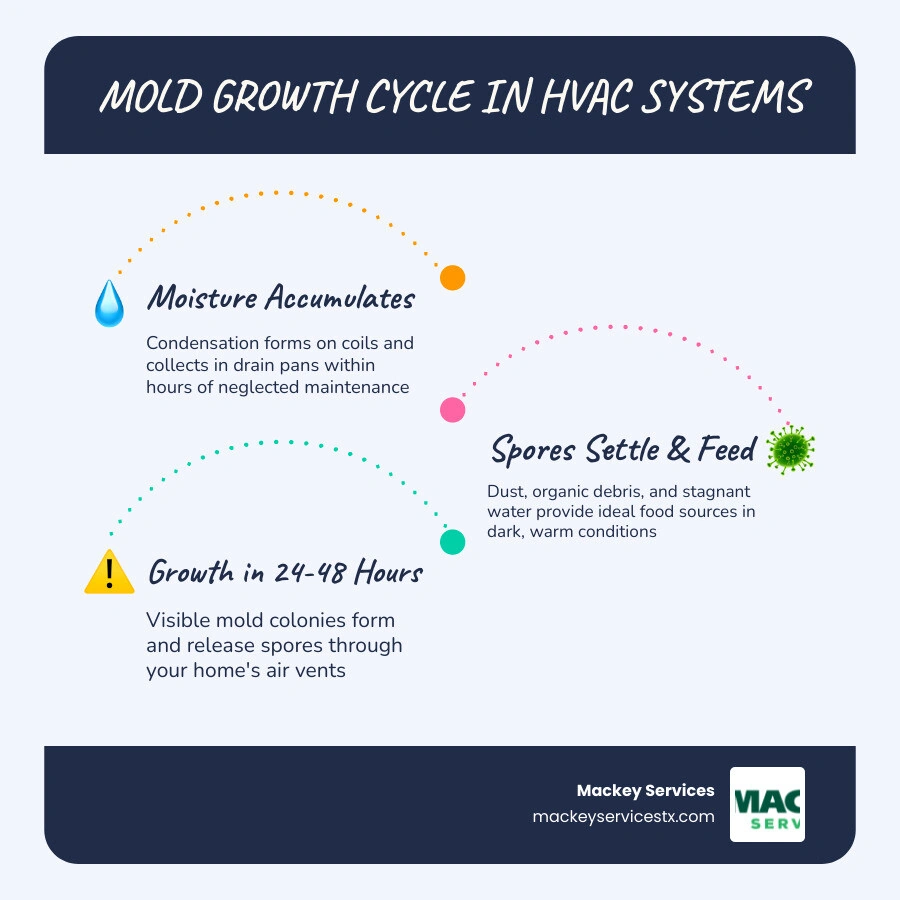
Mold spores are always present in the air around us — that's just a fact of life. They only become a problem when they find the right conditions: moisture, warmth, darkness, and something to feed on. Your HVAC system, if not properly maintained, checks every one of those boxes. Studies have found that roughly 20% of buildings across the US, Canada, and Europe showed signs of dampness — and poor HVAC upkeep is a leading reason why. Once moisture hits a duct surface, mold can begin growing in as little as 24 to 48 hours.
For Houston-area homeowners, this is especially real. The Gulf Coast's heat and humidity mean your AC runs hard for most of the year, creating more condensation, more moisture, and more opportunity for mold to move in if your system isn't in good shape.
"I'm worried about the air quality in my house." Understanding How Proper HVAC Maintenance Prevents Mold Growth
When we talk to our neighbors in Dickinson or League City, the conversation often starts with a simple concern: "The air just feels... off." Maybe it’s a faint musty smell or an uptick in sneezing. Understanding how proper HVAC maintenance prevents mold growth starts with recognizing that your air conditioner is essentially a giant dehumidifier.
In the humid Texas climate, your AC’s job is to pull heat and water out of the air. As warm air from your home passes over the cold evaporator coils, the moisture in that air turns into liquid water—just like a cold glass of sweet tea "sweats" on a July afternoon. In a healthy system, that water drips into a pan and flows safely out of your home. However, when maintenance is skipped, that water gets trapped. Combined with the dust and organic matter that naturally settles in your system, you’ve basically built a five-star hotel for mold.
To dive deeper into the local challenges we face, check out our guide on How Gulf Coast Climate Affects Your HVAC System.
Why Mold Thrives in Neglected Systems
Mold isn't particularly picky, but it does have a favorite "vibe." It loves darkness, stagnant air, and consistent warmth. Inside a neglected HVAC unit, the interior is pitch black. If the fan isn't moving air efficiently due to a dying motor or a clogged filter, the air becomes stagnant.
The "food" source is the most surprising part for most homeowners. Mold eats organic matter. What organic matter is inside a metal machine? Dust. Dust is largely made up of skin cells, pet dander, and pollen. When this dust coats a damp evaporator coil or settles in a moist duct, it provides the perfect nutrient base for mold colonies. With roughly 20% of buildings showing signs of dampness, a lack of regular cleaning means your system is statistically likely to be at risk.

"How can I keep my home dry?" The Role of Humidity and Moisture Control
In the Greater Houston area, humidity is our constant companion. But while we might tolerate it at a backyard BBQ, we shouldn't tolerate it in our living rooms. According to the EPA, the "sweet spot" for indoor humidity is between 30% and 50%.
Once your indoor relative humidity climbs above 60%, you’ve entered the danger zone. This is often called the "60% Rule." At this level, mold spores that were previously dormant "wake up" and begin to colonize surfaces. If your home stays at 70% humidity or higher, mold can activate and spread in as little as 24 hours.
Properly managing this moisture is a core part of Dehumidification and Your Air Conditioner Explained. For many homes in Pearland or Baytown, a standard AC might struggle to keep up with the extreme Gulf moisture, which is where Whole House Dehumidification Houston TX becomes a lifesaver.
How proper HVAC maintenance prevents mold growth through humidity management
Your HVAC system prevents mold by reaching the "dew point" on its coils, pulling gallons of water out of your indoor air every single day. But this only works if the system is sized correctly and running efficiently.
We often see issues with "oversized" units. You might think a bigger AC is better, but if it's too powerful for your square footage, it will "short-cycle." This means it cools the house down so fast that it shuts off before it has a chance to actually remove the humidity. You end up with a home that is cold but "clammy"—the perfect environment for mold. Regular maintenance checks ensure your system’s refrigeration cycle is balanced, which is vital for The Role of Humidity Control for Home Comfort.
"What are the best ways to stop mold?" Critical Maintenance Tasks to Stop Mold Before It Starts
Prevention is always cheaper than remediation. While mold remediation can cost anywhere from $700 to $3,000, a routine maintenance visit is a fraction of that. When we perform a tune-up, we focus on the "wet" areas of your system.
One of the most critical tasks is clearing the condensate drain line. Over time, algae and "sludge" (a biofilm of bacteria and fungus) can grow inside the PVC pipe that carries water away. If this line clogs, water backs up into the drain pan. Standing water in a dark, warm attic is a recipe for a mold explosion. A simple flush—sometimes using a vinegar-and-water mixture—can keep this line clear.
We also focus on the evaporator coils. If these are dirty, they stay damp much longer than they should, allowing mold to grow directly on the fins. You can learn more about the Benefits of Routine AC Maintenance and How Often Should You Service Your HVAC System to stay ahead of these issues.
Filter Changes: A Simple Way How Proper HVAC Maintenance Prevents Mold Growth
The humblest part of your HVAC system is actually one of its strongest defenses. Your air filter’s primary job isn’t just to clean the air you breathe; it’s to protect the internal components of the machine from getting coated in "mold food" (dust).
When a filter gets too dirty, two bad things happen:
- Airflow is restricted: This causes the coils to get too cold, leading to excessive condensation or even ice buildup. When that ice melts, it creates a massive moisture surge.
- The filter itself becomes a host: If a filter is left in place too long and becomes damp from high humidity, the dust trapped on it can actually start growing mold right there in the intake.
We recommend checking your filters monthly and replacing them at least every 90 days—or every 30 days if you have pets or allergies. This is a foundational step in A Homeowners Guide to Extending Your HVAC Systems Lifespan.
"Why does my AC smell musty?" Warning Signs of Mold in Your Houston Home’s HVAC System
In Dickinson and surrounding areas, we often hear about "Dirty Sock Syndrome." No, it’s not because someone left their gym bag by the return vent. It’s a specific smell caused by bacteria and mold buildup on the evaporator coils. When the system kicks on, it smells like a locker room.
Other warning signs include:
- Visible Spots: Black, green, or fuzzy patches around your supply registers (the vents in your ceiling or floor).
- Musty Odors: A damp, "earthy" smell that is strongest when the fan is running.
- Allergy Flare-ups: If you feel better when you’re outside or at the office but start sneezing the moment you get home, your HVAC might be the culprit.
- Dark Residue: If you see what looks like "wet dust" sticking to the vent grates, it could be mold colonization.
For a full breakdown of what to look for, see our Ultimate Guide Indoor Air Quality Home and learn How Texas Pollen and Humidity Affect Indoor Air.
Health Risks of Circulating Spores
When mold grows in your ductwork, your HVAC system becomes a distribution network. Every time the blower turns on, it sends microscopic spores into every bedroom. This can lead to headaches, fatigue, and persistent respiratory issues.
| Feature | Mold Growth | Standard Dust | Dirty Sock Syndrome |
|---|---|---|---|
| Odor | Pungent, musty, earthy | None to slightly "dry" | Sweaty, locker room smell |
| Appearance | Fuzzy, slimy, or spotted | Grey, fibrous, dry | Often invisible (on coils) |
| Health Impact | High (allergies, toxins) | Low (irritant) | Moderate (irritant) |
| Primary Cause | Excess moisture | Normal living | Bacteria on damp coils |
"Who in Dickinson specializes in air purification?" Professional Solutions for Long-Term Air Quality
Sometimes, standard maintenance needs a boost—especially in the high-humidity environment of the Texas Gulf Coast. If you’ve struggled with recurring mold or have family members with sensitive immune systems, we often recommend "active" solutions.
UV-C Lights are a game-changer. These are installed inside your air handler, right next to the evaporator coil. The ultraviolet light actually scrambles the DNA of mold spores and bacteria, killing them before they can ever start a colony. It’s a silent, 24/7 guardian for your air. Check out our services for UV Lights League City TX to see how this works.
Another major factor is your ductwork. If your ducts have leaks, they can pull in hot, humid air from your attic or crawlspace. When that humid air hits the cool air inside the duct, it creates condensation—and you guessed it—mold. Sealing and insulating your ducts is a huge part of Whole House Air Purification Pearland TX and Boosting Indoor Air Quality Using Proper Ventilation.
Frequently Asked Questions about HVAC Mold Prevention
What causes mold to grow inside HVAC systems and ductwork?
Mold requires three things: moisture, a food source, and a lack of sunlight. HVAC systems provide all three when neglected. Moisture comes from condensation on the coils or leaky ducts; the "food" is the dust and dander that bypasses a dirty filter; and the interior of your ducts is perfectly dark.
How often should I schedule professional HVAC tune-ups?
We recommend a professional inspection and cleaning twice a year—once in the spring before the brutal Houston summer hits, and once in the fall before the heating season. This ensures your drain lines are clear and your coils are clean before the system has to work its hardest.
What is the ideal indoor humidity level to prevent mold?
The EPA recommends keeping indoor humidity between 30% and 50%. In our area, anything below 50% is considered excellent for both comfort and mold prevention. If your AC can't keep it below 60%, it's time to look into a whole-home dehumidifier or a system tune-up.
Conclusion
At Mackey Services, we’ve spent 30 years helping our neighbors in Dickinson, League City, Friendswood, and across the Greater Houston area stay comfortable and healthy. As a family-owned business with an A+ BBB rating, we know that how proper HVAC maintenance prevents mold growth isn't just a technical question—it's about the safety and well-being of your family.
From our 24/7 emergency readiness to our custom ductwork capabilities, we are committed to providing reliable, family-like service. Don't let your AC become a "petri dish" for mold. Whether you need a routine tune-up or advanced IAQ solutions like UV lights and dehumidification, we’re here to help.
Ready to breathe easier? Contact us today to schedule your maintenance visit and keep your home's air clean, dry, and mold-free!
Ready for a better day?
One call handles it all — HVAC, electrical, and generators across the Texas Gulf Coast. Less to pay. Better day. That's the Mackey way.
Mon–Fri: 7 AM – 8 PM · Sat: 8 AM – 5 PM · Licensed & insured · #TACLA 112769C · #TECL 558211